3 Best LED Grow Lights for High Yield in 5×5 Tents
The best LED grow lights for high yield need more than impressive wattage. A productive indoor canopy depends on high PPF, efficient photon conversion, even PPFD, appropriate spectrum, dimming, and enough coverage to keep edge plants from falling behind the center.
For a large 5×5-style garden, I would prioritize a broad fixture with strong full-canopy distribution rather than chasing the highest single center reading. High yield is ultimately a whole-system result involving light, genetics, temperature, humidity, nutrition, root health, airflow, and canopy management—not the lamp alone.
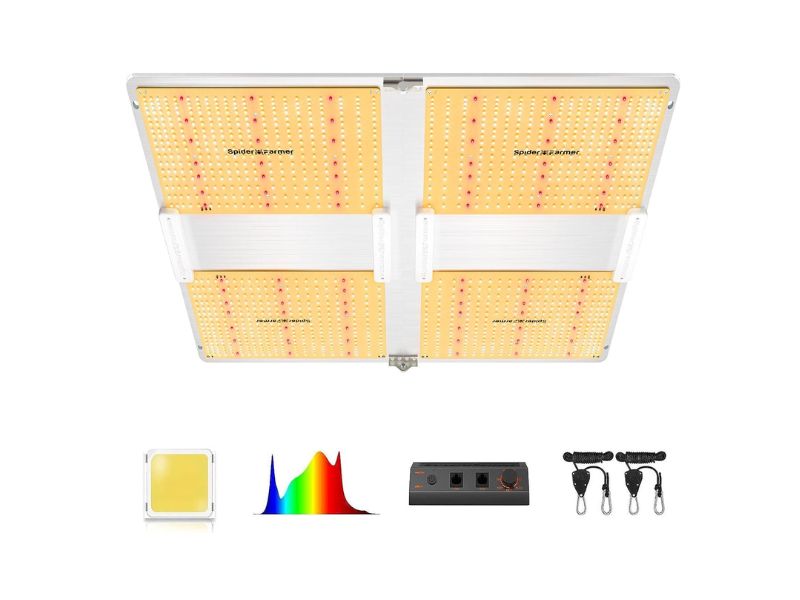
My primary recommendation is the Spider Farmer SF7000 650W LED Grow Light. I would choose it for most growers because its current listing combines 650W actual draw, Samsung LM301B diodes, 2.8 µmol/J photon efficiency, approximately 1,786 µmol/s PPF, dimming, detachable driver capability, and commercial 5×5 coverage.
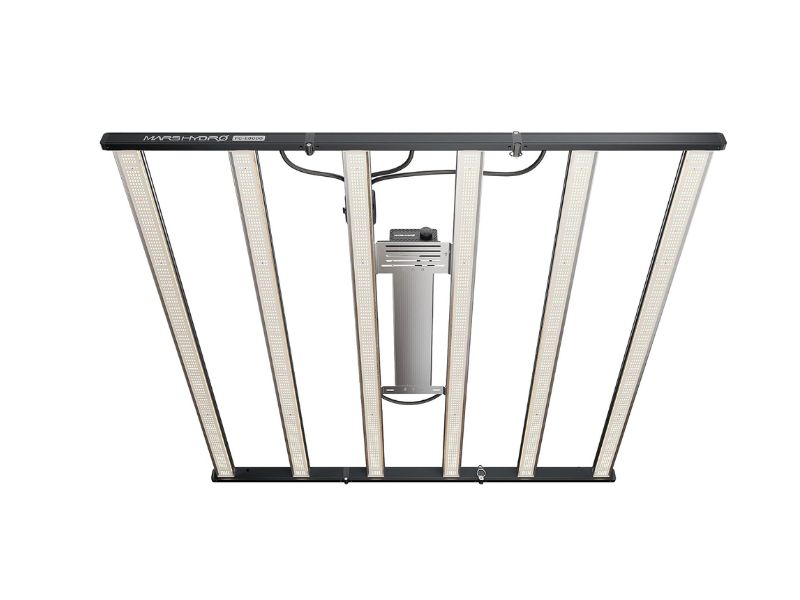
I would choose the MARS HYDRO FC-E8000 800W LED Grow Light when maximum photon headroom is the priority. It is currently listed at 800W, 2.8 µmol/J system PPE, approximately 2,240 µmol/s PPF, Bridgelux 2835 LEDs, Osram 660nm red supplementation, and maximum 5×5 coverage.
For growers who want modern smart controls with strong bar-style distribution, I would choose the Spider Farmer SE7000 730W LED Grow Light. The refreshed model is listed at 730W and approximately 2,146 µmol/s, with a six-bar design, app control, digital dimming, sunrise/sunset scheduling, detachable-driver architecture, and 5×5 coverage.
3 Best LED Grow Lights for High Yield Reviewed
| Image | Product Name | Check Price |
|---|---|---|
Best Choice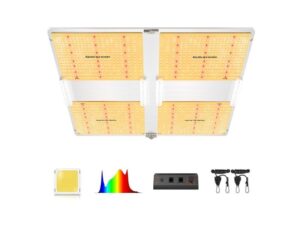 | Spider Farmer SF7000 650W LED Grow Light | Check Price |
Second Best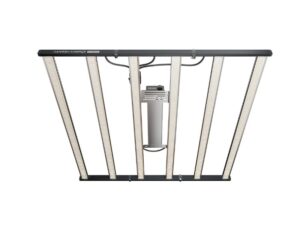 | MARS HYDRO FC-E8000 800W LED Grow Light | Check Price |
Third Choice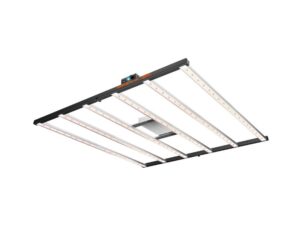 | Spider Farmer SE7000 730W LED Grow Light | Check Price |
1. Spider Farmer SF7000 650W LED Grow Light
Key Features
- 650W actual power draw
- Samsung LM301B diodes
- 2.8 µmol/J photon efficiency
- Approximately 1,786 µmol/s PPF
- Full-spectrum output
- Dimmable intensity
- Detachable driver
- Fanless operation
- Uniform-PPFD emphasis
- Commercial 5×5 coverage
The Spider Farmer SF7000 is my primary recommendation because it provides a strong balance of total output, efficiency, canopy size, and practical control without pushing power as high as the 800W FC-E8000.
Spider Farmer currently specifies 650W electrical input, Samsung LM301B diodes, 2.8 µmol/J efficiency, approximately 1,786 µmol/s PPF, and commercial 5×5 coverage.
That combination is well suited to growers trying to maximize productive canopy area rather than just create an extremely bright center zone.
At high output levels, uniformity becomes increasingly important.
A 5×5 tent contains 25 square feet. If the middle of the canopy receives excellent PPFD but the corners receive dramatically less, plants near the perimeter can lag behind.
Spider Farmer describes the SF7000 as using a large diode-spread surface intended to reduce the difference between center and edge PPFD.
That is valuable for a dense canopy of:
- Tomatoes
- Peppers
- Eggplants
- Large herbs
- Indoor vegetables
- High-light ornamental plants
- Multiple mature plants sharing one tent
The published 1,786 µmol/s PPF gives the SF7000 substantial photon capacity.
PPF describes the total amount of photosynthetically active photons emitted each second.
It does not tell you exactly where those photons land, but it provides a much better indication of horticultural output than wattage alone.
The 2.8 µmol/J efficiency figure is equally relevant.
At 650W, efficiency matters because the fixture may operate for many hours every day.
More efficient photon production means a larger portion of the electrical input becomes plant-useful light rather than merely increasing electrical demand.
The SF7000 also uses a broad spectrum listed around 2800–3000K, 4800–5000K, and 650–665nm red.
That makes the fixture suitable for a full growth cycle rather than only one stage.
I would not choose it because of a specific Kelvin value or red wavelength alone.
For high-yield growing, I would place the priorities in this order:
- Appropriate canopy PPFD.
- Uniformity.
- Daily light exposure.
- Environment.
- Spectrum refinements.
Dimming is another major advantage.
A powerful light should rarely be treated as an all-or-nothing device.
Young plants may require only a fraction of the available output.
As the canopy develops, intensity can rise gradually.
That lets the same fixture handle:
Seedlings → vegetative growth → mature canopy
without replacing the lighting system.
The detachable driver is useful for heat management.
Spider Farmer states that the driver can be separated from the fixture when needed.
This does not reduce total room heat, but moving the driver outside a tent can reduce the amount of heat concentrated directly above the canopy.
The fanless design also avoids fixture-fan noise and removes a moving component.
However, fanless does not mean heatless.
At 650W, the grow space still needs adequate environmental control.
For a high-yield setup, I would expect to plan for:
- Exhaust ventilation
- Fresh-air intake
- Canopy circulation
- Temperature monitoring
- Humidity management
The main downside is scale.
This fixture makes little sense for one seedling tray or a 2×2 tent.
Its strength appears when you actually have a large active canopy.
What I Like
- Strong 1,786 µmol/s PPF
- Efficient 2.8 µmol/J system
- Excellent 5×5-class output
- Wide light distribution
- Dimming
- Detachable driver
- Full-spectrum design
- Good balance of power and efficiency
What I Do Not Like
- Excessive for small tents
- 650W creates a meaningful heat load
- Physically large
- High output requires careful PPFD management
The Spider Farmer SF7000 is the model I would choose for most growers who want high-output 5×5 performance without automatically moving into an 800W fixture. Its balance of 650W power, strong PPF, efficient photon production, and broad canopy coverage makes it the most versatile option of these three.
2. MARS HYDRO FC-E8000 800W LED Grow Light
Key Features
- 800W actual power
- 2.8 µmol/J system PPE
- Approximately 2,240 µmol/s PPF
- Bridgelux 2835 LEDs
- Osram 660nm red LEDs
- Foldable multi-bar construction
- Full-spectrum output
- Dimmable
- Maximum 5×5 coverage
- Designed for large high-output canopies
The MARS HYDRO FC-E8000 is the model I would choose when total photon output is the priority.
Its current Amazon listing specifies 800W actual power, 2.8 µmol/J PPE and approximately 2,240 µmol/s PPF.
That is considerably more total photon output than the SF7000.
The difference does not automatically mean higher yield.
Plants can only use additional light effectively when the rest of the growing environment supports it.
If CO₂, temperature, water, nutrition, root-zone health, or leaf area becomes limiting, adding more photons can produce diminishing returns.
But for a grower with a large, well-managed 5×5 canopy, the FC-E8000 offers substantial headroom.
Its broad multi-bar architecture is important because 800W concentrated into a compact source could create an intense hotspot.
Distributed bars spread the emitters over more of the grow area.
That can improve:
- Edge PPFD
- Corner performance
- Center-to-edge consistency
- Heat distribution
- Air movement around the fixture
This is exactly the type of architecture I prefer for a high-output 5×5.
The current listing uses Bridgelux 2835 diodes with enhanced Osram 660nm red supplementation.
Deep red wavelengths are useful within horticultural lighting, especially for mature plants, but the much bigger reason to consider this fixture is its total system performance.
The headline combination is:
800W + 2.8 µmol/J + ~2,240 µmol/s PPF.
That places it well into large-canopy territory.
Dimming is essential at this level.
Eight hundred watts is not something I would automatically operate at full output from the beginning of a grow.
A better approach is to match intensity to:
- Plant age
- Canopy size
- Hanging height
- Leaf response
- Target PPFD
- Daily light integral
If the canopy does not need full output, dimming saves electricity and reduces heat.
That becomes especially important during early vegetative growth.
The foldable design is also practical.
Large bar fixtures can be awkward to transport and store.
A foldable frame makes the FC-E8000 easier to move than a permanently rigid structure of similar size.
For high-yield growing, the biggest consideration is environmental capacity.
An 800W fixture can substantially affect tent temperature.
At full power, you need enough airflow and room conditioning to keep the canopy within an appropriate temperature and humidity range.
Otherwise, additional light can create more stress than benefit.
I would consider this fixture primarily for growers who already understand:
- VPD management
- Canopy training
- Irrigation consistency
- Air exchange
- PPFD measurement
- Temperature control
A beginner can certainly use it, but the output capacity is easier to exploit when the rest of the system is equally well developed.
What I Like
- Highest published PPF of these three
- 2,240 µmol/s total photon output
- 2.8 µmol/J system PPE
- Broad multi-bar design
- 5×5 coverage
- Strong mature-canopy headroom
- Foldable construction
- Dedicated Osram red supplementation
What I Do Not Like
- 800W can be unnecessary for many home grows
- Highest electrical and heat load here
- Requires careful dimming with young plants
- Large fixture needs substantial installation space
The FC-E8000 is the product I would choose when maximum high-yield photon headroom across a 5×5 canopy matters more than minimizing electrical input. Its approximately 2,240 µmol/s PPF gives experienced growers a great deal of intensity to work with.
3. Spider Farmer SE7000 730W LED Grow Light
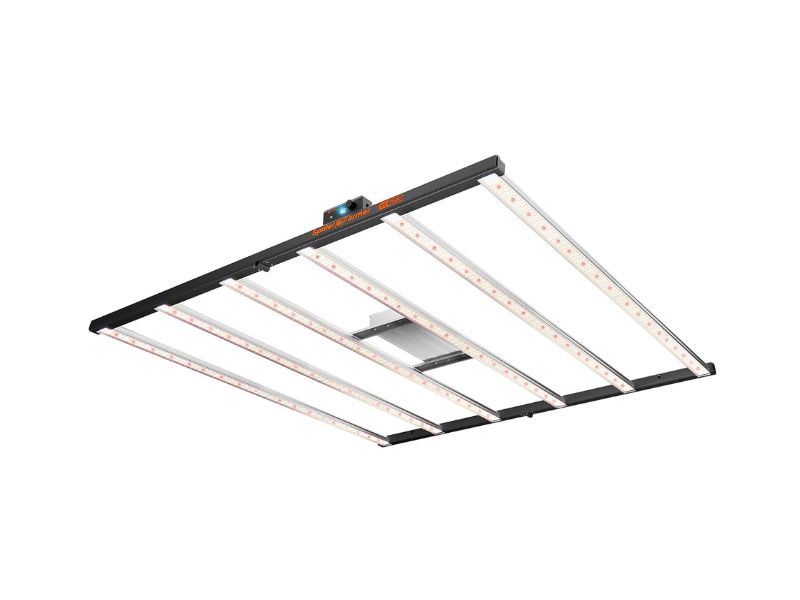
Key Features
- 730W actual power
- Approximately 2,146 µmol/s PPF
- Premium Bridgelux diodes
- Six-bar architecture
- Full-spectrum output
- Enhanced deep-red spectrum
- App control
- Digital dimming
- Sunrise/sunset scheduling
- Daisy-chain capability
- Designed for 5×5 tents
- Five-year listed support
The Spider Farmer SE7000 is the model I would choose when I want strong photon output combined with better automation.
The current refreshed listing specifies 730W actual input and approximately 2,146 µmol/s photon output.
That puts the SE7000 between the SF7000 and FC-E8000 in raw output.
It also uses a six-bar design specifically positioned around 5×5 coverage.
Spider Farmer says the design is intended to distribute light evenly across the canopy and reduce hotspots.
That makes it particularly appealing for a highly trained, flat canopy.
A uniform canopy takes better advantage of distributed overhead lighting because most leaves sit at similar distances from the fixture.
The SE7000 is a strong fit for growers using techniques that create broad horizontal plant structure rather than one tall central plant.
Its smart-control platform is one of the biggest differences from SF7000.
The current listing includes app-based scheduling and remote brightness control, including sunrise/sunset simulation.
That can help with consistency.
Plants do not inherently produce more because an app controls the lamp.
The benefit is operational:
- Repeatable schedules
- Easier dimming changes
- Remote control
- Gradual intensity transitions
- Multi-light management
The digital dimmer is also useful for documenting settings.
Instead of guessing where an analog knob was positioned last week, a more explicit control system can make stage-by-stage adjustments easier to reproduce.
The listing also supports daisy chaining up to 50 compatible units from a master controller, which is far beyond what most home growers need but useful for multi-fixture installations.
The spectrum includes broad white light plus emphasized 660–665nm deep red, according to the current listing.
Again, the important point is not simply that deep red exists.
The more meaningful high-yield specifications are:
- 730W input
- ~2,146 µmol/s total output
- Wide bars
- Dimming
- 5×5 distribution
The SE7000 also provides enough output to create excessive intensity if hung too close or operated at full power unnecessarily.
That is why I would strongly prefer to work from a PPFD map or meter rather than choosing settings based only on plant height.
For example, two fixtures can hang at the same distance but produce very different PPFD because of:
- Wattage
- Efficiency
- Bar spacing
- Optics
- Tent reflectivity
The high-yield approach is to measure or estimate what reaches the canopy, not simply follow a generic “18 inches” rule.
The five-year after-sales support stated on the current listing is another useful consideration for equipment in this class.
High-output grow fixtures are long-term equipment purchases, so driver service and manufacturer support become more important than with a small inexpensive clip lamp.
What I Like
- Strong 2,146 µmol/s output
- 730W power class
- Wide six-bar distribution
- App control
- Digital dimming
- Sunrise/sunset scheduling
- Daisy-chain capability
- Excellent 5×5 fit
What I Do Not Like
- More setup complexity
- Higher electrical demand than SF7000
- Smart features may be unnecessary for simple grows
- Current exact listing has less marketplace history than the first two selections
The SE7000 is the model I would choose when I want high-output 5×5 lighting with sophisticated intensity and scheduling controls. It gives up a little raw PPF to the FC-E8000 while adding more convenient automation.
High-Yield LED Grow Light Comparison
| Product | Actual Power | Published PPF | Efficiency | Fixture Style | Dimming | Best Fit |
| Spider Farmer SF7000 | 650W | ~1,786 µmol/s | 2.8 µmol/J | Broad distributed fixture | Yes | Efficient 5×5 growing |
| MARS HYDRO FC-E8000 | 800W | ~2,240 µmol/s | 2.8 µmol/J | Foldable multi-bar | Yes | Maximum 5×5 photon headroom |
| Spider Farmer SE7000 | 730W | ~2,146 µmol/s | ~2.94 µmol/J implied by listed PPF/input | Six-bar | Yes + App | Smart high-output 5×5 |
The SF7000 offers the most balanced electrical load, FC-E8000 provides the highest total published photon output, and SE7000 combines high output with stronger smart-control functionality.
How to Choose the Best LED Grow Lights for High Yield
Focus on PPF, Not Just Watts
Watts tell you how much electricity the fixture consumes.
PPF tells you how many photosynthetically active photons it produces every second.
For these three fixtures, the published figures range from approximately 1,786 to 2,240 µmol/s.
That is a substantial difference in total photon capacity.
PPE Helps Explain Efficiency
PPE measures photon output per joule of electrical energy.
The SF7000 and FC-E8000 both publish approximately 2.8 µmol/J system efficiency.
This makes it easier to compare how efficiently fixtures convert power into plant light.
PPFD Determines What the Canopy Receives
PPF measures total fixture output.
PPFD measures photon density at a specific canopy location.
High yield depends more directly on appropriate canopy PPFD than on watts or PPF in isolation.
A powerful fixture with poor distribution can still produce disappointing edge performance.
Uniformity Matters More as the Tent Gets Larger
In a 5×5 grow tent, you have 25 square feet of canopy area.
A strong center hotspot only benefits a small portion of that area.
Bar-style or broad distributed fixtures aim to keep more of the canopy within a useful PPFD range.
That is one reason all three selections use wide light-emitting architectures.
Is 650W Enough for High Yield in a 5×5?
Yes, an efficient 650W fixture can provide substantial 5×5 photon output.
The SF7000 publishes approximately 1,786 µmol/s PPF at 650W and is positioned for commercial 5×5 coverage.
Whether that is enough depends on target PPFD and crop.
Is 730W Good for a 5×5?
Yes.
The SE7000 is currently positioned specifically around 5×5 coverage at 730W and publishes roughly 2,146 µmol/s output.
That provides substantial high-intensity headroom for a full canopy.
Is 800W Too Much for a 5×5?
Not necessarily, but many growers may not need to run an efficient 800W fixture at full output.
The FC-E8000 provides approximately 2,240 µmol/s PPF, which is a large photon budget for 25 square feet.
Dimming lets you use only as much output as the crop and environment can effectively support.
650W vs 800W Grow Lights
Moving from 650W to 800W adds roughly 23% more electrical input.
The FC-E8000 also publishes considerably higher total PPF.
However, extra light only contributes to yield when the rest of the environment is not limiting growth.
A well-managed 650W garden can outperform a poorly managed 800W garden.
Bar Fixtures Are Excellent for Yield-Focused Canopies
Bar-style designs spread diodes over a larger physical area.
That can improve:
- Edge coverage
- Canopy uniformity
- Heat distribution
- Airflow
- Usable grow area
The SE7000 uses six bars, while FC-E8000 also uses a broad multi-bar frame.
Dimming Is Not Optional in Practice
I strongly prefer dimming on any high-output fixture.
The plant’s light requirement changes throughout the growth cycle.
Running maximum power over a small young canopy wastes electricity and can create unnecessary stress.
Increase intensity as leaf area and plant demand increase.
Daily Light Integral Matters
DLI describes the total number of photosynthetic photons a plant receives over an entire day.
Two gardens can have the same PPFD but different DLI if one runs the lights longer.
Yield-focused lighting therefore involves both:
- Intensity
- Photoperiod
rather than maximizing either one independently.
More Light Does Not Guarantee More Yield
Once another factor becomes limiting, extra light may not produce proportional gains.
Potential bottlenecks include:
- Temperature
- Humidity
- Carbon dioxide availability
- Nutrition
- Root health
- Irrigation
- Genetics
- Canopy structure
Think of the grow light as one part of a complete production system.
Best High-Yield Light for a 5×5 Tent
My first choice for most growers is Spider Farmer SF7000 because it provides strong output at a lower electrical draw than the other two.
For maximum photon headroom, I would move to MARS HYDRO FC-E8000.
For smart control, I would choose Spider Farmer SE7000.
Best High-Yield Light for a 4×4 Tent
These fixtures are primarily 5×5-class products.
They can be dimmed for a 4×4, but a smaller 450–600W fixture may be more proportionate for many 4×4 setups.
Buying excessive fixture capacity only to run permanently at low output may not be the best sizing decision.
Best High-Yield Light for Tomatoes
Tomatoes can form large high-light canopies.
For multiple mature tomato plants in a 5×5, I would favor the FC-E8000 when environmental control is strong.
For a more balanced electrical load, SF7000 is easier to manage.
Best High-Yield Light for Peppers
Peppers also respond well to strong, uniform lighting once mature.
SE7000 is particularly attractive when you want remote dimming and schedule changes as plants move through different stages.
High Yield Starts With an Even Canopy
A powerful lamp cannot compensate fully for poor canopy architecture.
If some plants sit a foot higher than others, the taller leaves may receive dramatically more PPFD.
Training plants into a relatively level canopy helps high-output LEDs work more effectively.
Driver Placement and Heat
Drivers contribute heat.
SF7000 and SE7000 both support detachable-driver arrangements in their current configurations.
Moving a driver outside a tent can reduce localized heat inside the growing enclosure.
It does not change total electrical energy consumption.
Ventilation Becomes Critical Above 600W
A 650–800W LED system can substantially warm a 5×5 tent.
Plan for enough airflow to control both:
- Temperature
- Humidity
High transpiration under strong light can also raise humidity quickly in a dense canopy.
Electricity Use
At 650W for 12 hours daily:
0.65 × 12 = 7.8 kWh/day
Over 30 days:
234 kWh/month
At 730W:
0.73 × 12 = 8.76 kWh/day
Over 30 days:
262.8 kWh/month
At 800W:
0.8 × 12 = 9.6 kWh/day
Over 30 days:
288 kWh/month
Actual consumption may be lower when dimmed.
Electrical Safety
Use actual fixture input when planning electrical load.
Remember that the grow light shares the circuit with equipment such as:
- Exhaust fans
- Circulation fans
- Pumps
- Dehumidifiers
- Humidifiers
- Heaters
Do not size a circuit based only on the grow light.
Common High-Yield Grow Light Mistakes
Buying the Highest Wattage Automatically
Higher power is useful only when the canopy can use it.
Ignoring PPFD Uniformity
Edge plants contribute to total harvest too.
Running Full Power Too Early
Use dimming as the canopy develops.
Focusing Only on Spectrum
Intensity and distribution usually deserve more attention first.
Ignoring Heat and Humidity
More light drives more environmental demand.
Hanging the Fixture by a Generic Rule
Use model-specific PPFD information and plant response.
Assuming the Light Alone Determines Yield
Genetics and overall cultivation quality remain major factors.
Frequently Asked Questions
What are the best LED grow lights for high yield?
Spider Farmer SF7000, MARS HYDRO FC-E8000, and Spider Farmer SE7000 are my three selections.
They combine strong photon output, large-canopy coverage, dimming, and broad light distribution suited to serious 5×5 indoor growing.
Which is my primary recommendation?
I would choose the Spider Farmer SF7000 for the best overall balance.
Its 650W draw, approximately 1,786 µmol/s PPF, 2.8 µmol/J efficiency, and 5×5 coverage provide strong output without the highest electrical demand.
Which grow light has the highest PPF here?
The MARS HYDRO FC-E8000 publishes approximately 2,240 µmol/s PPF.
That is the highest listed total photon output of the three selected fixtures.
Which light is best for smart control?
Spider Farmer SE7000 provides the most developed smart-control package of these three.
Its current configuration supports app control, scheduling, digital dimming, and sunrise/sunset simulation.
Is 650W enough for a 5×5 tent?
Yes, an efficient 650W fixture can provide substantial output across a 5×5 canopy.
The SF7000 is specifically positioned for commercial 5×5 coverage.
Is 730W good for a 5×5 tent?
Yes, 730W provides significant high-intensity headroom for a properly managed 5×5 canopy.
The SE7000 publishes approximately 2,146 µmol/s at that power level.
Is 800W good for a 5×5 tent?
Yes, but full output may exceed what some crops or environments need.
The FC-E8000’s dimmer lets you reduce intensity rather than operating all 800W continuously.
Does more wattage mean more yield?
No, wattage alone does not guarantee higher yield.
Photon efficiency, PPFD distribution, crop genetics, temperature, nutrition, irrigation, CO₂ availability, and canopy management all affect productivity.
What is PPF?
PPF measures the total photosynthetically active photons emitted by a grow light each second.
It is useful for comparing overall fixture output but does not describe distribution across the canopy.
What is PPFD?
PPFD measures photosynthetic photon density reaching a specific canopy location.
It is directly affected by hanging height, dimming, fixture geometry, and position beneath the light.
What is PPE?
PPE measures photon output produced for each joule of electrical energy consumed.
Higher comparable system PPE generally indicates more efficient conversion of electricity into plant-useful light.
Why does PPFD uniformity matter for yield?
Uniform PPFD helps more of the canopy contribute productively instead of favoring only center plants.
A strong center hotspot combined with weak edges can reduce the effective growing area.
Are bar-style grow lights better for high yield?
They are particularly useful for large flat canopies because they distribute LEDs over more area.
That can improve edge coverage and reduce extreme center hotspots.
Do high-yield grow lights need dimming?
Yes, dimming makes powerful fixtures much easier to match to changing plant requirements.
It also reduces unnecessary electrical use and heat during stages when full output is not needed.
Is the SF7000 better than the FC-E8000?
SF7000 is easier to manage electrically; FC-E8000 provides substantially more photon headroom.
I would choose based on canopy demand and environmental control rather than assuming one is universally better.
Is the SE7000 better than the SF7000?
SE7000 offers higher output and stronger smart controls, while SF7000 uses less power.
SF7000 is my simpler balanced choice; SE7000 is better suited to automation-focused growers.
Can these lights be used for seedlings?
Yes when heavily dimmed, but all three are much larger than seedlings alone require.
They make sense when the same plants will remain under the fixture through later growth stages.
How much electricity does a 650W grow light use?
At full power for 12 hours, it consumes approximately 7.8 kWh per day.
That equals roughly 234 kWh over 30 days before accounting for dimming.
How much electricity does an 800W grow light use?
At full power for 12 hours, it consumes approximately 9.6 kWh per day.
That equals about 288 kWh over 30 days.
Do high-output LED grow lights produce a lot of heat?
Yes, 650–800W fixtures create a substantial thermal load even when highly efficient.
Adequate exhaust, airflow, temperature control, and humidity management remain important.
Conclusion
The best LED grow lights for high yield should deliver strong total photon output without sacrificing canopy uniformity, efficiency, dimming, or environmental manageability. Raw wattage matters, but I would place PPF, system PPE, PPFD distribution, canopy size, and thermal control ahead of simple power numbers.
The Spider Farmer SF7000 remains my primary recommendation. Its 650W input, approximately 1,786 µmol/s PPF, 2.8 µmol/J photon efficiency, Samsung LM301B platform, broad distribution, and 5×5 coverage provide an excellent balance between output and electrical demand.
The MARS HYDRO FC-E8000 is the option I would choose when maximum photon headroom matters most. Its 800W draw and approximately 2,240 µmol/s PPF give a well-managed 5×5 canopy substantially more available light.
The Spider Farmer SE7000 is my preferred smart alternative. Its 730W input, approximately 2,146 µmol/s output, six-bar architecture, app control, digital dimming, and scheduling features make it particularly useful for growers who want precise automation.
For most 5×5 growers, I would start with Spider Farmer SF7000. For maximum output capacity, I would choose MARS HYDRO FC-E8000. For high-output lighting with stronger smart control, I would choose Spider Farmer SE7000.

I’m Maya L. Greenwood, a lifelong plant lover who believes anyone can grow something beautiful with the right guidance. After years of testing soil mixes, pruning methods, irrigation tricks, and pest-safe solutions, I started EasyGardenTips.com to turn hard-won lessons into step-by-step advice. From seed starting and container gardens to composting and seasonal checklists, my goal is to make gardening simple, sustainable, and fun.