3 Best LED Grow Light for Small Space Indoor Growing
A small apartment, desk, kitchen counter, or narrow plant shelf does not need a large grow-tent fixture. The best LED grow light for small space should deliver useful plant light without taking over the room, while offering flexible positioning, dimming, and automatic timing.
For compact setups, fixture shape matters almost as much as output. A flexible clamp lamp works well over several nearby plants, a pot-mounted light is ideal for one plant, and a compact tabletop fixture gives more growth headroom without requiring overhead hanging.
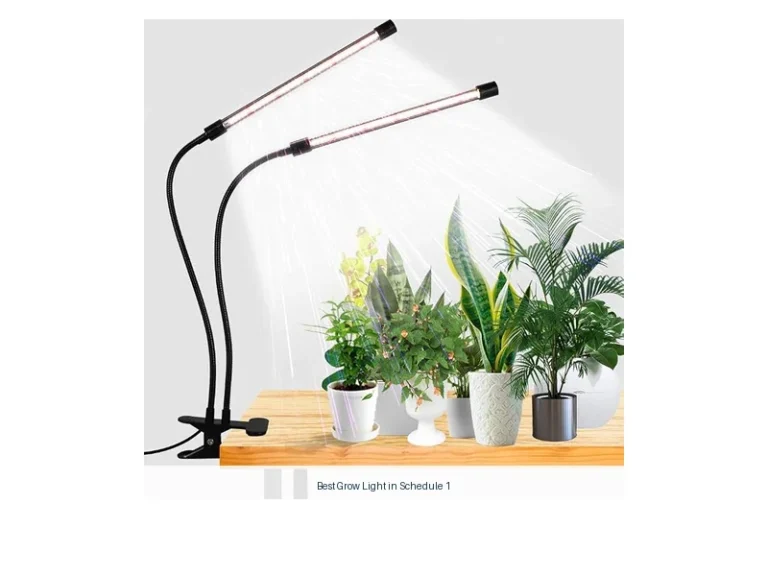
My primary recommendation is the GooingTop 6000K Full Spectrum LED Grow Light. I would choose it for most small spaces because it combines a compact clamp, flexible gooseneck, five brightness levels, and 4/8/12-hour timer with 6000K white/red output. Its current Amazon listing shows 21,990 ratings, substantially more than the other two selections.
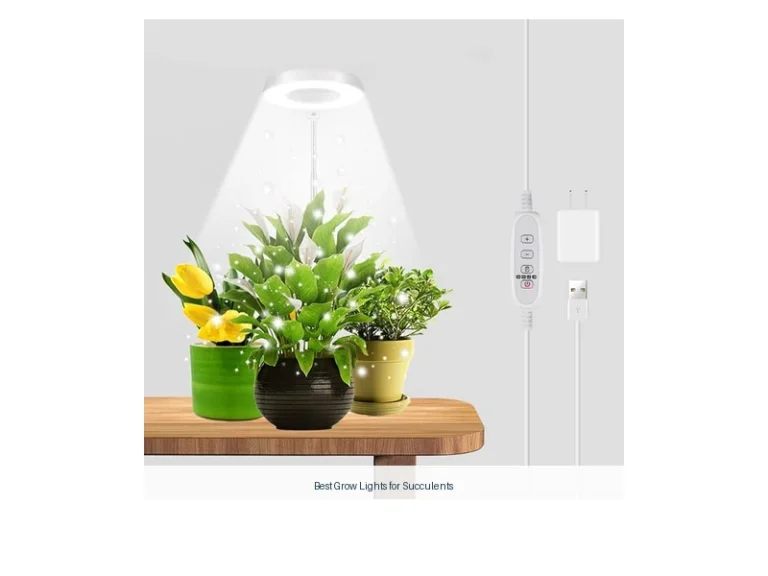
I would choose the SANSI 10W Pot Clip Grow Light when only one plant needs supplemental light. It clips directly to the pot and provides 10W actual power, 4000K full-spectrum output, four brightness levels, and 3/6/12-hour automatic timing.
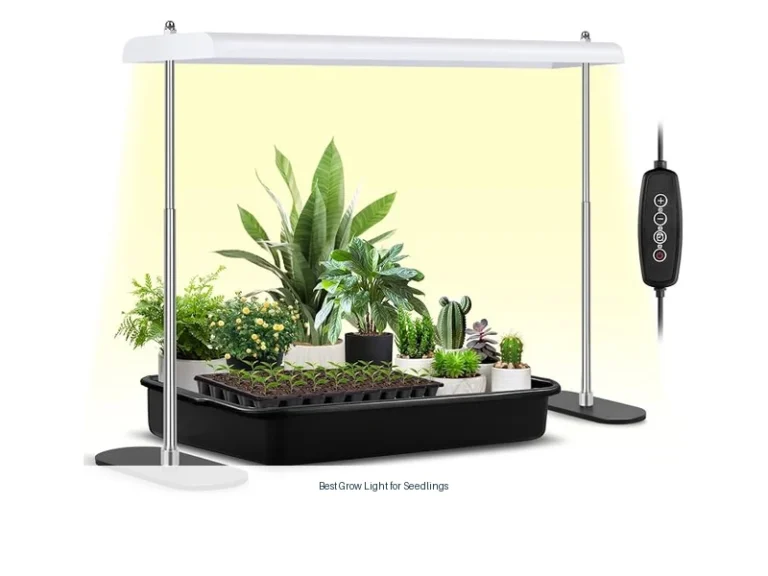
For a desk, countertop, or small propagation station that needs more output, I would choose the FECiDA 25W Desk Grow Light. The current listing specifies 25W actual power, 208 LEDs, 2,000-lumen listed brightness, full-spectrum output, and a 16–24-inch adjustable tabletop design.
3 Best LED Grow Lights for Small Spaces Reviewed
| Image | Product Name | Check Price |
|---|---|---|
Best Choice | GooingTop 6000K Full Spectrum LED Grow Light | Check Price |
Second Best | SANSI 10W Pot Clip Grow Light | Check Price |
Third Choice | FECiDA 25W Desk Grow Light | Check Price |
1. GooingTop 6000K Full Spectrum LED Grow Light
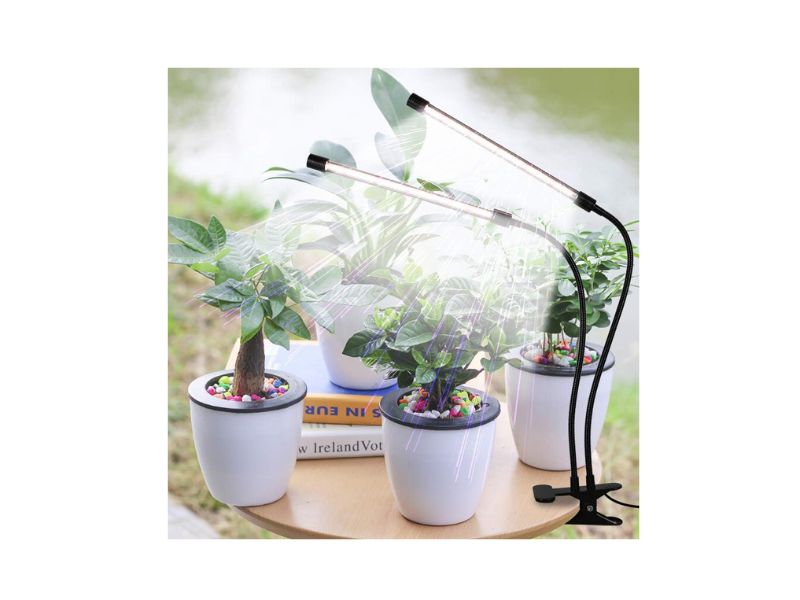
Key Features
- 6000K full-spectrum-style output
- White and red LEDs
- Five brightness levels
- 4/8/12-hour automatic timer
- Flexible gooseneck
- Clamp mounting
- Compact footprint
- Suitable for houseplants and seedlings
The GooingTop is my primary recommendation because it solves the main problem in small-space growing: where to put the light.
Large grow panels need hanging hardware and open space above the plants.
This fixture simply clamps onto a:
- Desk
- Shelf
- Table
- Counter edge
- Plant stand
and uses a flexible gooseneck to position the LEDs over the canopy.
Its current Amazon listing identifies it as a 6000K full-spectrum plant lamp with five dimming levels and repeating 4-, 8-, and 12-hour timer settings.
That combination is particularly convenient for:
- Pothos
- Philodendrons
- Herbs
- Small succulents
- Seedlings
- Individual vegetable starts
- Compact foliage plants
The five-level dimmer adds useful flexibility.
A plant sitting beside a bright window may need only supplemental illumination.
A seedling growing in a dark corner may need considerably more artificial light.
Instead of changing fixtures, you can adjust brightness and distance.
The flexible neck is equally important.
Light intensity drops as the fixture moves farther from the leaves.
In a small setup, it is often more efficient to place a modest light close to the canopy than to use a much larger fixture several feet away.
That makes GooingTop a practical choice where every inch of space matters.
The built-in timer reduces clutter too.
Without an integrated timer, a compact plant station may require:
- Lamp
- Power adapter
- External timer
- Additional plug space
GooingTop handles scheduling internally.
Its maximum automatic cycle is 12 hours, which is convenient for supplemental houseplant lighting but may be shorter than desired for seedlings relying almost completely on artificial illumination.
In that situation, an external timer can provide a longer daily schedule if the fixture supports the desired operating behavior.
Another advantage is appearance.
The 6000K white/red configuration looks much more natural in a living room or office than older intensely purple grow lights.
That matters because small-space grow lights are often visible all day.
A large grow tent can hide industrial-looking equipment.
A desk lamp needs to coexist with normal furniture.
Coverage is the biggest limitation.
This fixture is designed for a compact canopy.
Trying to stretch one lamp across several large nursery trays will result in uneven intensity.
For a few nearby plants, however, that concentrated coverage is exactly what makes it efficient.
What I Like
- Very compact installation
- Flexible gooseneck
- Five brightness levels
- Built-in timer
- No hanging hardware needed
- Natural-looking white light
- Excellent for apartments and desks
What I Do Not Like
- Limited coverage
- Built-in timer tops out at 12 hours
- Less growth headroom than a larger tabletop fixture
The GooingTop is the model I would choose for most buyers who want the simplest small-space grow-light setup with useful dimming, timing, and flexible placement.
2. SANSI 10W Pot Clip Grow Light
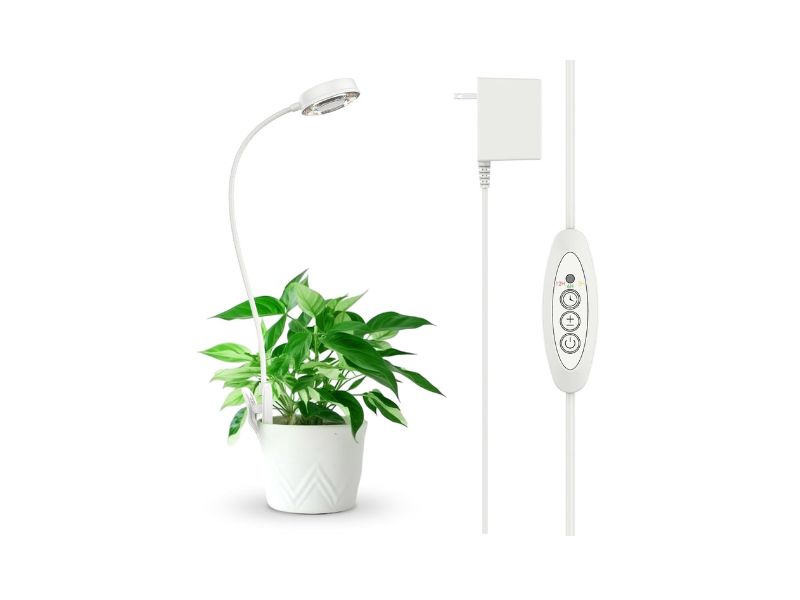
Key Features
- 10W actual power
- 4000K full-spectrum output
- Pot-mounted clip design
- Four brightness levels
- 3/6/12-hour timer
- Compact adjustable stem
- Designed for individual plants
- Minimal floor or shelf footprint
The SANSI 10W Pot Clip is the smallest-footprint solution here.
Instead of requiring a table edge or separate support, it clips directly onto the plant pot.
That makes it particularly useful when the growing area is extremely limited.
The current Amazon listing specifies 10W power, 4000K full-spectrum output, four brightness levels, and 3-, 6-, and 12-hour timer settings. It currently shows 882 ratings.
I would consider it for:
- One pothos
- Small philodendron
- Succulents
- Compact herbs
- Bonsai
- Desk plants
- Window plants needing additional light
The 10W actual power is appropriate to the format.
Ten watts is not enough to illuminate a large garden.
It does not need to be.
The fixture is designed to concentrate output onto one relatively small canopy.
This is an important small-space principle:
Do not pay for light that lands on empty floor or furniture.
A lower-power fixture positioned close to one plant can make more sense than a much stronger panel mounted far away.
The 4000K white spectrum also suits living spaces particularly well.
It looks closer to neutral indoor lighting than the cooler GooingTop 6000K output.
If the plant sits beside:
- A monitor
- Bed
- Sofa
- Kitchen counter
the warmer visual appearance may be preferable.
Four dimming levels give you control over intensity.
This is useful because different plants tolerate different light levels.
For example, a shade-adapted foliage plant generally does not need the same intensity as a sun-loving herb or succulent.
The integrated timer is convenient too.
You can choose:
- 3 hours
- 6 hours
- 12 hours
depending on whether the fixture is adding supplemental light or functioning as the primary source.
The biggest benefit is physical simplicity.
There is:
- No grow tent
- No ceiling hook
- No stand
- No shelf clamp
The pot itself supports the lighting system.
That can be especially useful in rented apartments where permanent mounting is undesirable.
The limitation is equally clear.
This is an individual-plant light.
If you have six separate plants spread across a room, buying six pot lights can create more cords and clutter than using one larger fixture over a shelf.
So I would use SANSI when the setup is genuinely small, not when a large collection has merely been divided into many small pots.
What I Like
- Clips directly to a plant pot
- Very small physical footprint
- Four brightness settings
- Integrated timer
- Neutral-looking 4000K light
- Sensible 10W output for one plant
What I Do Not Like
- Very limited coverage
- Not practical for several nursery trays
- Multiple units can create cable clutter
The SANSI 10W Pot Clip is my preferred option when the goal is to illuminate one plant without dedicating any separate desk, shelf, or floor space to the grow light.
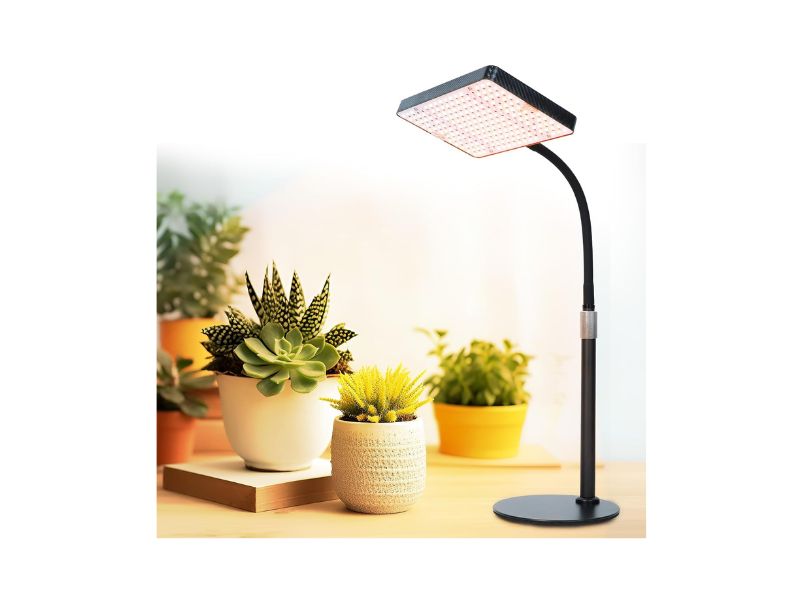
3. FECiDA 25W Desk Grow Light
Key Features
- 25W actual power draw
- 208 LEDs
- Listed 2,000-lumen brightness
- Full-spectrum output
- UV/IR supplemental spectrum
- 16–24-inch adjustable height
- Tabletop format
- Suitable for seed starting and small plant groups
The FECiDA 25W Desk Grow Light is the model I would choose when a small space needs more growth headroom than a clip lamp can provide.
Its current Amazon listing identifies it as a 25W tabletop full-spectrum grow light with 208 LEDs, 2,000-lumen listed brightness, and an adjustable 16–24-inch height. The exact listing currently shows 771 ratings.
The design is fundamentally different from GooingTop and SANSI.
Instead of reaching sideways from a clamp or attaching to a pot, the FECiDA creates a small overhead growing station.
That makes it attractive for:
- Several herb pots
- Bonsai
- Seed starting
- Small vegetable seedlings
- A compact succulent group
- Desk or countertop propagation
The 25W actual draw provides more potential output than the 10W SANSI while remaining modest enough for a tabletop fixture.
That additional power is useful when several plants share the same growing zone.
Imagine three basil pots grouped beneath one light.
A single pot-mounted lamp would illuminate only one plant well.
A broader desk fixture can cover the group more naturally.
Height adjustment from approximately 16 to 24 inches is another useful feature.
As seedlings grow taller, the fixture can move upward.
That is particularly important for:
- Tomatoes
- Peppers
- Herbs
- Young flowers
because canopy height can change quickly.
The product also advertises full-spectrum output with UV/IR components.
Those supplemental wavelengths can be interesting, but I would not choose this light primarily because it lists them.
For small-space growing, the fundamentals matter more:
- Adequate intensity
- Appropriate distance
- Even coverage
- Correct photoperiod
- Healthy plant response
A fixture can have an impressive spectrum description and still perform poorly if mounted too far away.
Another advantage of the tabletop format is organization.
A small plant station can look much cleaner when one fixture sits directly above the plants rather than several separate clip lamps approaching from different angles.
The tradeoff is that it consumes actual table space.
The GooingTop clamp and SANSI pot clip require almost no independent footprint.
FECiDA needs a dedicated surface underneath its stand.
That means it is better suited to a:
- Desk corner
- Countertop
- Small plant table
than an extremely narrow shelf.
What I Like
- Stronger 25W tabletop format
- More suitable for several plants
- Adjustable 16–24-inch height
- 208 LEDs
- Full-spectrum design
- Useful for compact seed starting
What I Do Not Like
- Requires dedicated tabletop space
- Larger footprint than pot or clamp lights
- Lumens are less useful for plants than photon-based metrics
The FECiDA is the model I would choose when a small space still needs enough light for several plants or a compact seed-starting station, rather than just one decorative houseplant.
LED Grow Lights for Small Spaces Comparison
| Product | Format | Actual Power Class | Dimming | Timer | Space Requirement | Best Use |
| GooingTop 6000K | Clamp/gooseneck | Compact | 5 levels | 4/8/12 hr | Very small | Several nearby plants |
| SANSI Pot Clip | Pot-mounted | 10W | 4 levels | 3/6/12 hr | Minimal | One plant |
| FECiDA Desk Grow Light | Tabletop | 25W | Model controls | Model dependent | Small tabletop | Several plants/seedlings |
The GooingTop offers the best all-around flexibility, SANSI takes up the least independent space, and FECiDA provides more output and vertical adjustability for a slightly larger compact growing station.
How to Choose the Best LED Grow Light for Small Space
Measure the Actual Plant Area First
Do not begin with wattage.
Measure:
- Width
- Depth
- Available height
- Number of plants
A single plant may need only a 10W pot-mounted lamp.
Several seedlings require broader coverage.
The correct fixture is the smallest one that can adequately cover the actual canopy.
Clamp, Pot Clip, or Tabletop?
Each format solves a different space problem.
Clamp Light
Best when:
- A shelf edge is available
- You want flexible aiming
- Several plants sit close together
Pot Clip Light
Best when:
- Only one plant needs light
- Table space is extremely limited
- You cannot mount hardware
Tabletop Light
Best when:
- Several plants share one area
- You want stronger output
- Vertical adjustment matters
Best Grow Light for a Small Apartment
I would choose GooingTop for most apartments.
The clamp design does not occupy additional floor space, and the flexible neck can work around furniture.
The white 6000K appearance is also less visually intrusive than purple grow lights.
Best Grow Light for a Desk
For one plant, I prefer SANSI.
It attaches directly to the pot, leaving more room for:
- Laptop
- Monitor
- Keyboard
- Work materials
For several desk plants, FECiDA makes more sense.
Best Grow Light for a Small Shelf
GooingTop is usually the easiest option because the clamp can attach directly to the shelving frame.
Aim it downward over the plants rather than horizontally from the side whenever practical.
Overhead lighting generally produces more balanced plant growth.
Best Grow Light for a Countertop
FECiDA works particularly well on a countertop if there is enough overhead clearance.
The vertical format creates a defined growing zone rather than requiring a separate shelf above the plants.
Best Small Grow Light for Seedlings
For a handful of seedlings, GooingTop can work.
For several pots or a compact seed tray, FECiDA’s 25W output provides more useful headroom.
If you plan to raise a full nursery flat, I would move beyond these small-space products to a broader panel or linear light.
Best Small Grow Light for Herbs
For one herb pot, SANSI works well.
For several basil, parsley, cilantro, or mint pots grouped together, GooingTop or FECiDA provides better coverage.
Best Small Grow Light for Succulents
Succulents often require stronger usable light than shade-tolerant foliage plants.
A close-positioned SANSI can work for an individual plant.
For several succulents, I would favor FECiDA because of its greater output and broader tabletop coverage.
Best Small Grow Light for Houseplants
For common small houseplants, GooingTop is the most flexible selection.
Its adjustable head can be repositioned as plant height and arrangement change.
That flexibility matters more when several plants share a small apartment corner.
Full Spectrum Is Practical Indoors
All three selected products use broad white-style full-spectrum output.
That has two advantages.
Plants receive useful wavelengths, and you can still evaluate leaf color naturally.
This makes it easier to notice:
- Yellowing
- Brown edges
- Bleaching
- Pest damage
- Water stress
than under strongly purple LED fixtures.
Color Temperature: 4000K vs 6000K
The SANSI is listed at 4000K, while GooingTop uses a 6000K white/red arrangement.
4000K appears more neutral or slightly warmer.
6000K appears cooler and more daylight-like.
Both can work for plants.
Choose based on fixture performance and how the light looks in your room rather than assuming one color temperature is automatically superior.
Dimming Matters in Small Spaces
Small spaces often force fixtures close to plants.
That makes dimming particularly useful.
If the light cannot be moved much farther away, reducing intensity can prevent excessive exposure.
GooingTop provides five brightness levels, while SANSI provides four.
Built-In Timers Reduce Clutter
A grow-light setup with fewer separate devices is easier to manage in a small space.
Both GooingTop and SANSI include timer controls.
That can eliminate the need for another large timer plug behind furniture.
How Close Should a Small Grow Light Be?
There is no universal distance.
A 10W pot lamp and a 25W tabletop fixture produce different intensity.
Start with the manufacturer’s recommended setup.
Then watch the plant.
Signs of insufficient light can include:
- Stretching
- Leaning
- Long spaces between leaves
- Pale growth
Signs of excessive intensity can include:
- Bleaching
- Curling
- Pale upper leaves
- Localized stress
Adjust gradually.
Do Not Compensate for Weak Light With 24-Hour Operation
More hours cannot completely compensate for poor intensity.
Plants generally benefit from a regular light-and-dark cycle.
If a plant stretches under a small grow light, first examine:
- Distance
- Brightness setting
- Coverage
before simply running the lamp continuously.
Small-Space Grow Light Electricity Use
Small fixtures generally consume modest amounts of electricity.
For example, a 10W light operating 12 hours daily uses:
0.01 kW × 12 = 0.12 kWh per day
Over 30 days:
0.12 × 30 = 3.6 kWh
A 25W fixture running 12 hours uses:
0.025 × 12 = 0.30 kWh per day
Over 30 days:
9 kWh
Multiply by your local electricity rate to estimate cost.
Avoid Excess Heat in Tight Spaces
Small LEDs produce relatively modest heat, but airflow still matters.
Do not bury the driver or power adapter behind:
- Curtains
- Cushions
- Clutter
- Enclosed drawers
Keep some open air around electrical components.
Common Small-Space Grow-Light Buying Mistakes
Buying a Huge Panel
Large fixtures waste space when only one or two plants need light.
Choosing Too Small a Lamp for Several Plants
Compact does not mean unlimited coverage.
Ignoring Mounting
A light is only useful if you have somewhere practical to position it.
Choosing by Lumens Alone
Lumens describe human-visible brightness, not plant photon delivery.
Ignoring Dimming
Close-mounted lights benefit from intensity adjustment.
Using Side Lighting Only
Overhead lighting usually encourages more balanced growth.
Letting Cables Take Over the Room
Integrated timers and pot-mounted fixtures can reduce clutter.
Frequently Asked Questions
What is the best LED grow light for small space?
GooingTop 6000K is my primary recommendation for most compact indoor setups.
Its clamp, flexible gooseneck, five brightness settings, and built-in timer make it highly adaptable to desks, shelves, and plant stands.
What grow light takes up the least space?
The SANSI Pot Clip takes up almost no independent desk or shelf space.
It mounts directly to the plant pot and provides a 10W full-spectrum light source.
What is the best small grow light for one plant?
I would choose the SANSI 10W Pot Clip for a single compact plant.
Its 4000K output, four brightness levels, and automatic timer make it easy to manage.
What is the best small grow light for several plants?
FECiDA 25W is better when several plants share one compact tabletop area.
Its broader overhead format and greater output provide more growth headroom than a single pot lamp.
Are small LED grow lights effective?
Yes, when the fixture’s coverage and intensity match the size of the plant canopy.
Small lights fail mainly when growers expect them to illuminate an area much larger than they were designed for.
Is 10W enough for one plant?
Yes, 10W can be useful when concentrated closely over one small plant.
The SANSI 10W design is specifically intended for this compact pot-level application.
Is 25W enough for seedlings?
Yes, 25W can support a compact seedling setup when coverage and distance are appropriate.
FECiDA’s tabletop format is particularly practical for a small group of seedlings rather than a full nursery rack.
Are clip grow lights good for apartments?
Yes, clip lights are among the easiest grow-light formats for space-limited apartments.
They use existing furniture or shelving for support instead of requiring floor stands.
Can I use a grow light on a desk?
Yes, pot-mounted and compact tabletop lights are especially well suited to desks.
SANSI minimizes footprint, while FECiDA creates a slightly larger dedicated growing zone.
Can I use a grow light on a kitchen counter?
Yes, compact white-spectrum grow lights work well on counters with adequate clearance.
Keep electrical connections away from sinks, standing water, and food-preparation splashes.
Is 4000K good for plants?
Yes, 4000K full-spectrum-style white light works well for many indoor plants.
SANSI uses a 4000K configuration that also looks relatively natural in living spaces.
Is 6000K good for plants?
Yes, cool-white 6000K lighting is practical for vegetative and supplemental indoor growth.
GooingTop combines its 6000K output with red LEDs in the current configuration.
Do small grow lights need timers?
A timer is very useful because it keeps the daily light schedule consistent automatically.
GooingTop and SANSI both include built-in timing functions.
How many hours should a small grow light stay on?
The correct duration depends on the plant, fixture intensity, and available natural daylight.
A houseplant beside a window may need only supplemental lighting, while seedlings relying primarily on LEDs may require a longer daily photoperiod.
Should I leave a small grow light on 24 hours?
No, normal indoor plant routines should generally include a regular dark period.
Improve placement and intensity instead of trying to compensate for weak light with continuous operation.
How close should a grow light be to a houseplant?
The correct distance depends on fixture output, beam spread, dimming, and plant tolerance.
Start with manufacturer guidance and adjust according to plant response.
Do small LED grow lights get hot?
They produce some heat, but much less total heat than large high-wattage fixtures.
Keep the light and power adapter ventilated rather than enclosing them behind furniture.
Can I grow herbs with a small LED grow light?
Yes, compact herbs are a strong use case for small full-spectrum fixtures.
One herb pot can use SANSI, while several grouped herbs are better matched to GooingTop or FECiDA.
Can I grow tomatoes with a small grow light?
Small grow lights can support tomato seedlings, but larger plants eventually need more coverage.
Watch for stretching and upgrade when the canopy becomes wider than the useful illuminated area.
Which small grow light is best for apartments?
GooingTop offers the best balance of flexibility, output control, and compact mounting.
Its clamp and gooseneck allow it to work around existing furniture rather than requiring dedicated floor space.
Conclusion
The best LED grow light for small space should provide enough usable plant light without turning a desk, apartment corner, or narrow shelf into a full grow room. In compact setups, I would prioritize mounting flexibility, dimming, built-in timing, full-spectrum output, and realistic coverage rather than buying the highest wattage available.
The GooingTop 6000K remains my primary recommendation. Its five brightness levels, flexible gooseneck, clamp mounting, 6000K white/red output, and 4/8/12-hour timer make it particularly adaptable to small shelves, desks, and compact groups of houseplants or seedlings.
The SANSI 10W Pot Clip is my choice when the growing area consists of only one plant. Its 10W power, 4000K spectrum, four-level dimming, and 3/6/12-hour timer provide the essential controls without consuming separate tabletop space.
The FECiDA 25W Desk Grow Light is the stronger small-space option for several plants. Its 25W actual draw, 208 LEDs, 2,000-lumen listed output, and adjustable 16–24-inch tabletop design provide more growth headroom while remaining compact.
For most small spaces, I would choose GooingTop. For one plant with almost no spare room, I would choose SANSI 10W Pot Clip. For several plants or a compact seed-starting station, I would choose the FECiDA 25W Desk Grow Light.

I’m Maya L. Greenwood, a lifelong plant lover who believes anyone can grow something beautiful with the right guidance. After years of testing soil mixes, pruning methods, irrigation tricks, and pest-safe solutions, I started EasyGardenTips.com to turn hard-won lessons into step-by-step advice. From seed starting and container gardens to composting and seasonal checklists, my goal is to make gardening simple, sustainable, and fun.