3 Best High End LED Grow Lights for Premium Indoor Growing
The best high end LED grow lights go beyond simply putting more watts over a plant canopy. Premium fixtures should combine high photon output, efficient diodes, strong edge-to-edge distribution, precise dimming, dependable thermal management, and controls that make a large indoor garden easier to operate.
For a serious 5×5-style setup, I would pay especially close attention to system PPE, total PPF, PPFD uniformity, bar spacing, driver placement, dimming, smart scheduling, spectrum, and electrical load. A fixture can look impressive on paper yet still be poorly matched to the shape or intensity requirements of your actual canopy.
My primary recommendation is the MARS HYDRO FC-E8000 LED Grow Light. I would choose it for growers who want very high output and commercial-style 5×5 coverage because the current Amazon listing specifies 800W power, 2.8 µmol/J PPE, approximately 2,240 µmol/s PPF, Bridgelux 2835 diodes, enhanced Osram 660nm red LEDs, and a foldable bar design.
I would choose the AC Infinity IONFRAME EVO8 when premium diode technology and integrated automation matter more. It uses 2,688 Samsung LM301H EVO diodes, 730W power, 10 brightness levels, programmable schedules, sunrise/sunset dimming, removable-driver construction, and UIS-compatible Wi-Fi control, with listed 5×5 flowering and 6×6 vegetative coverage.
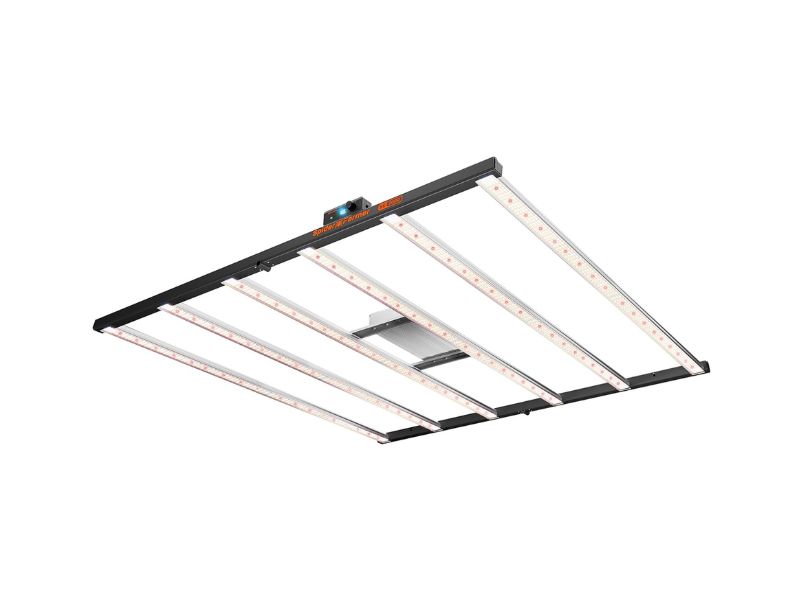
For growers who prefer Spider Farmer’s ecosystem, I would choose the Spider Farmer SE7000. The refreshed model is a 730W six-bar fixture delivering a listed 2,146 µmol/s, with app control, dimming, daisy-chain capability, enhanced red output, and positioning for 5×5 tents or commercial-style racks.
3 Best High End LED Grow Lights Reviewed
| Image | Product Name | Check Price |
|---|---|---|
Best Choice | MARS HYDRO FC-E8000 800W LED Grow Light | Check Price |
Second Best | AC Infinity IONFRAME EVO8 730W LED Grow Light | Check Price |
Third Choice | Spider Farmer SE7000 730W LED Grow Light | Check Price |
1. MARS HYDRO FC-E8000 800W LED Grow Light
Key Features
- 800W actual power
- 2.8 µmol/J system PPE
- Approx. 2,240 µmol/s PPF
- Bridgelux 2835 diodes
- Enhanced Osram 660nm red LEDs
- Full-spectrum output
- Foldable multi-bar design
- Dimmable operation
- Maximum 5×5-foot coverage
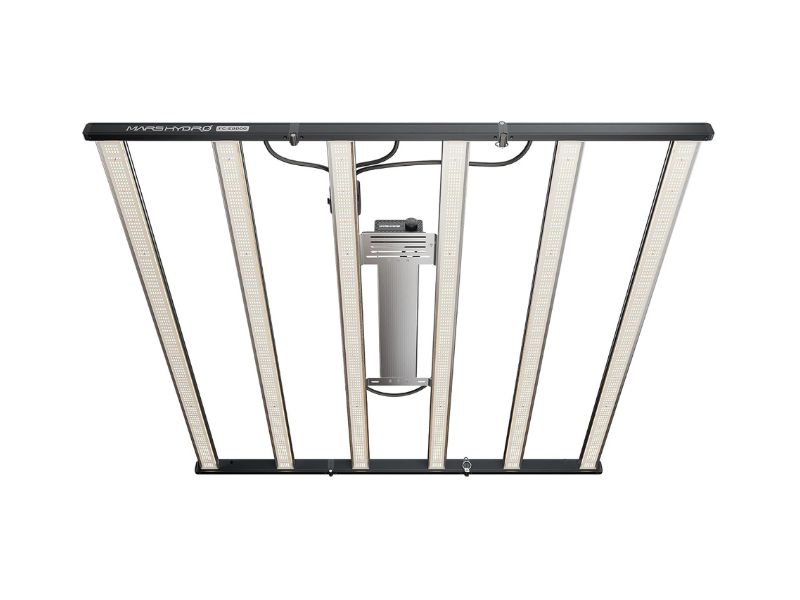
The MARS HYDRO FC-E8000 is my primary recommendation because it combines genuinely large photon output with a distributed fixture design that makes sense over a full 5×5 canopy.
The current Amazon listing specifies 800W input, 2.8 µmol/J PPE and approximately 2,240 µmol/s PPF, along with Bridgelux 2835 LEDs and enhanced Osram red output.
That distinction between wattage and photon output is important.
PPE, or photosynthetic photon efficacy, describes how efficiently the fixture turns electrical energy into photosynthetically active photons.
PPF, or photosynthetic photon flux, describes the total quantity of those photons produced each second.
An expensive grow light should perform well in both areas rather than relying on a large wattage label.
At approximately 2,240 µmol/s, the FC-E8000 provides significantly more total photon output than the smaller 300W- and 500W-class fixtures a home grower may be accustomed to.
That output makes it much more appropriate for a substantial canopy containing:
- Several mature tomato plants
- Peppers
- Eggplants
- Large indoor vegetables
- Dense herb production
- Large houseplants
- Multiple nursery trays
- High-light 5×5 growing areas
The multi-bar construction is one of the biggest reasons to consider this model.
At 800W, concentrating all the diodes into one small central board could create a very intense hotspot.
By spreading emitters across multiple bars, the fixture can distribute photons farther toward the canopy edges.
That can improve:
- Center-to-edge consistency
- Corner intensity
- Airflow through the fixture
- Passive thermal spreading
- Overall usable canopy area
MARS HYDRO currently positions the FC-E8000 for maximum 5×5-foot coverage and describes the light as foldable.
Foldability matters more on an 800W light than on a small 100W panel.
A fixture designed to span much of a 5×5 tent is physically large. Being able to fold the frame simplifies transportation and storage.
The 2.8 µmol/J PPE specification is also competitive for a high-power system.
That efficiency matters because a high-end grow light may run for many hours every day.
At this scale, even modest efficiency differences can meaningfully affect how much electrical energy becomes useful plant light instead of simply increasing operating load.
The updated version also emphasizes Osram 660nm red output.
Deep red is useful within a broad horticultural spectrum, particularly as plants mature, but I would not choose the FC-E8000 merely because it includes an Osram name or a specific red wavelength.
Its real strengths are the combined package:
PPF + PPE + coverage + bar distribution + dimming.
Dimming is essential.
Eight hundred watts is far more output than young seedlings need.
If I were starting tomatoes or peppers under this fixture, I would operate at much lower intensity and gradually increase power as the canopy expands.
That lets one premium fixture support:
Seedlings → vegetative plants → mature high-light canopy
without requiring a different grow light for every stage.
The main issue is environmental management.
An 800W fixture creates a substantial electrical and thermal load.
Even an efficient LED fixture ultimately contributes most of its consumed electrical energy to heat within the room.
A serious FC-E8000 setup therefore needs appropriate:
- Exhaust ventilation
- Fresh-air intake
- Canopy circulation
- Temperature monitoring
- Humidity control
For a small apartment shelf or one nursery flat, this fixture makes little sense.
For a dedicated 5×5 garden, its scale becomes much more logical.
What I Like
- Very high 2,240 µmol/s PPF
- Strong 2.8 µmol/J PPE
- Large distributed bar layout
- 5×5-focused coverage
- Foldable construction
- Enhanced red spectrum
- Excellent mature-canopy headroom
What I Do Not Like
- 800W creates substantial heat and electrical demand
- Excessive for small indoor gardens
- Large physical size requires dedicated space
- High output makes proper dimming and placement important
The FC-E8000 is the high-end light I would choose when maximum usable output over a serious 5×5 canopy is the priority. It provides enough photon headroom for mature plants while retaining the efficiency and broad distribution I expect from a commercial-class bar fixture.
2. AC Infinity IONFRAME EVO8 730W LED Grow Light
Key Features
- 730W actual power
- 2,688 Samsung LM301H EVO diodes
- Diodes rated at 3.14 µmol/J
- 10 brightness levels
- Programmable light schedules
- Sunrise/sunset dimming
- UIS-compatible Wi-Fi app control
- Algorithmically spaced bar layout
- Removable driver
- IP65 fixture construction
- 5×5 flowering / 6×6 vegetative coverage
- ETL-certified configuration
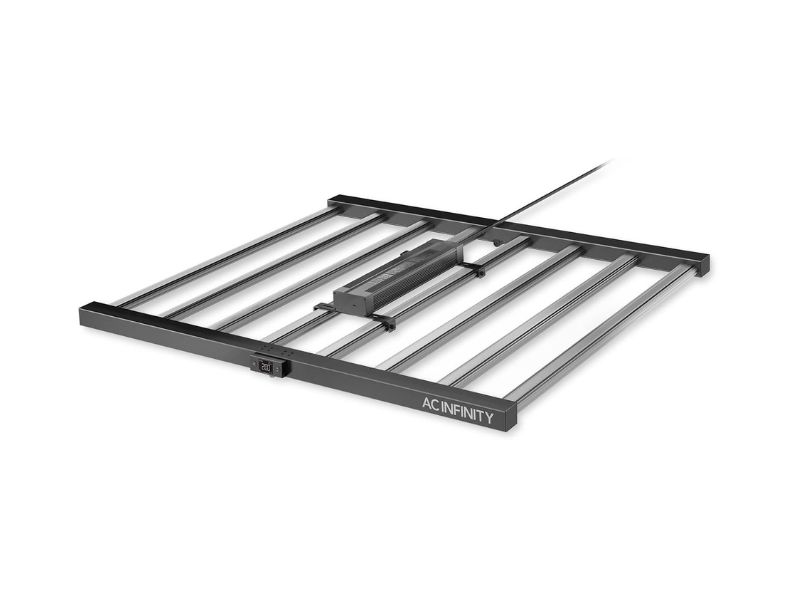
The AC Infinity IONFRAME EVO8 is the most compelling option here for growers who value system integration as much as raw photon output.
Its current Amazon listing specifies 730W power, 2,688 Samsung LM301H EVO diodes, programmable schedules, 10 brightness levels, sunrise/sunset control, removable-driver construction, and UIS-compatible Wi-Fi functionality.
One specification needs careful interpretation.
AC Infinity states that its Samsung LM301H EVO LEDs are individually rated at 3.14 µmol/J PPE.
That is a diode-level efficiency figure.
It should not automatically be compared directly with the 2.8 µmol/J system-level PPE published for the MARS HYDRO FC-E8000.
Real fixtures lose some efficiency through drivers, optics, operating temperature, and other system components.
Even so, LM301H EVO is a premium diode platform, and AC Infinity uses 2,688 diodes across the EVO8’s bar architecture.
The bar spacing is another key high-end feature.
AC Infinity describes the diodes as algorithmically spaced to improve coverage, canopy penetration, and hotspot reduction.
This is exactly the kind of engineering difference I would look for when moving into premium grow lights.
A large fixture should not simply maximize the number at the center of a PPFD chart.
A useful 5×5 grow light should produce a reasonably balanced map across:
- Center
- Sides
- Corners
- Spaces between plants
The EVO8 is currently listed for approximately 6×6-foot vegetative coverage and 5×5-foot flowering coverage.
That stage-dependent distinction matters.
Vegetative plants can often tolerate a broader footprint because they generally require less photon density than mature high-light fruiting or flowering canopies.
For a demanding 5×5 setup, I would evaluate the fixture using its flowering footprint rather than the larger vegetative number.
Smart control is where EVO8 really distinguishes itself.
The included controller provides:
- Scheduled operation
- 10 brightness levels
- Sunrise dimming
- Sunset dimming
- UIS ecosystem support
- Wi-Fi app connectivity
The plants do not inherently care whether a schedule comes from a smart controller or a basic timer.
The advantage is precision and convenience.
A large indoor garden may also use AC Infinity equipment for:
- Exhaust
- Circulation
- Environmental monitoring
- Humidity management
Keeping compatible devices within one ecosystem can reduce the number of separate controllers and apps you need to manage.
The removable driver is another premium design choice.
Drivers generate heat.
AC Infinity allows the driver to be remotely mounted away from the fixture, which gives growers another way to manage heat distribution in a warm tent.
The listing also states that the fixture uses an IP65-rated steel/aluminum construction and cites ETL certification information.
IP65 is useful in humid environments, but it does not make the grow light submersible.
Plugs, controllers, timers, and wall outlets should still remain safely away from irrigation water.
At 730W, the EVO8 is still a serious electrical appliance.
Running it at full output in a 5×5 tent will require meaningful heat removal.
Its smart dimming system can help because you do not have to operate at maximum wattage throughout the entire growth cycle.
What I Like
- Premium Samsung LM301H EVO diode platform
- 2,688 diodes
- Sophisticated scheduling
- 10 brightness levels
- Sunrise/sunset transitions
- Excellent 5×5-oriented bar architecture
- Removable driver
- UIS smart ecosystem integration
- IP65 construction
What I Do Not Like
- Diode-level 3.14 µmol/J should not be confused with system PPE
- Full benefits are strongest inside the AC Infinity ecosystem
- 730W is unnecessary for small gardens
- More controls mean more setup than a simple manual fixture
The IONFRAME EVO8 is the option I would choose when I want a premium 5×5 grow light integrated into a sophisticated automated environment. Its combination of Samsung EVO diodes, broad bar spacing, driver flexibility, and scheduling features makes it particularly attractive to growers who value control as much as raw intensity.
3. Spider Farmer SE7000 730W LED Grow Light
Key Features
- 730W actual power
- Approx. 2,146 µmol/s PPF
- Premium Bridgelux diode platform
- Enhanced red output
- Six-bar architecture
- Full-spectrum output
- App-based control
- Digital dimming
- Daisy chaining
- Detachable driver
- 5×5 tent positioning
- Five-year listed warranty
The Spider Farmer SE7000 is the alternative I would choose for growers who want high photon output with a modern app-controlled bar fixture.
The refreshed Amazon listing specifies 730W power and approximately 2,146 µmol/s photon output, using premium Bridgelux diodes.
That is serious output.
At 730 watts, the SE7000 produces enough listed PPF to compete directly with other commercial-style fixtures designed around a 5×5 canopy.
Spider Farmer uses a six-bar design to distribute those photons across the growing footprint.
As with MARS HYDRO and AC Infinity, physical diode distribution matters because large grow tents need useful edge illumination.
The objective is not simply to create a bright center.
You want plants across the canopy to receive enough usable intensity to develop at a similar rate.
Spider Farmer’s current listing positions the SE7000 for 5×5 grow tents and commercial-style 4×4 vertical racks.
That difference in use cases makes sense.
In a traditional 5×5 tent, a relatively broad area is illuminated from above.
In higher-intensity commercial rack applications, the same fixture may be used over a smaller footprint when more photon density is desired.
App control is another major feature.
The current SE7000 platform supports smart control through the Spider Farmer app along with a dimmer/display and daisy-chain operation.
That makes it easier to manage:
- Photoperiod
- Intensity changes
- Multiple fixtures
- Large grow-room installations
Daisy chaining becomes particularly useful when one grow light turns into several.
Spider Farmer lists support for connecting multiple fixtures for larger installations.
For one home 5×5 tent, that scalability may never matter.
For a multi-tent or rack system, centralized adjustment can save substantial setup time.
The current listing also describes a detachable driver.
Like the AC Infinity design, that gives the grower more flexibility in deciding where driver heat is released.
This is useful because a 730W system produces enough heat that every thermal-management option helps.
The full spectrum includes enhanced red output, supporting use throughout several growth stages.
Again, I would focus more on total usable photon output and distribution than on isolated spectrum labels.
High-end horticultural performance begins with:
PPF + PPFD uniformity + efficiency + environment.
Spectral refinements come after those fundamentals.
For seedlings, the SE7000 should be dimmed aggressively.
A 730W fixture is not a replacement for careful intensity management.
Its value is that the same light can remain useful long after those seedlings turn into large plants.
What I Like
- High 2,146 µmol/s listed output
- 730W commercial-class power
- Broad six-bar architecture
- App control
- Digital dimming
- Daisy-chain capability
- Detachable driver
- Strong 5×5 suitability
What I Do Not Like
- Current exact Amazon listing has limited rating history
- Excessive for a small home grow
- App features may be unnecessary for simple setups
- Requires significant ventilation at high output
The SE7000 is the product I would choose when I want Spider Farmer smart control combined with a high-output 730W bar platform. Its 5×5 positioning and substantial PPF give it enough headroom for a serious mature canopy.
High End LED Grow Lights Comparison
| Product | Actual Power | Fixture Style | Published Photon Metric | Smart Control | Coverage Focus | Main Strength |
| MARS HYDRO FC-E8000 | 800W | Foldable multi-bar | 2.8 µmol/J; ~2,240 µmol/s | Controller dependent | 5×5 | Maximum output + efficiency |
| AC Infinity IONFRAME EVO8 | 730W | Multi-bar | LM301H EVO diode platform | UIS/Wi-Fi | 5×5 flower / 6×6 veg | Premium automation |
| Spider Farmer SE7000 | 730W | Six-bar | ~2,146 µmol/s | App control | 5×5 | High output + smart control |
The FC-E8000 offers the most total published photon output of these three, the IONFRAME EVO8 emphasizes premium Samsung diodes and advanced environmental control, and the SE7000 combines high output with Spider Farmer’s app-based ecosystem.
How to Choose the Best High End LED Grow Lights
High End Should Mean More Than High Wattage
A premium fixture should justify its size and complexity through more than electrical input.
Look for:
- System PPE
- Total PPF
- PPFD maps
- Uniformity
- Quality diodes
- Dimming
- Thermal design
- Controls
- Safety certification
The FC-E8000, for example, publishes 2.8 µmol/J system PPE alongside 2,240 µmol/s PPF rather than relying solely on its 800W rating.
PPE vs PPF vs PPFD
These three terms answer different questions.
PPE: How efficiently does the light convert electricity to photons?
PPF: How many plant-usable photons does the entire fixture produce?
PPFD: How many of those photons reach a particular square meter of canopy each second?
A premium light should perform well across all three concepts.
Diode PPE and System PPE Are Not the Same
This is especially important when comparing the EVO8.
AC Infinity states that the Samsung LM301H EVO diodes are rated at 3.14 µmol/J.
That does not mean the complete 730W fixture necessarily operates at exactly 3.14 µmol/J wall-to-photon efficiency.
When possible, compare system PPE to system PPE.
Best High End LED Grow Light for a 5×5 Tent
My first choice is the MARS HYDRO FC-E8000 when maximum output is the priority.
Its 800W draw and roughly 2,240 µmol/s PPF provide substantial 5×5 headroom.
If automation matters more, I would move to AC Infinity EVO8.
Is 730W Enough for a 5×5 Tent?
Yes, for many high-intensity indoor growing applications.
Both AC Infinity EVO8 and Spider Farmer SE7000 are explicitly positioned around 5×5-foot use in their current listings.
Actual required intensity depends on crop, growth stage, hanging height, and target DLI.
Is 800W Too Much for a 5×5?
Not necessarily.
A 5×5 contains 25 square feet.
At 800W, the nominal electrical density is:
800 ÷ 25 = 32 watts per square foot.
That figure is only rough context because photon efficiency and PPFD distribution matter more than watts per square foot.
Dimming gives you flexibility when full power is unnecessary.
High End Grow Lights for 4×4 Tents
All three lights can be dimmed for smaller areas, but they are physically and electrically larger than most growers need for a typical 4×4.
A premium 400–600W fixture may be more proportionate unless your crop requires unusually high photon density.
Buying extra power only to leave the fixture permanently dimmed can be inefficient from a purchase-sizing perspective.
Bar Lights vs Quantum Boards
High-powered premium fixtures increasingly use distributed bars.
Bar layouts can provide:
- Wider diode spacing
- Better edge coverage
- Reduced center hotspots
- More open airflow
- More distributed heat
All three selected models use bar-oriented architectures.
Why Uniformity Matters
An impressive maximum PPFD number can be misleading.
If a fixture delivers extreme center intensity but weak corners, a substantial portion of the tent may underperform.
A high-end grow light should make as much of the canopy usable as possible.
This is why AC Infinity specifically emphasizes algorithmic diode spacing and hotspot reduction.
Smart Controls: Luxury or Useful Feature?
Both.
For one light on a fixed schedule, a mechanical timer can work perfectly well.
Smart controls become more useful when you want:
- Remote brightness changes
- Programmed schedules
- Sunrise/sunset ramps
- Multi-device coordination
- Several linked fixtures
AC Infinity has the deepest control feature set here, while Spider Farmer SE7000 provides app-based operation as well.
Removable Drivers Are Useful
A driver produces heat.
Moving it outside the tent can reduce the thermal load concentrated immediately above the plants.
AC Infinity specifically lists a removable driver, while Spider Farmer’s current SE7000 configuration also uses detachable-driver construction.
This feature becomes increasingly valuable as wattage climbs.
Full Spectrum vs Specialized Spectrum
Broad full-spectrum white lighting is the most flexible starting point.
Supplemental 660nm red can support a spectrum designed for multiple growth stages.
MARS HYDRO currently adds enhanced Osram 660nm red output, while Spider Farmer likewise emphasizes enhanced red within its current SE7000 spectrum.
Do not let spectrum marketing distract from weak PPFD or poor distribution.
Best High End Grow Light for Tomatoes
For several large indoor tomato plants filling a 5×5 canopy, I would choose FC-E8000.
Its high total PPF offers substantial mature-plant headroom.
Use dimming during propagation and increase output only as canopy size and light demand justify it.
Best High End Grow Light for Peppers
Any of these three can provide more than enough potential output for several mature pepper plants.
I would favor EVO8 if I wanted easy schedule and brightness management through a smart ecosystem.
Its 10 brightness levels make gradual intensity changes straightforward.
Best High End Grow Light for Seedlings
None of these makes sense solely for one small seedling flat.
They become logical when seedlings are merely the first stage of a larger grow.
If I planned to keep the plants under the same fixture until maturity, I would operate the light heavily dimmed during propagation.
How Much Electricity Does an 800W Grow Light Use?
At full output:
800W = 0.8 kW
At 16 hours per day:
0.8 × 16 = 12.8 kWh/day
Over 30 days:
12.8 × 30 = 384 kWh/month
Multiply 384 kWh by your local electricity rate to estimate the lighting portion of your monthly operating cost.
Electricity Use of a 730W Grow Light
At maximum output:
730W = 0.73 kW
At 16 hours:
0.73 × 16 = 11.68 kWh/day
Over 30 days:
350.4 kWh/month
Both EVO8 and SE7000 are currently 730W-class fixtures.
Actual consumption falls when the light is dimmed.
High-End LEDs Still Produce Heat
An efficient fixture is not a heat-free fixture.
A 730–800W light creates a substantial indoor thermal load.
Expect to plan for:
- Exhaust airflow
- Intake air
- Canopy circulation
- Room cooling when necessary
- Temperature and humidity monitoring
Remote-mountable drivers can help, but they do not eliminate the total heat produced by the electrical system.
Check Your Electrical Circuit
A large grow room rarely contains only a grow light.
You may also have:
- Exhaust fans
- Circulation fans
- Humidifiers
- Dehumidifiers
- Pumps
- Heaters
- Controllers
Add the actual input loads rather than relying on product names.
If you are unsure about circuit capacity or permanent electrical installation, use a qualified electrician.
IP65 Is Useful but Not Waterproof
AC Infinity describes the EVO8 body as IP65-rated for humid environments.
IP65 does not mean you should expose plugs or electrical connections to standing water.
Keep power equipment away from irrigation runoff.
Warranty and Service Matter More With Premium Equipment
A high-end fixture is a long-term equipment purchase.
Look beyond raw output and consider:
- Warranty length
- Replacement parts
- Driver replaceability
- Local support
- App longevity
- Controller availability
Spider Farmer currently lists a five-year warranty and U.S. service support for the SE7000.
Common High-End Grow Light Buying Mistakes
Buying More Wattage Than the Tent Needs
Match the fixture to your real canopy.
Comparing Diode PPE With System PPE
They are not equivalent measurements.
Looking Only at Maximum PPFD
Check the whole PPFD map.
Ignoring Heat Management
Premium LEDs still produce large thermal loads.
Assuming Smart Controls Improve Plant Biology
Controls improve convenience and consistency, not photosynthesis by themselves.
Ignoring Driver Placement
Remote mounting can make a meaningful difference in a hot tent.
Choosing by Brand Alone
Compare the actual generation and exact ASIN.
Frequently Asked Questions
What are the best high end LED grow lights?
MARS HYDRO FC-E8000 is my primary choice, followed by AC Infinity EVO8 and Spider Farmer SE7000.
The three represent different premium strengths: maximum photon output, sophisticated automation, and smart high-output bar lighting.
What makes an LED grow light high end?
High system efficiency, uniform PPFD, quality diodes, dimming, thermal design, and dependable controls matter most.
A large wattage number alone does not make a fixture premium.
Which high-end grow light has the most published PPF here?
MARS HYDRO FC-E8000 lists approximately 2,240 µmol/s PPF.
That makes it the highest published total photon-output specification among these three current selections.
Which high-end grow light uses Samsung LM301H EVO LEDs?
The AC Infinity IONFRAME EVO8 uses 2,688 Samsung LM301H EVO diodes.
Its listing states an individual-diode efficiency rating of 3.14 µmol/J.
Which premium grow light has the best smart controls?
AC Infinity IONFRAME EVO8 has the strongest integrated control package here.
It provides programmed schedules, 10 brightness levels, sunrise/sunset dimming, and UIS Wi-Fi compatibility.
Which premium LED grow light is best for a 5×5 tent?
I would choose MARS HYDRO FC-E8000 when maximum output is the priority.
It is currently specified at 800W, 2.8 µmol/J, 2,240 µmol/s PPF, and maximum 5×5 coverage.
Is the AC Infinity EVO8 good for a 5×5?
Yes, AC Infinity specifically lists 5×5 flowering coverage for the EVO8.
The larger listed 6×6 footprint applies to vegetative coverage.
Is Spider Farmer SE7000 good for a 5×5?
Yes, the current SE7000 is positioned for 5×5 tents.
It combines 730W output with six bars and approximately 2,146 µmol/s PPF.
Is 800W too much for seedlings?
At full output, yes; substantial dimming is appropriate for young seedlings.
An 800W fixture makes sense during propagation mainly when it will later support a much larger mature canopy.
Can high-end grow lights be dimmed?
Yes, all three selections provide intensity-control capability.
Dimming is essential when one large fixture serves several different plant stages.
Are bar grow lights better than board lights?
Bars often improve distribution and airflow, especially at higher wattages.
They physically spread LEDs farther across the growing footprint, helping control hotspots.
Is 730W enough for a 5×5?
Yes, efficient 730W fixtures can provide substantial 5×5 photon density.
Both EVO8 and SE7000 are positioned around this footprint.
What is PPE in a grow light?
PPE measures photosynthetic photon output produced for each joule of electrical energy.
It is one of the most useful efficiency measurements for comparing complete horticultural fixtures.
What is PPF?
PPF measures the total photosynthetically active photons emitted by the fixture each second.
The FC-E8000 publishes about 2,240 µmol/s, while the SE7000 publishes about 2,146 µmol/s.
What is PPFD?
PPFD measures photon density actually reaching a particular area of the plant canopy.
It changes with hanging distance, dimming, fixture geometry, and measurement position.
Do expensive grow lights save electricity?
Efficient fixtures can produce more plant-useful photons per watt, but high-power models still consume substantial electricity.
Compare system PPE rather than assuming a premium price automatically means lower power use.
Are removable drivers worth having?
Yes, remote driver placement can help manage heat inside an enclosed grow tent.
AC Infinity specifically supports remote driver mounting on the EVO8.
How much electricity does an 800W grow light use?
At full power for 16 hours, an 800W fixture uses about 12.8 kWh daily.
That equals approximately 384 kWh over 30 days.
How much electricity does a 730W grow light use?
At full power for 16 hours, a 730W light uses about 11.68 kWh daily.
That equals approximately 350.4 kWh over 30 days.
Do high-end LED grow lights need ventilation?
Yes, 700–800W fixtures create substantial heat even when their photon efficiency is excellent.
Plan exhaust, intake, and canopy circulation around the actual grow-room temperature.
Conclusion
The best high end LED grow lights justify their place in a serious indoor garden through more than raw wattage. I would look for strong system efficiency, total photon output, canopy uniformity, dimming, premium components, thermal flexibility, and controls that genuinely simplify day-to-day growing.
The MARS HYDRO FC-E8000 remains my primary recommendation. Its 800W draw, 2.8 µmol/J system PPE, approximately 2,240 µmol/s PPF, Bridgelux and Osram diode mix, foldable multi-bar architecture, and 5×5 positioning provide the strongest raw performance package of these three.
The AC Infinity IONFRAME EVO8 is the model I would choose when automation and premium diode technology matter most. Its 2,688 Samsung LM301H EVO diodes, 730W draw, 10 brightness levels, sunrise/sunset programming, removable driver, and UIS integration make it particularly appealing for a sophisticated controlled environment.
The Spider Farmer SE7000 is my third choice for growers who want substantial 730W output, approximately 2,146 µmol/s PPF, six-bar distribution, app control, and 5×5 capability within Spider Farmer’s ecosystem.
For maximum 5×5 output, I would choose MARS HYDRO FC-E8000. For premium smart automation, I would choose AC Infinity IONFRAME EVO8. For a high-output Spider Farmer setup, I would choose SE7000.

I’m Maya L. Greenwood, a lifelong plant lover who believes anyone can grow something beautiful with the right guidance. After years of testing soil mixes, pruning methods, irrigation tricks, and pest-safe solutions, I started EasyGardenTips.com to turn hard-won lessons into step-by-step advice. From seed starting and container gardens to composting and seasonal checklists, my goal is to make gardening simple, sustainable, and fun.