3 Best 150 Watt LED Grow Light for Indoor Growing
A 150W LED grow light offers a useful step up from smaller propagation lamps without jumping into the heat and electrical demand of a 300W fixture. It is a practical power class for vegetable seedlings, herbs, leafy greens, houseplants, and compact 2×2-style indoor gardens.
The best 150 watt LED grow light should provide actual 150W-class power, good canopy uniformity, useful dimming, efficient full-spectrum output, and enough growth headroom to remain useful after seedlings become mature plants.
My primary recommendation is the MARS HYDRO TS1000 150W LED Grow Light. I would choose it for most compact indoor gardens because it combines 150W input power, 10–100% dimming, a reflective hood, full-spectrum output, fanless cooling, and daisy-chain functionality in a straightforward fixture. MARS HYDRO specifies 150W±5% input for the TS1000.
I would choose the VIVOSUN AeroLight A150SE 150W LED Grow Light when smart automation and canopy airflow matter as much as lighting. It combines 150W full-spectrum output with an integrated circulation fan and works with VIVOSUN’s GrowHub/App ecosystem for automated intensity and airflow control.
For buyers who prioritize photon efficiency and bar-style light distribution, I would choose the MARS HYDRO FC-E1500 150W LED Grow Light. MARS HYDRO specifies 150W power, 2.8 µmol/J PPE, approximately 420 µmol/s PPF, Bridgelux diodes, and a 2.5×2.5-foot maximum coverage area.
3 Best 150 Watt LED Grow Lights Reviewed
| Image | Product Name | Check Price |
|---|---|---|
Best Choice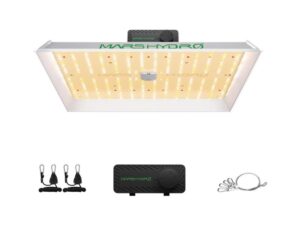 | MARS HYDRO TS1000 150W LED Grow Light | Check Price |
Second Best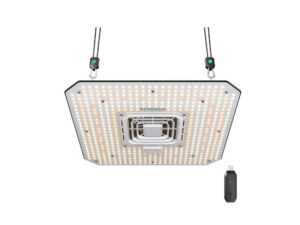 | VIVOSUN AeroLight A150SE 150W LED Grow Light | Check Price |
Third Choice | MARS HYDRO FC-E1500 150W LED Grow Light | Check Price |
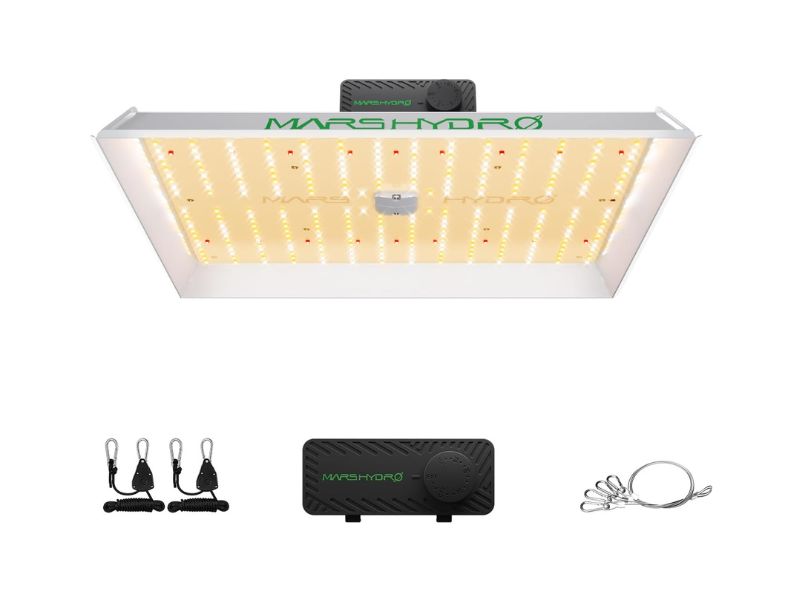
1. MARS HYDRO TS1000 150W LED Grow Light
Key Features
- 150W actual input power
- 10–100% dimming
- Full-spectrum LED output
- Reflective hood
- Fanless passive cooling
- Daisy-chain capability
- Approximately 2.5×2.5-foot maximum footprint
- Suitable for seedlings through mature growth
The MARS HYDRO TS1000 is my primary recommendation because it combines enough output for serious indoor growing with a relatively uncomplicated design.
MARS HYDRO’s current documentation specifies 150W±5% input power, a 10–100% dimming range, and approximately 2.5×2.5-foot footprint for the TS1000.
That dimming range is particularly important.
A 150W fixture can deliver far more light than a few freshly emerged seedlings need, especially when mounted close to the canopy.
Instead of running maximum output immediately, you can begin at a lower setting and increase intensity as plants grow.
That makes the TS1000 useful for:
- Tomato seedlings
- Pepper seedlings
- Eggplants
- Herbs
- Lettuce
- Leafy greens
- Houseplants
- Compact fruiting plants
The reflective hood is one of the fixture’s defining design elements.
The current Amazon listing describes an upgraded reflector intended to redirect more light toward the growing area while improving uniformity across the canopy.
That can be particularly useful outside a highly reflective grow tent.
Some photons that would otherwise spread sideways can be redirected toward plants.
The compact board-style format also makes installation simple.
You are hanging one relatively small fixture rather than assembling a large multi-bar frame.
That is useful in a:
- 2×2 tent
- 2.5×2.5 tent
- Plant cabinet
- Seed-starting station
- Small indoor garden
Fanless operation is another practical benefit.
The TS1000 relies on passive thermal management rather than an onboard cooling fan.
That means no fan noise and fewer moving components.
It does not mean the fixture produces no heat.
A 150W grow light still adds a meaningful amount of thermal energy to a small enclosed area.
Maintain appropriate ventilation and canopy airflow.
The TS1000 also supports daisy-chain operation, making it easier to add compatible fixtures later if your growing area expands.
For seedlings, I would use the dimmer rather than relying solely on hanging distance.
As plants mature, gradually increase light based on canopy response.
Signs of insufficient light can include:
- Stretching
- Long internodes
- Weak stems
- Strong leaning toward the fixture
Signs that intensity may be excessive include:
- Bleaching
- Upward leaf curl
- Pale areas directly beneath the LEDs
- Stressed new growth
The main limitation is coverage.
A 150W fixture is not intended to provide high-intensity illumination over a large 4×4 canopy.
It works best when matched to a compact growing footprint.
What I Like
- Wide 10–100% dimming range
- Full-spectrum output
- Reflective hood
- Quiet fanless operation
- Simple compact installation
- Daisy-chain capability
What I Do Not Like
- Less distributed than a true bar fixture
- Too much output for a few seedlings at full power
- Limited for large mature canopies
The TS1000 is the 150W light I would choose for most buyers who want a simple, dimmable fixture capable of serving seedlings through later indoor growth.
2. VIVOSUN AeroLight A150SE 150W LED Grow Light
Key Features
- 150W LED grow light
- Integrated circulation fan
- Broad 380–780nm full-spectrum output
- 3000K and 5000K white LEDs
- 660nm red component
- Dimmable operation
- GrowHub compatibility
- App-based controls
- Automated scheduling potential
- Mounting hooks included
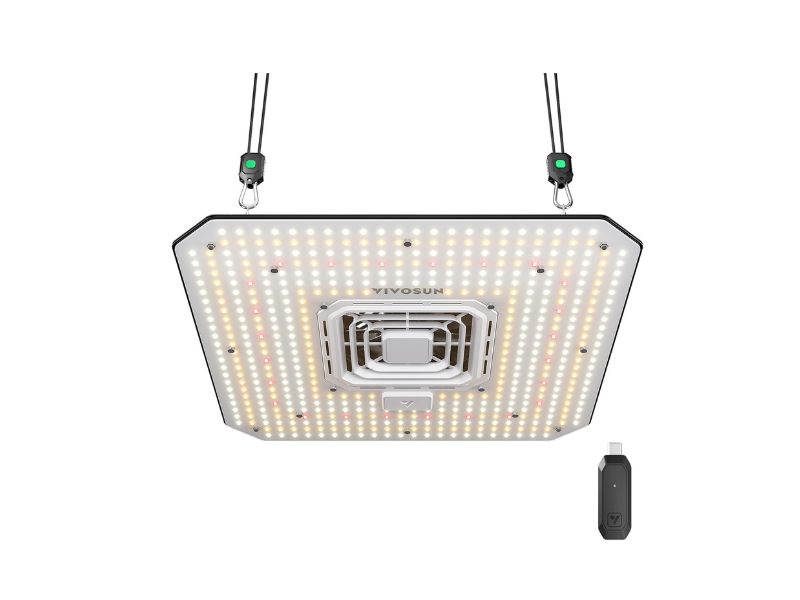
The AeroLight A150SE takes a different approach from a normal passive grow light.
VIVOSUN integrates a circulation fan directly into the fixture, so lighting and airflow originate from the same overhead position. Its Amazon listing specifies 150W output and broad full-spectrum lighting while highlighting integrated air circulation.
That can be useful in a compact grow tent where space is limited.
Dense plant canopies can trap warm, humid air around leaves.
Gentle circulation helps:
- Mix air
- Reduce stagnant pockets
- Balance local temperature
- Move humidity away from dense foliage
- Encourage sturdier stems
A separate clip fan can accomplish similar goals, but an integrated fan reduces the number of individual devices mounted around the tent.
The A150SE’s spectrum is listed around 380–780nm, including 3000K, 5000K, and 660nm output.
That makes it suitable for several plant stages rather than being limited to propagation.
I would consider it for:
- Tomatoes
- Peppers
- Basil
- Herbs
- Leafy vegetables
- Houseplants
- Compact indoor crops
The smart-control ecosystem is another major advantage.
VIVOSUN states that AeroLight can work with its GrowHub controller and app, allowing users to program light schedules and remotely control compatible equipment.
That can be useful if you want to coordinate:
- Lighting
- Fan operation
- Day/night schedules
- Other compatible growing equipment
For a grower already using the VIVOSUN ecosystem, that integration can simplify environmental management.
For someone who simply needs a light to turn on for 16 hours every day, however, these smart features may be more complexity than necessary.
A mechanical timer and manual dimmer can still produce excellent plants.
The integrated fan also introduces a moving component.
Passive grow lights have no fan bearings or fan motor to maintain.
With AeroLight, the additional hardware is useful, but it is another component that exists within the system.
Its coverage claims should also be interpreted carefully.
The listing refers to 2×4/3×3-style coverage, but usable footprint depends heavily on:
- Crop
- Growth stage
- Target PPFD
- Hanging height
- Reflective environment
A 150W fixture can illuminate a broad vegetative area more easily than it can deliver high mature-plant PPFD across the same area.
What I Like
- Integrated circulation fan
- 150W full-spectrum output
- App and GrowHub compatibility
- Can coordinate lighting and airflow
- Useful for compact smart tents
- Broad spectrum for multiple growth stages
What I Do Not Like
- More complicated than a passive light
- Fan introduces a moving component
- Smart-controller functionality may be unnecessary for simple setups
The AeroLight A150SE is the model I would choose when I want lighting, canopy circulation, and smart automation combined in one compact grow system.
3. MARS HYDRO FC-E1500 150W LED Grow Light
Key Features
- 150W actual power
- 2.8 µmol/J PPE
- Approx. 420 µmol/s PPF
- Bridgelux LEDs
- Full-spectrum output
- Bar-style construction
- Dimmable control
- Smart/remote-control functionality
- Maximum coverage around 2.5×2.5 feet
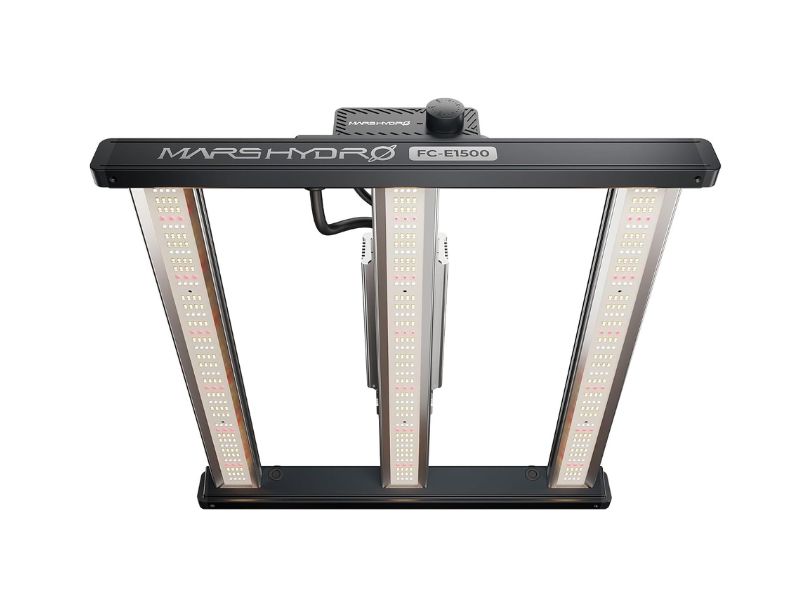
The FC-E1500 is the model I would choose when photon efficiency and canopy uniformity matter more than having the most established product history.
MARS HYDRO currently specifies 150W±5% input power, 2.8 µmol/J PPE, approximately 420 µmol/s PPF, Bridgelux diodes, and 2.5×2.5-foot maximum coverage.
Those photon metrics are useful.
PPE — Photosynthetic Photon Efficacy measures how efficiently the fixture converts electrical energy into photosynthetically useful photons.
PPF — Photosynthetic Photon Flux measures the total quantity of those useful photons emitted per second.
This makes it easier to compare lights than relying on wattage alone.
Two fixtures can both consume 150W while producing different quantities of useful plant light.
The FC-E1500’s 2.8 µmol/J PPE is particularly strong for this power class.
The bar-style construction provides another benefit.
Rather than concentrating all LEDs into the center of a solid board, the FC-E1500 distributes them across a wider structure.
That can improve:
- Edge illumination
- Canopy uniformity
- Heat distribution
- Airflow through the fixture
Uniformity is important for seed trays and several plants sharing one canopy.
A grow light can produce an impressive PPFD number in the center while still performing poorly near the edges.
Distributed LEDs help reduce that center-hotspot problem.
MARS HYDRO specifies a spectrum combining approximately 2800–3000K, 4800–5000K, and 660–665nm red wavelengths.
That broad spectrum makes the fixture suitable for:
- Seedlings
- Vegetative growth
- Herbs
- Leafy greens
- Flowering and fruiting stages
Dimming is important because a 420 µmol/s-class fixture can provide substantial intensity over a compact canopy.
Young seedlings rarely need all of that immediately.
Start lower and increase output gradually.
The bar format is particularly attractive for a square 2×2 to 2.5×2.5-foot canopy.
Plants positioned near corners can receive more useful illumination than they might beneath a small central board, depending on hanging height.
The physical tradeoff is size.
Bar fixtures generally occupy more horizontal space than compact board lights.
For a dedicated tent, that is usually beneficial.
For a tiny shelf, the TS1000 may be easier to install.
What I Like
- Strong 2.8 µmol/J published PPE
- Approximately 420 µmol/s PPF
- Bar-style uniformity
- Bridgelux LED platform
- Dimmable full-spectrum output
- Good fit for compact square canopies
What I Do Not Like
- Larger physical footprint than TS1000
- More sophisticated than a basic propagation light
- Newer platform with less long-term marketplace history
The FC-E1500 is the 150W fixture I would choose when efficient photon production and even canopy distribution are my main priorities.
150 Watt LED Grow Light Comparison
| Product | Actual Power | Fixture Style | Dimming | Published Photon Metric | Coverage Focus | Main Strength |
| MARS HYDRO TS1000 | 150W | Board + reflector | 10–100% | — | 2×2–2.5×2.5 class | Simple all-around design |
| VIVOSUN AeroLight A150SE | 150W | Panel + integrated fan | Yes | — | Compact smart tent | Light + airflow automation |
| MARS HYDRO FC-E1500 | 150W | Bar | Yes | 2.8 µmol/J / 420 µmol/s | 2.5×2.5 | Efficiency and uniformity |
The TS1000 is the simplest all-around option, AeroLight is the most integrated smart-environment choice, and FC-E1500 has the strongest published photon-efficiency specification of these three.
How to Choose the Best 150 Watt LED Grow Light
Confirm It Really Uses About 150 Watts
Grow-light model names frequently create confusion.
The “1000” in TS1000 does not mean the light consumes 1000 watts.
MARS HYDRO specifies the TS1000 at approximately 150W±5%.
Likewise, the FC-E1500 is a 150W-class fixture, not a 1500W electrical load.
Always check actual input power.
Is 150W Enough for a 2×2 Grow Tent?
For many plants, yes.
A good 150W LED is a strong match for a compact 2×2-foot area.
It provides considerably more output than a 100W fixture while remaining manageable for:
- Seedlings
- Vegetables
- Herbs
- Compact mature plants
The exact usable footprint depends on the desired PPFD.
Is 150W Enough for a 3×3 Tent?
It can illuminate a 3×3 area, particularly for vegetative or lower-intensity crops.
However, high-light mature plants across a full nine-square-foot canopy may require more photon output.
Do not judge coverage by footprint alone.
Check PPFD distribution.
150W vs 100W Grow Light
A 150W fixture uses about 50% more electrical input than a true 100W light.
All else equal, that means more potential photon output.
The additional headroom is especially useful for:
- Larger vegetable seedlings
- Mature herbs
- Wider canopies
- Fruiting plants
However, fixture efficiency matters too.
A highly efficient 100W model can narrow the real performance gap.
150W vs 200W Grow Light
A 200W fixture offers roughly one-third more electrical input than a 150W fixture.
That can increase coverage and mature-plant intensity.
The tradeoff is:
- Higher power use
- More heat
- Larger fixture size
For a compact 2×2-style garden, 150W is often a practical balance.
PPE Matters
PPE tells you how many photosynthetically active photons are produced per joule of electrical energy.
The FC-E1500 publishes 2.8 µmol/J PPE.
That means wattage alone does not tell the entire performance story.
PPF Matters Too
The FC-E1500 also publishes approximately 420 µmol/s PPF.
PPF describes total fixture photon output.
However, it does not tell you where those photons land.
That requires PPFD measurements.
What Is PPFD?
PPFD measures photon density reaching a specific part of the plant canopy.
It changes with:
- Hanging height
- Dimming
- Fixture design
- Reflective surfaces
- Measurement position
The highest center PPFD is not necessarily the goal.
Uniform useful intensity across the entire canopy is often more valuable.
Why Dimming Matters at 150W
A dimmer significantly increases versatility.
Seedlings may need relatively low intensity.
Several weeks later, the same plants can use much more.
The TS1000 provides 10–100% dimming, making it particularly straightforward to adapt through multiple growth stages.
Board vs Bar Grow Lights
A board-style fixture such as the TS1000 offers:
- Compact installation
- Simple hanging
- Centralized output
A bar-style fixture such as the FC-E1500 offers:
- Wider diode spacing
- Better airflow through the fixture
- Potentially improved edge uniformity
Neither format is automatically superior.
Match the fixture to your growing area.
Best 150W Grow Light for Seedlings
For seedlings, I would choose the TS1000 and run it dimmed.
Its wide dimming range makes intensity adjustment straightforward.
The FC-E1500 also works very well if you want broader tray uniformity.
Best 150W Grow Light for Vegetable Seedlings
Tomatoes, peppers, and eggplants can quickly outgrow small clip lamps.
A 150W fixture provides enough headroom to keep supporting them until transplanting.
For one tray, I favor TS1000.
For a broad square canopy, FC-E1500’s bar layout is particularly appealing.
Best 150W Grow Light for Tomatoes
Tomatoes become relatively demanding as they mature.
For a compact growing area, FC-E1500’s 420 µmol/s PPF provides useful output while its bar architecture helps spread that output across several plants.
Best 150W Grow Light for Peppers
Peppers frequently remain indoors for a long period before outdoor temperatures are suitable.
A dimmable 150W fixture provides enough reserve to follow them from small seedlings into substantial transplants.
Best 150W Grow Light for Herbs
Most compact herb gardens will not need maximum 150W output.
Use the dimmer.
Basil, parsley, cilantro, and other herbs can share a broader canopy while the fixture runs at an intensity appropriate for their needs.
Best 150W Grow Light for Lettuce
Lettuce generally benefits more from even moderate illumination than extremely high center PPFD.
The FC-E1500 bar design is particularly useful over broad flat canopies.
How Far Should a 150W Grow Light Be From Plants?
There is no universal distance.
Follow the manufacturer’s recommendations for the exact fixture.
Then watch the plants.
If they stretch, they may need greater usable intensity.
If leaves bleach or curl, the light may be too close or too intense.
How Long Should a 150W Grow Light Run?
Photoperiod depends on the crop and PPFD.
Vegetable seedlings commonly receive roughly 14–18 hours of light per day followed by darkness.
Mature plants can have different requirements.
Use a timer for consistency.
Electricity Use of a 150W Grow Light
At full power:
150W = 0.15 kW
At 16 hours daily:
0.15 × 16 = 2.4 kWh per day
Over 30 days:
2.4 × 30 = 72 kWh
Multiply 72 by your local electricity rate to estimate monthly operating cost.
Dimming can reduce actual consumption.
150W LEDs Still Produce Heat
LEDs are efficient, not heatless.
A 150W fixture adds meaningful heat to a small grow tent.
Maintain airflow around:
- Driver
- LED board or bars
- Plant canopy
The AeroLight approaches this issue by integrating a circulation fan directly into the fixture.
Smart Controls: Useful or Optional?
Smart controls can make it easier to manage:
- Scheduling
- Brightness
- Airflow
- Remote adjustments
AeroLight is particularly strong here because it integrates with VIVOSUN’s GrowHub/App system.
For a simple setup, however, an external timer and manual dimmer remain perfectly adequate.
Common 150W Grow Light Buying Mistakes
Confusing Model Number With Wattage
Always check actual input watts.
Buying Without Dimming
A 150W fixture can be difficult to manage over seedlings without intensity control.
Ignoring PPFD Uniformity
Edge plants matter as much as center plants.
Assuming Every 3×3 Claim Means High-Intensity Coverage
Vegetative and mature high-light requirements differ.
Hanging the Light Too High
This can produce leggy growth despite owning a powerful fixture.
Hanging It Too Close
Efficient LEDs can cause light stress even without obvious heat burn.
Ignoring Ventilation
A compact tent still needs airflow.
Frequently Asked Questions
What is the best 150 watt LED grow light?
The MARS HYDRO TS1000 is my primary recommendation for most compact indoor gardens.
Its combination of 150W power, 10–100% dimming, full-spectrum output, reflective hood, and fanless operation makes it highly versatile.
Is a 150W LED grow light enough?
Yes, 150W is substantial for seedlings, herbs, vegetables, and compact indoor gardens.
It offers more growth headroom than 100W while remaining easier to manage than a 300W fixture.
Is 150W enough for a 2×2 grow tent?
Yes, 150W is a strong power class for many 2×2-foot applications.
Fixture efficiency, plant type, PPFD target, and hanging height determine the final result.
Is 150W enough for a 3×3 grow tent?
It can work for vegetative or moderate-intensity use, but mature high-light crops may need more.
Evaluate PPFD across the entire canopy rather than relying only on a coverage label.
Is 150W too much for seedlings?
It can be at full power and close range, so dimming is highly useful.
Begin with lower intensity and increase light gradually as seedlings grow.
Which 150W grow light is most efficient here?
The MARS HYDRO FC-E1500 publishes 2.8 µmol/J PPE.
It also publishes approximately 420 µmol/s total PPF.
Which 150W grow light has an integrated fan?
The VIVOSUN AeroLight A150SE integrates a circulation fan into the fixture.
The fan is designed to move air through the canopy while the LEDs provide overhead light.
Which 150W grow light supports app control?
The VIVOSUN AeroLight supports GrowHub and VIVOSUN App integration.
That allows programmable schedules and compatible smart-grow automation.
Which 150W grow light has a bar design?
The MARS HYDRO FC-E1500 uses a distributed bar-style LED layout.
This format can improve canopy uniformity and airflow through the fixture.
Is 150W good for tomato seedlings?
Yes, a dimmable 150W fixture gives tomato seedlings substantial growth headroom.
Start at lower intensity and increase output as plants develop larger leaves.
Is 150W good for pepper seedlings?
Yes, particularly because peppers may remain indoors for several weeks.
A 150W fixture can continue serving them long after they outgrow a small tabletop lamp.
Can I grow lettuce under 150 watts?
Yes, 150W provides ample potential output for a compact lettuce canopy.
Use dimming to prioritize even moderate intensity rather than maximum power.
Can I grow herbs under a 150W LED?
Yes, 150W can cover several herb pots or a substantial herb canopy.
Most herbs will not require maximum intensity in a compact footprint.
What does 2.8 µmol/J mean?
It measures how efficiently electricity is converted into photosynthetically useful photons.
The FC-E1500 publishes a 2.8 µmol/J PPE specification.
What does 420 µmol/s PPF mean?
It represents the total photosynthetically active photon output emitted every second.
MARS HYDRO publishes approximately 420 µmol/s for the FC-E1500.
Is a bar grow light better than a panel?
Bar fixtures often improve uniformity, while panels are usually more compact and simple.
The better format depends on canopy shape and installation space.
How far should a 150W grow light be from seedlings?
The correct distance depends on the exact fixture, dimming level, and growth stage.
Use manufacturer guidance first and then adjust based on plant response.
How many hours should a 150W grow light run?
The proper photoperiod depends on crop, PPFD, growth stage, and natural light.
Seedlings commonly use long daily schedules followed by a regular dark period.
How much electricity does a 150W grow light consume?
At full output for 16 hours, it consumes approximately 2.4 kWh per day.
That equals roughly 72 kWh over 30 days.
Do I need a timer with a 150W grow light?
A timer is highly useful for keeping the daily light-and-dark schedule consistent.
Smart fixtures may automate schedules internally, while conventional fixtures work well with a properly rated external timer.
Conclusion
The best 150 watt LED grow light should deliver enough usable light for a compact indoor canopy while giving you control over intensity as plants progress from seedlings to mature growth. I would prioritize dimming, canopy uniformity, photon efficiency, full-spectrum output, thermal management, and realistic coverage.
The MARS HYDRO TS1000 remains my primary recommendation. Its 150W actual power, 10–100% dimming, reflective hood, fanless cooling, and daisy-chain capability make it the most straightforward all-around choice for seedlings, vegetables, herbs, and compact indoor plants.
The VIVOSUN AeroLight A150SE is the alternative I would choose when environmental automation matters. Its 150W full-spectrum light, integrated circulation fan, and GrowHub/App compatibility combine several grow-room functions into one fixture.
The MARS HYDRO FC-E1500 is the performance-focused option. Its 150W draw, 2.8 µmol/J PPE, approximately 420 µmol/s PPF, Bridgelux LEDs, and bar-style design make it particularly attractive when efficiency and even canopy coverage are priorities.
For most buyers specifically looking for a dependable 150 watt LED grow light, I would choose the MARS HYDRO TS1000. For smart airflow and automation, I would choose the VIVOSUN AeroLight A150SE, while the FC-E1500 is the stronger choice when published photon efficiency matters most.

I’m Maya L. Greenwood, a lifelong plant lover who believes anyone can grow something beautiful with the right guidance. After years of testing soil mixes, pruning methods, irrigation tricks, and pest-safe solutions, I started EasyGardenTips.com to turn hard-won lessons into step-by-step advice. From seed starting and container gardens to composting and seasonal checklists, my goal is to make gardening simple, sustainable, and fun.