3 Best Full Spectrum LED Grow Light Strips for Plant Shelves
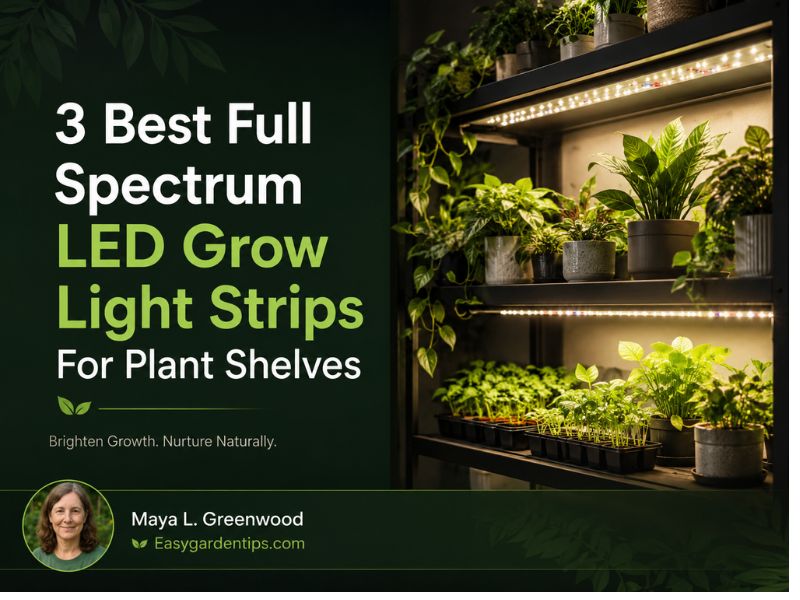
Full-spectrum LED strips can turn an ordinary bookcase, cabinet, wire rack, or propagation shelf into a dedicated plant-growing area. Their low-profile housings fit beneath shelves where a bulb, panel, or large reflector would occupy too much vertical space.
The best full spectrum led grow light strips should produce useful light across the complete plant canopy while remaining easy to mount, schedule, cool, and protect from water. The number of LEDs printed in a listing matters less than actual power, fixture length, spectrum, coverage, and distance from the leaves.
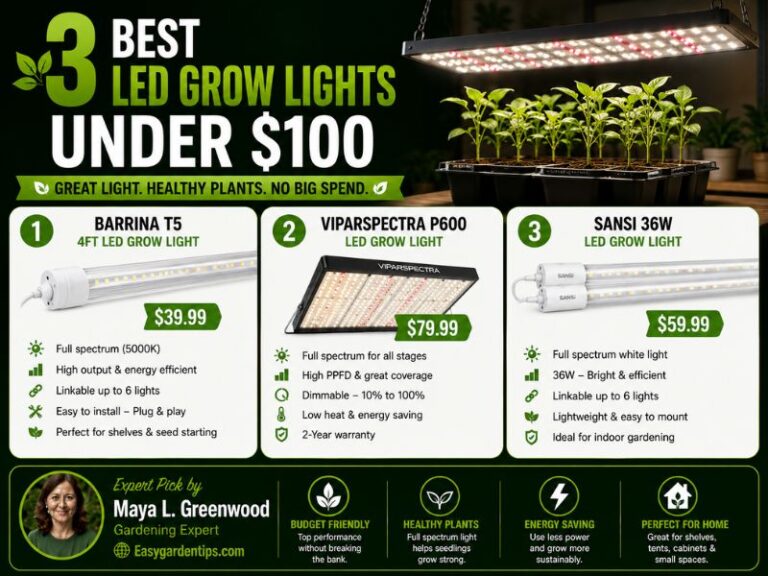
My primary recommendation is the Litever 36W Full Spectrum White Grow Light Strip Kit. Its four rigid strips, dedicated power supply, timer, extension cables, and mounting accessories create the strongest overall package for a plant cabinet, propagation rack, or one concentrated shelf.
I would choose the Mosthink 40W 5500K Full Spectrum Grow Light Strips, 4-Pack for buyers who prioritize automated 3-, 6-, or 12-hour schedules and adjustable brightness. Its white, red, and blue LEDs provide several operating options, although the shorter timer presets may not suit every plant.
The Wiaxulay 15W Full Spectrum Grow Light Strips, 4-Bar Set is more suitable for a small display shelf or low-light plant stand. Its 16-inch bars, 6-, 12-, and 16-hour timer, lighting modes, and five brightness levels make it flexible, but its 15-watt total draw places it below the other systems in overall output.
All three products are designed for relatively close-range use. None should be installed on a ceiling several feet above a plant shelf and expected to maintain high-light crops. Strip lights are most effective when their geometry follows the canopy and their distance remains controlled.
Quick Selection Guide
| Growing area | Recommended system | Why it fits |
| One concentrated propagation shelf | Litever 36W | Higher-output four-strip kit with extension cables |
| Two narrow cabinet levels | Litever 36W | Strips can be distributed between compact levels |
| Automated foliage shelf | Mosthink 40W | Built-in timer and dimming |
| Mixed decorative plant display | Mosthink 40W | Multiple lighting modes and white-dominant output |
| Small desktop plant stand | Wiaxulay 15W | Lower power and compact 16-inch strips |
| Fresh cuttings or low-light plants | Wiaxulay 15W | Adjustable brightness is easy to manage |
| Deep succulent shelf | Multiple higher-output strips or a panel | One low-power strip set may be insufficient |
| Mature fruiting plants | High-output panel or bar fixture | Strip lights may lack canopy penetration |
The final choice should be based on the plant canopy rather than the cabinet’s external dimensions. A large cabinet containing three small plants needs less illuminated area than a narrow shelf filled edge to edge with seedlings.
Best Full Spectrum LED Grow Light Strips Reviewed
| Image | Product Name | Check Price |
|---|---|---|
Best Choice | Litever 36W Full Spectrum White Grow Light Strip Kit | Check Price |
Second Best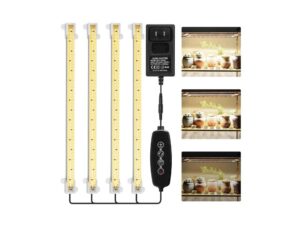 | Mosthink 40W 5500K Full Spectrum Grow Light Strips, 4-Pack | Check Price |
Third Choice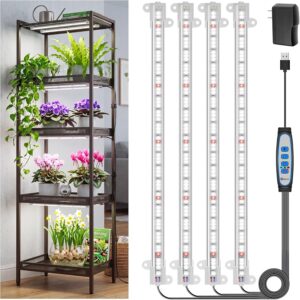 | Wiaxulay 15W Full Spectrum Grow Light Strips, 4-Bar Set | Check Price |
1. Litever 36W Full Spectrum White Grow Light Strip Kit
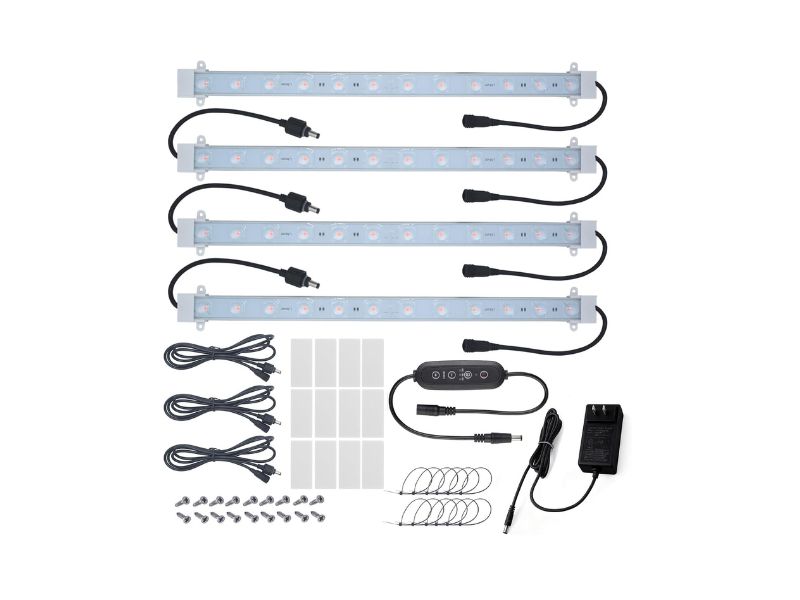
Key Features
- Four rigid LED grow-light strips
- Approximately 36 watts total
- White full-spectrum output
- Dedicated power adapter
- Timer included
- Extension and connecting cables
- Mounting hardware supplied
- Suitable for cabinets, racks, and shelves
- Low-profile construction
- Strips can be arranged across one or more levels
The Litever kit ranks first because it is built as a complete shelf-lighting system rather than a decorative USB lamp. Four strips and a 36-watt combined draw provide enough flexibility for a concentrated shelf, propagation area, or small cabinet.
Its white spectrum makes plant inspection easier than strongly purple lighting. Natural-looking illumination helps reveal chlorosis, pest damage, fungal spots, mineral residue, and leaf-color changes.
Extension cables allow the strips to be separated instead of forcing every fixture into one continuous line. This is useful when illuminating two cabinet levels or positioning several strips from front to back over a deep shelf.
The included timer creates a repeatable daily schedule. Users should verify the timer’s exact cycle behavior after a power interruption, as some inline controllers reset when electricity is lost.
Although the kit is more substantial than low-powered decorative strips, 36 watts should not be interpreted as unlimited coverage. Dividing the system among several shelves reduces the power allocated to each level.
The rigid housings dissipate heat more effectively than bare adhesive LED tape, but they still require airflow. They should not be enclosed behind fabric or pressed against material that blocks heat dissipation.
My verdict: Litever is the best overall option for a compact, purpose-built plant shelf. It provides useful installation hardware and a practical output level, but high-light plants may need the four strips grouped closely rather than distributed across several levels.
2. Mosthink 40W 5500K Full Spectrum Grow Light Strips, 4-Pack
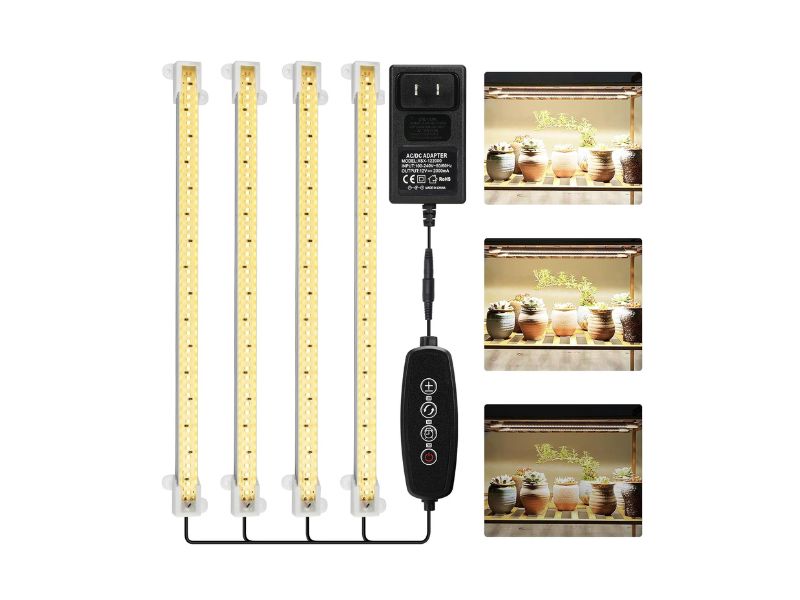
Key Features
- Four rigid grow-light strips
- Approximately 40 watts total
- 204 LEDs
- Approximately 5500K white appearance
- White, red, and blue diodes
- 3-, 6-, and 12-hour timer settings
- Adjustable brightness
- Multiple lighting modes
- Under-shelf mounting format
- Intended for indoor plant displays and cabinets
Mosthink offers the highest listed total wattage among these three products, although the difference between 36 and 40 watts should not determine the purchase by itself. Its more meaningful advantage is the combination of timer presets, brightness control, and selectable lighting modes.
The 5500K output appears cool white and fits visually into a working plant shelf or office. Dedicated red and blue LEDs supplement the white spectrum, depending on the selected operating mode.
The 12-hour timer is a practical starting point for many foliage plants. Three or six hours is generally supplemental and may be useful when plants already receive strong window light. Those shorter schedules are unlikely to replace daylight for a plant in a dark interior area.
Brightness adjustment helps acclimate sensitive plants. Instead of immediately exposing a shade-grown plant to full output at close range, the user can begin lower and increase intensity gradually.
The system’s practical limitation is control dependence. Inline electronic timers can lose their settings after an outage, and multiple lighting modes can encourage unnecessary adjustments before a plant has time to respond.
My verdict: Mosthink is the best choice for buyers who want stronger automation and multiple spectrum modes. I would use it for a decorative shelf or mixed plant display where dimming and timer convenience matter as much as raw output.
3. Wiaxulay 15W Full Spectrum Grow Light Strips, 4-Bar Set
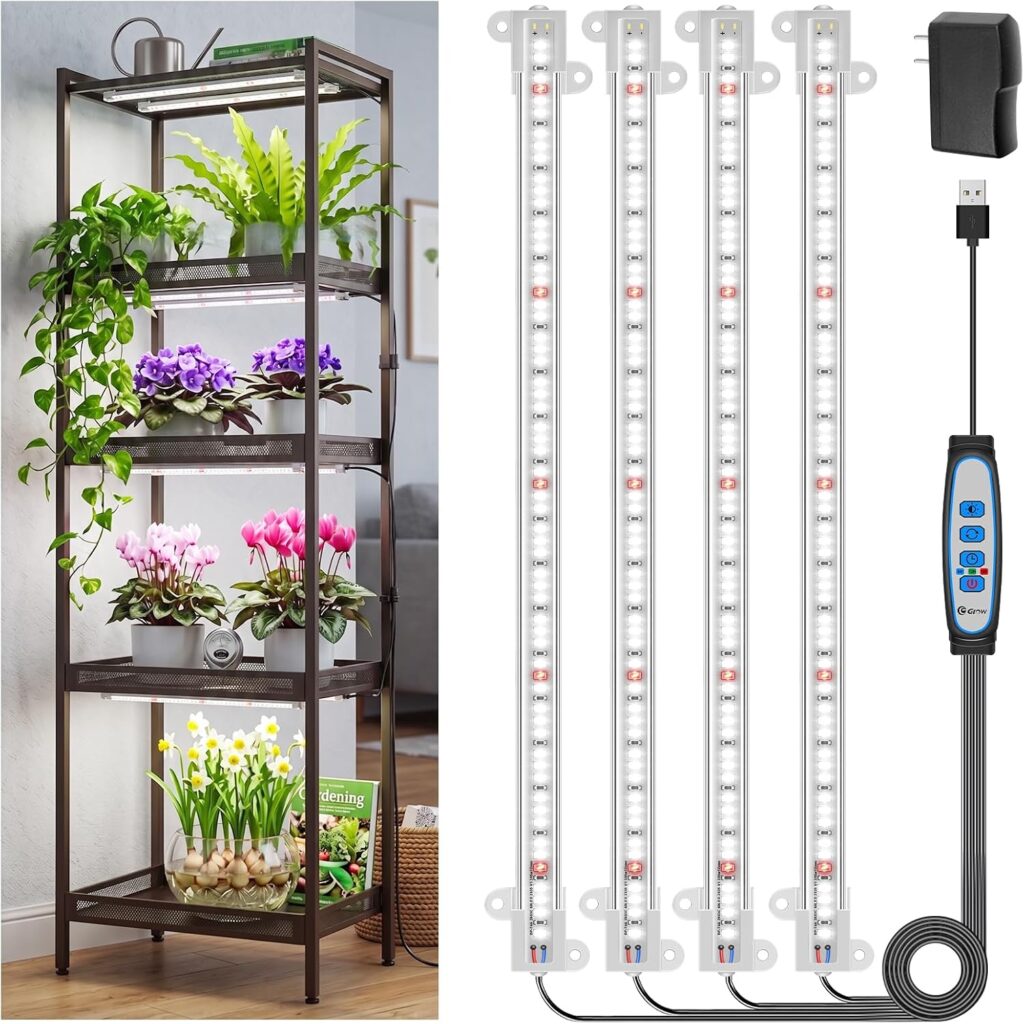
Key Features
- Four approximately 16-inch rigid strips
- 15-watt total power draw
- 240 LEDs
- Full-spectrum white-dominant output
- 6-, 12-, and 16-hour timer settings
- Three lighting modes
- Five brightness levels
- Low-voltage powered design
- Compact under-shelf format
- Suitable for small plants and propagation
The Wiaxulay set is the lowest-output product in the comparison, making it easier to use around a small shelf, low-light foliage plants, or fresh cuttings. It should not be expected to match the canopy intensity of the 36- or 40-watt systems.
Its 6-, 12-, and 16-hour schedules cover a more useful range than controllers limited to very short periods. Twelve hours works as a conservative starting point for many foliage plants, while sixteen may suit seedlings or plants that need greater daily light.
Five brightness levels help compensate for limited mounting flexibility. If a fixed cabinet shelf cannot be raised, intensity can be reduced electronically for sensitive leaves.
The four 16-inch strips work best over compact growing areas. Placing them far apart across several shelves may leave each level with weak coverage. Grouping two or more over one level is more suitable for plants with moderate light requirements.
The high LED count should not be mistaken for high output. Small diodes can be numerous while the system still consumes only 15 watts. Actual canopy response is determined by photon delivery, not LED quantity.
My verdict: Wiaxulay is most appropriate for a small display, propagation station, or supplemental-light application. It ranks third because its limited total power makes it less suitable as the only light for dense seedlings, herbs, or high-light plants.
Product Comparison
| Product | Strips | Approximate length | Total power | Color appearance | Timer options | Dimming | Best use |
| Litever | 4 | About 16 in | 36W | Full-spectrum white | Included timer | Version-dependent control | Concentrated shelf or cabinet |
| Mosthink | 4 | Model-specific rigid strips | 40W | About 5500K white with red and blue | 3/6/12 hours | Yes | Automated decorative shelf |
| Wiaxulay | 4 | 16 in | 15W | Cool white full spectrum | 6/12/16 hours | Five levels | Small plants and propagation |
Litever provides the strongest overall system balance. Mosthink provides the most versatile spectrum and schedule controls. Wiaxulay uses much less power and is better treated as a compact supplemental system.
The correct choice is not always the highest wattage. A low-light plant six inches below a 15-watt strip system may receive more useful light than a high-light plant positioned several feet below a 40-watt system.
Rigid Strips Versus Flexible LED Tape
The phrase “LED grow light strip” can describe two different product types.
Rigid Grow-Light Strips
The reviewed products use rigid housings containing LEDs and heat-dissipating material.
Their advantages include:
- Better heat management
- Straighter installation
- More secure mounting
- Protected electrical paths
- Purpose-built power supplies
- Repeatable positioning
- Easier cleaning
Their limitations include:
- Fixed lengths
- Inability to bend around corners
- Less customization
- Complete-strip replacement after failure
Flexible LED Tape
Flexible tape uses small LEDs on a bendable circuit strip, often with adhesive backing.
Potential advantages include:
- Cut-to-length installation
- Curved or hidden placement
- Low profile
- Easy decorative integration
Potential limitations include:
- Weak heat dissipation without aluminum channels
- Adhesive failure
- Exposed contacts
- Lower output
- Unclear plant spectrum
- Voltage drop across long runs
- Complicated wiring after cutting
- Greater risk near water
For plant shelves, rigid strips are generally the more predictable choice. Flexible tape should be installed in an appropriate channel with a compatible power supply and moisture protection.
What “Full Spectrum” Should Mean to a Buyer
“Full spectrum” is not one standardized performance class. Manufacturers use it to describe fixtures that emit a broad range of visible wavelengths.
A useful full-spectrum strip should provide:
- Meaningful blue output
- Broad white-light output
- Useful red wavelengths
- Adequate photon intensity
- Reasonable color appearance
- Consistent coverage
Spectrum alone does not determine whether a product can grow plants. A broad but weak spectrum remains weak.
White LEDs
White LEDs use a blue diode and phosphor coating to produce a broad visible spectrum. Their output is comfortable in occupied rooms and allows accurate inspection.
Red LEDs
Red wavelengths contribute efficiently to photosynthesis. Dedicated red diodes can increase output in that region.
Blue LEDs
Blue light contributes to vegetative form, leaf development, and compact growth.
Green Light
Green wavelengths are less strongly absorbed at the top leaf surface than red or blue, but they can penetrate deeper into leaves and dense canopies. Green light is not useless to plants.
Understanding Color Temperature
Color temperature describes how white light appears:
- 2700–3000K: warm and yellow
- 3500–4500K: neutral
- 5000–6500K: cool daylight
Mosthink’s approximately 5500K appearance and Wiaxulay’s cool-white output are visually suitable for seedling and foliage shelves.
Color temperature does not reveal exact spectral distribution. Two fixtures rated 5500K may use different phosphors and diode combinations.
How Strip Length Affects Coverage
Match the Canopy Width
A 16-inch strip cannot evenly illuminate a 36-inch plant row by itself. Multiple strips can be positioned end to end, but connections and gaps may create weaker zones.
Consider Shelf Depth
Length controls side-to-side coverage. Shelf depth determines how many parallel strips are needed.
A shelf only eight inches deep may use one centered row for low-light plants. A shelf 16–20 inches deep generally needs multiple strips placed from front to back.
Avoid Over-Centering
Mounting all four strips close together at the center produces high intensity in one band while leaving the front and back underlit.
Distribute them according to the plant canopy unless a concentrated high-light zone is intentional.
Check the Ends
LED output may be lower near strip endpoints. Keep demanding plants within the actively illuminated region rather than directly beyond the housing.
How Many Strips Should Be Installed?
One Strip
One moderate strip may provide supplemental light for:
- A narrow plant row
- One or two low-light plants
- Fresh propagation cuttings
- A window-assisted shelf
- Small decorative displays
Two Strips
Two parallel strips work well for:
- Small seedling trays
- Medium-light foliage
- African violets
- Peperomia
- Small herbs
- Shelves around 12 inches deep
Four Strips
Grouping four strips may be necessary for:
- Denser seedlings
- Succulents
- Wider shelves
- Herbs grown without window light
- Concentrated propagation areas
- Greater edge-to-edge uniformity
Distributing a four-strip system across four separate shelves leaves only one-quarter of the package output on each level.
Using Actual Watts Correctly
Watts measure electricity consumed, not photons delivered to plants.
Actual power helps estimate:
- Relative output class
- Heat
- Energy use
- Adapter load
- Timer capacity
Do not compare these products using equivalent-wattage claims. A 40-watt LED system consumes approximately 40 watts regardless of any much larger “replacement” number in advertising.
PPF, PPFD, and Daily Light
PPF
Photosynthetic photon flux measures total photosynthetically active output in µmol/s.
Many compact strip listings do not publish reliable PPF data, making direct output comparison difficult.
PPFD
Photosynthetic photon flux density measures the light arriving at the leaf surface in µmol/m²/s.
PPFD changes with:
- Distance
- Strip spacing
- Dimming
- Shelf reflections
- Plant height
- Natural daylight
- Position near edges
DLI
Daily light integral measures the total PAR accumulated over the day.
Use:
DLI = PPFD × operating seconds ÷ 1,000,000
A canopy receiving an average PPFD of 80 µmol/m²/s for 12 hours receives:
80 × 43,200 ÷ 1,000,000 = 3.46 mol/m²/day
Increasing the schedule to 16 hours would raise the total to:
80 × 57,600 ÷ 1,000,000 = 4.61 mol/m²/day
Longer duration helps only within reasonable limits. A very weak fixture cannot always be corrected by operating continuously.
Matching Strips to Plant Types
Low-Light Foliage
Suitable examples include:
- ZZ Plant
- Snake Plant
- Pothos
- Heartleaf Philodendron
- Chinese Evergreen
- Cast Iron Plant
These plants tolerate moderate strip intensity, although they still need useful daily light. Wiaxulay can supplement a small low-light display when positioned correctly.
Medium-Light Houseplants
Examples include:
- Hoya
- Peperomia
- African Violet
- Anthurium
- Compact Monstera
- Philodendron cultivars
- Small orchids with appropriate requirements
Litever or Mosthink provides more useful output for these plants, particularly without window light.
Succulents and Cacti
High-light succulents may stretch beneath one widely spaced low-power strip. Several strips should be grouped close enough to deliver useful intensity.
A high-output panel or T8 system may be more efficient for a large succulent shelf.
Seedlings
Seedlings need uniform light to avoid thin, leaning stems. Mount strips parallel over the tray and raise them as plants grow.
Herbs
Basil, parsley, cilantro, and greens require more light than many shade-tolerant houseplants. Use the higher-output kits and avoid distributing their strips too thinly across multiple levels.
Fruiting Crops
Compact strips can start tomato and pepper seedlings, but mature fruiting crops generally require a stronger fixture with better canopy penetration and verified PPFD coverage.
Timer Settings and Photoperiod
Three or Six Hours
Short schedules are usually supplemental. They may help a shelf that already receives several hours of useful daylight.
They are rarely sufficient as the sole lighting period in a dark room.
Twelve Hours
Twelve hours is a practical starting point for many foliage plants. Monitor growth and adjust according to natural light and species requirements.
Sixteen Hours
A 16-hour period may suit seedlings, propagation, and some herbs when intensity is moderate. Plants still receive an eight-hour dark period.
Avoid 24-Hour Lighting
Continuous lighting wastes electricity and can interfere with normal plant physiology. A stable dark period is a better default.
Timer Behavior After Power Loss
Electronic inline timers may reset after an outage. Check:
- Current time
- Selected cycle
- Brightness level
- Spectrum mode
- Whether the fixture automatically resumed
Dimming the Strips
Dimming is helpful when:
- Plants were previously in weak light
- Cuttings have not rooted
- Shelf height cannot be changed
- Natural sunlight increases seasonally
- Sensitive foliage shows bleaching
- The growing area becomes too bright for people
A low dimmer setting does not make the spectrum incomplete, but it reduces the total photon delivery. If plants begin stretching, the setting may be too low.
Change intensity gradually and evaluate the newest leaves.
Mounting Options
Mechanical Clips
Clips and screws provide the most reliable attachment to solid shelving. Use fasteners appropriate for wood, metal, or composite material.
Cable Ties
Cable ties work well on wire racks. Use enough ties to prevent sagging and inspect them for heat-related brittleness.
Magnetic Mounts
Magnets are convenient on steel shelves. Not all metal surfaces are magnetic, and thin painted panels may provide weak holding strength.
Double-Sided Adhesive
Adhesive is easy but may fail because of heat, humidity, dust, or textured surfaces. It should not be the only support above plants unless the product specifically approves that use.
Aluminum Channels
Flexible LED tape benefits from aluminum channels that improve heat dissipation and protect the strip. The rigid products reviewed here already provide structural support.
Heat Management
LED strips still create heat. A 40-watt system in a closed cabinet adds almost all its consumed energy to that space eventually.
Heat problems are more likely when:
- All strips are close together
- Drivers are enclosed
- Cabinet doors remain closed
- Ventilation is poor
- The room is warm
- Fixtures operate for long periods
Measure temperature at canopy height. Add gentle airflow or ventilation when necessary.
Do not cover the strips, adapters, or control modules.
Electrical and Water Safety
Use Drip Loops
Arrange each cord so it dips below the outlet or adapter before rising to the connection. Water traveling along the cord will fall from the low point.
Keep Adapters Elevated
Do not place power adapters or inline controllers on the floor below watering shelves. Mount them in a dry, ventilated location.
Protect Connections
Extension connections should remain:
- Dry
- Fully seated
- Free from tension
- Away from drainage holes
- Accessible for inspection
Do Not Overload USB Adapters
Low-voltage strip systems require adapters capable of supplying the specified voltage and current. Do not substitute a random phone charger unless compatibility is confirmed.
Unplug Before Cleaning
Switch off and unplug the system before wiping fixtures or rearranging wet plants.
Estimating Energy Consumption
Monthly electricity consumption is:
Watts ÷ 1,000 × daily hours × 30
Litever 36W
At 36 watts for 14 hours:
0.036 × 14 × 30 = 15.12 kWh per month
Mosthink 40W
At 40 watts for 12 hours:
0.040 × 12 × 30 = 14.4 kWh per month
Wiaxulay 15W
At 15 watts for 16 hours:
0.015 × 16 × 30 = 7.2 kWh per month
Actual consumption changes with dimming and operating mode. Multiply monthly kWh by the local electricity rate to estimate cost.
Signs the Strips Are Too Weak
- Seedlings become tall and thin
- Plants lean toward a window
- Internodes lengthen
- New leaves are smaller
- Variegated growth becomes greener
- Succulents stretch
- Herbs remain sparse
- Soil stays wet longer
- Edge plants grow more slowly than center plants
Move the strips closer, increase brightness, add another strip, improve coverage, or lengthen the schedule within a reasonable range.
Signs the Strips Are Too Strong or Close
- Upper leaves bleach
- Dry tan spots align with LEDs
- Leaf margins curl upward
- Pigments fade
- Leaves feel warm
- New growth remains stressed
- The center plants decline while edge plants remain healthy
Raise the strips, reduce brightness, shorten the schedule, or move sensitive plants toward the edge.
Maintenance
Clean the Optical Surface
Dust reduces output. Unplug the lights and wipe them using the approved method.
Inspect Adhesive and Clips
Check every mounting point monthly. Humidity and heat can weaken adhesive over time.
Check the Controller
Confirm that the timer, dimmer, and lighting mode remain correct after power interruptions.
Watch for Flicker
Intermittent flickering can indicate:
- Loose connectors
- Inadequate adapter capacity
- Damaged wiring
- Controller failure
- Heat-related electronics problems
Stop using components that become discolored, smell burned, or feel unusually hot.
Common Buying Mistakes
- Confusing rigid strips with flexible tape
- Comparing LED count instead of actual power
- Assuming full spectrum guarantees high output
- Dividing a low-power system across too many shelves
- Mounting strips several feet from plants
- Using one strip over a deep shelf
- Selecting timer presets without considering natural light
- Running the system continuously
- Treating color temperature as complete spectrum data
- Trusting equivalent-wattage claims
- Depending entirely on adhesive mounting
- Placing adapters below drainage holes
- Using incompatible USB power supplies
- Blocking heat dissipation
- Ignoring cabinet temperature
- Changing spectrum mode every few days
- Expecting strips to light mature fruiting plants
- Forgetting that dimming reduces DLI
Frequently Asked Questions
What are the best full spectrum LED grow light strips?
Litever’s 36W kit offers the strongest overall balance for a compact plant shelf. Mosthink provides more timer and spectrum controls, while Wiaxulay suits smaller displays and lower-output supplemental lighting.
Do full-spectrum LED strips work for plants?
Yes, when they provide sufficient intensity at the leaf surface. Their low-profile shape is useful beneath shelves and cabinets. Distance, strip count, daily duration, and plant type determine whether the output is adequate.
Are grow-light strips better than bulbs?
Strips are better for rows and shelves, while bulbs suit compact circular canopies. A strip distributes light along a rectangular area. A bulb generally produces a brighter center and weaker edges.
Are these flexible LED tape lights?
No, the selected products use rigid strip-style housings. Rigid strips provide better structure, mounting consistency, and heat dissipation than bare adhesive tape. They cannot normally be cut to custom lengths.
How many grow-light strips do I need per shelf?
One to four strips may be appropriate depending on shelf depth and plant demand. A narrow foliage shelf may use one, while seedlings or succulents may require several parallel fixtures.
How close should grow-light strips be to plants?
Use the product’s guidance and adjust according to new plant growth. Low-power strips usually need closer placement than high-output panels. Watch for stretching when too far and bleaching when too close.
What does full spectrum mean?
It generally means the fixture emits a broad range of visible plant-usable wavelengths. The term is not a guaranteed performance standard. Output, coverage, spectrum distribution, and efficiency must still be evaluated.
Is 5500K good for growing plants?
Yes, 5500K white light is suitable for seedlings and vegetative growth. It produces a daylight-like appearance with a meaningful blue component. Color temperature alone does not determine total plant-light output.
Can these strips grow succulents?
They can support small succulents when several strips provide sufficient close-range intensity. The 15W Wiaxulay system may be too weak for a large shelf. Monitor rosettes for stretching or flattening.
Can grow-light strips start seeds?
Yes, their linear format provides useful coverage across rectangular seed trays. Mount the strips evenly, keep seedling height uniform, and raise the fixtures as plants grow.
How long should LED grow-light strips remain on?
Twelve to sixteen hours suits many shelf-growing applications. Foliage plants often use a shorter period than seedlings. Include natural daylight and provide darkness every day.
Is a three-hour timer useful?
Three hours is useful primarily as supplemental lighting. It may extend a bright window’s day but is unlikely to replace daylight in a dark room. Use a longer period when the strips are the main source.
Can the strips be left on overnight?
Yes, if the plants receive a consistent dark period at another time. Daytime operation is usually more convenient and reduces nighttime glare. The total photoperiod matters more than clock time.
Do LED grow-light strips get hot?
Yes, particularly when several strips operate inside a closed cabinet. Keep their housings and power adapters ventilated. Monitor leaf and cabinet temperatures rather than assuming low wattage produces no heat.
Can I mount grow strips with double-sided tape?
Yes, but adhesive should not be trusted blindly above plants. Heat, humidity, and dust can weaken it. Mechanical clips, ties, or secondary restraints provide better security.
Can I cut these light strips?
No, rigid integrated strips should not be cut unless the manufacturer explicitly permits it. Cutting can expose live conductors and destroy the electrical circuit. Flexible tape products use different cut-point designs.
Why are plants growing unevenly under the strips?
The fixtures may be too widely spaced or misaligned with the canopy. Reposition the strips, add another parallel row, level the plants with risers, and check intensity at shelf edges.
Can grow-light strips replace sunlight completely?
Yes, if their intensity, coverage, spectrum, and daily duration meet the plant’s needs. Small low-power systems are often better suited to supplementation. High-light or mature fruiting plants may require stronger fixtures.
Conclusion
The best full spectrum led grow light strips should fit the plant canopy, provide adequate close-range output, and remain securely mounted above watering areas. Timer convenience and LED count are secondary to actual wattage, coverage, distance, and heat management.
Litever 36W Full Spectrum White Grow Light Strip Kit remains my primary recommendation. Its four-strip arrangement, extension cables, mounting accessories, and practical output make it suitable for a concentrated shelf, cabinet, or propagation area.
Mosthink’s 40W four-strip system is the better alternative when automated schedules, dimming, and multiple lighting modes are priorities. The 12-hour setting is the most practical starting option when the strips provide most of the plant’s light.
Wiaxulay’s 15W four-bar set is intended for smaller installations. Its longer timer choices and brightness controls make it convenient for low-light plants and fresh cuttings, but the strips should not be spread too thinly across several shelves.
Measure the canopy before buying, install strips from front to back on deep shelves, and keep power supplies and connections dry. Start with moderate brightness, then adjust according to the newest leaves rather than the apparent brightness of the room.
For a compact indoor shelf that needs a complete, dependable strip-light system, I would begin with Litever 36W.

I’m Maya L. Greenwood, a lifelong plant lover who believes anyone can grow something beautiful with the right guidance. After years of testing soil mixes, pruning methods, irrigation tricks, and pest-safe solutions, I started EasyGardenTips.com to turn hard-won lessons into step-by-step advice. From seed starting and container gardens to composting and seasonal checklists, my goal is to make gardening simple, sustainable, and fun.