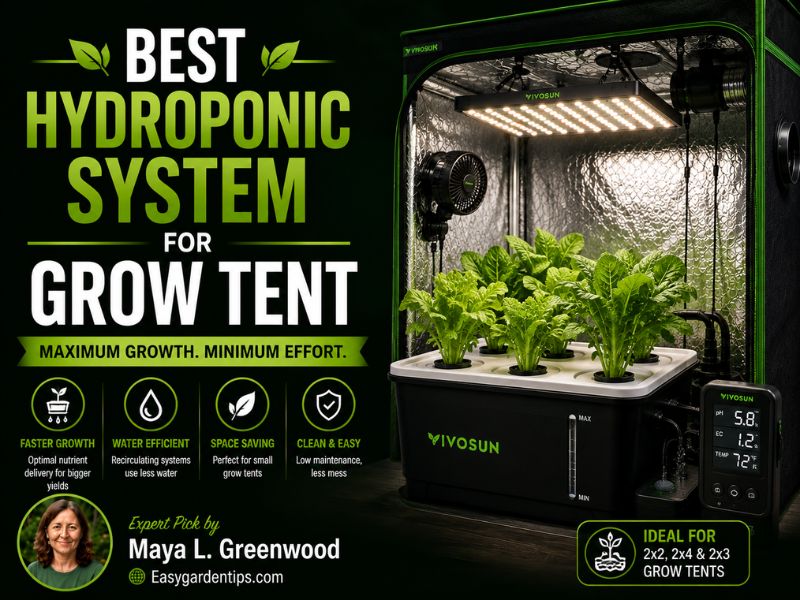
Best Hydroponic System for Grow Tent: 3 Smart DWC Kits Reviewed
Choosing the best hydroponic system for grow tent use starts with one practical question: how much water-based equipment can you comfortably fit inside the enclosure while still reaching every plant, airline, bucket, and nutrient solution?
That matters because hydroponics uses space differently from soil containers. A hydroponic setup may include buckets, net pots, air stones, pumps, tubing, water-level indicators, drip rings, pH and EC testing equipment, and electrical connections. A system that technically fits on the tent floor can still be frustrating if you cannot reach the nutrient solution once the canopy fills in.
For most small-to-medium grow tents, deep water culture (DWC) is one of the easiest hydroponic methods to package into a manageable footprint. Instead of installing long NFT channels or a large flood table, individual buckets can be arranged around the light footprint and adjusted according to the available space.
My first recommendation is the VEVOR 4-Bucket DWC Hydroponic System. It combines four approximately 5-gallon planting buckets with an air pump, individual air stones, water-level indicators, tubing, check valves, and clay growing media. The bucket format is straightforward and particularly useful if you want independent plant sites without complicated recirculating plumbing between every container.
The VIVOSUN 4-Bucket DWC Hydroponics Grow System is my second recommendation. It also uses four 5-gallon buckets but adds an adjustable top-drip irrigation system, 8-inch grow baskets, water-level indicators, and a powerful adjustable air pump rated at up to 25 L/min. VIVOSUN specifically describes the system as suitable for grow tents.
For a smaller plant count or a tent where maintenance space matters more than maximum site count, the Spider Farmer 2-Bucket 7-Gallon DWC System is particularly attractive. Its two larger 7-gallon buckets use top-drip irrigation and a triangular access cover that lets you add water or take measurements without removing the plant from the main lid.
3 Best Hydroponic Systems for Grow Tents
| Image | Product Name | Check Price |
|---|---|---|
Best Choice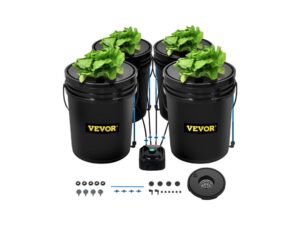 | VEVOR 4-Bucket DWC Hydroponic System | Check Price |
Second Best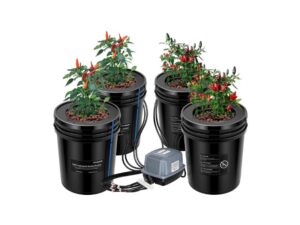 | VIVOSUN 4-Bucket DWC System With Top Drip | Check Price |
Third Choice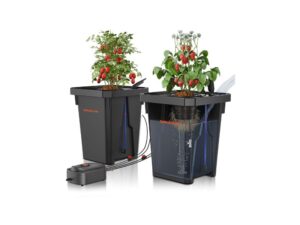 | Spider Farmer 2-Bucket 7-Gallon DWC System | Check Price |
I ranked these systems using current Amazon customer-confidence signals first, then evaluated the characteristics that matter inside an enclosed tent:
- Bucket capacity
- Plant-site count
- Air-pump capacity
- Root-zone aeration
- Water-level visibility
- Nutrient-solution access
- Top-drip functionality
- Tubing complexity
- Leak points
- Tent footprint
- Ease of maintenance
All three are DWC-style systems, but they suit different growers.
1. VEVOR 4-Bucket DWC Hydroponic System
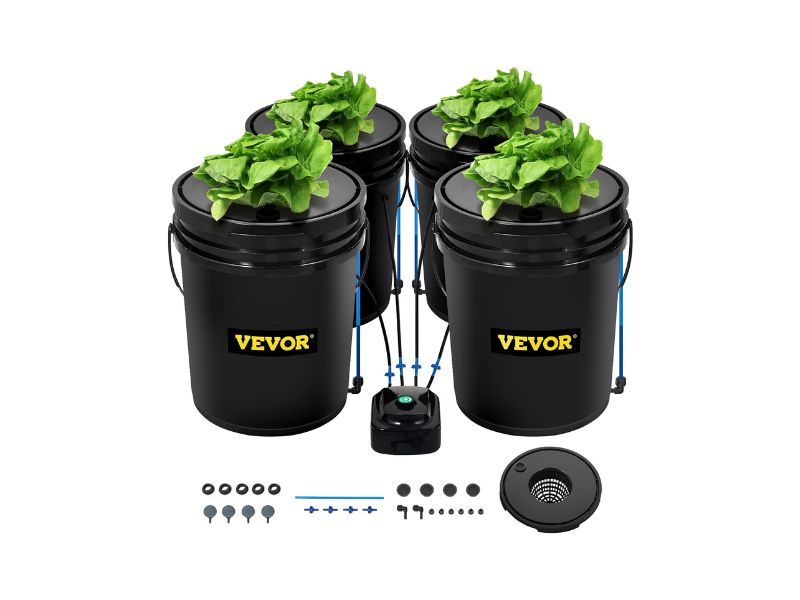
Key Features
- Four approximately 5-gallon buckets
- PP bucket construction
- Individual air stones
- 8W air pump
- Approximately 4 × 4 L/min airflow specification
- Water-level indicators
- Check valves
- Clay growing media included
VEVOR takes the first position because its four-bucket DWC kit combines a well-established Amazon feedback history with a relatively simple layout.
Each planting bucket holds roughly five gallons, with VEVOR specifying dimensions of about 12 × 12 × 15 inches. The included 8W air pump supplies four air stones through separate airlines, giving each root zone its own aeration source.
That simplicity is important inside a grow tent.
Every additional water connection between buckets introduces another fitting that needs to remain accessible and leak-free. The VEVOR layout keeps the main hydroponic sites relatively independent while still providing external water-level tubes for easier monitoring.
The system also includes check valves, which are especially useful when an air pump sits near nutrient solution. They help reduce the risk of water traveling backward through airline tubing if pump pressure stops.
For a 4×4 tent, four individual buckets can be arranged roughly as quadrants, leaving a center or perimeter area for tubing and maintenance.
What I Like
- Four useful plant sites
- Simple DWC architecture
- Individual root-zone aeration
- Water-level indicators simplify routine checks
- Good match for a medium grow tent
What I Do Not Like
- Smaller net-pot opening than some competing systems
- Access to the nutrient solution becomes less convenient once plants become very large
The VEVOR is the strongest choice when you want four DWC sites without making the plumbing more complicated than necessary.
2. VIVOSUN 4-Bucket DWC System With Top Drip
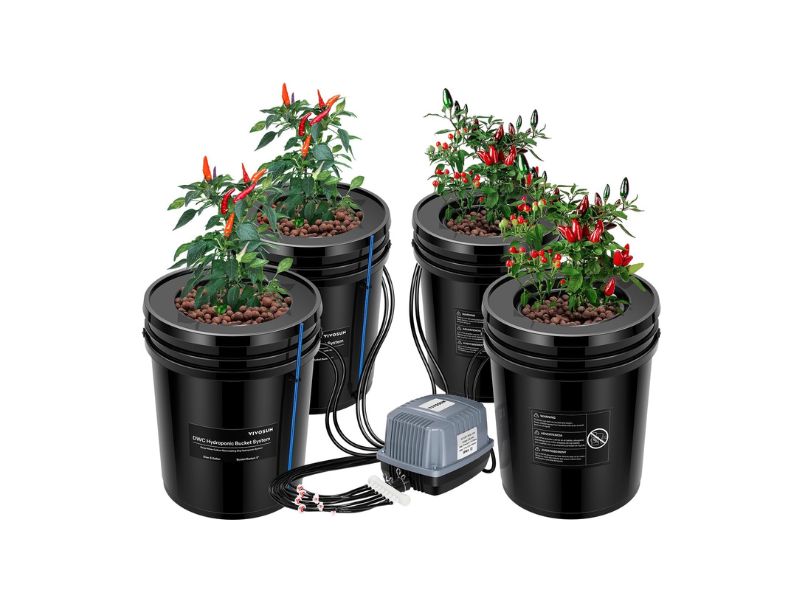
Key Features
- Four 5-gallon DWC buckets
- Four 8-inch grow baskets
- Adjustable top-drip system
- 25 L/min adjustable air output
- Four air stones
- Water-level indicators
- Clay pebbles included
- Individual bucket configuration
VIVOSUN takes second place because it adds more active root-zone irrigation to the basic DWC design.
Its four-bucket system combines deep water culture with top-feed drip rings. The air pump feeds air stones beneath the nutrient solution while the drip system circulates nutrient solution around the upper root zone.
VIVOSUN specifies 5-gallon buckets measuring about 30 cm in diameter and 38 cm high, along with 8-inch grow baskets. The included air pump delivers up to 25 L/min and can be adjusted through individual airflow controls.
The system’s external water-level indicator is also useful because it gives you a quick reference without repeatedly lifting the plant basket.
Where VIVOSUN becomes particularly attractive is during early root establishment. A top-drip ring can keep the upper growing media moist while developing roots work their way toward the aerated nutrient solution below.
The tradeoff is complexity. More tubing and fittings mean more components to route and inspect.
What I Like
- Strong air-pump capacity
- Top-drip functionality
- Large 8-inch net baskets
- Individual plant sites
- External water-level monitoring
What I Do Not Like
- More tubing than a basic DWC kit
- Four buckets plus drip lines can make a compact tent crowded
The VIVOSUN is my preferred choice for growers who specifically want DWC plus top feeding rather than the simplest possible bucket system.
3. Spider Farmer 2-Bucket 7-Gallon DWC System
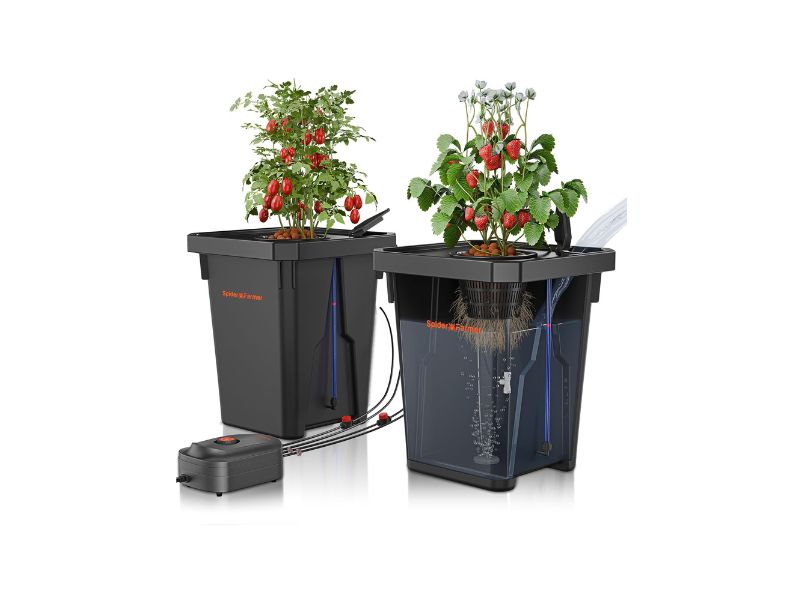
Key Features
- Two 7-gallon DWC buckets
- Triangular access covers
- Adjustable top-drip rings
- 6-inch net cups
- 8W air pump
- Two air stones
- Water-level tubes
- Approximately 6 meters of airline tubing
Spider Farmer’s two-bucket system is the most interesting option when you value maintenance access and larger reservoir volume per plant.
Each bucket holds approximately seven gallons, giving the root zone more nutrient-solution capacity than a typical 5-gallon bucket. Spider Farmer also uses a triangular access panel in the bucket lid so you can add water or check solution parameters without removing the entire lid or disturbing the plant.
That feature becomes increasingly valuable as plants grow.
With a conventional lid, a large canopy can make it difficult to lift the net pot or access the bucket opening. Spider Farmer’s separate access section provides another route to the solution.
The system also includes adjustable top-drip rings and an 8W air pump. Spider Farmer recommends at least about 70 cm of tent width when two buckets are positioned side by side, illustrating why actual bucket dimensions should be checked before choosing a tent.
What I Like
- Larger 7-gallon root zones
- Excellent nutrient-solution access
- Top-drip system
- Better suited to fewer, larger plants
- Simple two-site layout
What I Do Not Like
- Only two plant sites
- Larger buckets use more floor space per plant
The Spider Farmer is especially attractive for a 2×4 or 3×3 setup with two plants, or for a 4×4 where you intentionally want generous spacing instead of filling every available site.
Hydroponic Grow Tent System Comparison
| Product | Plant Sites | Bucket Size | Irrigation Style | Air Pump | Main Advantage |
| VEVOR DWC System | 4 | ~5 gal | DWC aeration | 8W | Simple four-site setup |
| VIVOSUN DWC + Drip | 4 | 5 gal | DWC + top drip | Up to 25 L/min | Strong aeration and drip feeding |
| Spider Farmer DWC | 2 | 7 gal | DWC + top drip | 8W | Larger root zone and easy access |
The main decision is not which system has the longest feature list. It is whether you want more plant sites, stronger top-drip integration, or easier maintenance with larger buckets.
What Is DWC Hydroponics?
Deep water culture places plant roots in or immediately above an aerated nutrient solution.
An air pump pushes air through tubing to an air stone submerged in the reservoir. The air stone releases bubbles and keeps the nutrient solution oxygenated around the root system.
This is why the air pump is a critical part of a DWC system.
Unlike soil, where pore spaces can provide oxygen around the roots, DWC roots spend much of their time surrounded by water. The system therefore depends on dissolved oxygen and reliable aeration.
The VEVOR, VIVOSUN, and Spider Farmer kits all include air pumps and air stones specifically for this purpose.
Why DWC Works Well in a Grow Tent
A DWC bucket provides a clearly defined growing site.
You do not need:
- A large flood table
- Long NFT channels
- Extensive drain plumbing
- A thick layer of soil
- Large bags of growing media
Instead, the bucket serves as both the root-zone container and nutrient reservoir.
That can make DWC surprisingly space-efficient.
The challenge is maintenance.
A bucket may look small when the plant is young, but once the canopy develops, you still need access to:
- Nutrient solution
- Air lines
- Water-level tube
- Drip ring
- pH testing
- EC testing
- Drain point
A well-designed grow tent therefore leaves maintenance space, not just plant space.
DWC vs RDWC in a Grow Tent
These terms are easy to confuse.
DWC
In a conventional DWC arrangement, each plant has its own nutrient reservoir.
Advantages include:
- Simple setup
- Fewer shared plumbing connections
- Easier isolation of individual plants
- Less risk that one leaking connection drains the entire system
The three products reviewed here primarily use this independent-bucket approach. VIVOSUN specifically notes that its individual buckets allow different plants to be managed independently.
RDWC
Recirculating deep water culture connects multiple plant sites to a common control reservoir.
A water pump continuously circulates nutrient solution through the connected buckets.
Advantages include:
- One central nutrient reservoir
- More uniform solution chemistry
- Easier centralized adjustments
Disadvantages include:
- More plumbing
- More potential leak points
- Larger physical footprint
- Greater dependence on water circulation
For a compact first grow tent, individual DWC buckets are often easier to understand and troubleshoot.
What Does the Top-Drip System Do?
Both the VIVOSUN and Spider Farmer systems add a top-feed drip ring.
Instead of relying only on the reservoir below, nutrient solution can be delivered around the upper growing media.
This is particularly useful before roots have grown deeply enough to reach the main nutrient solution comfortably.
VIVOSUN describes its system as combining DWC with recirculating top-drip irrigation, while Spider Farmer uses an adjustable drip ring around its net cup.
Once roots are well established in the aerated solution, the importance of top feeding may decrease depending on the system and crop.
How Many DWC Buckets Fit in a Grow Tent?
Always plan around the complete bucket diameter plus plant canopy, not bucket count alone.
2×2 Tent
One large DWC bucket is the safest general-purpose layout.
Two compact sites may physically fit, but equipment and canopy space become limited.
2×4 Tent
A 2×4 works especially well for two buckets arranged in a row.
Spider Farmer’s two 7-gallon system fits naturally into this general layout, provided the actual bucket dimensions and tent opening are checked first. Spider Farmer recommends at least about 70 cm of width for its two-bucket side-by-side arrangement.
3×3 Tent
A 3×3 provides nine square feet.
Two large DWC sites are comfortable.
Four 5-gallon buckets may physically fit, but maintenance space can become limited as the canopy grows.
4×4 Tent
A 4×4 is ideal for many four-bucket systems.
The four buckets can be arranged roughly as:
| Bucket 1 | Bucket 2 |
| Bucket 3 | Bucket 4 |
This makes the VEVOR and VIVOSUN four-bucket kits particularly easy to understand in a 4×4 layout.
5×5 Tent
A 5×5 gives considerably more space around a four-site system.
That extra room can be useful for:
- Large plants
- Circulation fans
- Reservoir equipment
- Drainage access
- Environmental devices
The downside is needing a light capable of covering the larger canopy if the plants eventually occupy the whole tent.
5-Gallon vs 7-Gallon DWC Buckets
Bucket size affects much more than physical footprint.
5-Gallon Buckets
Advantages:
- Compact
- Easy to arrange
- Common size
- Less nutrient solution required for a full change
Disadvantages:
- Smaller solution volume changes more quickly
- Large root systems occupy a greater percentage of the reservoir
- Water level may require more frequent attention
The VEVOR and VIVOSUN systems both use roughly 5-gallon plant buckets.
7-Gallon Buckets
Advantages:
- More solution volume
- More root-zone room
- Potentially slower concentration changes
- Better suited to fewer large plants
Disadvantages:
- More floor space
- More water weight
- Larger nutrient changes
Spider Farmer’s system uses 7-gallon buckets, making it especially interesting for growers who prefer fewer plant sites with more reservoir capacity per plant.
Why Reservoir Volume Matters
A larger volume of nutrient solution generally changes more slowly than a very small volume.
Plants remove:
- Water
- Nutrients
- Dissolved ions
while evaporation and nutrient additions also influence the reservoir.
In a small bucket, those changes can become noticeable quickly.
That does not mean the largest reservoir is always best.
Larger reservoirs also mean:
- More water to replace
- More nutrient solution to mix
- More weight inside the tent
A gallon of water weighs a little over eight pounds, so a filled multi-bucket DWC system becomes a substantial load on the room floor.
Why Air-Pump Quality Matters
In DWC, aeration is not an optional accessory.
The air pump should run reliably enough to maintain oxygenation around submerged roots.
VIVOSUN specifies up to 25 L/min from its four-bucket pump, while VEVOR specifies approximately four 4-L/min outlets for its system. Spider Farmer uses an 8W air pump with adjustable airflow for its two-bucket configuration.
Do not judge a pump solely by wattage.
Also consider:
- Airflow
- Number of outlets
- Air-stone restriction
- Tubing length
- Noise
- Reliability
Where Should the Air Pump Go?
Whenever practical, keep the air pump:
- Dry
- Well ventilated
- Easy to inspect
- Away from nutrient splashes
Many growers place it outside the grow tent and run the airline through an existing cable or duct port.
This preserves floor space and removes one electrical device from the wettest part of the environment.
If the pump sits below the reservoir waterline, correctly installed check valves become particularly important because they reduce the risk of solution siphoning backward through the airline if the pump stops.
Water Temperature Matters in DWC
Root-zone water temperature influences dissolved oxygen and plant health.
A grow tent can warm a DWC reservoir because of:
- Grow-light heat
- Warm room temperature
- Pumps
- Dark bucket surfaces
- Limited floor airflow
Do not place the buckets where direct radiant heat from a fixture or hot driver unnecessarily warms the reservoir.
If nutrient solution consistently runs too warm, address the overall room and tent environment rather than relying only on stronger aeration.
Why Light-Proof Buckets Matter
Nutrient solution should not receive unnecessary light.
Light entering the reservoir can encourage algae growth.
The VIVOSUN manual specifies light-blocked black buckets, while VEVOR and Spider Farmer also use opaque polypropylene containers in their DWC systems.
When assembling a hydroponic system:
- Keep lids closed
- Cover unused openings
- Use opaque tubing where appropriate
- Avoid letting the grow light shine directly into the nutrient solution
Why Water-Level Indicators Are Useful
Every reviewed system includes external water-level monitoring.
That small feature is surprisingly helpful.
Instead of lifting a heavy lid or disturbing roots, you can quickly see whether the nutrient solution is dropping.
VIVOSUN’s external indicator can also be used to access a small amount of solution for checking parameters such as pH and EC.
Remember that the external tube itself needs to remain properly sealed.
Inspect:
- Grommets
- Elbows
- Tube connections
during setup and after moving the buckets.
pH Monitoring in Hydroponics
Hydroponics removes much of the chemical buffering that growers receive from a larger soil environment.
That makes pH monitoring particularly important.
pH influences how readily different nutrient ions remain available to plant roots.
Do not make large corrections based on one questionable reading.
Use a reliable meter, maintain it properly, and check the nutrient solution according to the requirements of the crop and nutrient program.
Why EC or TDS Monitoring Helps
Electrical conductivity (EC) gives an indication of dissolved-ion concentration in the nutrient solution.
That can help you understand whether the reservoir is becoming more or less concentrated as plants consume water and nutrients.
A hydroponic kit may include buckets and pumps, but growers should still plan for separate water-quality tools such as:
- pH meter
- EC/TDS meter
- Calibration solution
- Measuring equipment
These are not optional luxuries once you want predictable control over a recirculating nutrient solution.
How Often Should You Check the Reservoir?
There is no universal schedule because consumption changes with:
- Plant size
- Temperature
- Relative humidity
- Light intensity
- Reservoir capacity
A small plant in a 7-gallon bucket may barely change the water level.
A mature plant in a 5-gallon system can change it much faster.
At minimum, get into the habit of visually checking:
- Water level
- Air bubbles
- Air-pump operation
- Tubing
- Leaks
- Root condition
every time you inspect the tent.
Hydroponic Grow Tent Height
Do not calculate vertical space from the tent floor.
A DWC bucket can already raise the plant roughly a foot or more above the floor before the stem begins.
You then need space for:
- Plant
- Grow light
- Hanging hardware
- Light-to-canopy distance
- Exhaust filter or ducting
This is why an 80-inch-tall tent is much more flexible for DWC than a very short enclosure.
A short tent can still work for compact crops, but large fruiting plants may quickly consume the available height.
Grow Light Selection for a Hydroponic System
Hydroponics does not change the fundamental rule for grow lights:
size the light to the canopy, not the hydroponic bucket count.
Four small leafy plants do not need the same fixture as four large fruiting plants.
Consider:
- Canopy dimensions
- Crop light requirement
- PPFD distribution
- Dimming
- Fixture size
- Heat output
If four buckets occupy a 4×4 floor but the actual canopy only covers 3×3, the useful lighting requirement is based on the canopy you are creating.
Ventilation for a Hydroponic Grow Tent
Hydroponic systems introduce open water and wet surfaces into the enclosure.
That can contribute to humidity.
A grow tent therefore benefits from an appropriately sized inline exhaust fan plus internal circulation.
Exhaust airflow helps manage:
- Heat
- Humidity
- Fresh-air exchange
while a circulation fan helps prevent stagnant air around the foliage and reservoir surfaces.
Do not point a strong fan directly into an open reservoir where it causes unnecessary evaporation.
Electrical Safety Around Hydroponics
Hydroponics places a large amount of water near electrical equipment.
That makes cable management more important than in many soil-container setups.
Keep:
- Power strips
- Plug connections
- Timers
- Controllers
off the tent floor and away from bucket openings.
Use drip loops where appropriate so water traveling along a cord is less likely to reach an electrical connection.
Do not place air pumps, extension connections, or electrical adapters where a leaking water-level tube could soak them.
Leak-Test the System Before Adding Plants
This is one of the most important setup steps.
Fill the system with plain water and run it before adding nutrients or plants.
Check:
- Bucket seams
- Water-level tube fittings
- Check valves
- Airlines
- Drip connections
- Lid fit
Let the system operate long enough to reveal slow leaks.
A leak is dramatically easier to fix before a mature plant and root system make the bucket difficult to move.
How to Set Up a DWC System in a Grow Tent
1. Assemble the Empty Tent
Install the grow tent completely before placing filled hydroponic buckets inside.
2. Put Empty Buckets in Position
Decide the plant layout while everything is easy to move.
3. Check Maintenance Access
Make sure you can reach water-level indicators and tubing.
4. Route Airlines
Keep tubing away from sharp bends and moving fan blades.
5. Place the Air Pump
Preferably keep it in a dry, accessible location.
6. Add Plain Water
Test all seals and fittings.
7. Run the Air Stones
Confirm each bucket receives strong, reasonably even aeration.
8. Test Top Drip
For VIVOSUN or Spider Farmer, confirm drip rings deliver solution evenly.
9. Verify Electrical Safety
Keep plugs and connections away from wet areas.
10. Add Nutrient Solution and Plants
Only after the system has operated without leaks.
Common Mistakes With Hydroponic Systems in Grow Tents
Choosing by Bucket Count Alone
Four buckets may physically fit while four mature plants do not.
Filling the Entire Tent Floor
Leave room to reach every reservoir.
Ignoring Bucket Height
Hydroponic containers reduce usable plant height.
Putting Electrical Connections on the Floor
Keep plugs away from potential spills.
Forgetting Check Valves
Airline backflow protection is important when pumps and reservoirs are arranged at different heights.
Blocking Access With a Trellis
A fixed trellis can make individual DWC buckets difficult to remove.
Ignoring Water Temperature
A warm tent can also mean a warm root zone.
Allowing Light Into the Reservoir
Keep nutrient solution covered and containers opaque.
Forgetting to Test for Leaks
Run the complete system with plain water first.
Letting the Air Pump Stop Unnoticed
In DWC, root-zone aeration is critical.
Overcomplicating the First System
Independent buckets are often easier to troubleshoot than complex connected plumbing.
DWC System Maintenance
Hydroponics is clean when maintained well, but it is not maintenance-free.
Regularly inspect:
- Air stones
- Air pump
- Drip rings
- Tubing
- Water-level indicators
- Bucket walls
- Roots
Mineral deposits and biological buildup can accumulate over time.
Between crops, clean reusable components according to their material and manufacturer guidance before setting up the next run.
VEVOR vs VIVOSUN DWC Systems
These two four-bucket kits look similar but emphasize slightly different priorities.
Choose VEVOR When You Want
- Straightforward four-bucket DWC
- Simpler layout
- Independent aeration
- Fewer top-feed components
- Strong Amazon feedback confidence
Choose VIVOSUN When You Want
- Four 5-gallon buckets
- 8-inch grow baskets
- Stronger published air-pump capacity
- Top-drip irrigation
- Adjustable airflow and drip behavior
VIVOSUN provides the more feature-rich root-zone system, while VEVOR is appealing when simplicity has value.
VIVOSUN vs Spider Farmer DWC
This comparison is mostly about quantity versus reservoir size.
VIVOSUN gives you four 5-gallon sites.
Spider Farmer gives you two 7-gallon sites.
Choose VIVOSUN if you want more independent plants.
Choose Spider Farmer if you prefer fewer, larger reservoirs and appreciate the triangular maintenance opening for nutrient access.
Frequently Asked Questions
1. What is the best hydroponic system for grow tent use?
The VEVOR 4-Bucket DWC System is my first choice for a straightforward multi-plant setup with strong Amazon customer confidence.
It provides four approximately 5-gallon DWC buckets, individual air stones, an air pump, water-level indicators, check valves, and the basic hardware required to build an aerated root zone.
2. Is DWC good for a grow tent?
Yes. DWC works particularly well in tents because individual buckets provide a compact, clearly defined hydroponic root zone.
The main requirements are reliable aeration, nutrient monitoring, safe electrical layout, and enough access to maintain each reservoir.
3. Is VEVOR DWC good for indoor growing?
Yes. VEVOR specifically lists grow tents among the suitable applications for its DWC bucket systems.
Its four-bucket configuration is particularly easy to arrange in a medium square tent.
4. Is VIVOSUN DWC good for a grow tent?
Yes. VIVOSUN specifically designs its four-bucket kit for indoor applications including grow tents.
Its combination of 5-gallon buckets, top-drip rings, air stones, and external water-level indicators gives it a complete DWC platform.
5. Is Spider Farmer DWC good for a grow tent?
Yes, especially if you prefer fewer plants with larger 7-gallon reservoirs.
The triangular access cover also makes it easier to add water and measure nutrient solution without disturbing the primary plant opening.
6. How many DWC buckets fit in a 2×4 tent?
Two large buckets are a practical starting point for most 2×4 tents.
This provides room for the plants to expand while preserving access for tubing, water-level checks, and circulation.
7. How many DWC buckets fit in a 3×3?
Two large buckets are comfortable, while four smaller sites may fit if the intended plants remain compact.
Do not plan only around bucket diameter; account for mature canopy size as well.
8. Is a 4×4 tent good for a 4-bucket DWC system?
Yes. A 4×4 is one of the most natural footprints for a four-bucket system.
The buckets can be arranged in four quadrants while leaving some room for airflow and maintenance access.
9. Is a 5-gallon bucket big enough for DWC?
Yes. Five-gallon buckets are widely used for individual DWC sites and are the standard size in both the VEVOR and VIVOSUN systems reviewed here.
Larger plants may benefit from additional solution volume, which is where 7-gallon systems become attractive.
10. Is a 7-gallon DWC bucket better than 5 gallons?
It provides more nutrient-solution and root-zone volume, but it also occupies more floor space and becomes heavier when filled.
The better size depends on plant size, tent dimensions, and how frequently you want to manage the reservoir.
11. Does DWC need an air pump?
Yes. Reliable root-zone aeration is a fundamental part of conventional DWC.
All three systems reviewed here include an air pump and individual air stones.
12. Does top-drip irrigation help DWC?
It can be particularly useful while roots are establishing in the upper net-pot area.
VIVOSUN and Spider Farmer combine DWC with adjustable top-drip systems for this reason.
13. Should the air pump stay inside or outside the grow tent?
Keeping it outside the wettest part of the tent is often convenient when tubing can be routed cleanly through an existing port.
The pump should remain dry, ventilated, and easy to inspect.
14. Do I need a pH meter for DWC?
Yes, a reliable pH meter is highly useful for monitoring hydroponic nutrient solution.
Unlike soil growing, hydroponics gives you direct control over the root-zone solution, which also means you need to monitor it appropriately.
15. Do I need an EC or TDS meter?
An EC or TDS meter is useful for tracking the concentration of dissolved nutrients in the reservoir.
Pair that information with pH, water level, and plant condition rather than relying on one measurement alone.
16. Can DWC buckets leak?
Any system with water fittings can leak if connections are loose, damaged, or installed incorrectly.
Fill and operate the entire system with plain water before installing plants, and inspect external water-level fittings especially carefully.
17. Can I use a trellis with DWC?
Yes, but a fixed trellis can make individual buckets harder to remove or service.
Plan nutrient access before weaving large plants permanently through a net.
18. Which hydroponic system is easiest for beginners in a grow tent?
An independent-bucket DWC system is one of the easier hydroponic layouts to understand because each plant site can be inspected separately.
The VEVOR four-bucket kit is particularly straightforward, while the VIVOSUN adds top-drip features for growers who want a more active system.
Conclusion
Choosing the best hydroponic system for grow tent use comes down to balancing plant count, reservoir size, aeration, maintenance access, and the amount of plumbing you are comfortable managing.
The VEVOR 4-Bucket DWC System is my first recommendation for growers who want a straightforward four-site setup. Its approximately 5-gallon buckets, individual air stones, 8W air pump, water-level indicators, check valves, and simple DWC architecture make it well suited to a 4×4-class tent without introducing unnecessary connected plumbing.
VIVOSUN’s 4-Bucket DWC System is the stronger alternative when you specifically want top-drip irrigation and higher published air-pump capacity. Its four 5-gallon buckets, 8-inch net baskets, adjustable 25-L/min air system, drip rings, and external water-level indicators create a more feature-rich hydroponic platform.
Spider Farmer’s 2-Bucket system is the better fit for growers who prefer fewer plant sites with more root-zone volume. Its 7-gallon buckets and triangular maintenance covers make checking and adjusting nutrient solution significantly easier once plants become large.
Whichever system you choose, measure the tent using the complete bucket footprint plus mature canopy, not bucket count alone. Leave room to reach the nutrient solution, keep electrical connections away from water, run a full leak test before adding plants, and make sure every air stone remains active.
For most first-time hydroponic grow tents, a simple DWC system that stays accessible will usually be easier to manage than a more complicated setup that fills every inch of available floor space.

I’m Maya L. Greenwood, a lifelong plant lover who believes anyone can grow something beautiful with the right guidance. After years of testing soil mixes, pruning methods, irrigation tricks, and pest-safe solutions, I started EasyGardenTips.com to turn hard-won lessons into step-by-step advice. From seed starting and container gardens to composting and seasonal checklists, my goal is to make gardening simple, sustainable, and fun.