Best Grow Tent Ventilation Kit: 5 Picks for Cooler, Cleaner Air
Choosing the best grow tent ventilation kit is one of the most important parts of building a stable indoor growing environment. A grow light produces heat, plants release moisture through transpiration, and an enclosed tent can quickly develop stale air or excessive humidity if there is no effective exhaust system.
A good ventilation kit solves several problems at once. The inline fan exchanges tent air with the surrounding room, the carbon filter can reduce odors in the outgoing air, flexible ducting directs that air where it needs to go, and a speed or environmental controller prevents you from running the fan at maximum power when that airflow is unnecessary.
For many 3×3, 4×4, and 5×5 tents, a controllable 6-inch EC inline fan provides an excellent combination of airflow capacity and flexibility. Instead of buying an undersized fan that constantly runs at full speed, you can use a larger variable-speed fan at a lower setting and still have additional airflow available when temperature or humidity rises.
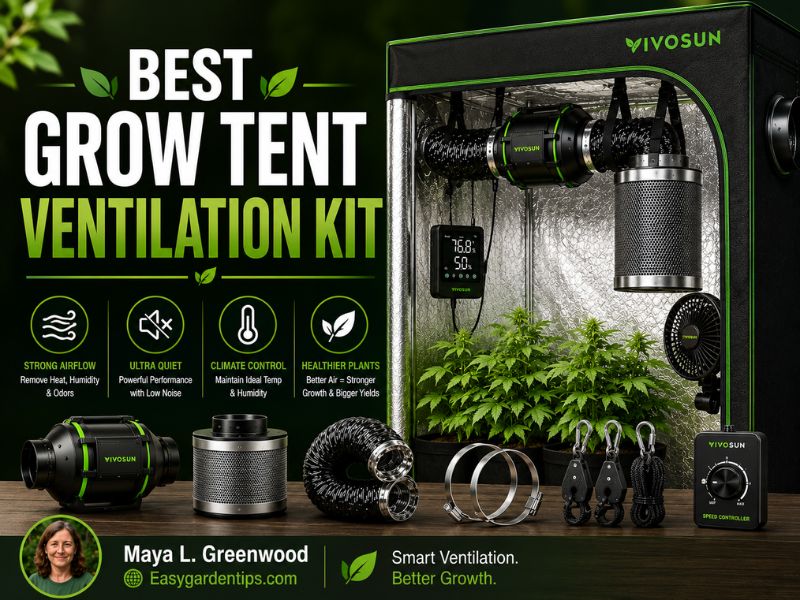
My first recommendation is the VIVOSUN AeroZesh T6 6-Inch Air Filtration Kit. It combines a 408-CFM PWM-controlled EC fan, E12 speed controller, activated-carbon filter, and 8 feet of matching ducting. Its combination of strong Amazon customer confidence and practical specifications gives it the top position in this five-product comparison.
The AC Infinity CLOUDLINE LITE 6-Inch Air Filtration Kit is the other product I would consider first. Its maximum airflow is lower at 352 CFM, but it pairs strong customer feedback with a 10-speed controller, 1200+ IAV activated-carbon filter, and an unusually generous 25-foot duct section.
Growers who specifically want Wi-Fi environmental automation should also look closely at the VIVOSUN G6 Smart kit. Spider Farmer and MARS HYDRO round out the group with complete 6-inch systems that combine carbon filtration with controlled EC fans.
5 Best Grow Tent Ventilation Kits
| Image | Product Name | Check Price |
|---|---|---|
Best Choice | VIVOSUN AeroZesh T6 6-Inch Air Filtration Kit | Check Price |
Second Best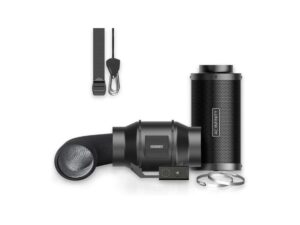 | AC Infinity CLOUDLINE LITE 6-Inch Air Filtration Kit | Check Price |
Third Choice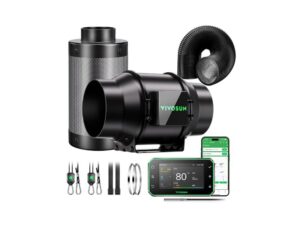 | VIVOSUN AeroZesh G6 Smart Air Filtration PRO Kit | Check Price |
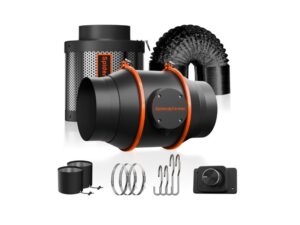 | Spider Farmer 6-Inch Air Filtration Kit | Check Price |
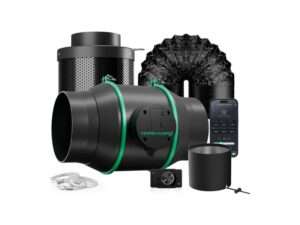 | MARS HYDRO iFresh 6-Inch Air Filtration Kit | Check Price |
I selected and ordered these kits using current Amazon customer feedback together with the specifications that matter in a real tent:
- Inline-fan airflow
- EC/PWM motor control
- Carbon-filter construction
- Controller features
- Noise
- Ducting length
- Installation completeness
- Compatibility with common tent sizes
- Environmental automation
All five are complete systems rather than bare inline fans.
1. VIVOSUN AeroZesh T6 6-Inch Air Filtration Kit
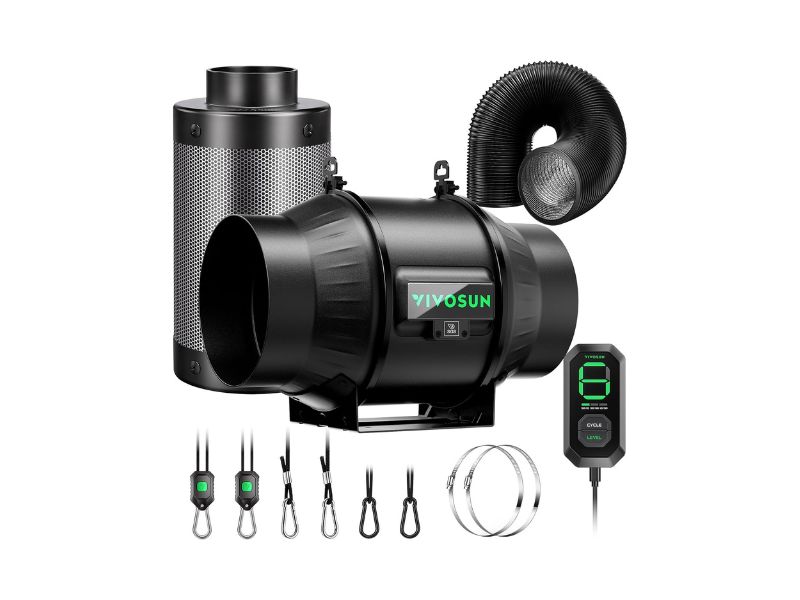
Key Features
- 6-inch AeroZesh T6 EC inline fan
- Up to 408 CFM
- E12 PWM controller
- Ten fan speeds
- 1200+ IAV activated-carbon filter
- 38 mm carbon bed
- 8 feet of 6-inch ducting
The AeroZesh T6 is the strongest all-around choice because it provides substantial airflow without sacrificing adjustability.
VIVOSUN rates the 6-inch T6 at 408 CFM and uses a PWM-controlled EC motor with a mixed-flow design. The included E12 controller provides ten fan speeds, memory, and cycling modes, so you can reduce airflow when the tent is cool and increase it when environmental conditions demand more exhaust.
The kit also includes a 6-inch carbon filter using RC 412 Australian virgin charcoal rated at 1200+ IAV. Its 38 mm carbon bed is paired with matching ducting and clamps, eliminating most of the compatibility questions that come with assembling a filtration system from separate components.
The T6 is particularly attractive for a 4×4 because it gives you enough airflow overhead to deal with a filter and duct resistance while still letting you turn the fan down.
What I Like
- Strong 408-CFM maximum airflow
- Ten selectable fan speeds
- Efficient EC/PWM motor
- Matching filter, duct, and clamps included
What I Do Not Like
- E12 control is simpler than a full Wi-Fi environmental controller
- Eight feet of duct may be limiting for a long exhaust route
The T6 is the kit I would start with when I want powerful but adjustable ventilation without paying primarily for advanced automation.
2. AC Infinity CLOUDLINE LITE 6-Inch Air Filtration Kit
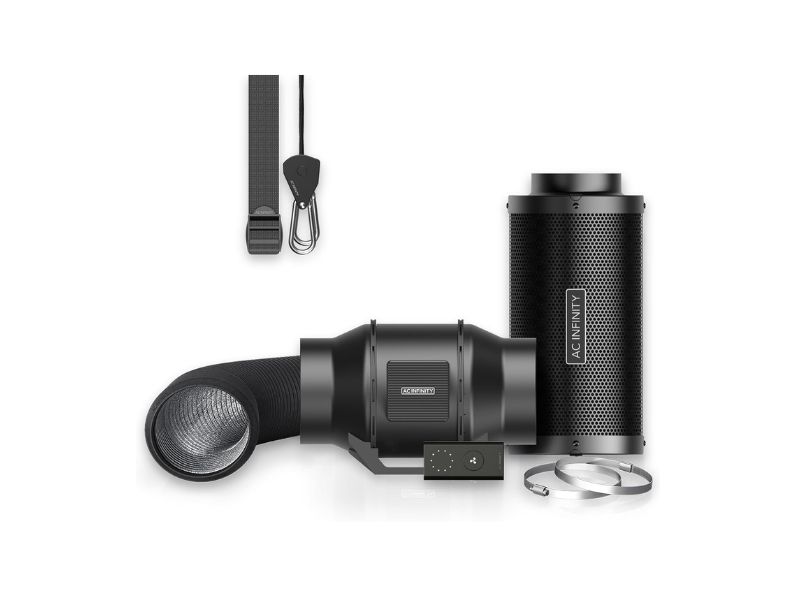
Key Features
- 6-inch CLOUDLINE inline fan
- 352-CFM airflow
- 10-speed controller
- 1200+ IAV activated charcoal
- 38 mm carbon bed
- 25 feet of four-layer ducting
- Hanging and connection hardware
The AC Infinity kit ranks second because its airflow figure is more modest than the T6, but the overall package is exceptionally well balanced.
AC Infinity specifies 352 CFM and about 34 dBA for this 6-inch configuration. Its mixed-flow fan is designed to maintain useful airflow in restrictive duct systems, while the included ten-speed controller makes it easy to match output to the tent instead of running a single fixed speed.
The carbon filter uses 1200+ IAV Australian virgin charcoal and includes a pre-filter. AC Infinity also supplies 25 feet of flexible ducting, which is far more generous than many kits and can be useful when the exhaust destination is several feet away from the tent.
The lower maximum CFM may actually be perfectly appropriate for smaller and medium tents where noise and controlled airflow matter more than the highest possible specification.
What I Like
- Excellent customer confidence
- Ten-speed control
- Long 25-foot duct section
- High-grade activated-carbon filter
What I Do Not Like
- Lower maximum airflow than several competing 6-inch fans
- Standard speed controller lacks the automation of AC Infinity’s higher-end controller kits
This is an excellent choice for growers who prioritize quiet, straightforward ventilation and a well-matched filtration package.
3. VIVOSUN AeroZesh G6 Smart Air Filtration PRO Kit
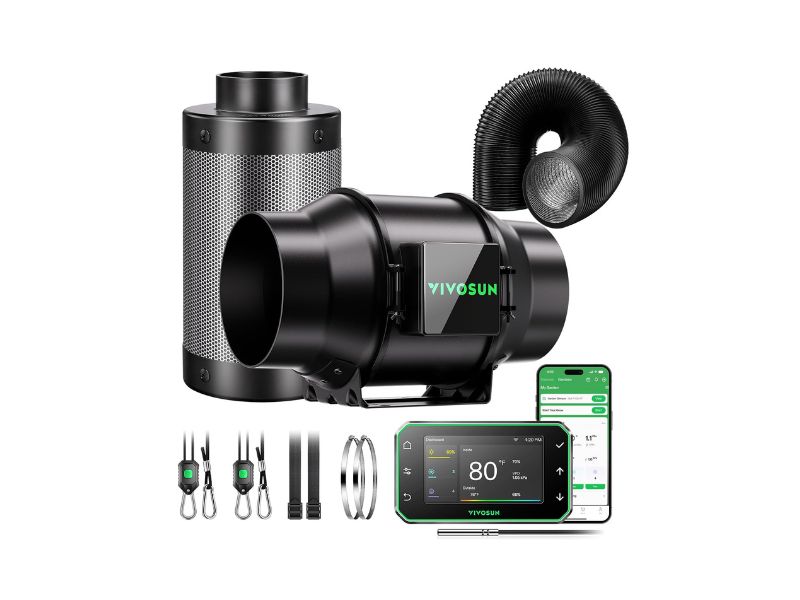
Key Features
- 6-inch AeroZesh G6 fan
- 388-CFM maximum airflow
- GrowHub E42A+ controller
- Wi-Fi and app connectivity
- Temperature and humidity monitoring
- VPD monitoring
- 1200+ IAV carbon filter
- 8-foot duct section
The G6 Smart kit is aimed at the buyer who wants ventilation to react automatically instead of manually changing fan speed throughout the day.
Its EC inline fan is rated at 388 CFM, slightly below the T6, but the GrowHub E42A+ controller is significantly more advanced. It can monitor temperature, humidity, and VPD and connect through Wi-Fi for app-based control and environmental monitoring.
The filtration side is equally complete. VIVOSUN uses a 38 mm carbon bed with 1200+ IAV activated charcoal and includes matching 6-inch ducting.
The real reason to select the G6 over the T6 is not airflow. It is automation.
If your temperature and humidity vary considerably during the day, a controller that changes fan behavior automatically can be much more useful than constantly adjusting a manual setting.
What I Like
- Smart temperature and humidity control
- Wi-Fi remote access
- VPD monitoring
- Strong 388-CFM airflow
What I Do Not Like
- More expensive and complicated than basic ventilation needs require
- T6 provides slightly more raw airflow
Choose the G6 Smart when environmental automation matters more than squeezing out the highest CFM figure.
4. Spider Farmer 6-Inch Air Filtration Kit
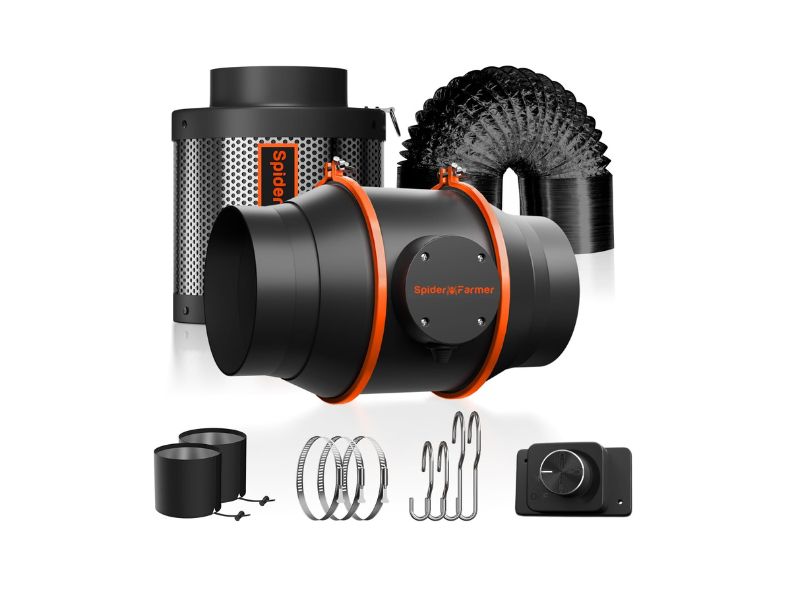
Key Features
- 6-inch EC inline fan
- 402-CFM airflow
- 32 dBA specified noise
- RJ12-compatible speed control
- 1200+ activated-carbon filter
- 13 feet of ducting
- Pre-filter and mounting hardware
Spider Farmer’s 6-inch system provides strong specifications without straying far from the proven fan-filter-duct layout.
The EC fan is rated at 402 CFM and approximately 32 dBA. Spider Farmer’s current platform also supports RJ12 connectivity, allowing the fan to work with compatible GGS control equipment if you want to expand beyond simple manual speed adjustment.
A matching carbon filter, pre-filter, clamps, hanging hardware, and approximately 13 feet of ducting make the kit substantially more complete than purchasing only the fan.
The extra duct length is useful if the fan and exhaust outlet are not mounted directly beside each other.
What I Like
- Strong 402-CFM airflow
- Efficient EC motor
- Generous duct length
- Expandable controller compatibility
What I Do Not Like
- Controller ecosystem is less intuitive for some users than a simple standalone control
- Smart environmental control requires the correct compatible controller
The Spider Farmer is a good choice when you want strong 6-inch performance with the option to expand the control system later.
5. MARS HYDRO iFresh 6-Inch Air Filtration Kit
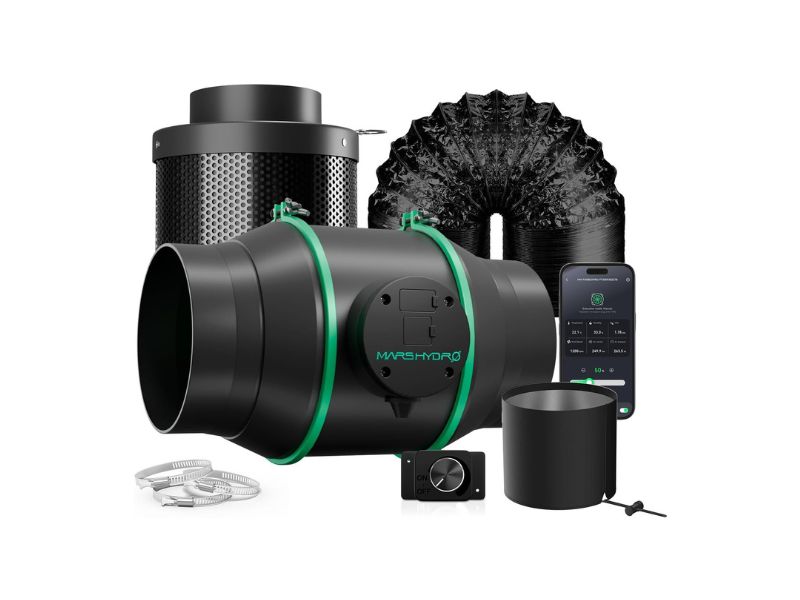
Key Features
- 6-inch iFresh EC inline fan
- Up to 402 CFM
- Approximately 32 dBA
- RJ12 control connection
- Carbon filter
- 13 feet of ducting
- Compatible smart-control ecosystem
MARS HYDRO completes the list with another capable 402-CFM 6-inch system.
The iFresh uses a PWM-controlled EC motor and mixed-flow design, with MARS HYDRO specifying 402 CFM maximum airflow at around 32 dBA. The current system supports its smart-control platform through compatible RJ12 hardware, enabling features such as environmental monitoring, triggers, and scheduled operation when paired with the appropriate controller.
The included carbon filter and long duct section make it suitable for a complete medium-tent exhaust setup rather than requiring several additional purchases.
Its position at number five reflects a smaller current Amazon feedback base compared with the products above, not weak technical specifications.
What I Like
- Strong 402-CFM output
- Efficient EC motor
- Long ducting
- Smart-control expansion capability
What I Do Not Like
- Less Amazon feedback history than the leading kits
- Smart features depend on compatible controller hardware
The iFresh is worth considering when you already use MARS HYDRO equipment or want a 402-CFM fan-filter package with room for later automation.
Grow Tent Ventilation Kit Comparison
| Product | Fan Size | Max Airflow | Control Style | Ducting | Main Strength |
| VIVOSUN AeroZesh T6 | 6 in. | 408 CFM | 10-speed PWM | 8 ft. | Strong balance of airflow and control |
| AC Infinity CLOUDLINE LITE | 6 in. | 352 CFM | 10-speed | 25 ft. | Quiet, complete, long duct run |
| VIVOSUN G6 Smart | 6 in. | 388 CFM | Wi-Fi environmental control | 8 ft. | Advanced automation |
| Spider Farmer 6-Inch | 6 in. | 402 CFM | Speed/RJ12 expandable | 13 ft. | Strong airflow and flexibility |
| MARS HYDRO iFresh | 6 in. | 402 CFM | RJ12/smart expandable | 13 ft. | Powerful smart-ready platform |
A difference of 10 or 20 CFM should not decide the purchase by itself.
The actual airflow reaching your tent depends heavily on the carbon filter, duct length, duct shape, fan speed, and intake restriction.
What a Grow Tent Ventilation Kit Actually Does
A complete ventilation system normally performs three primary jobs.
Removes Warm and Humid Air
Grow lights, pumps, controllers, and the plants themselves affect temperature and humidity.
The inline fan continuously or periodically removes that air from the enclosure.
Draws Fresh Replacement Air Into the Tent
When the fan removes air, replacement air enters through passive vents or an active intake.
That process is called air exchange.
Filters Exhaust Air
When odor control is required, the exhaust air passes through an activated-carbon filter before leaving the tent.
The fan therefore has to do more than move free air. It also has to overcome the resistance of the filter and ducting.
Inline Fan vs Ordinary Fan
An inline duct fan is not the same as an oscillating circulation fan.
Inline Fan
The inline fan connects to ducting and exchanges air between the tent and the surrounding environment.
Its jobs include:
- Temperature control
- Humidity removal
- Fresh-air exchange
- Carbon-filter airflow
- Negative pressure
Circulation Fan
A circulation fan moves air inside the enclosure.
It prevents stagnant pockets around the foliage.
A strong inline fan cannot replace proper internal circulation because air can still take the shortest route from intake to exhaust without moving evenly through a dense canopy.
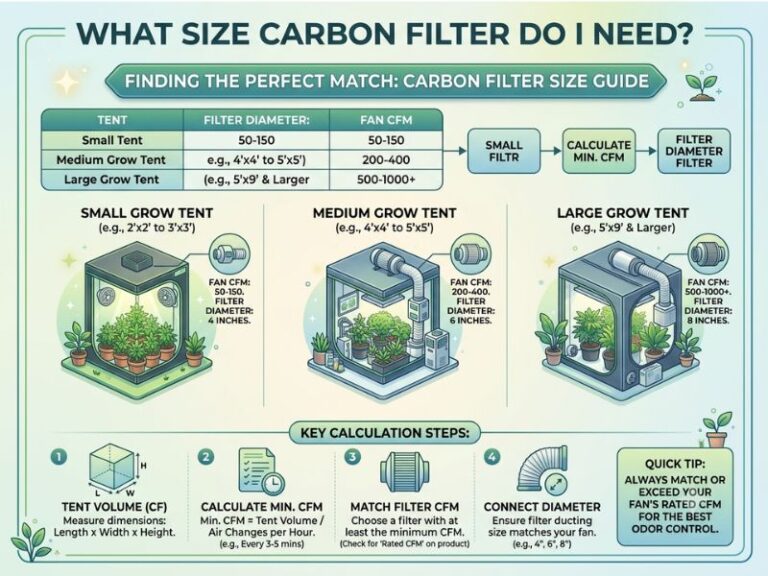
What Size Ventilation Kit Do You Need?
The most common choices for small and medium tents are 4-inch and 6-inch kits.
4-Inch Ventilation Kit
A quality 4-inch system can work well for:
- 2×2 tents
- 2×3 tents
- 2×4 tents
- Smaller 3×3 setups
These systems are physically compact and usually easier to mount in short tents.
6-Inch Ventilation Kit
A 6-inch system is a more flexible choice for:
- 3×3 tents with higher heat loads
- 4×4 tents
- 5×5 tents
- Longer duct runs
- Carbon-filter setups requiring more pressure capability
A variable-speed 6-inch fan can also operate in a smaller enclosure.
You do not need to run a 400-CFM fan at 400 CFM all the time.
Is a 6-Inch Fan Too Powerful for a Small Tent?
Not if it has good speed control.
A fixed high-output fan can create excessive negative pressure and noise.
A PWM-controlled EC fan can run at a fraction of its maximum output.
That makes an adjustable 6-inch model surprisingly versatile.
A larger fan at reduced speed can sometimes be quieter than forcing a smaller fan to operate near maximum continuously.
How to Calculate Grow Tent Volume
Multiply:
Length × Width × Height
For a 4×4 tent that is about 6.67 feet tall:
4 × 4 × 6.67 ≈ 107 cubic feet
For a 5×5 tent at the same height:
5 × 5 × 6.67 ≈ 167 cubic feet
This gives you the raw internal air volume.
It is only the starting point.
Why You Cannot Size the Fan From Tent Volume Alone
Suppose a 4×4 contains roughly 107 cubic feet.
That does not mean a 107-CFM fan is automatically enough.
The completed ventilation system may include:
- Carbon filter
- Ten feet of ducting
- Two 90-degree bends
- Restricted intake vents
Each component makes it harder for air to move.
The actual airflow at the tent can therefore be substantially lower than the fan’s free-air CFM specification.
This is why airflow overhead and speed control are useful.
What Does CFM Mean?
CFM means cubic feet per minute.
A fan rated at 400 CFM can theoretically move 400 cubic feet of air per minute under its specified test conditions.
In an actual tent, airflow is lower once the system adds resistance.
CFM is useful for comparing fan capacity, but it should never be read as a guarantee of completed-system airflow.
What Is Static Pressure?
Static pressure describes resistance to airflow in a duct system.
Carbon filters create static pressure because air must travel through the activated-carbon bed.
Ducting adds more resistance.
Sharp bends add even more.
Mixed-flow inline fans are useful because their fan architecture is designed for ducted applications where resistance is present rather than only moving unrestricted room air. AC Infinity specifically emphasizes the restrictive-application performance of its CLOUDLINE design.
Carbon Filter Basics
Activated carbon works through adsorption.
Odor molecules attach to the large internal surface area of the carbon as air passes through it.
This is different from simple mechanical filtration.
The filter therefore needs enough quality carbon and sufficient contact time to treat the moving air.
Several of the kits in this guide use activated carbon rated at 1200+ IAV, including the selected VIVOSUN and AC Infinity configurations.
Do You Need a Carbon Filter?
Not every grow tent requires one.
A carbon filter is useful when you specifically need odor reduction.
If odor control is unnecessary, the inline fan can exhaust air without a carbon filter.
Removing the filter reduces resistance and may increase effective airflow.
The ventilation function and odor-control function are related but not identical.
What Is a Carbon Pre-Filter?
The fabric sleeve covering many carbon filters is the pre-filter.
It catches larger contaminants such as:
- Dust
- Hair
- Debris
before they reach the carbon bed.
This helps protect airflow through the filter.
The pre-filter should be checked and cleaned according to the manufacturer’s instructions rather than being ignored until airflow noticeably declines.
Does High Humidity Affect a Carbon Filter?
It can.
Very humid air can reduce practical activated-carbon performance because moisture competes for available surface area.
This is another reason grow-tent humidity management matters.
A carbon filter is not a substitute for controlling excessive moisture in the enclosure.
Where Should the Carbon Filter Go?
The most common location is near the top of the tent.
A typical system is:
Carbon filter → inline fan → exhaust duct
This arrangement pulls tent air through the carbon before sending it out of the enclosure.
Mounting the filter overhead also preserves valuable floor space.
Make sure the tent’s support bars are designed to carry the combined filter and fan weight.
Can the Inline Fan Go Outside the Tent?
Yes.
External mounting can free overhead space.
One possible layout is:
Filter inside tent → duct → fan outside tent → exhaust
This can be useful in short tents where the light and filter already occupy much of the vertical space.
The tradeoff is potentially longer ducting.
Longer ducting creates more resistance.
Why Duct Length Matters
Long flexible duct creates more friction than a short direct route.
You may also need to route it around:
- Walls
- Lights
- Shelving
- Windows
- Ceiling structures
The AC Infinity kit’s 25-foot duct section is especially convenient when the exhaust point is far from the tent.
However, having 25 feet available does not mean you should automatically use all 25 feet.
Use only what the installation requires.
Why Sharp Duct Bends Are Bad
Every sharp turn increases resistance and turbulence.
A tightly crushed 90-degree bend can hurt airflow more than a smooth gradual curve.
For better performance:
- Keep ducting short
- Avoid crushing it
- Minimize tight bends
- Remove unnecessary loops
- Keep connections properly sealed
A cleaner duct path may improve real airflow more than buying a fan with slightly more advertised CFM.
Understanding Negative Pressure
A tent develops negative pressure when more air is being exhausted than actively supplied.
The fabric walls pull slightly inward.
This is usually normal.
Negative pressure helps ensure that air enters through designated intakes and leaves through the exhaust path.
Too Much Negative Pressure
If the walls collapse dramatically, the fan may be running faster than necessary.
Possible fixes include:
- Lowering fan speed
- Opening more passive intake area
- Removing intake obstructions
Extreme negative pressure wastes usable tent space and can make zippers harder to operate.
Passive Intake vs Active Intake
Passive Intake
Most small and medium grow tents can use passive intake.
The exhaust fan creates suction, and fresh air enters through lower vents.
Advantages:
- Simple
- Quiet
- Fewer electrical devices
- Easier balancing
Active Intake
An active intake adds another powered fan.
It may become useful when:
- The tent is very large
- Intake ducting is long
- Intake openings are highly restrictive
- The room layout requires forced air delivery
The exhaust system should normally remain strong enough to maintain the desired pressure relationship.
Best Ventilation Kit Size for a 2×2 Tent
A 4-inch kit is generally the more sensible starting point.
A 6-inch EC system can work if it is heavily speed-controlled, but the larger physical filter and fan may consume unnecessary overhead room.
For a compact 2×2, equipment size matters almost as much as airflow.
Best Ventilation Kit Size for a 2×4 Tent
Both 4-inch and 6-inch systems can work.
Use a 4-inch setup when:
- Heat load is moderate
- Ducting is short
- Compact equipment is important
Use a 6-inch setup when:
- The light produces more heat
- A restrictive filter is installed
- The exhaust path is long
- You want airflow headroom
Best Ventilation Kit Size for a 3×3 Tent
A strong 4-inch fan may be sufficient.
A speed-controlled 6-inch fan provides greater flexibility.
If you expect to upgrade to a larger tent later, buying a quality 6-inch system once can make more sense than replacing an undersized ventilation kit in the future.
Best Ventilation Kit Size for a 4×4 Tent
A 6-inch variable-speed kit is my preferred starting point for most complete 4×4 environments.
The products in this article provide roughly 350–408 CFM at maximum output.
That leaves plenty of adjustment range for the resistance caused by a carbon filter and ducting.
Best Ventilation Kit Size for a 5×5 Tent
A quality 6-inch EC kit can work well in many 5×5 tents.
However, consider:
- Light heat output
- Room temperature
- Filter resistance
- Duct length
- Humidity load
A heavily equipped 5×5 in a warm room may require more ventilation than a lightly equipped tent in a cool basement.
Manual Speed Controller vs Smart Controller
Manual or Basic Controller
Advantages:
- Simple
- Easy to understand
- Fewer settings
- Quick adjustment
The VIVOSUN T6 and AC Infinity standard kit both work well for growers who simply want several fan speeds without turning the exhaust system into a full automation platform.
Smart Environmental Controller
Advantages:
- Temperature-based automation
- Humidity-based automation
- Scheduling
- Remote monitoring
- Data logging on some platforms
- VPD features on compatible systems
The VIVOSUN G6 Smart is the clearest example in this group.
Its GrowHub controller monitors environmental conditions and can be adjusted through a Wi-Fi-connected app.
Do You Need Wi-Fi Ventilation Control?
No.
Plants do not care whether the fan is connected to Wi-Fi.
Wi-Fi is useful for the grower.
It can help when you want to:
- Check temperature remotely
- Check humidity remotely
- Adjust settings away from the tent
- Receive alerts
- Review environmental trends
If you visit the tent several times every day and prefer manual controls, Wi-Fi may add little practical value.
Understanding Fan Noise
Fan noise comes from more than the motor.
You may hear:
- Motor noise
- Moving air
- Turbulence
- Flexible duct vibration
- Carbon-filter airflow
- Tent-frame vibration
The 6-inch fans here generally fall into a relatively quiet EC-fan category, with several manufacturers specifying noise around the low-30-dBA range under their test conditions.
Actual sound in your room may be different.
How to Make a Grow Tent Ventilation System Quieter
Reduce Fan Speed
This is often the biggest improvement.
If the tent remains within the desired environmental range at 50% fan speed, there is no reason to run 100%.
Straighten the Ducting
Air turbulence creates noise.
Smooth bends help.
Tighten Connections
Loose duct sections can vibrate or rattle.
Use Hanging Straps
Suspending the fan rather than rigidly mounting it to a resonant surface can reduce transferred vibration.
Avoid Unnecessary Restrictions
A blocked intake forces the fan to work against additional pressure.
How to Install a Grow Tent Ventilation Kit
1. Identify Airflow Direction
Look for the airflow arrow on the fan housing.
Do this before hanging the fan.
2. Hang the Carbon Filter
Mount the filter high in the tent when using the common internal-filter configuration.
3. Connect the Inline Fan
Use a direct connection or the shortest practical duct section between the filter and fan.
4. Install the Exhaust Duct
Route the fan outlet through an upper tent port.
5. Tighten the Clamps
Loose joints can allow unfiltered air to bypass the intended route.
6. Open an Intake
Open enough lower intake area to let replacement air enter.
7. Install the Controller Probe
If the system uses temperature and humidity sensing, place the probe around canopy height.
8. Start at Moderate Speed
Do not automatically use maximum power.
9. Check Negative Pressure
A slight inward pull is fine.
Heavy wall collapse means airflow balance needs adjustment.
10. Watch Temperature and Humidity
Make fan changes according to measurements rather than guesswork.
Where Should the Temperature and Humidity Probe Go?
Place it near the active plant canopy.
Avoid:
- Direct humidifier mist
- Direct fan airflow
- Exhaust openings
- Intake vents
- Hot light drivers
- Tent walls
You want the reading to represent the conditions the leaves experience.
As the plants grow, move the sensor upward with the canopy.
Ventilation and Temperature Control
An exhaust fan can only remove warm tent air and replace it with the intake air available outside the enclosure.
If the bedroom is 85°F, the ventilation system cannot create 70°F intake air.
This is why the surrounding room matters.
Ventilation is most effective when the room itself has manageable temperature.
If the surrounding room remains hot, air conditioning may need to address the room rather than forcing the inline fan to run faster indefinitely.
Ventilation and Humidity Control
Plants release water vapor through transpiration.
As plant size increases, the humidity load can rise substantially.
Increasing exhaust airflow can help when the surrounding room is drier than the tent.
However, if the basement or room itself is extremely humid, bringing more of that air into the tent may not solve the problem.
A dehumidifier may need to condition the room supplying intake air.
Does Ventilation Control VPD?
Ventilation influences temperature and relative humidity, which in turn affect vapor pressure deficit (VPD).
The inline fan does not directly “create” a VPD level.
It helps adjust two of the environmental variables involved.
Advanced controllers such as VIVOSUN’s GrowHub can display or respond to VPD-related information, making it easier to coordinate ventilation with the rest of the environment.
Common Mistakes When Choosing a Grow Tent Ventilation Kit
Buying Only by Maximum CFM
Real airflow after a filter and ducting is lower than unrestricted fan output.
Buying a Fan That Cannot Be Adjusted
Variable-speed control makes one ventilation kit useful across more conditions.
Using a Tiny Fan With Long Ducting
Static pressure and friction can reduce effective airflow substantially.
Oversizing Without Speed Control
An oversized fixed-speed fan can create unnecessary noise and negative pressure.
Blocking Intake Vents
Keep pots and equipment away from lower air openings.
Using Too Many 90-Degree Bends
Simplify ducting whenever possible.
Forgetting Internal Air Circulation
Inline exhaust and canopy circulation solve different problems.
Hanging the Probe Beside the Exhaust
This can produce misleading environmental readings.
Ignoring the Carbon Pre-Filter
A dirty pre-filter can restrict airflow.
Assuming the Carbon Filter Lasts Forever
Activated carbon eventually loses odor-control effectiveness.
Exhausting Into an Already Hot Room
The tent depends on the room surrounding it.
Buying a 4-Inch System Only Because It Is Cheaper
If you later move to a 4×4 or 5×5, replacing the entire ventilation platform may cost more than buying an adjustable 6-inch system initially.
Frequently Asked Questions
1. What is the best grow tent ventilation kit?
VIVOSUN AeroZesh T6 is my first choice for a balanced complete system because it combines strong airflow, ten-speed control, carbon filtration, and matching ducting.
AC Infinity’s 6-inch kit is the strongest alternative when you value a highly refined fan-filter package and long duct section, while VIVOSUN G6 Smart makes more sense when Wi-Fi environmental control is the priority.
2. What should a complete ventilation kit include?
Look for an inline fan, compatible carbon filter, controller, ducting, clamps, pre-filter, and mounting hardware.
Buying the pieces together helps ensure that the primary fan, filter, and duct diameters match.
3. Is a 4-inch or 6-inch ventilation kit better?
A 4-inch system is ideal for many small tents, while a variable-speed 6-inch system provides more flexibility for medium tents and restrictive duct layouts.
The best choice depends on tent volume, heat, filter resistance, and duct length rather than fan diameter alone.
4. What size ventilation kit should I use for a 2×2?
A quality 4-inch system is usually the most practical choice for a 2×2.
The smaller fan and filter occupy less overhead space. A 6-inch EC system can work if speed is reduced substantially, but it is physically larger than most 2×2 setups require.
5. What size ventilation kit works for a 2×4?
A 4-inch fan can handle many 2×4 setups, while a controlled 6-inch fan gives additional capacity for heat, filters, and longer ducts.
If you expect to move to a larger tent later, a 6-inch system may offer better long-term flexibility.
6. What size ventilation kit is good for a 3×3?
A strong 4-inch or variable-speed 6-inch kit can both work well in a 3×3.
Choose according to lighting heat and system resistance. A 6-inch model provides more headroom without needing to run at maximum speed.
7. What size ventilation kit is best for a 4×4?
A 6-inch variable-speed inline fan is an excellent starting point for most complete 4×4 systems.
The five kits reviewed here provide roughly 350–408 CFM of maximum capacity, which leaves useful adjustment range after a filter and ducting are installed.
8. Is a 6-inch fan enough for a 5×5?
Often yes, especially with a high-quality EC fan around the 400-CFM class, but actual requirements depend on heat and airflow restrictions.
A hot 5×5 with a long duct route may require more airflow than a cool tent using a short straight exhaust.
9. Does a carbon filter reduce airflow?
Yes. Air has to pass through the activated-carbon bed, creating resistance that reduces completed-system airflow.
That is normal and should be considered when selecting the fan.
10. Do I need a carbon filter in my grow tent?
Only when odor control is needed.
Ventilation can operate without carbon filtration. Removing the filter reduces resistance but also removes its odor-adsorption function.
11. Should the carbon filter be inside the tent?
Mounting it near the top inside the tent is the most common configuration.
This preserves floor space and allows warm upper air to be pulled through the filter before leaving the enclosure.
12. Can the inline fan be outside the tent?
Yes. External fan mounting can free valuable overhead space.
Keep the duct route short and secure because extra duct length and bends can reduce airflow.
13. Should grow tent walls pull inward?
A slight inward pull is normal and shows that the tent is operating under negative pressure.
If the walls collapse severely, lower the exhaust setting or provide more intake area.
14. Do I need an intake fan?
Most small and medium tents can use passive intake openings instead of a second fan.
Active intake is more useful for large tents or installations where the intake path is long or restrictive.
15. Do I still need circulation fans?
Yes. An inline fan exchanges tent air, while circulation fans move air through the canopy.
Using both helps prevent stagnant pockets around foliage.
16. Are smart grow tent fan controllers worth it?
They can be very useful when temperature and humidity change throughout the day.
Smart systems can automatically adjust fan operation instead of requiring repeated manual speed changes. VIVOSUN’s G6 Smart kit adds Wi-Fi monitoring, temperature and humidity sensing, and VPD functionality.
17. How can I make my inline fan quieter?
Run only as fast as necessary, reduce sharp duct bends, secure loose ducting, and isolate fan vibration from rigid surfaces.
EC fans are particularly useful because they retain precise speed control instead of forcing all-or-nothing operation.
18. How often should I replace the carbon filter?
Replace it when odor control noticeably declines after confirming that the pre-filter is clean and all duct connections are properly sealed.
Actual service life depends on humidity, airflow, odor load, dust, and runtime rather than one universal replacement interval.
Conclusion
The best grow tent ventilation kit should give you enough airflow to handle real-world restrictions while still allowing the fan to run quietly and efficiently when maximum output is unnecessary.
VIVOSUN AeroZesh T6 takes the first position because its 408-CFM EC fan, ten-speed E12 controller, 1200+ IAV carbon filter, and matching 6-inch ducting provide an excellent balance for medium grow tents. It has enough airflow overhead for a carbon-filter setup without forcing the buyer into a complicated smart-control platform.
AC Infinity CLOUDLINE LITE is my next choice when refined construction, strong customer confidence, and a generous 25-foot duct section matter most. VIVOSUN G6 Smart is the better fit when you want Wi-Fi environmental automation, while Spider Farmer and MARS HYDRO provide strong 402-CFM alternatives with expandable control systems.
For very small 2×2 or 2×4 tents, a 4-inch system can still be the more efficient choice. For many 3×3, 4×4, and 5×5 setups, however, a variable-speed 6-inch EC fan gives you much more room to adapt.
Whatever kit you choose, keep the duct route short, minimize sharp bends, provide adequate intake area, and place environmental sensors near the canopy. Good ventilation is not about running the biggest fan at full power—it is about maintaining steady temperature, humidity, air exchange, and filtration with the least unnecessary noise and resistance.

I’m Maya L. Greenwood, a lifelong plant lover who believes anyone can grow something beautiful with the right guidance. After years of testing soil mixes, pruning methods, irrigation tricks, and pest-safe solutions, I started EasyGardenTips.com to turn hard-won lessons into step-by-step advice. From seed starting and container gardens to composting and seasonal checklists, my goal is to make gardening simple, sustainable, and fun.