Best LED Grow Light for 5×5 Tent: 5 Full-Canopy LED Systems
A 5×5 tent is where grow-light selection becomes a full-canopy engineering decision rather than a simple wattage comparison. The fixture must illuminate 25 square feet, maintain usable intensity near four distant corners, fit around ventilation equipment, and avoid creating an unmanageable heat load.
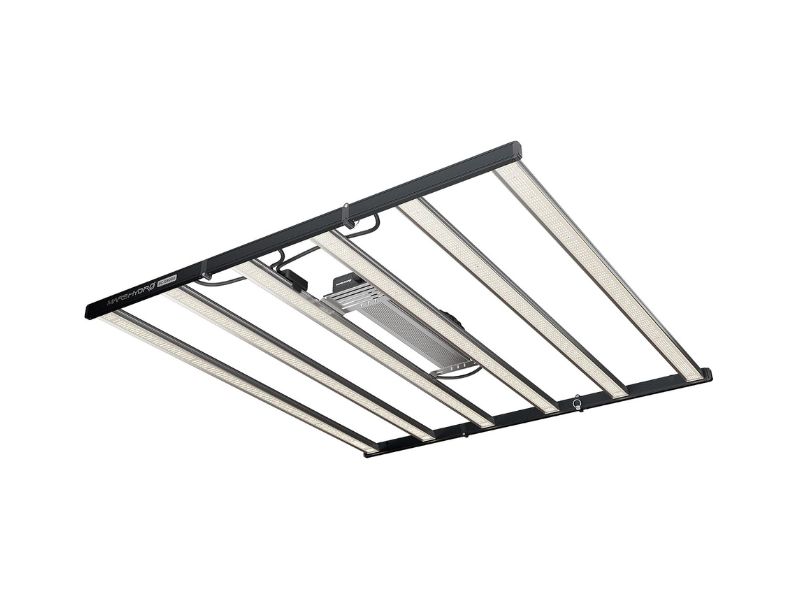
My primary recommendation is the Mars Hydro FC-E8000 800W LED Grow Light. Its foldable bar-style frame, 800-watt output, 5×5 coverage, dimming system, and high total photon output provide a strong combination of intensity and physical distribution for a fully occupied tent.
The Spider Farmer G8600 offers similar power with integrated wireless controls, while the AC Infinity IONFRAME EVO8 emphasizes premium diodes, scheduling, and removable-driver heat management. Growers who prefer a lower electrical load can consider the 650-watt VIVOSUN VSFD6500 or Spider Farmer SF7000.
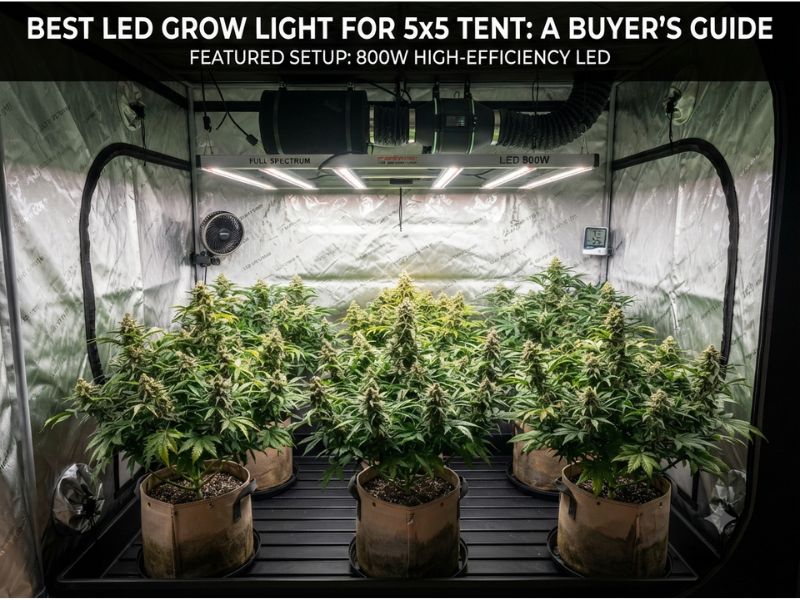
The best LED grow light for 5×5 tent use should provide enough output for the complete canopy without forcing the center plants to absorb far more light than the edges. Fixture geometry, dimming, photon efficacy, driver placement, room temperature, and available circuit capacity are therefore as important as maximum wattage.
5 Best LED Grow Lights for a 5×5 Tent
| Image | Product Name | Check Price |
|---|---|---|
Best Choice | Mars Hydro FC-E8000 800W LED Grow Light | Check Price |
Second Best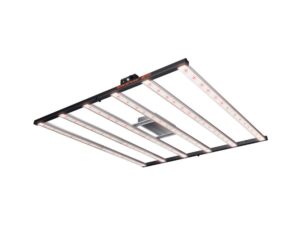 | Spider Farmer G8600 800W LED Grow Light | Check Price |
Third Choice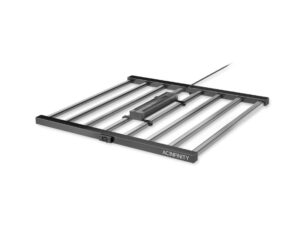 | AC Infinity IONFRAME EVO8 730W LED Grow Light | Check Price |
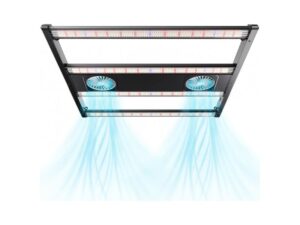 | VIVOSUN VSFD6500 650W LED Grow Light | Check Price |
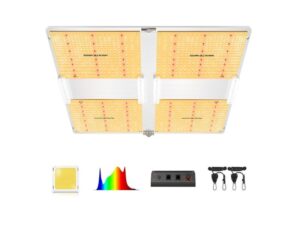 | Spider Farmer SF7000 650W LED Grow Light | Check Price |
1. Mars Hydro FC-E8000 800W LED Grow Light
Key Features
- 800W actual power draw
- Approximately 2.8 µmol/J photon efficacy
- Approximately 2,240 µmol/s PPF
- 5×5 personal cultivation coverage
- Foldable multi-bar frame
- Bridgelux diodes with OSRAM deep-red supplementation
- Full-spectrum output
- Dimmable intensity
- Detachable power supply
- Optional intelligent-controller compatibility
The FC-E8000 is a high-output bar fixture designed to spread light across the complete 5×5 footprint. Its eight-bar layout places the diodes closer to the outer canopy than a compact board, helping reduce the steep center-to-corner drop associated with smaller fixtures.
An 800-watt draw equals an average of 32 watts per square foot across a 25-square-foot tent. Its listed 2.8 µmol/J efficacy and approximately 2,240 µmol/s PPF place it in a practical range for intensive full-canopy use, though the final PPFD depends on hanging height, wall reflection, and dimmer position.
The foldable frame simplifies storage and installation, while the removable driver creates more options for heat management. Full power is unnecessary for seedlings and may also be unnecessary during mature growth when the environment cannot support very high intensity.
What I Like
- Strong output for all 25 square feet
- Wide bar spacing supports uniformity
- Useful combination of Bridgelux and OSRAM diodes
- Detachable driver
- Dimmable full-cycle operation
- Foldable construction
What I Do Not Like
- Creates a substantial heat load
- Requires significant ceiling space
- Full smart functionality may require extra equipment
- High output demands careful acclimation
The FC-E8000 is my first choice for growers who intend to fill most of a 5×5 canopy and want substantial flowering headroom. Its output is powerful, but the dimmer should be treated as an essential control rather than an optional convenience.
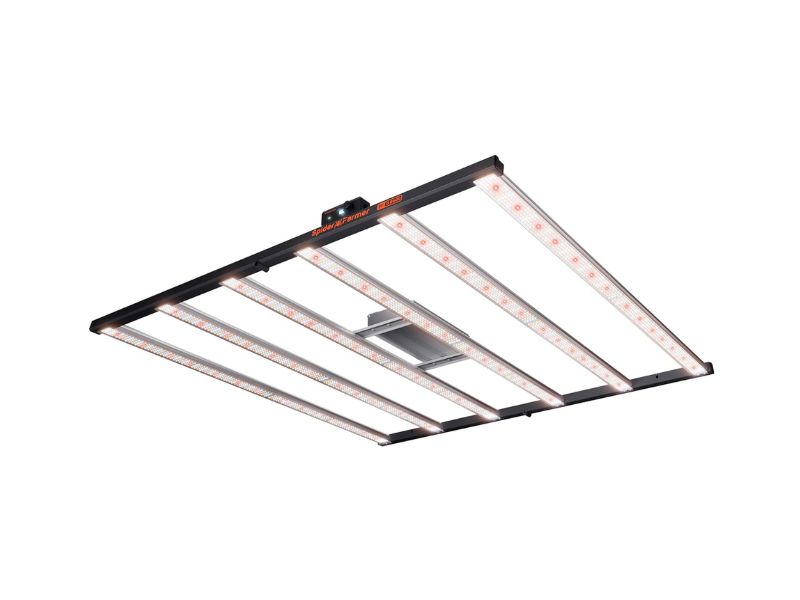
2. Spider Farmer G8600 800W LED Grow Light
Key Features
- 800W power draw
- Approximately 2.85 µmol/J PPE
- 5×5 coverage
- Bridgelux diode platform
- OSRAM 660 nm hyper-red LEDs
- Wide bar-style construction
- Wi-Fi and Bluetooth app control
- Dimmable intensity
- Full-spectrum output
- Approximately 44.17 × 45.39-inch frame
The G8600 provides the same general power class as the FC-E8000 but adds integrated wireless control. Its nearly square 44-inch frame occupies much of the tent ceiling, placing the outer bars close enough to the perimeter to support broad coverage.
The current model combines Bridgelux LEDs with OSRAM 660 nm deep-red diodes and is rated at approximately 2.85 µmol/J. Its app platform supports remote adjustment and scheduled operation through Wi-Fi or Bluetooth.
The physical distribution is well suited to a square canopy, but its large dimensions require planning around a carbon filter, ducting, suspension cables, and tent crossbars. At full output, it also requires a capable exhaust system and a room that can absorb the discharged heat.
What I Like
- Strong 5×5 physical coverage
- High 800-watt output
- Wireless scheduling and dimming
- OSRAM deep-red supplementation
- Wide, square bar layout
- Useful flowering reserve
What I Do Not Like
- Large overhead footprint
- High heat and electricity demand
- Wireless setup may be unnecessary for manual users
- Maximum intensity may exceed early-stage requirements
The G8600 is the better option when app-based control is a priority. Its power and coverage suit a dense canopy, but a smaller or partially occupied tent may not use its full capacity efficiently.
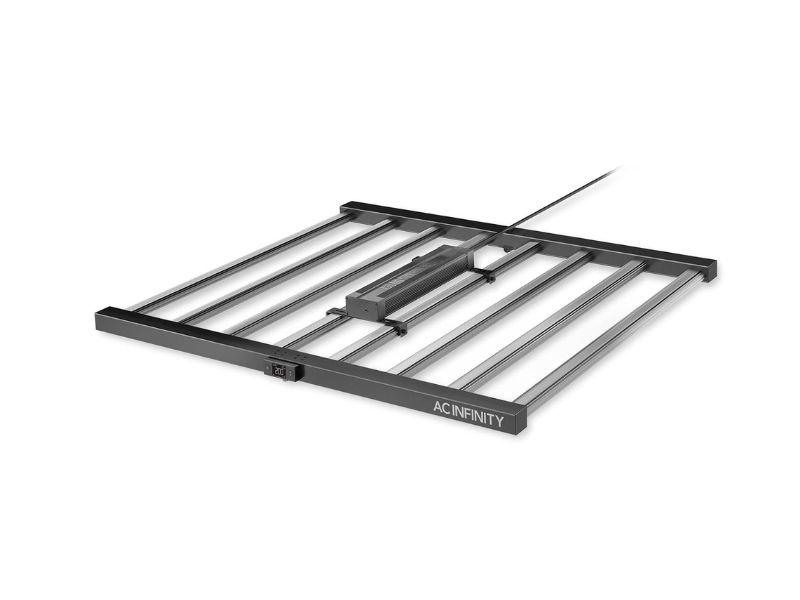
3. AC Infinity IONFRAME EVO8 730W LED Grow Light
Key Features
- 730W actual power draw
- 2,688 Samsung LM301H EVO diodes
- 5×5 flowering coverage
- 6×6 vegetative coverage
- Ten brightness levels
- Built-in schedule controller
- Sunrise and sunset dimming
- Removable driver
- UIS smart-controller compatibility
- IP65 protection
- ETL-certified construction
The IONFRAME EVO8 combines a lower power draw than the two 800-watt fixtures with a more extensive control system. Its 2,688 Samsung LM301H EVO diodes are arranged across a wide bar frame intended to limit hotspots and provide consistent 5×5 flowering coverage.
Built-in scheduling, ten brightness levels, and sunrise or sunset transitions provide repeatable operation without depending exclusively on a separate outlet timer. The removable driver can be mounted outside the tent to reduce some of the internal thermal load.
Its IP65 construction is valuable in a humid environment, while UIS compatibility allows the light to coordinate with supported ventilation and humidity equipment. The advanced platform is useful for automation-focused growers but may be excessive for a simple manually controlled tent.
What I Like
- Premium Samsung diode platform
- Lower wattage than the 800W models
- Built-in schedules and ten output levels
- Removable driver
- IP65 protection
- Environmental-system integration
What I Do Not Like
- More complex than a basic dimmer
- Ecosystem expansion can increase total cost
- Large frame still occupies substantial ceiling space
- Peak diode efficacy is not complete system efficacy
The EVO8 is the strongest option for a coordinated smart-growing environment. It offers an effective balance between 5×5 coverage, automation, safety documentation, and manageable power consumption.
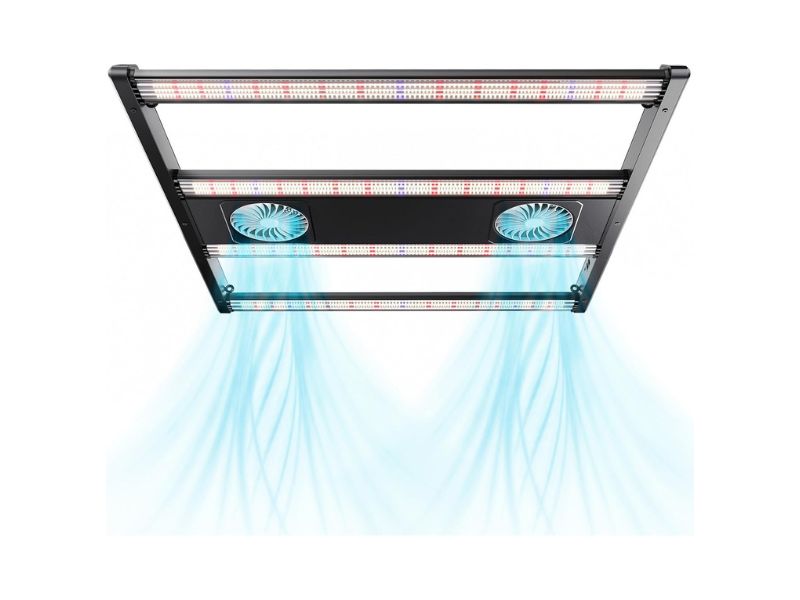
4. VIVOSUN VSFD6500 650W LED Grow Light
Key Features
- 650W actual power draw
- Approximately 2.8 µmol/J efficiency
- 5×5 coverage
- Full-spectrum output
- Foldable and detachable construction
- Manual and GrowHub dimming
- App-based adjustment from 25% to 100%
- IP65 protection
- Approximately 42.8 × 39-inch frame
- Passive cooling
The VSFD6500 is a lower-power bar fixture designed for full 5×5 coverage. Its 650-watt draw can be easier to cool than an 800-watt system while still providing substantial output for a broad canopy.
The fixture is rated at approximately 2.8 µmol/J and includes manual stepped dimming, GrowHub compatibility, app adjustment, a detachable power supply, and IP65 construction. Its frame measures approximately 42.8 by 39 inches, leaving somewhat more overhead room than several larger square fixtures.
The lower wattage may provide less maximum intensity at the far edges than a properly positioned 800-watt fixture. However, it can be a more practical choice when ambient temperature, circuit capacity, or operating cost limits the usable power.
What I Like
- Lower heat load than 800W systems
- Exact 5×5 coverage design
- IP65-sealed construction
- Manual and app-compatible controls
- Detachable power supply
- Foldable bar frame
What I Do Not Like
- Less maximum output
- Stepped manual dimming is less precise
- Smart functions require compatible hardware
- Edge intensity remains installation-dependent
The VSFD6500 is a sensible choice for growers who want a full-size bar light without moving to an 800-watt load. It favors environmental manageability over maximum intensity.
5. Spider Farmer SF7000 650W LED Grow Light
Key Features
- 650W actual power draw
- Approximately 1,786 µmol/s PPF
- Approximately 2.8 µmol/J PPE
- Samsung LM301B diodes
- 5×5 core coverage
- Dimmable full-spectrum output
- 0–10V control support
- Detachable driver
- Foldable panel-style construction
- Passive fanless cooling
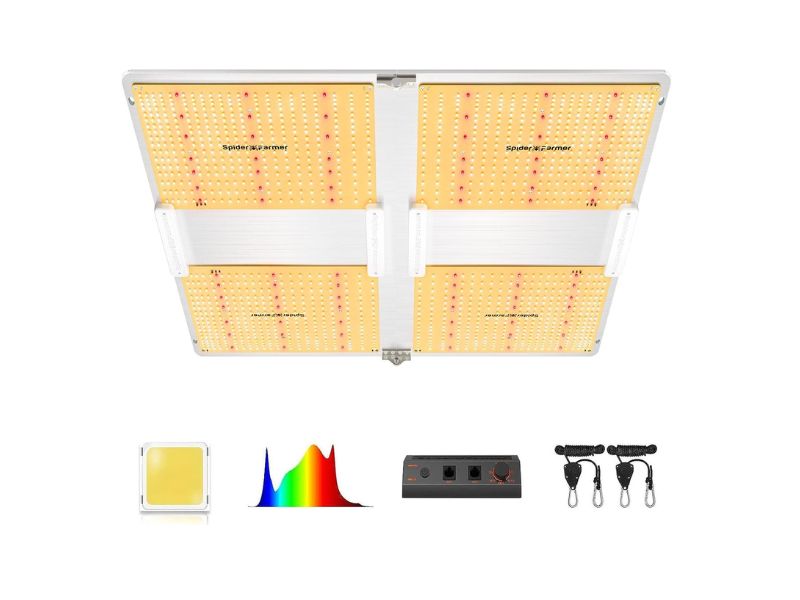
The SF7000 differs from the other products because it uses a broad panel-style structure rather than a widely separated bar matrix. Its 650-watt draw, Samsung LM301B diodes, approximately 1,786 µmol/s PPF, and 2.8 µmol/J efficacy support a full 5×5 footprint.
Its compact folded dimensions can simplify storage, and the detachable driver offers useful heat-management flexibility. The panel distributes diodes over a larger area than a small quantum board, but it may still provide less open airflow and a different center-to-edge pattern than a multi-bar fixture.
The 650-watt load makes it easier to operate in a warm room, although careful hanging and canopy mapping remain necessary.
What I Like
- Established 650W platform
- Samsung LM301B diodes
- Useful PPF and efficacy
- Detachable driver
- Full 5×5 coverage
- Quiet passive cooling
What I Do Not Like
- Older diode generation than some premium options
- Panel design allows less open airflow between bars
- Lower maximum output than 730–800W fixtures
- Large folded panels are relatively heavy
The SF7000 suits buyers who prefer a proven, lower-wattage full-canopy fixture with uncomplicated dimming. It provides less raw headroom than the leading models but can be easier to cool and power.
5×5 Grow Light Comparison Table
| Product | Power | Fixture Design | Coverage | Listed Efficiency | Controls | Main Strength | Main Limitation |
| Mars Hydro FC-E8000 | 800W | Foldable bar frame | 5×5 | 2.8 µmol/J | Dimming; optional smart control | High output and value | Heavy heat load |
| Spider Farmer G8600 | 800W | Square bar frame | 5×5 | 2.85 µmol/J | App and manual control | Wireless control and coverage | Large ceiling footprint |
| AC Infinity EVO8 | 730W | Wide bar frame | 5×5 flower | Premium EVO diode platform | Schedule, ten levels, UIS | Automation and removable driver | Higher complexity |
| VIVOSUN VSFD6500 | 650W | Foldable bar frame | 5×5 | 2.8 µmol/J | Manual, app, GrowHub | Lower heat and IP65 protection | Less maximum output |
| Spider Farmer SF7000 | 650W | Foldable panel | 5×5 | 2.8 µmol/J | Dimmer and 0–10V control | Proven lower-wattage platform | Less open bar distribution |
The 800-watt models provide the most intensity reserve. The EVO8 reduces power while adding advanced control, and the two 650-watt fixtures prioritize lower heat and electricity consumption.
How Much Light Does a 5×5 Tent Need?
A 5×5 tent contains:
5 feet × 5 feet = 25 square feet
A practical high-efficiency LED range is approximately 650 to 800 watts for full-canopy use.
That equals:
- 650W ÷ 25 = 26 watts per square foot
- 730W ÷ 25 = 29.2 watts per square foot
- 800W ÷ 25 = 32 watts per square foot
These figures are starting points, not performance guarantees. A light with better diode efficiency and distribution can deliver more usable photons than a less efficient fixture drawing the same power.
A 650-watt system may be sufficient when:
- The fixture spreads light evenly
- The canopy is not extremely dense
- Heat control is limited
- The grower values lower operating cost
- High-intensity supplementation is unnecessary
A 730- to 800-watt fixture offers more headroom when:
- All 25 square feet are occupied
- The canopy is dense
- The light must be hung higher for uniformity
- Strong flowering intensity is desired
- Ventilation and cooling are adequate
High-output fixtures should still be dimmable. Maximum power is rarely appropriate during propagation or early vegetative development.
Why Fixture Width Matters in a 5×5 Tent
A five-foot-square canopy places the corners a considerable distance from the center. A compact fixture may produce excellent central PPFD while leaving the perimeter weak.
A wide bar fixture positions LEDs closer to:
- Sidewalls
- Corners
- Outer plant rows
- Canopy edges
This reduces how far photons must travel laterally before reaching the outer leaves.
The fixture should not fill the entire tent from wall to wall. Some clearance is necessary for:
- Light spreading
- Reflected-wall contribution
- Air circulation
- Hanging hardware
- Ducting
- Electrical cables
A frame around 40 to 46 inches wide generally leaves several inches of clearance inside a nominal 60-inch tent.
One Large Fixture vs. Two Smaller Lights
One 5×5 fixture provides:
- Simpler hanging
- One power connection
- Unified dimming
- Fewer drivers
- Cleaner cable management
Two smaller fixtures provide:
- Independent height adjustment
- Separate dimming zones
- Greater layout flexibility
- Partial operation during early growth
- Redundancy if one fixture requires service
The disadvantage of two lights is increased wiring, more hanging hardware, and a possible intensity seam where the outputs overlap.
For the products in this guide, one dedicated 5×5 fixture is the intended configuration.
Understanding 650W, 730W, and 800W Systems
650W fixtures
A 650-watt light produces approximately 26 watts per square foot. This can be an efficient full-canopy level when the frame provides strong distribution.
The lower load reduces:
- Heat
- Electricity use
- Circuit demand
- Exhaust requirements
730W fixtures
A 730-watt light provides a middle position. It offers more output than 650 watts without creating the full heat load of an 800-watt system.
This range is useful when smart control and high-efficiency diodes improve how the power is delivered.
800W fixtures
An 800-watt light provides the greatest reserve in this comparison. It can support higher intensity, wider hanging heights, or dense canopies.
Its disadvantages are:
- Higher temperature
- Higher electrical cost
- Increased circuit load
- Greater risk of excessive PPFD
More wattage is useful only when the plants and environment can use the additional photons.
Heat Output and Cooling Requirements
Electrical power eventually becomes heat in the tent or surrounding room.
Use:
BTU per hour = watts × 3.412
| Fixture Power | Approximate Heat Output |
| 650W | 2,218 BTU/h |
| 730W | 2,491 BTU/h |
| 800W | 2,730 BTU/h |
Moving the driver outside the tent can reduce the heat released inside the enclosure, but the driver still warms the room.
A 5×5 setup typically needs:
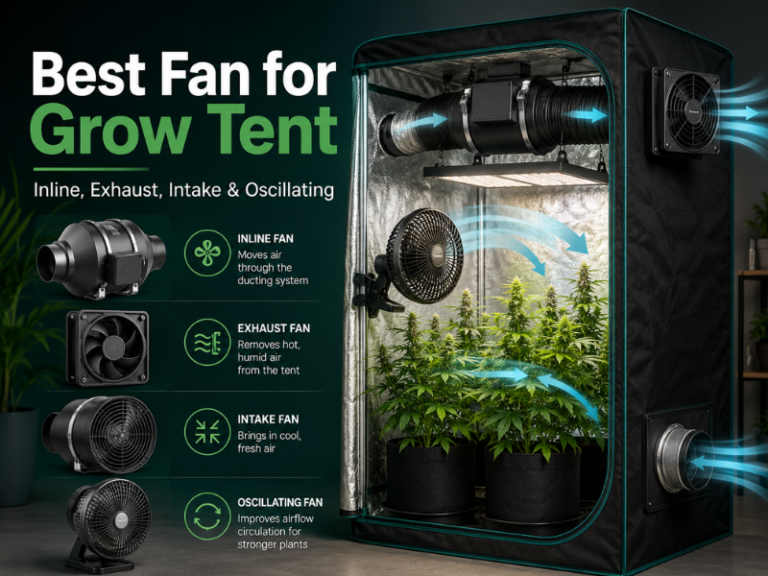
- High-capacity inline exhaust
- Appropriate intake openings
- Multiple circulation points
- Room-level ventilation or cooling
- Temperature monitoring at canopy height
The light cannot cool the tent below the intake-air temperature. If the surrounding room is hot, stronger exhaust may simply introduce more hot air.
Electrical Load at 120 Volts
Approximate lighting-only current is:
- 650W ÷ 120V = 5.42 amps
- 730W ÷ 120V = 6.08 amps
- 800W ÷ 120V = 6.67 amps
The full circuit must also support:
- Exhaust fan
- Circulation fans
- Pumps
- Humidifier
- Dehumidifier
- Heater
- Controllers
- Monitoring equipment
Do not calculate circuit capacity from the grow light alone.
Check:
- Circuit amperage
- Timer rating
- Controller relay rating
- Extension-cord capacity
- Power-strip capacity
- Continuous-load requirements
Keep connectors dry and use grounded outlets.
Mapping Light Across 25 Square Feet
A center measurement does not represent a complete 5×5 canopy.
A useful PPFD map can include a five-by-five measurement grid:
[1] [2] [3] [4] [5]
[6] [7] [8] [9] [10]
[11] [12] [13] [14] [15]
[16] [17] [18] [19] [20]
[21] [22] [23] [24] [25]
Compare:
- Center reading
- Corner readings
- Edge readings
- Average intensity
- Lowest intensity
- Highest intensity
If the center is excessive but the corners are weak, raise the light to improve blending before increasing power.
If the complete map remains weak, increase output gradually.
If one side is consistently lower, confirm that the frame is centered and level.
Dimming a High-Output 5×5 Light
A dimmer allows one fixture to support multiple stages without changing the complete system.
Begin conservatively when:
- Starting seedlings
- Moving plants from lower-intensity lighting
- Transplanting
- Lowering the fixture
- Expanding the light schedule
Increase output in measured steps and observe new growth.
Possible excess-light symptoms include:
- Bleached upper leaves
- Pale center growth
- Upward-curling edges
- Excessive leaf-surface temperature
- Rapid drying
- Slower growth directly beneath the fixture
Possible insufficient-light symptoms include:
- Stretching
- Thin stems
- Weak corners
- Plants leaning toward the center
- Slow canopy development
Do not increase intensity merely because the dimmer has unused capacity.
Full-Spectrum Output and Supplemental Wavelengths
A full-spectrum fixture generally combines:
- Warm white
- Cool white
- Blue
- Deep red
- Sometimes far red or ultraviolet
White diodes provide most of the usable broad-spectrum output. Deep-red light near 660 nm contributes efficiently to photosynthesis.
Far-red and ultraviolet can alter plant responses, but their presence does not automatically make one light better. The total photon output, intensity, distribution, and photoperiod remain more important.
A well-distributed white-and-red fixture can outperform a poorly designed light advertising numerous supplemental wavelengths.
Common 5×5 Grow-Light Mistakes
Buying a 4×4 light for a 5×5 canopy
A strong 4×4 fixture may illuminate the center but leave the outer 4.5 feet of perimeter underlit.
Judging only by wattage
Two 800-watt lights can differ substantially in efficacy, frame size, spectrum, and uniformity.
Ignoring ceiling equipment
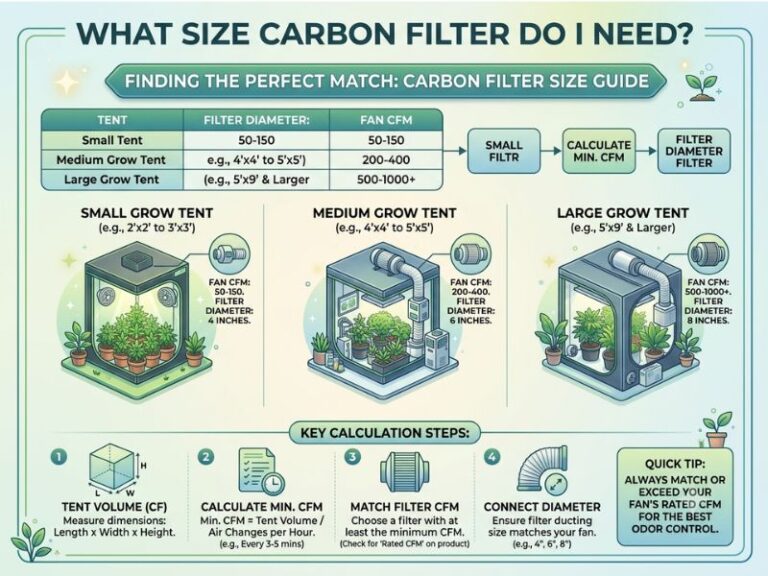
A wide fixture may conflict with the carbon filter, exhaust fan, duct, and tent supports.
Running full power immediately
High-output fixtures should be acclimated gradually.
Checking only center PPFD
The corners often reveal whether the fixture truly covers 5×5 feet.
Underestimating heat
A 650- to 800-watt light contributes roughly 2,200 to 2,700 BTU/h.
Overloading a controller
Confirm that timers and smart relays support the fixture’s continuous load.
Assuming app control corrects poor placement
Automation cannot fix a tilted frame, weak corners, excessive heat, or incorrect hanging height.
Maintenance and Long-Term Use
Disconnect the fixture before cleaning or adjustment.
Inspect:
- LED bars or panels
- Drivers
- Connectors
- Dimming controls
- Suspension cables
- Ratchet hangers
- Folding joints
- Tent crossbars
- Power cords
Dust can reduce cooling performance and block light. Clean the fixture with a soft, dry material or follow its maintenance instructions.
Do not spray liquid directly onto LEDs, optics, drivers, or electrical connectors.
Keep passive-cooling surfaces unobstructed. A removable driver should remain secure, ventilated, and protected from moisture.
Recheck the fixture height and level as the canopy grows.
Frequently Asked Questions
What is the best LED grow light for a 5×5 tent?
My primary recommendation is the Mars Hydro FC-E8000. Its 800-watt output, wide bar frame, dimming, and approximately 2,240 µmol/s PPF provide strong full-canopy capacity.
The Spider Farmer G8600 is better for integrated wireless control, while the AC Infinity EVO8 provides more advanced scheduling and driver management.
Is 650 watts enough for a 5×5 grow tent?
Yes, an efficient 650-watt fixture can cover a 5×5 tent when its diodes are distributed across a suitably wide frame.
The VIVOSUN VSFD6500 and Spider Farmer SF7000 are designed around this lower-power approach.
Is 800 watts too much for a 5×5 tent?
No, but it may require dimming.
An 800-watt fixture provides substantial intensity reserve. Full output should be used only when canopy response, temperature, airflow, and other environmental conditions support it.
How many watts should a 5×5 grow light use?
Approximately 650 to 800 actual LED watts is a practical range for full-canopy use.
The appropriate point within that range depends on fixture efficacy, distribution, plant type, temperature, and desired intensity.
Can one grow light cover a 5×5 tent?
Yes. A dedicated 5×5 bar or panel fixture can cover the complete footprint.
Confirm that the product’s flowering coverage—not only its vegetative or maximum coverage—is appropriate.
Is a bar-style light better for a 5×5 tent?
Bar fixtures generally provide better physical distribution because the diodes extend toward the canopy perimeter.
A broad panel can also work when its diode layout and hanging height provide acceptable uniformity.
How high should a 5×5 grow light hang?
Begin with the fixture’s current guidance and adjust using canopy measurements and plant response.
Raising the fixture improves blending but reduces overall intensity. Lowering it increases PPFD and hotspot risk.
Do I need an 8-inch exhaust fan for an 800W light?
Not automatically.
The exhaust requirement depends on tent volume, filter resistance, duct length, room temperature, and desired conditions. A high-capacity six-inch system may work in some installations, while hotter or more restrictive systems may need a larger setup.
Can the LED driver be mounted outside the tent?
Yes, when the fixture includes a supported removable-driver system.
External placement can reduce internal heat but does not remove heat from the surrounding room.
How much electricity does an 800W light use?
On a 12-hour daily schedule at full power:
0.8 kW × 12 × 30 = 288 kWh per month
Multiply 288 by the local electricity rate to estimate lighting-only cost.
Do I need supplemental CO₂ with an 800W light?
Not necessarily.
The fixture can be dimmed to match ambient conditions. Supplemental CO₂ is a separate environmental strategy and should not be treated as mandatory simply because a light has high maximum output.
How do I improve weak corner growth?
Center and level the fixture, raise it slightly for better beam blending, check the corner PPFD, and prevent taller center plants from shading the perimeter.
Are smart grow lights worth it?
They are useful for schedules, remote adjustment, sunrise and sunset transitions, and integration with environmental equipment.
A manual dimmer and reliable timer remain sufficient for many growers.
Which is better: 650W or 800W?
Choose 650 watts for lower heat, lower electricity use, and easier environmental control.
Choose 800 watts for greater intensity reserve, higher hanging positions, or a dense full canopy.
Conclusion
Choosing the best LED grow light for 5×5 tent use requires balancing full-canopy intensity with uniformity, heat, dimming, electrical demand, and available ceiling space.
My primary recommendation is the Mars Hydro FC-E8000 800W LED Grow Light. Its foldable bar frame and substantial photon output make it well suited to a fully occupied 25-square-foot canopy.
The Spider Farmer G8600 800W LED Grow Light is a strong alternative for wireless control, while the AC Infinity IONFRAME EVO8 730W LED Grow Light offers scheduling, premium diodes, and removable-driver heat management.
The VIVOSUN VSFD6500 650W LED Grow Light provides bar-style coverage with a lower thermal load. The Spider Farmer SF7000 650W LED Grow Light suits buyers who prefer a proven panel-style system.
For most installations, the correct decision is not simply 650 versus 800 watts. Select the fixture whose physical coverage, dimming range, driver design, and heat output match the tent and surrounding room.

I’m Maya L. Greenwood, a lifelong plant lover who believes anyone can grow something beautiful with the right guidance. After years of testing soil mixes, pruning methods, irrigation tricks, and pest-safe solutions, I started EasyGardenTips.com to turn hard-won lessons into step-by-step advice. From seed starting and container gardens to composting and seasonal checklists, my goal is to make gardening simple, sustainable, and fun.