3 Best Non String Grass Trimmer: Blade Picks for Clean Edges
Are you looking for the best non string grass trimmer because you are tired of broken line, tangled spools, bump-feed problems, and constantly restringing a weed eater? Blade-based and cordless grass shear systems eliminate nylon line completely, making them especially useful for lawn edges, flower beds, shrubs, walkways, and other precision trimming jobs.
My primary recommendation is the WORKPRO 7.2V Cordless Grass Shear & Shrubbery Trimmer. Its 4.17-inch grass shear, interchangeable shrub blade, 7.2V rechargeable battery, lightweight body, and tool-free blade changes make it an excellent choice for detailed grass trimming without a string spool.
For gardeners who want more power and a wider range of vegetation capability, I would choose the Saker 20V Cordless Grass Shear and Hedge Trimmer. Its 20V battery platform, adjustable cutting head, SK5 steel blades, two-battery configuration, and 2-in-1 grass-and-shrub design make it better suited to thicker garden growth.
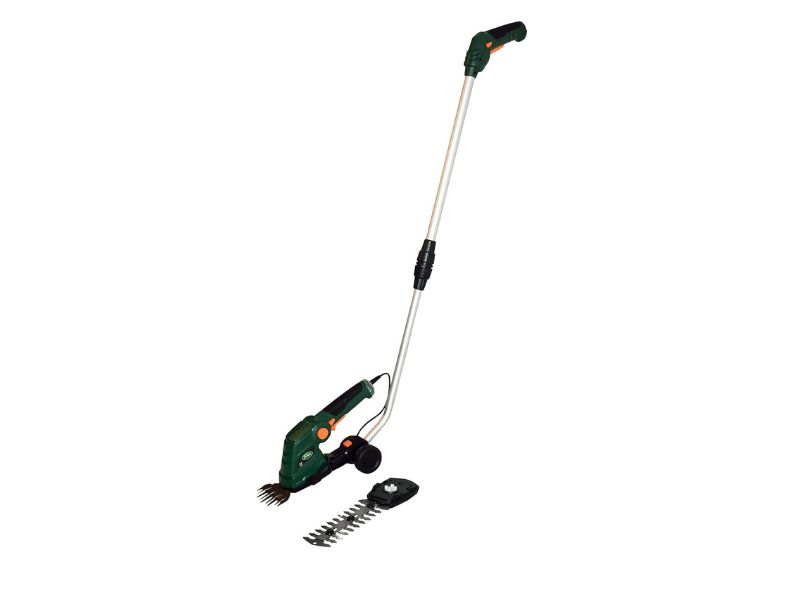
The Scotts LSS10272PS 7.5V Cordless Grass Shear with Wheeled Extension Handle is my preferred option when reducing bending is the priority. Its wheeled extension pole, 3.5-inch grass blade, 6.7-inch shrub blade, adjustable cutting head, and lightweight design provide a much more upright way to maintain lawn edges.
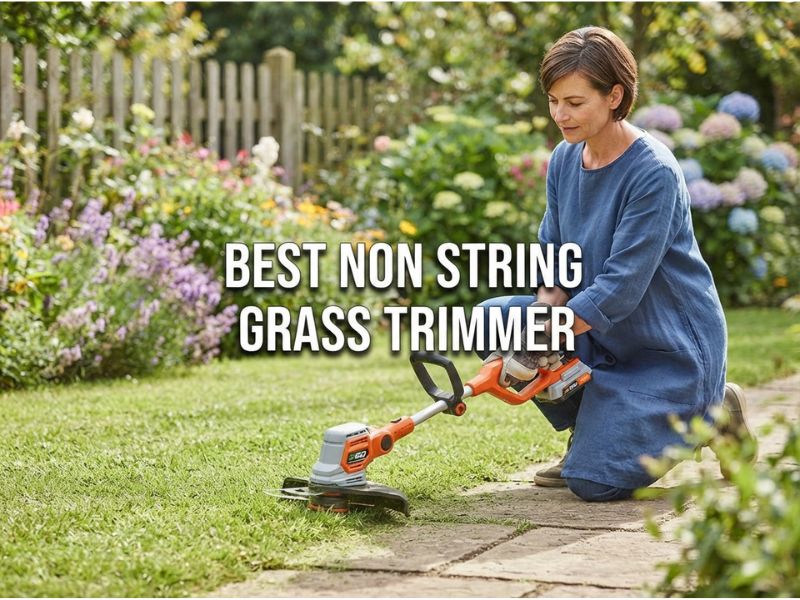
3 Best Non String Grass Trimmer
| Image | Product Name | Check Price |
|---|---|---|
Best Choice | WORKPRO 7.2V Cordless Grass Shear & Shrubbery Trimmer | Check Price |
Second Best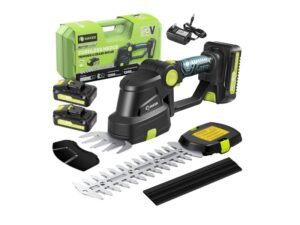 | Saker 20V Cordless Grass Shear and Hedge Trimmer | Check Price |
Third Choice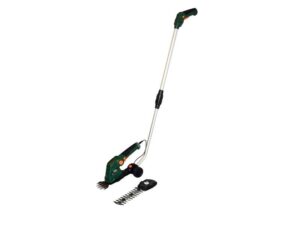 | Scotts LSS10272PS 7.5V Cordless Grass Shear with Wheeled Extension Handle | Check Price |
1. WORKPRO 7.2V Cordless Grass Shear & Shrubbery Trimmer- Best Overall
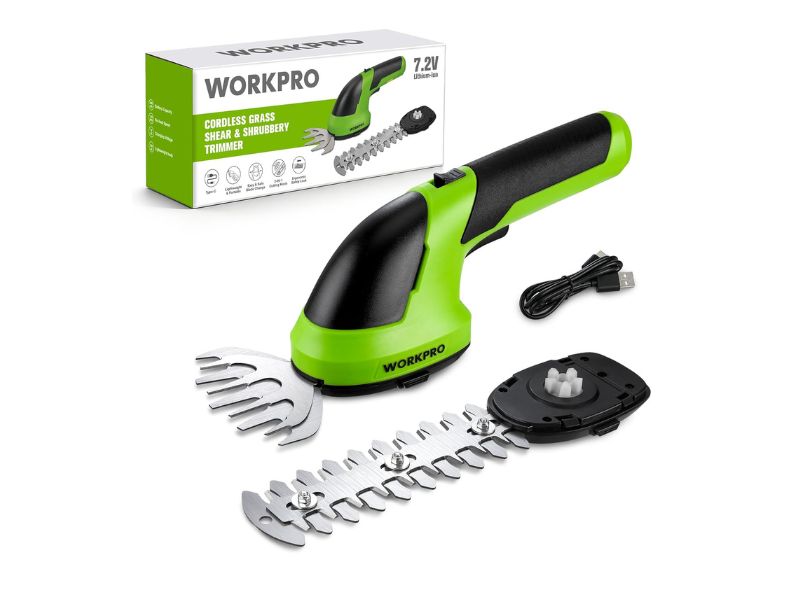
Key Features
- 7.2V rechargeable lithium-ion battery
- Approximately 4.17-inch grass cutting width
- 5.9-inch shrub trimming blade
- Approximately 1,100 cutting strokes per minute
- Interchangeable grass and shrub blades
- Tool-free blade replacement
- Dual safety-lock design
- Lightweight handheld construction
- USB-C charging on current configurations
- Suitable for lawn edges, flower beds, small shrubs, and garden cleanup
The WORKPRO is my first choice because it focuses on the job many homeowners actually mean when searching for a grass trimmer without line: cutting the grass a mower leaves behind without dealing with a spool.
Instead of spinning nylon cord at high speed, the WORKPRO uses a reciprocating steel grass shear.
The blades move back and forth like powered scissors. Grass entering between the blade teeth is sliced rather than struck by a flexible line.
This creates a very different trimming experience.
No String, Spool, or Feed Head
A conventional string trimmer introduces several consumable and mechanical components:
- Nylon line
- Spool
- Bump-feed mechanism
- Automatic-feed mechanism
- Eyelets
- Line-cutting blade
Any of these can create interruptions.
The WORKPRO eliminates that entire system.
Install the grass-shear blade, charge the battery, and begin trimming.
For homeowners who use a trimmer only for small missed patches after mowing, this simplicity is a major advantage.
4.17-Inch Grass Shear
The approximately 4.17-inch grass blade is much narrower than the 12- to 16-inch circular cutting path of a conventional weed eater.
That initially sounds like a disadvantage.
For open areas, it is.
You would not choose the WORKPRO to clear hundreds of feet of tall roadside grass.
But the narrow blade provides outstanding precision around:
- Flower beds
- Patio edges
- Stepping stones
- Raised planters
- Landscape edging
- Sprinkler heads
- Tree surrounds
- Retaining walls
You can see exactly where the blade will cut.
There is less risk of a long piece of spinning line unexpectedly reaching a flower or stripping bark from a young tree.
5.9-Inch Shrub Blade
The included shrub blade turns the same tool into a small hedge trimmer.
This is particularly useful for homeowners who need occasional touch-ups rather than maintaining huge hedges.
It can handle tasks such as:
- Boxwood shaping
- Small ornamental shrubs
- Young hedge growth
- Dead perennial stems
- Light garden cleanup
Changing between the grass and shrub attachments requires no complicated spool disassembly.
This 2-in-1 design gives the tool more year-round value.
Lightweight Handling
One of the biggest advantages of a handheld shear is weight.
Traditional cordless string trimmers often place a relatively heavy battery at the rear of a long shaft.
Even a well-balanced model can become tiring during a lengthy session.
The WORKPRO is compact enough for easy one-handed maneuvering.
That makes it especially useful for:
- Older gardeners
- Small-yard homeowners
- Detailed landscaping
- Occasional trimming
- Gardeners who dislike heavy equipment
The tradeoff is that you work relatively close to the ground.
If bending is uncomfortable, the Scotts extension-handle model later in this guide is the better choice.
Rechargeable Battery
The 7.2V system is designed around precision rather than maximum cutting torque.
That is enough for normal grass and lighter plant material.
Do not treat it as a miniature brush cutter.
If vegetation contains woody stems or thick vines, switch to pruning shears, hedge trimmers, loppers, or a brush cutter appropriate for that material.
Blade Maintenance
The absence of string does not mean maintenance disappears.
Steel blades need to remain:
- Clean
- Dry
- Free from packed grass
- Properly aligned
- Lubricated when specified
Grass sap can accumulate between reciprocating blade surfaces.
Cleaning after use helps maintain smooth blade movement.
Always disable the tool before touching or changing the cutting assembly.
What I Like
- Completely eliminates trimmer string
- Excellent precision around landscaping
- Interchangeable grass and shrub blades
- Lightweight
- Easy blade changes
- Rechargeable design
- Compact storage
- Strong buyer history
What I Do Not Like
- Narrow cutting width
- Requires more bending than a long-shaft trimmer
- Not intended for heavy weeds or brush
- Handheld design is slower across large properties
The WORKPRO is the best non string grass trimmer here for small-yard detail work. If your mower handles the large areas and you simply need something for the grass it cannot reach, this compact shear is easy to use and avoids virtually every frustration associated with a spool.
2. Saker 20V Cordless Grass Shear and Hedge Trimmer- Best for Thick Garden Growth
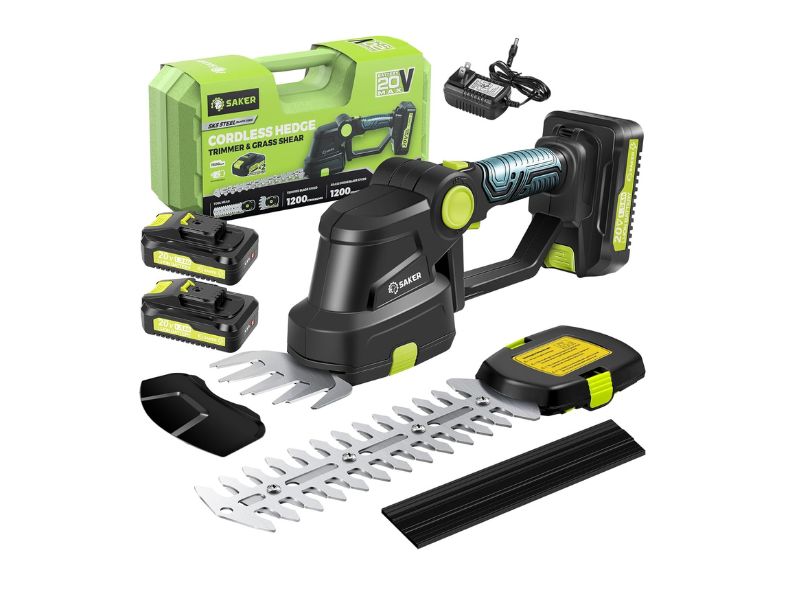
Key Features
- 20V cordless power system
- Two rechargeable batteries in this configuration
- 2-in-1 grass shear and hedge-trimmer design
- Approximately 1,200 cutting strokes per minute
- SK5 alloy-steel blades
- Adjustable cutting-head positions
- Approximately 6.8-inch grass cutting width depending on blade configuration
- 9.45-inch hedge blade
- Dual safety controls
- Tool-free-style blade switching
- Suitable for grass, shrubs, small hedges, and garden growth
The Saker is the option I would choose when a small 7.2V shear feels too light for the vegetation around your property.
It uses a 20V battery system, providing greater energy and motor capability for demanding trimming.
This does not turn it into a full-size string trimmer or brush cutter, but it gives the tool more authority in thicker grass and shrub growth.
20V Power
Voltage alone does not determine cutting performance.
Blade sharpness, tooth geometry, stroke speed, battery output, and vegetation type also matter.
Still, the 20V design provides a useful step up from compact integrated-battery shears.
That extra capability becomes noticeable when trimming:
- Dense grass clumps
- Overgrown lawn edges
- Thick ornamental plants
- Shrub growth
- Garden vegetation
The important distinction is between soft vegetation and woody material.
Grass, leaves, and young stems are appropriate.
Large woody branches are not.
SK5 Steel Blades
Saker uses SK5 steel cutting components.
This high-carbon tool steel is commonly used in pruning and cutting equipment because it can provide a hard, sharp cutting edge.
A quality blade matters more in a grass shear than many buyers expect.
A dull blade does not simply cut more slowly.
It can:
- Tear grass
- Pinch stems
- Increase motor load
- Increase vibration
- Reduce battery runtime
Keeping the blades clean and properly maintained improves both cutting quality and tool efficiency.
Adjustable Cutting Head
The cutting head offers multiple working angles.
This can make the tool easier to position when trimming:
- Sloped lawn edges
- Raised beds
- Low shrubs
- Awkward corners
- Areas beside walls
Instead of twisting your wrist into an uncomfortable position, you can change the blade angle to match the surface.
That is especially useful during precision trimming because the blade needs to remain reasonably parallel with the grass.
Two Batteries
Having two batteries provides a practical advantage even if a single pack is usually enough for your normal trimming session.
One can remain ready while the other is in use.
If the first battery becomes depleted, you can swap packs rather than stopping the job.
This arrangement is useful for larger gardens or homeowners who also use the shrub attachment extensively.
Wider Grass-Cutting Ability
Compared with very compact handheld shears, the Saker provides a broader working area.
That makes it more practical when trimming continuous sections rather than individual tufts.
You still will not match the productivity of a 15-inch string trimmer across a large open property.
However, around garden borders and landscaping it offers a useful compromise between precision and cutting speed.
2-in-1 Function
The longer blade changes the tool into a compact hedge trimmer.
For homeowners with relatively small ornamental hedges, this can eliminate the need for a separate full-size hedge tool.
I especially like this approach for:
- Small boxwoods
- Foundation shrubs
- Topiary maintenance
- New hedge growth
- Perennial cleanup
The tool becomes significantly more useful than a grass-only cutter.
Safety Controls
Reciprocating blades are exposed cutting components.
Unlike nylon string, steel blades do not flex harmlessly when touched.
Use the safety controls exactly as designed.
Before changing blades:
- Switch the tool off.
- Remove the battery.
- Wait for all blade movement to stop.
- Wear suitable gloves if handling sharp blade surfaces.
Never clear trapped vegetation while the battery remains connected.
What I Like
- More powerful 20V platform
- Two batteries
- SK5 steel blades
- Grass and shrub functions
- Adjustable head
- Wider cutting capability
- Better for thicker garden growth
- No spool or nylon line
What I Do Not Like
- Heavier than compact 7.2V shears
- Still not intended for large lawn areas
- Metal blades require careful handling
- More tool than very small gardens may need
The Saker is my choice for buyers who want a non-string grass cutter but regularly encounter vegetation heavier than simple lawn edging. Its stronger battery system and steel blade setup provide more flexibility than a tiny precision shear.
3. Scotts LSS10272PS 7.5V Cordless Grass Shear with Wheeled Extension Handle- Best Stand-Up Option
Key Features
- 7.5V lithium-ion system
- 2.0Ah battery
- Approximately 3.5-inch grass shear blade
- 6.7-inch shrub blade
- Around 2,600 cutting strokes per minute
- Wheeled telescoping extension handle
- Adjustable blade-head angle
- Tool-free blade switching
- Lightweight construction
- Can operate handheld or with extension pole
- No nylon line required
The Scotts solves the biggest weakness of most compact grass shears: working height.
Handheld shears are precise and lightweight, but spending 20 minutes bent close to the ground can become uncomfortable.
Scotts adds a telescoping wheeled extension handle, allowing the grass blade to roll along the lawn while you remain more upright.
Wheeled Extension Handle
The extension system changes how the tool feels in use.
Instead of holding the shear directly above the ground with one hand, you can guide it using a longer shaft.
Small wheels support the cutting head and help maintain a relatively consistent height.
This design is particularly useful along:
- Walls
- Walkways
- Patio borders
- Garden beds
- Fences
- Mower-missed lawn strips
It is closer to a miniature powered lawn shear than a conventional weed eater.
3.5-Inch Grass Blade
The approximately 3.5-inch grass blade is narrow.
That means this tool prioritizes control rather than high productivity.
It works best when your lawn mower already handles 95% of the grass.
Use the Scotts for the remaining areas where the mower deck cannot reach.
This can include strips beside hard surfaces where a mower leaves an inch or two of grass standing.
High Stroke Rate
The blades operate at approximately 2,600 strokes per minute, giving the Scotts a notably quick reciprocating action.
A faster blade movement helps produce clean cuts through normal lawn grass without requiring you to move the tool extremely slowly.
Grass still needs to enter between the blade teeth properly, so forcing the tool rapidly through dense growth can reduce cutting quality.
Use a smooth, steady pace.
Converts to a Handheld Tool
The extension handle can be removed, turning the Scotts back into a compact handheld grass and shrub shear.
This adds useful versatility.
Use the extension pole for lawn edges.
Remove it when working around:
- Raised planters
- Shrubs
- Containers
- Table-height garden areas
- Detailed landscaping
This two-position operating style is its biggest advantage over basic handheld alternatives.
Shrub Blade
The included 6.7-inch shrub blade expands its usefulness beyond grass.
It works for light shrub shaping and thin new hedge growth.
Again, remember that tooth spacing limits branch capacity.
A compact battery shear is not designed for mature branches.
Use pruning shears or loppers when stems exceed the tool’s intended cutting capacity.
Battery Capacity
The integrated lithium-ion battery keeps the tool compact and relatively light.
For small-yard edge maintenance, this is usually sufficient.
The disadvantage is that you cannot simply insert a huge high-capacity battery when the original battery becomes depleted.
This makes Scotts better for moderate trimming sessions than all-day yard maintenance.
What I Like
- Wheeled extension handle reduces bending
- Can also operate handheld
- Fast reciprocating blade action
- Grass and shrub blades
- Adjustable head angle
- Lightweight
- Excellent around mower-missed edges
- No line-feed system
What I Do Not Like
- Narrow grass blade
- Less powerful than 20V alternatives
- Integrated battery limits quick battery swapping
- Extension assembly adds storage bulk
The Scotts is the strongest choice for someone who likes the precision of grass shears but does not want to kneel or crouch throughout the job. Its wheeled pole makes string-free trimming considerably more comfortable along long lawn borders.
Non String Grass Trimmer Comparison
| Product | Power | Grass Blade | Shrub Blade | Working Style | Extension Handle | Best Use | Main Limitation |
| WORKPRO Cordless Grass Shear | 7.2V | 4.17 in. | 5.9 in. | Handheld | No | Precision trimming | Requires bending |
| Saker Cordless Grass Shear | 20V | ~6.8 in. | 9.45 in. | Handheld | No | Thicker grass and shrubs | Heavier |
| Scotts LSS10272PS | 7.5V | ~3.5 in. | 6.7 in. | Handheld / wheeled pole | Yes | Lawn edges without bending | Narrow cutting width |
The WORKPRO provides the strongest overall combination of popularity, precision, simplicity, and lightweight operation.
The Saker is better when you need more cutting power and frequently maintain shrubs in addition to grass.
The Scotts sacrifices cutting width in exchange for one very useful advantage: you can trim lawn edges from a more upright position.
What Is a Non String Grass Trimmer?
A non string grass trimmer cuts vegetation without conventional nylon monofilament.
Several cutting technologies can achieve this.
Reciprocating Grass Shears
These use two toothed metal blades moving against one another.
They work like powered scissors.
Advantages include:
- Precise cutting
- Reusable steel blades
- No spool
- No line feed
- Low noise
- Excellent control
WORKPRO, Saker, and Scotts use this general cutting concept.
Plastic or Resin Blade Trimmers
Some long-shaft trimmers use rotating replaceable polymer blades.
These behave more like a traditional weed eater while avoiding nylon line.
They cover more ground than shears but use replacement blades as consumables.
Metal Blade Brush Cutters
Heavy-duty machines can use rigid steel discs or cutting blades.
These are designed for significantly heavier vegetation and require greater operator protection.
They should not be confused with lightweight grass trimmers.
Grass Shear vs. String Trimmer
A string trimmer wins when you need speed.
A 14- or 16-inch cutting path can clear hundreds of feet of lawn edge quickly.
A grass shear wins when you need control.
Its compact steel blade excels near:
- Flowers
- Trees
- Irrigation equipment
- Raised beds
- Decorative stone
- Garden structures
If your property has a large amount of open trimming, string remains more efficient.
If the job consists mostly of detail work after mowing, a non-string shear can be much more pleasant.
Why Choose a Grass Trimmer Without String?
No Restringing
The obvious advantage is eliminating spool maintenance.
You never need to:
- Measure trimmer line
- Wind a spool
- Deal with crossed line
- Retrieve line from inside the head
- Diagnose bump-feed problems
For some homeowners, this alone justifies choosing blades.
Precise Cutting
Steel shears provide a clearly defined cutting area.
You can place them beside a plant and know exactly where the blade will reach.
Less Flying Debris
A high-speed string trimmer can throw substantial amounts of:
- Grass
- Soil
- Stones
- Mulch
Grass shears typically create less projectile debris because the blades reciprocate rather than spinning through a large circle.
Eye protection is still important.
Quieter Operation
Compact electric shears are typically much quieter than gas equipment and can also sound less aggressive than a full-speed weed eater.
This can make them more comfortable for quick cleanup work.
What Are the Limitations?
The main limitation is cutting width.
A four-inch shear requires many more passes than a 15-inch string head.
These tools are therefore best viewed as finishing equipment.
They complement a lawn mower.
They are not designed to cut an entire lawn.
Best Non String Trimmer for Lawn Edges
The Scotts is my preferred choice when you have long borders.
Its wheels and extension handle let you move along the edge while standing.
For small areas, WORKPRO gives you more direct control.
If vegetation is thicker, Saker provides more power.
Best Non String Trimmer Around Flower Beds
I prefer the WORKPRO.
Its compact blade makes it easier to trim right beside flowers without creating the broad cutting radius of a string trimmer.
Use both hands when necessary to stabilize nearby plants and always keep fingers away from the blade.
Best Non String Trimmer for Thick Grass
The Saker has the strongest configuration among these three.
Its 20V power system and larger steel blade setup make it better suited to dense grass and garden vegetation.
However, even Saker has limits.
For waist-high weeds, thick vines, or woody brush, use a machine designed for heavier vegetation.
Battery Voltage Explained
A higher voltage does not automatically mean a better tool.
The WORKPRO and Scotts use relatively low-voltage systems because reciprocating grass blades require much less rotating power than a large string head.
Saker’s 20V battery supports heavier work.
Consider:
- Blade width
- Stroke speed
- Battery capacity
- Tool weight
- Intended vegetation
instead of shopping by voltage alone.
How to Use a Grass Shear Correctly
Keep the blade approximately level with the grass.
Move steadily rather than forcing it into thick clumps.
For very tall grass, trim in multiple stages.
Do not bury the entire blade underneath a dense mat and expect the motor to cut everything simultaneously.
Allow vegetation to enter between the teeth.
How to Trim Grass Against a Wall
One of the best uses for non-string shears is trimming the narrow strip of grass a mower leaves beside a wall.
Hold the grass blade parallel to the ground.
Move along the wall without forcing the teeth directly into:
- Concrete
- Brick
- Metal edging
- Stone
Hard contact can dull or damage steel blade teeth.
Blade Care
Clean blade surfaces after use.
Plant sap and moisture can increase friction and encourage corrosion.
Depending on manufacturer guidance, a small amount of suitable blade lubricant can help maintain smooth reciprocating movement.
Keep blades protected during storage.
Do not place an exposed grass shear blade loose inside a tool drawer.
Common Mistakes With Non String Grass Trimmers
Expecting String-Trimmer Speed
A four-inch shear cannot cover ground as quickly as a 15-inch spinning head.
Use it for precision.
Cutting Branches That Are Too Thick
Grass blades are designed primarily for grass.
Switch to the shrub blade for light woody growth and follow the specified maximum cutting capacity.
Trimming Against Concrete
Steel teeth can become damaged when repeatedly dragged against hard masonry.
Ignoring Blade Cleaning
Packed grass creates extra resistance.
Clean the cutting mechanism after use.
Forgetting to Disconnect Power
Never touch, clean, or change a blade while the battery remains capable of powering the motor.
Non String Grass Trimmer Safety
Wear eye protection even though these tools generally throw less debris than string trimmers.
Inspect the area for:
- Wire
- Glass
- Stones
- Irrigation tubing
- Hidden garden hardware
Keep your free hand away from the blade.
Never hold vegetation in one hand while moving an operating shear toward it.
Remove or disconnect the battery before clearing jams.
Frequently Asked Questions
What is the best non string grass trimmer?
The WORKPRO 7.2V Cordless Grass Shear is my best overall choice for precise string-free lawn trimming.
Its 4.17-inch grass blade, interchangeable shrub attachment, lightweight body, rechargeable battery, and strong cutting control make it particularly useful for flower beds, lawn edges, and areas missed by a mower.
Is there a grass trimmer that does not use string?
Yes, grass shears and blade-based trimmers cut grass without using nylon trimmer line.
Some use reciprocating steel blades, while others use replaceable resin or polymer blades. Grass shears provide greater precision, whereas rotating blade trimmers cover larger areas.
Are non string grass trimmers any good?
Yes, they work extremely well for precise lawn-edge and garden trimming.
Their main disadvantage is working width. Compact shears are slower than full-size string trimmers across large areas but provide excellent control near valuable landscaping.
What can I use instead of a string trimmer?
Cordless grass shears are one of the easiest string-free alternatives for residential lawn cleanup.
They work especially well around flower beds, patios, walls, raised gardens, stepping stones, and other areas a lawn mower cannot reach.
Is a grass shear better than a weed eater?
A grass shear is better for precision, while a weed eater is faster across larger areas.
Choose shears for delicate landscaping. Choose a full-size trimmer when you have long fence lines or large areas of weeds.
Can grass shears cut weeds?
Yes, grass shears can cut many young and soft weeds, but they are not designed for heavy brush.
For coarse woody vegetation, use a shrub blade, pruning tool, or dedicated brush cutter appropriate for the stem size.
Which non string grass trimmer is best for thick grass?
The Saker 20V model is the strongest choice here for denser grass and garden vegetation.
Its higher-voltage battery system and steel cutting attachments provide more capability than compact 7.2V precision shears.
Which non string trimmer is best for older users?
The Scotts wheeled extension-handle model reduces bending and can be easier for users who dislike ground-level trimming.
Its pole and wheels support the cutting head while allowing a more upright working position.
Do grass shear blades need sharpening?
Steel grass-shear blades eventually require maintenance, although cleaning and proper storage often matter first.
Follow the manufacturer’s blade-service instructions. Replace badly damaged blades rather than trying to reshape broken teeth.
How long do cordless grass shears run?
Runtime varies with battery capacity, grass density, blade condition, and how continuously the tool operates.
Precision trimming involves frequent starts and stops, so real-world working time may be longer than continuous motor-runtime figures suggest.
Can I use grass shears for edging?
Yes, grass shears are excellent for horizontally trimming grass beside sidewalks, walls, and garden borders.
They do not create exactly the same deep vertical groove as a dedicated lawn edger, but they produce a neat finished edge.
Are metal blades safer than string?
Neither system is inherently harmless, and metal blades require careful hand placement.
Grass shears generally throw less debris because their blades do not rotate through a large circle, but the sharp steel cutting teeth can cause serious injury if touched while operating.
Can non string trimmers cut around trees?
Yes, precision grass shears are particularly useful around tree trunks because their cutting area is easy to control.
Avoid touching the bark with steel blades, especially on young trees.
Are replacement blades easy to find?
Availability depends on the model, so replacement-blade support should be checked before choosing a proprietary cutting system.
Reusable steel grass-shear blades usually need replacement less frequently than disposable plastic blades when maintained correctly.
Should I buy a handheld or long-handle grass shear?
Choose handheld shears for maximum precision and a long-handle model when reducing bending is more important.
For many gardeners, a convertible tool such as the Scotts offers the most flexibility.
Conclusion
The best non string grass trimmer should eliminate spool frustration without making normal lawn-edge maintenance more difficult.
My primary recommendation is the WORKPRO 7.2V Cordless Grass Shear & Shrubbery Trimmer. Its compact 4.17-inch grass blade, interchangeable shrub attachment, rechargeable power system, and lightweight construction make it an excellent finishing tool for grass around beds, walls, walkways, trees, and other mower-missed areas.
Choose the Saker 20V Cordless Grass Shear and Hedge Trimmer when you need additional power for thicker grass and also want a capable shrub-trimming attachment. The stronger battery platform and larger blades make it better suited to more demanding garden maintenance.
The Scotts LSS10272PS Cordless Grass Shear is the option I prefer when comfort and working height matter most. Its wheeled extension handle lets you maintain lawn edges with considerably less bending while still allowing handheld operation when you need close control.
For most small and medium residential lawns, WORKPRO provides the most useful balance of string-free operation, precision, lightweight handling, steel-blade durability, and garden versatility.

I’m Maya L. Greenwood, a lifelong plant lover who believes anyone can grow something beautiful with the right guidance. After years of testing soil mixes, pruning methods, irrigation tricks, and pest-safe solutions, I started EasyGardenTips.com to turn hard-won lessons into step-by-step advice. From seed starting and container gardens to composting and seasonal checklists, my goal is to make gardening simple, sustainable, and fun.