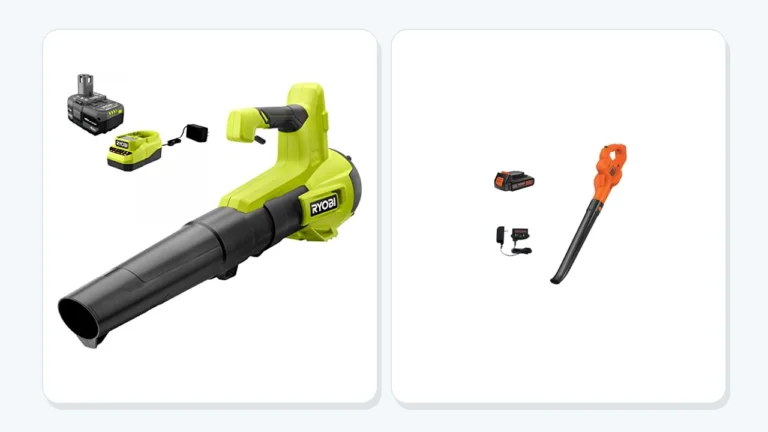
Ryobi Vs Toro Leaf Blower: Detailed Comparison and Verdict
If you’re weighing the ryobi vs toro leaf blower, the Toro Flex is the stronger choice on the stated airflow numbers: 110 mph and 565 CFM, against the RYOBI’s 100 mph and 325 CFM. That extra air-moving capacity matters most when you have a broad area or a stubborn pile to clear.
The RYOBI ONE+ is a cordless 18V blower with variable operation. The Toro Flex is a 60V brushless blower with variable-speed control, cruise control, turbo boost, and a stated 70-minute runtime.
That makes the decision less about which brand sounds better and more about your yard, your battery plans, and the kind of cleanup you do. If higher output and a supplied battery and charger matter, the Toro has the clearer case. If you’re considering the RYOBI, check what battery and charger you’ll need before budgeting.
Below, I’ll compare the ratings, battery details, controls, and practical trade-offs without treating either blower as the right answer for every yard. The short version: Toro for greater stated airflow; RYOBI if its 18V format and lower airflow rating suit your tasks and setup.
| RYOBI ONE+ 18V 100 MPH 325 CFM Cordless Battery Variable | Flex |
 |
 |
Ryobi Vs Toro Leaf Blower Detailed Comparison
The headline difference is airflow. RYOBI’s named specifications are 100 mph and 325 CFM. Toro’s Flex is rated at 110 mph and 565 CFM, so it leads by 10 mph in stated air speed and 240 CFM in stated air volume.
Those figures describe related but different things. MPH measures air speed; CFM measures how much air moves. Higher speed can help direct airflow at debris, while higher volume can help move a wider or heavier accumulation. The ratings don’t guarantee that one blower will clear every material faster: leaf condition, pile size, and how you aim the nozzle all affect the job.
A realistic example: Clearing a light scatter from a small patio may not call for the Toro’s higher numbers. If you regularly gather leaves across a long driveway or a larger lawn, its higher CFM gives you more stated air volume to work with. That’s a meaningful advantage, not a promise that every cleanup will take a particular amount of time.
The battery setup is another clear difference. The Toro Flex is a 60V model and comes with a 2.0-Ah battery and charger. It also has a stated 70-minute runtime on a charge. RYOBY’s name identifies an 18V ONE+ blower, but the verified details here don’t establish battery or charger inclusion or a runtime figure.
That matters when you’re comparing the total setup, not just the tool. If you already have a compatible battery for the RYOBI, that may affect what you need to buy; confirm fit before counting on it. If you’re starting from scratch, the Toro’s included battery and charger make its initial setup clearer, though neither product’s price is being compared here.
The controls also differ in confirmed detail. RYOBI’s product name identifies variable operation, but no further control details are established here. Toro specifies a variable-speed trigger, cruise control, and turbo boost. Those options let you adjust the airflow for a task and, with cruise control, hold a chosen setting without continuously squeezing the trigger.
Key Differences That Matter
1. Air speed and volume. RYOBI is rated at 100 mph and 325 CFM; Toro is rated at 110 mph and 565 CFM. Toro is higher on both measures, with the bigger separation in air volume. If your usual job is just nudging a few dry leaves off a walkway, you may not need that difference. If you face larger piles or more ground to cover, the extra stated airflow is the most persuasive reason to choose Toro.
Neither rating alone settles how a blower will feel on your property. Leaves can be scattered across grass, caught around edging, or matted together after damp weather. The shape and size of the area, and whether you’re pushing everything to one collection point, change what “enough power” means. Think about your regular cleanup, rather than buying for the biggest mess you might encounter once a year.
2. Battery platform and included gear. The RYOBI is identified as an 18V ONE+ model. Toro’s Flex Force system is 60V, and its battery is interchangeable with a range of Toro tools. That makes the Toro platform more relevant if you expect to use compatible Toro equipment for other seasonal yard work; the benefit depends on actually wanting those tools.
Toro includes a 2.0-Ah battery and charger with this blower. For RYOBI, check whether the battery and charger you need are included with the version you’re considering, and verify that any battery you already own is compatible. A tool that fits your budget on paper can require more spending if you still need its power supply.
3. Run time and power management. Toro has a stated 70-minute runtime on a charge, but don’t treat that as a guaranteed 70 minutes of continuous turbo use. The conditions behind a runtime figure matter, and turbo boost is intended for extra output rather than as a setting you should assume will match ordinary use. There’s no verified RYOBI runtime figure to compare against.
If you have a long cleanup, consider how you’ll handle breaks and charging, rather than relying on an exact number alone. The Toro’s included 2.0-Ah battery gives you a concrete battery size to assess, but the available details don’t give a charge time. For RYOBI, find out what battery configuration you plan to use and whether it suits the length of your typical jobs.
4. Adjustability and construction. Toro’s variable-speed trigger, cruise control, and turbo boost are confirmed features. They provide distinct ways to adjust or hold airflow, which can be useful when switching between a lighter sweep and a more demanding patch. RYOBI’s name specifies variable operation, but it doesn’t establish the same set of controls, so don’t assume the two offer identical adjustments.
Toro also has a brushless motor and a cast-aluminum direct-drive head. Those are specific construction details, but they don’t tell you the weight of the blower or prove how long it will last in your hands. Toro describes the tool as lightweight; there’s no verified weight comparison here, so someone prioritizing low carry weight should check the actual weight of both candidates before deciding.
Performance, Features, and Everyday Use
Starting with your cleanup routine helps. If you mostly clear a small porch, a short walkway, or leaves around a patio, consider whether a 325-CFM blower is enough for the area rather than paying more attention to the larger number alone. A modest cleanup can be about directing leaves neatly, not moving the biggest possible pile in one pass.
The RYOBI’s 100-mph, 325-CFM ratings give you a concrete reference for that kind of decision. Its variable designation suggests adjustable operation, which can be useful when you want a lighter touch on scattered debris. But battery inclusion, runtime, and the details of its controls aren’t confirmed here, so check those points against how long and how often you expect to work.
For larger areas, the Toro’s ratings give it more headroom. Its 565 CFM is substantially higher than RYOBI’s 325 CFM, and the 110-mph figure is also higher. That combination makes the Flex the stronger numerical fit for buyers who regularly push broad accumulations or want greater airflow available for tougher cleanup. It still won’t make wet or compacted debris effortless, and no specific clearance time can be promised from the ratings.
Using turbo boost selectively may make more sense than treating it as the everyday setting. The Flex also offers a variable-speed trigger and cruise control, so you can adjust airflow or hold a setting for a stretch of work. Those controls give the Toro more confirmed options for managing output; they don’t establish how long the included battery will last in each mode.
Budget for the whole setup. The Toro comes with a 2.0-Ah battery and charger, which removes one unknown for a new buyer. Its 60V Flex Force system can also be shared with a range of Toro tools. That compatibility is useful if those tools already fit your plans, but it isn’t a reason by itself to buy a more powerful blower you don’t need.
With the RYOBI, the 18V ONE+ designation may appeal if you’re building around that platform. Before treating an existing battery as a saving, make sure it matches the blower and meets your expectations for the task. The confirmed details don’t settle what comes in the package or how long a particular battery will run, so those are worth resolving before purchase.
Don’t overlook handling. Toro is described as lightweight, but there’s no exact weight for either model in the facts used here. If you’ll be carrying a blower for an extended cleanup, compare the actual tool weights and how each feels in your grip. Don’t assume the lower-voltage model is lighter, or that a higher-airflow model is too heavy.
Both are cordless leaf blowers, so you aren’t managing a power cord as you move around the yard. Beyond that, the available information doesn’t establish a head-to-head comparison for noise, charging time, weight, or battery life under the same conditions. If one of those will decide the purchase for you, verify it rather than filling in the blank with assumptions.
Pros and Cons
RYOBI ONE+ 18V 100 MPH 325 CFM Cordless Battery Variable
Pros
- ✓18V ONE+ identity: Relevant if you’re choosing within that battery platform.
- ✓Variable operation: Offers an adjustable approach to clearing tasks.
- ✓100 mph and 325 CFM: Clear reference points for a modest cleanup routine.
Cons
- –Lower stated airflow: Trails Toro by 240 CFM and 10 mph.
- –Battery details need checking: Confirm inclusion and compatibility before planning your budget.
- –No verified runtime comparison: Check whether your intended battery suits longer jobs.
Flex
Pros
- ✓Higher stated output: 110 mph and 565 CFM exceed RYOBI’s ratings.
- ✓Battery and charger included: Comes with a 2.0-Ah pack and charger.
- ✓Multiple controls: Variable trigger, cruise control, and turbo boost are specified.
- ✓Stated runtime: Toro gives a 70-minute figure for one charge.
Cons
- –More airflow than some yards need: Small, light cleanups may not benefit much from the higher rating.
- –60V platform: Its shared-battery value depends on wanting compatible Toro tools.
- –Runtime varies by use: Don’t assume turbo-heavy work will match the stated figure.
Which One Should You Buy?
Choose the Toro Flex if airflow is your main concern. Its 110-mph speed and 565-CFM volume are both higher than the RYOBI’s named ratings. That makes it the better fit on paper for a large yard, a long driveway, or frequent jobs where you gather substantial piles. The variable trigger, cruise control, and turbo boost also give it more confirmed ways to manage its output.
The Toro is also easier to evaluate as a complete starting setup: a 2.0-Ah battery and charger are included, and a 70-minute runtime is stated. Treat that runtime as a reference, not a promise for every task or setting. If you’re drawn to the 60V battery system because it can work with a range of Toro tools, consider whether you’ll actually use that compatibility.
Choose the RYOBI if its 18V ONE+ format fits your plans and its airflow is enough for your routine. The named 100-mph and 325-CFM ratings are lower than Toro’s, but a smaller number isn’t a problem if you’re clearing limited areas and don’t need more output. Its variable designation may suit someone who wants adjustable operation without making maximum airflow the deciding factor.
Before buying the RYOBI, settle the battery question. If you already have a compatible battery, that may help the fit; if not, include the battery and charger you’ll need in your budget. There’s no confirmed runtime figure here, so think through whether your typical job is a quick sweep or a longer session.
Who Should Skip This: RYOBI. Skip the RYOBI if you regularly move large piles across a broad area and want the higher stated airflow; Toro is the stronger match for that job. Also pause if you don’t know which battery and charger you’ll need, since that can change the cost and convenience of the setup.
Who Should Skip This: Toro Flex. Skip the Toro if its 565-CFM capacity is more than your small, occasional cleanup calls for, or if its 60V platform doesn’t fit your plans. Its additional controls and higher output are useful only if you’ll benefit from them. Don’t choose it just because the larger numbers look impressive.
Don’t buy on voltage alone. An 18V label versus a 60V label doesn’t explain every factor in handling, runtime, or real-world clearing. The clearest decision points here are the stated airflow, the Toro’s included battery and charger, and whether each battery platform matches your needs. Check exact weight and any package details that matter to you before committing.
FAQS About Ryobi Vs Toro Leaf Blower
Which leaf blower has more airflow, RYOBI or Toro?
The Toro Flex is rated at 565 CFM, compared with 325 CFM for the RYOBI. Toro’s stated air speed is higher too: 110 mph versus 100 mph. Those figures favor Toro for buyers who want more rated airflow, though the right fit still depends on the size and type of cleanup.
Does the Toro Flex come with a battery and charger?
Yes. The Toro Flex comes with a 2.0-Ah battery and a Toro charger. For the RYOBI, confirm whether the version you’re considering includes a battery and charger, and check that any battery you own is compatible.
Is the Toro Flex’s 70-minute runtime guaranteed for turbo use?
No specific turbo-mode runtime is established. Toro gives a 70-minute figure for one charge, but you shouldn’t assume that applies to continuous turbo use or every yard condition. Consider the figure alongside how you expect to operate the blower.
Is the RYOBI or Toro leaf blower better for a small yard?
For a small yard with light, occasional cleanup, the RYOBI may be the more suitable match if its 325 CFM meets your needs and its battery setup works for you. The Toro has higher stated airflow, but that extra capacity may not matter for a small job. Choose based on the cleanup you actually do.
Final Verdict: Which One Wins?
The Toro Flex wins for higher stated airflow and a more fully specified setup. It reaches 110 mph and 565 CFM, includes a 2.0-Ah battery and charger, and has variable-speed, cruise-control, and turbo options. For frequent, larger cleanups, those are practical advantages.
The RYOBI ONE+ wins as the more sensible fit when its 100-mph, 325-CFM output is enough and its 18V format suits your plans. Check the battery and charger details, and don’t assume runtime or weight that hasn’t been established here. In short: Toro for more rated airflow; RYOBI for a lower-output match to a smaller routine, provided the battery setup works for you.

I’m Maya L. Greenwood, a lifelong plant lover who believes anyone can grow something beautiful with the right guidance. After years of testing soil mixes, pruning methods, irrigation tricks, and pest-safe solutions, I started EasyGardenTips.com to turn hard-won lessons into step-by-step advice. From seed starting and container gardens to composting and seasonal checklists, my goal is to make gardening simple, sustainable, and fun.