Which Is the Best 1020 Humidity Dome: Top Picks and Buying Guide
As an Amazon Associate, I earn from qualifying purchases. Learn more
Choosing the right 1020 humidity dome can be harder than it looks. Height, vent control, tray fit, plastic strength, and pack size all affect how useful a dome will be once seeds or cuttings are inside.
My first choice is BTPLASTIK 10 Pack 1020 Humidity Domes. Its two adjustable vents also make it easier to move from high-humidity germination to gradual hardening off without replacing the cover.
My second choice is ZJP 20 Pack Heavy Duty 5″ Humidity Dome. The shorter profile is especially practical for grow racks, while the 20-pack offers strong value for anyone running several propagation cycles or managing a larger indoor setup.
This comparison explains where each dome fits best, including height, ventilation, durability, tray compatibility, and pack quantity. The buying guidance also covers setup, cleaning, storage, common mistakes, and how to choose a cover that matches your growing space.
5 Best 1020 Humidity Dome
I selected these products by comparing their stated tray compatibility, height, ventilation design, construction details, pack size, relevance to seed starting and propagation, and available customer-feedback evidence. The rankings also recognize useful differences between tall seedling covers, compact rack-friendly domes, and established alternatives.
| # | Image | Product | Price on Amazon |
|---|---|---|---|
| 1 |  |
BTPLASTIK 10 Pack 1020 Humidity Domes | Check Price |
| 2 |  |
ZJP 20 Pack Heavy Duty 5″ Humidity Dome | Check Price |
| 3 |  |
MIXC 10 Pack Humidity Dome 7″ Tall Extra Strength | Check Price |
| 4 |  |
RooTrimmer 10 Pack 6.3″ Tall Humidity Domes | Check Price |
| 5 |  |
Yield Lab 7 Inch Clone Dome 5 Pack Humidity Vented Domes | Check Price |
BTPLASTIK 10 Pack 1020 Humidity Domes

The BTPLASTIK dome earns the top position by offering a well-rounded combination of height, adjustability, and durability. At 7.3 inches tall, it gives vigorous seedlings more time to develop before transplanting, which can be useful for tomatoes, flowers, herbs, and other plants that quickly outgrow low covers.
Two adjustable vents let a grower reduce trapped moisture as seedlings mature. That matters because a tightly closed dome can be helpful during germination, but excessive humidity later may encourage weak growth or damping off. The ability to open the vents gradually creates a more controlled transition instead of removing the cover all at once.
Its thicker BPA-free PET construction is another advantage for repeated seasonal use. The supplied information indicates that each dome can withstand up to 23 pounds of pressure, giving it a sturdier profile than a flimsy disposable lid. It is also designed for standard 10-by-20-inch trays and heating mats, with soil, hydroponic, cloning, microgreen, and orchid propagation applications listed.
The main trade-off is that extra height can be unnecessary for short-term germination and may require more vertical shelf space. Buyers using compact multi-level racks should measure clearance before ordering, while growers with tall seedlings or cuttings have more reason to appreciate the added room.
Pros
- 7.3-inch height accommodates vigorous seedlings and cuttings.
- Two adjustable vents support staged humidity reduction.
- Heavy-duty BPA-free PET is intended for repeated use.
- Designed for standard 1020 trays and heating mats.
Cons
- Tall profile may not fit every grow rack.
- Two vents provide less adjustment than some four-vent designs.
My Opinion
This is the strongest all-purpose choice for growers who want one dome for seeds, cuttings, and longer propagation periods. Its height and construction make it more versatile than a basic low lid, provided the growing area has enough vertical clearance.
ZJP 20 Pack Heavy Duty 5″ Humidity Dome
The ZJP dome takes second place because it targets a different but highly practical need: efficient propagation on shelving. Its 5-inch profile is shorter than the tall options in this group, so it is better suited to grow racks where every inch of vertical clearance matters. Seedlings and clones still receive a protected, humid environment without consuming as much space above the tray.
A precise rim is intended to create a secure seal on standard 10-by-20-inch propagation trays, including heavy-duty bottom trays and cell inserts. A dependable fit helps maintain the warm, moist microclimate that seeds need during early germination. Buyers should still confirm the dimensions of unusual trays, since “1020” products can vary slightly between brands.
The biggest practical advantage is the 20-pack. Commercial growers, microgreen businesses, nurseries, and gardeners running multiple cycles can equip many trays at once and keep spares available. The extra-thick clear plastic is described as resistant to repeated handling and humid conditions, while its transparency allows observation without repeatedly lifting the lid.
Adjustable rotary vents support hardening off by allowing airflow and moisture to increase gradually. The limitation is the 5-inch height: it may become restrictive for fast-growing tomatoes, taller seedlings, or cuttings that need more vertical room. For compact shelving and high-volume propagation, however, that same limitation becomes a space-saving benefit.
Pros
- Compact 5-inch height works well on multi-level grow racks.
- 20 domes support larger propagation operations.
- Adjustable vents help manage humidity during hardening off.
- Clear reinforced plastic allows easy plant observation.
Cons
- Limited height may crowd vigorous plants.
- The large pack may be excessive for casual growers.
My Opinion
This is the best alternative for buyers prioritizing quantity and shelf efficiency over maximum headroom. It should appeal to anyone starting many trays at once, but growers raising tall seedlings may be happier with BTPLASTIK or MIXC.
MIXC 10 Pack Humidity Dome 7″ Tall Extra Strength
The MIXC dome stands out for ventilation flexibility. Four adjustable vents provide more opportunities to fine-tune airflow than the two-vent designs in several competing options. That can be helpful when a tray contains different varieties, when room conditions change, or when a grower wants to lower humidity in small stages rather than opening the entire lid.
At approximately 7 inches tall, the dome provides useful clearance for seedlings, clones, and cuttings without being quite as demanding as the tallest covers. Its listed dimensions are 21.25 by 11.02 by 6.77 inches, so buyers should compare those measurements with their tray rims and shelving rather than relying only on the general “1020” label.
The dome is designed to sit securely on heavy-duty 1020 flats and other standard 10-by-20-inch trays. A tight seal helps retain warmth and moisture during germination, while the clear construction keeps plants visible. The lightweight design should also make moving trays easier than handling a bulky rigid enclosure.
Its ranking below the first two options reflects positioning rather than a major weakness. The product offers a strong mix of height and control, but the supplied information gives less detail about its material composition and pressure resistance than BTPLASTIK. Buyers who value maximum ventilation adjustment may prefer MIXC, while those wanting a large bulk quantity may lean toward ZJP.
Pros
- Four adjustable vents allow detailed humidity control.
- Nearly 7 inches of clearance suits many seedlings and clones.
- Designed for heavy-duty and standard 1020 trays.
- Clear, lightweight construction is easy to monitor and handle.
Cons
- Listed dimensions should be checked against shelf and tray measurements.
- Less material-strength information is supplied than for some alternatives.
My Opinion
MIXC is a compelling pick for growers who consider ventilation the most important feature. Its four-vent layout gives it a meaningful advantage for careful acclimation, especially when the growing area has changing temperature or humidity conditions.
RooTrimmer 10 Pack 6.3″ Tall Humidity Domes
RooTrimmer offers a middle-ground height of 6.3 inches, giving seedlings more headroom than standard low covers while remaining somewhat easier to fit on shelving than a 7-inch-plus model. That balance suits common seed-starting projects, microgreens, leaf propagation, and clones that need room to develop without an especially tall enclosure.
Two adjustable ventilation dials are positioned at the top and sides. This arrangement gives the grower a simple way to introduce airflow from more than one direction, which may help reduce excess moisture as plants move beyond the earliest stage. It is particularly relevant in dry indoor environments where removing the dome too quickly could cause a sharp change in conditions.
The domes are described as thicker BPA-free PET and intended for reuse over multiple seasons. They are also designed to fit standard 10-by-20-inch flats and heating mats, with a snug seal that supports a mini-greenhouse effect. Clear plastic makes it possible to watch germination and plant development without disturbing the tray.
One useful ownership detail is the stated inspection of each 10-pack for included and intact vent inserts. That does not remove the need to inspect the shipment, but it addresses a small setup problem that can otherwise make a vented dome difficult to use. The main limitation is that two vents offer less fine adjustment than MIXC’s four vents.
Pros
- 6.3-inch height balances clearance and shelf compatibility.
- Top and side vents provide practical airflow adjustment.
- BPA-free PET construction is intended for repeated use.
- Compatible with standard 1020 trays and heating mats.
Cons
- Not as tall as BTPLASTIK or MIXC.
- Two vents provide less precise control than four-vent designs.
My Opinion
RooTrimmer is a sensible choice for general-purpose propagation when a grower wants moderate height and straightforward ventilation. It is less specialized than the compact ZJP or highly adjustable MIXC, but the balance may suit beginners with varied projects.
Yield Lab 7 Inch Clone Dome 5 Pack Humidity Vented Domes
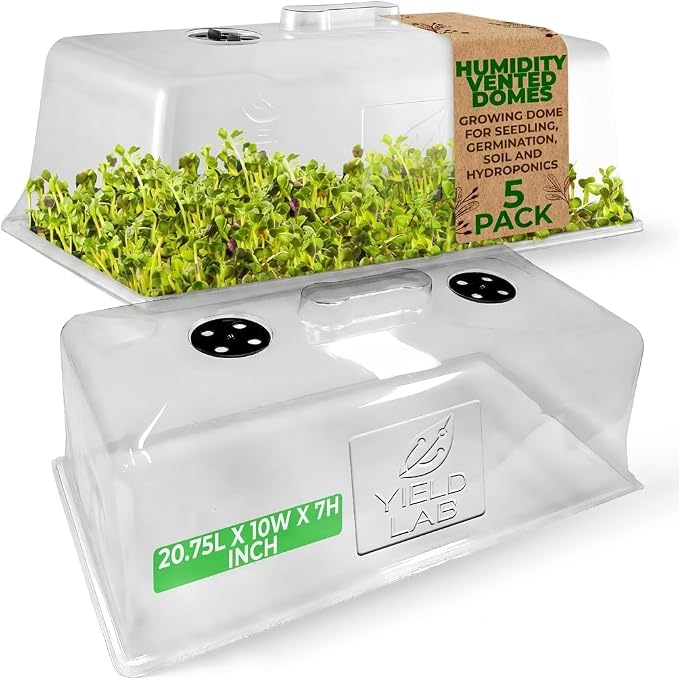
The Yield Lab dome is an established option with a substantial amount of customer-feedback evidence in the supplied data. Its 7-inch height provides room for seeds, clones, and cuttings, while the clear design makes it easy to observe roots, leaves, and moisture without lifting the cover repeatedly.
Adjustable vents give the grower control over temperature and humidity during germination. That is important for moving plants through different stages: a closed or nearly closed environment can support early rooting, while more ventilation can help acclimate developing plants. The product is described as lightweight but durable enough for repeated use, making it suitable for gardeners who do not need a large commercial bundle.
The five-pack is a practical middle option. It gives a home grower several covers without committing to 10 or 20 units, and the domes are compatible with Yield Lab 10-by-20-inch trays and heat mats. However, the package contains domes only; the tray is not included. Anyone building a complete setup should budget for compatible bottom trays or confirm that existing trays match the dome rim.
The thin-wall construction may be easier to handle, but buyers seeking the most reinforced option may prefer BTPLASTIK, ZJP, or another product specifically described as extra thick. Yield Lab remains useful for straightforward propagation, especially when a five-pack and a familiar 7-inch form are more appropriate than a bulk order.
Pros
- 7-inch height accommodates many clones and seedlings.
- Adjustable vents support changing humidity needs.
- Five-pack suits smaller home propagation setups.
- Clear design makes plant monitoring simple.
Cons
- Tray is not included.
- Thin-wall construction may appeal less to buyers wanting maximum reinforcement.
My Opinion
Yield Lab is a practical established-style option for buyers who need only a few tall domes. Its clear fit with compatible trays and heat mats is useful, but the dome-only package and smaller quantity make it less attractive for large propagation operations.
How I Selected These 1020 Humidity Dome Options
The selection centers on the conditions that determine whether a propagation cover is genuinely useful: reliable 1020 tray compatibility, enough vertical room, controllable ventilation, durable construction, and a pack size that matches the grower’s workload. Product descriptions were compared for specific details rather than vague claims about plant performance.
Customer-feedback evidence was considered where supplied, but it was not treated as a substitute for specifications. Yield Lab has a larger stated feedback count, while some other products provide ratings without a listed count. That difference adds context, yet it does not prove that one dome will fit every tray or perform identically in every room.
Brand variety also mattered. The list includes a tall heavy-duty option, a short bulk pack, a four-vent design, a medium-height dome, and a five-pack from an established brand. This makes the comparison more useful than choosing five nearly identical lids.
A good dome is not simply the tallest or cheapest option; it is the one whose height, vents, and tray fit match the plants and growing space.
The ranking favors versatility at the top. BTPLASTIK covers more use cases with tall clearance and sturdy construction, while ZJP ranks second because its compact height and 20-pack are especially valuable for high-volume or rack-based growing.
How to Choose a 1020 Humidity Dome
Start with the tray and shelf, then consider the plants. A dome that fits a standard 10-by-20-inch flat may still be unsuitable if its rim does not seal properly, its height blocks a light, or its vents cannot release enough moisture for the local environment.
- Measure vertical clearance: Compare dome height with rack shelves, lights, and the expected size of seedlings or cuttings.
- Check the tray relationship: Confirm that existing bottom trays, cell inserts, and heat mats are standard 1020 equipment and have a compatible rim.
- Count the vents: More vents can provide finer adjustment, but even two adjustable vents can be useful when operated gradually.
- Match pack size to workload: A five-pack works for a small home setup, while 10 or 20 covers make sense for repeated or commercial cycles.
- Look for reuse-friendly construction: Thicker plastic is generally more appropriate for frequent handling, storage, and repeated cleaning.
Height and plant stage
Short domes are efficient during germination and on compact racks, but they can crowd plants once stems and leaves begin developing. Taller covers delay the need to remove the lid and reduce the chance that foliage touches the plastic.
Height should also be considered alongside light placement. A tall cover may bring leaves closer to a grow light or create a clearance issue under a shelf. Measure the complete setup, including the tray, any cell insert, and the space above the dome.
Ventilation and humidity control
Vents are not an automatic substitute for observation. Begin with limited airflow when seeds or cuttings need a moist environment, then open the vents more as roots and leaves develop. The correct setting depends on room temperature, ambient humidity, plant type, and how much water is in the tray.
Four vents offer more adjustment points, while two vents may be simpler for beginners. Neither arrangement guarantees a perfect environment without regular checks for condensation, wilt, mold, and overly dry media.
Material and durability
Repeated handling is one of the main reasons to consider a stronger dome. Covers are moved for watering, inspection, cleaning, and transplanting, so thin plastic that bends or cracks easily can become frustrating even when the initial purchase cost is low.
Supplied product data describes several models as heavy-duty, extra-strength, or thicker PET, but those descriptions should be interpreted as comparative product information rather than a universal durability guarantee. Inspect the rim, vents, and corners when the package arrives.
How to Set Up a 1020 Humidity Dome
Place the cell tray or propagation medium inside a compatible 10-by-20-inch bottom tray before adding the dome. The cover should sit evenly around the rim rather than resting on one corner, since an uneven fit can allow moisture to escape and make the internal environment inconsistent.
- Moisten the growing medium evenly without leaving standing water.
- Place seeds, cuttings, or clones at the recommended depth or position.
- Set the dome over the tray and check that the vents are installed correctly.
- Begin with limited ventilation when high humidity is appropriate.
- Position the tray where temperature and light can be monitored safely.
- Inspect the plants daily and increase airflow as growth develops.
A heat mat may help maintain suitable warmth, but the dome itself does not regulate temperature. If a mat is used, check the growing medium and the inside of the dome more frequently because added warmth can increase evaporation and condensation.
Using the Dome During Germination and Propagation
A dome works best as a temporary climate-management tool, not a permanent enclosure. Its purpose is to slow moisture loss and create a more stable environment while seeds germinate or cuttings begin rooting.
Condensation on the inside is normal, but heavy dripping can indicate that humidity is higher than necessary. Open the vents slightly, wipe excessive moisture from the lid when needed, and avoid allowing water to pool around delicate stems.
Once seedlings have emerged, light and airflow become increasingly important. Gradually increase ventilation instead of making a sudden change, particularly when the room is dry or the plants have spent several days in a closed environment.
When to remove the dome
There is no single removal day for every crop. Seedlings with visible growth, cuttings beginning to root, and plants showing signs of excess moisture generally need more airflow. Remove or raise the cover in stages when possible so the plants can adapt.
If leaves touch the lid, the plant has likely outgrown the available headroom. A taller model may have allowed more time under cover, but the dome should not be forced onto foliage because contact can trap moisture and damage tender growth.
Compatibility with Trays, Inserts, and Heat Mats
The “1020” format usually refers to a tray family measuring about 10 by 20 inches, but exact rim designs can differ. A dome may sit well on one brand’s bottom tray and less securely on another, especially when the tray is unusually flexible or has a raised edge.
Heavy-duty trays generally provide a more stable base for repeated movement. Cell inserts and plug trays should not rise so high that they press against the dome, and tall plants may need a 6.3-inch, 7-inch, or 7.3-inch cover rather than a 5-inch model.
Heat mats should be sized for the tray and used according to their own instructions. A humidity dome helps retain moisture but does not replace temperature monitoring. Check that cables, thermostats, and electrical connections remain outside wet areas and are not trapped beneath the tray.
Cleaning and Maintenance Tips
Clean domes between propagation cycles to remove algae, mineral residue, old plant material, and soil particles. A clear lid is easier to inspect, and clean vents are less likely to become blocked when the next batch needs airflow.
- Remove loose soil and plant debris before washing.
- Use mild soapy water and a soft cloth rather than abrasive scrubbers.
- Rinse thoroughly so residue does not contact new seedlings.
- Allow the dome to dry completely before stacking or storing it.
- Check vent dials and inserts for cracks, looseness, or blockage.
Avoid aggressive scraping that can cloud the plastic and reduce visibility. Do not stack wet domes together, since trapped moisture can encourage odor or residue and make inspection more difficult.
Storage between seasons
Store clean, dry domes away from direct sunlight, extreme heat, and heavy objects that could bend the rim. If several covers are nested, avoid forcing them together because vents and edges can catch.
Before the next use, inspect every dome for cracks, sharp edges, missing vent parts, or a distorted seal. Replacing one damaged lid is preferable to relying on a cover that cannot maintain a stable environment.
Common Mistakes to Avoid with a Humidity Dome
Most problems come from treating the dome as a set-and-forget container. The cover changes moisture and airflow, so plants need observation as conditions change.
- Choosing by height alone: Extra headroom is useful, but the dome must still fit the rack, tray, and light arrangement.
- Leaving vents closed too long: Constantly high humidity can contribute to weak growth, condensation, or damping off.
- Removing the lid abruptly: A sudden change from saturated air to a dry room can stress young plants.
- Ignoring tray fit: A small mismatch around the rim can reduce humidity retention and make the cover unstable.
- Overwatering under the dome: Reduced evaporation means the medium may stay wet longer than expected.
- Skipping cleaning: Old plant residue and blocked vents can affect the next propagation cycle.
- Forgetting the package contents: Some listings provide domes only, so verify whether trays, inserts, or heat mats are included.
Use the dome to manage conditions, then adjust it as the plants change. The correct setting on day one may be too humid a week later.
Choosing Pack Quantity for Your Setup
Pack quantity should reflect both current needs and realistic future use. A five-pack can be efficient for a windowsill or small grow shelf, while 10 covers provide flexibility for staggered sowing and replacement. A 20-pack makes more sense when several trays are active at the same time.
Extra domes can also reduce downtime between cycles. One batch can be cleaned while another is growing, and a spare cover is useful if a vent or rim becomes damaged. Still, buying a large pack for a single tray may create unnecessary storage work.
For a beginner starting a few varieties, Yield Lab’s five-pack is appropriately scaled. For a serious home garden or small propagation business, BTPLASTIK, MIXC, RooTrimmer, or ZJP provide larger quantities with different height and ventilation priorities.
How to Troubleshoot Condensation and Weak Growth
Condensation by itself is not a failure. Light droplets can indicate that moisture is being retained, but constant dripping, cloudy air, or wet foliage suggests that ventilation should increase.
If the inside is excessively wet
Open one or more vents slightly and check whether the medium is already saturated. Reduce watering frequency if the tray remains wet, and remove the dome briefly when conditions need a larger reset.
If the medium dries too quickly
Confirm that the lid is seated evenly and that the vents are not fully open. Check for strong airflow from a fan or heater, and consider whether the dome is too short or poorly matched to the tray rim.
If seedlings look weak
Weak growth can have several causes, including insufficient light, excess water, poor airflow, or overcrowding. A dome only addresses humidity and limited climate protection; it cannot correct every propagation problem.
FAQS About 1020 Humidity Dome
What is a 1020 humidity dome used for?
It covers a standard 10-by-20-inch propagation tray to help retain moisture and create a more stable environment for germinating seeds, rooting cuttings, cloning, and starting young plants.
Will a 1020 humidity dome fit every 10-by-20-inch tray?
Not necessarily. Many products are designed for standard 1020 trays, but rim shapes and exact dimensions can vary. Check the dome and tray measurements before ordering, especially when mixing brands.
How tall should a 1020 humidity dome be?
Choose height according to the plants and available shelf space. A 5-inch dome is useful for compact racks, while 6.3-inch to 7.3-inch models offer more room for vigorous seedlings, clones, and cuttings.
Do 1020 humidity domes include trays?
Some listings are for the dome only. The Yield Lab product in this comparison specifically states that its tray is not included, so confirm the package contents before purchase.
Should the vents stay open on a 1020 humidity dome?
Vent settings should change with the plants and room conditions. Limited ventilation may suit early germination, while gradually opening the vents can reduce excess moisture during later growth and hardening off.
Can a 1020 humidity dome be used on a heat mat?
Several products in this comparison are described as compatible with 1020 heating mats. Use the mat according to its instructions and monitor the tray, since the dome retains moisture but does not independently control temperature.
How do I clean a 1020 humidity dome?
Remove debris, wash the cover with mild soapy water, rinse thoroughly, and let it dry fully before storage. Check the vents for residue or damage before using the dome again.
Final Thoughts
For most growers, BTPLASTIK 10 Pack 1020 Humidity Domes is the best overall choice because it combines useful height, adjustable ventilation, and sturdy construction. Buyers who need compact rack coverage and a large quantity should choose ZJP 20 Pack Heavy Duty 5″ Humidity Dome for 1020 Seed Starter Trays. The best 1020 humidity dome is ultimately the one that fits both the plants and the growing space.

I’m Maya L. Greenwood, a lifelong plant lover who believes anyone can grow something beautiful with the right guidance. After years of testing soil mixes, pruning methods, irrigation tricks, and pest-safe solutions, I started EasyGardenTips.com to turn hard-won lessons into step-by-step advice. From seed starting and container gardens to composting and seasonal checklists, my goal is to make gardening simple, sustainable, and fun.