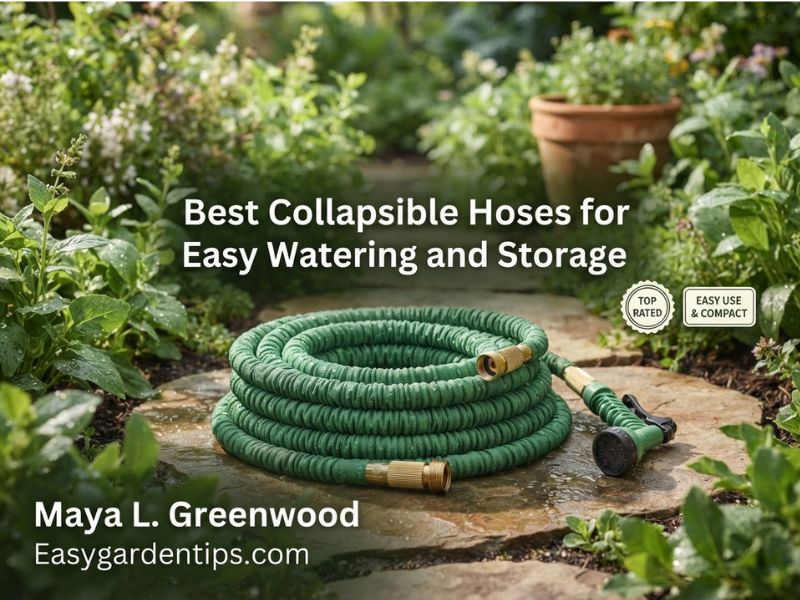
5 Best Collapsible Hoses for Easy Watering and Storage
Are you looking for the best collapsible hoses because a conventional garden hose feels heavy, bulky, or frustrating to store? A good expandable hose can stretch when pressurized, contract when drained, and take up a fraction of the storage space required by a traditional rubber hose.
The right choice still needs more than lightweight construction. I would pay close attention to inner-core construction, outer-sleeve durability, fittings, maximum reach, water pressure requirements, nozzle quality, and storage habits because expandable hoses depend on both flexible materials and water pressure to work properly. Independent testing continues to highlight their portability and compact storage while also showing meaningful differences in fittings and durability.
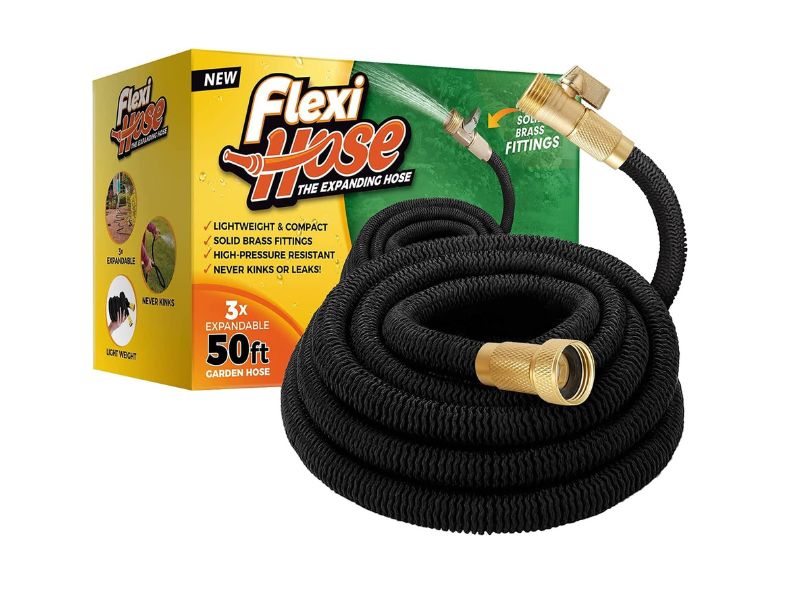
My primary recommendation is the Flexi Hose Expandable Garden Hose 50FT. It uses 3/4-inch solid-brass fittings, a flexible latex core, and an expandable design that grows under water pressure and shrinks after draining, making it a strong everyday option for yards, patios, gardening, and vehicle washing.
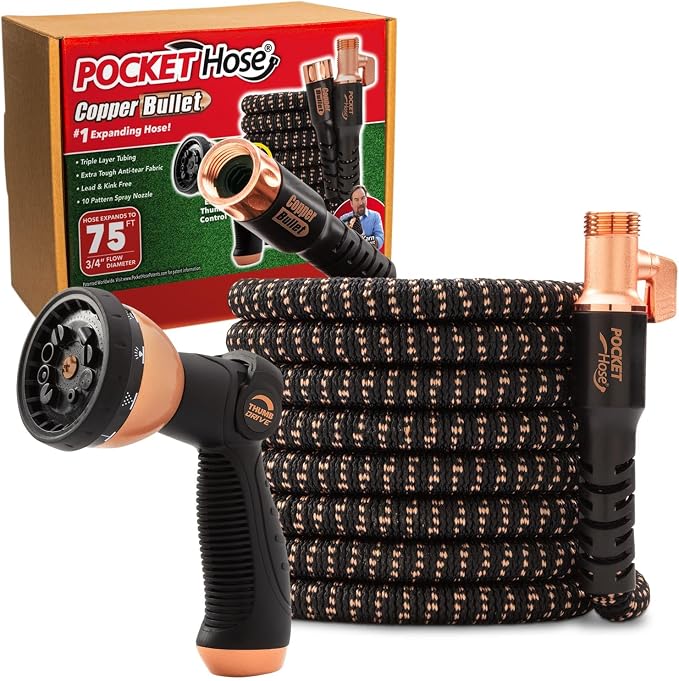
For homeowners who want a newer heavy-duty design with an integrated spray solution, I would choose the Pocket Hose Copper Bullet 50FT. Its current configuration combines a compact expandable body with copper-anodized aluminum fittings, a multi-pattern nozzle, and high-pressure-focused construction. Recent independent testing also rated the Copper Bullet highly for maneuverability, fittings, and spray-nozzle quality.
For a larger property where 50 feet is simply not enough reach, I would choose the J&B XpandaHose 100FT. The 100-foot model uses brass fittings, a lightweight expandable construction, a multi-pattern nozzle, and a listed maximum pressure of 12 bar, while contracting for easier storage after use.
5 Best Collapsible Hoses for Easy Watering and Storage
1. Flexi Hose Expandable Garden Hose 50FT- Best Overall
Key Features
- Expands under water pressure
- Contracts for compact storage
- 3/4-inch solid-brass fittings
- Flexible latex inner core
- Lightweight compared with traditional rubber hoses
- Available in multiple lengths
- Suitable for gardening, patios, and car washing
The Flexi Hose 50FT is my primary recommendation because it captures the main reason people buy collapsible hoses in the first place: it provides useful reach while remaining considerably easier to move and store than a heavy conventional hose.
The construction uses an expandable inner core and protective fabric exterior. Current product information also specifies solid-brass fittings, an important detail because hose ends receive repeated twisting, impact, and connection stress.
Under water pressure, the hose lengthens. After the water supply is shut off and pressure is released, it contracts again.
That gives it several practical advantages:
- Less storage space
- Easier carrying
- Less weight to drag around plants
- Faster cleanup after watering
For a suburban yard, 50 feet is also a useful middle-ground length.
It can handle many jobs around:
- Raised beds
- Flower beds
- Patios
- Driveways
- Cars
- Outdoor furniture
without the extra bulk associated with a 100- or 150-foot hose.
One thing I particularly like about this type of hose is how easy it is to maneuver around garden beds.
Traditional hoses can become heavy when filled with water and may catch on corners, planter edges, and landscaping.
A lighter expandable hose generally requires less effort to pull.
The brass fittings are another strong point.
Expandable hoses often fail first around:
- Connections
- Inner tube near the fitting
- Shutoff components
rather than in the center of an otherwise intact hose.
A sturdy metal coupling does not guarantee permanent durability, but I prefer it to thin plastic connectors for a frequently used outdoor hose.
The Flexi Hose design is also useful if storage is limited.
A 50-foot conventional hose requires a reel, hanger, large coil, or storage container.
A fully drained collapsible hose occupies much less space.
That makes it particularly attractive for:
- Townhouses
- Apartments with patios
- RV storage
- Small garages
- Garden sheds
There is one important limitation with virtually all expandable hoses: water pressure influences their usable length and firmness.
If your water pressure is very low, an expandable hose may not reach its maximum advertised length or may feel less substantial during use.
That is not unique to Flexi Hose; it is inherent to pressure-expanded designs.
I also would not leave it continuously pressurized after finishing a job.
Shut off the spigot, release the remaining pressure through the nozzle, let the water drain, and then store the hose.
That reduces unnecessary stress on the inner core.
What I Like
- Very easy to move
- Compact when drained
- Solid-brass fittings
- Practical 50-foot length
- Good fit for general residential watering
- Easier storage than a conventional hose
What I Do Not Like
- Expansion depends on water pressure
- Fabric-covered hoses need protection from sharp surfaces
- Not my first choice for permanent pressurized installations
The Flexi Hose 50FT is the model I would choose for most homeowners who want a lightweight, easy-to-store replacement for a bulky conventional garden hose.
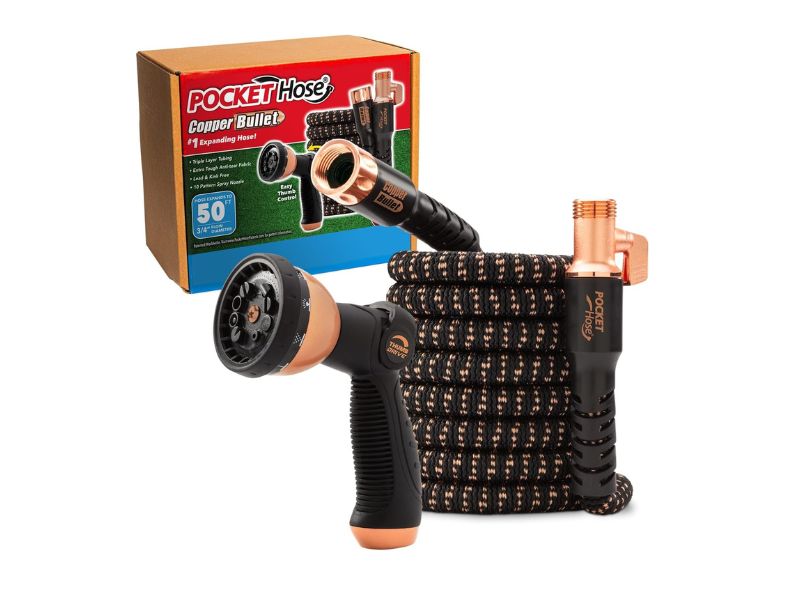
2. Pocket Hose Copper Bullet 50FT- Best With Spray Nozzle
Key Features
- 50-foot expanded length
- Compact expandable design
- Multi-pattern thumb-control nozzle
- Copper-anodized aluminum fittings
- Lightweight construction
- Reinforced flexible tubing
- Designed to resist tangling and kinking
The Pocket Hose Copper Bullet stands out because the complete watering setup is more refined than many inexpensive collapsible hoses.
Independent 2026 testing found the Copper Bullet particularly easy to pull around a yard and praised the quality of its spray nozzle and metal threads. The tested 50-foot version weighed roughly 3.2 pounds and was available in several lengths.
That makes it a good fit if you regularly switch between:
- Watering flowers
- Rinsing outdoor furniture
- Washing a car
- Cleaning a patio
- Watering shrubs
A good nozzle can make a surprisingly large difference.
Cheap trigger nozzles often become the weak point in an otherwise functional hose.
Thumb-control designs are generally easier to operate continuously because you do not have to keep squeezing a trigger for several minutes.
The Copper Bullet also uses a lightweight expandable architecture.
Turn the water on and the hose expands.
Shut the water off, release pressure, and it shrinks.
This makes a 50-foot hose much easier to tuck into a storage area than an equivalent length of conventional rubber hose.
The current 50-foot version also uses metal fittings rather than basic plastic hose ends.
That matters if you frequently attach and detach the hose.
The threaded end repeatedly experiences:
- Hand torque
- Side loading
- Dropping
- Contact with concrete
More substantial fittings can better suit that type of use.
Independent testing is also useful here because expandable-hose marketing often makes very similar durability claims.
HGTV’s 2026 hands-on evaluation found that this model expanded quickly, maintained useful pressure during spraying, and remained easy to maneuver.
I would still treat it as a collapsible hose rather than an indestructible commercial rubber hose.
Avoid:
- Driving over it routinely
- Leaving it pressurized indefinitely
- Dragging it repeatedly over sharp metal edges
- Storing it full of water in freezing weather
Good care can matter just as much as the brand name with expandable hoses.
What I Like
- Excellent included nozzle
- Lightweight and maneuverable
- Compact storage
- Metal fittings
- Practical 50-foot reach
- Strong general-purpose yard versatility
What I Do Not Like
- More complex construction than a basic rubber hose
- Requires draining before compact storage
- Fabric outer jackets can still suffer abrasion
The Pocket Hose Copper Bullet is my preferred option if you want a collapsible hose with a particularly useful spray-nozzle setup rather than buying the hose and sprayer separately.
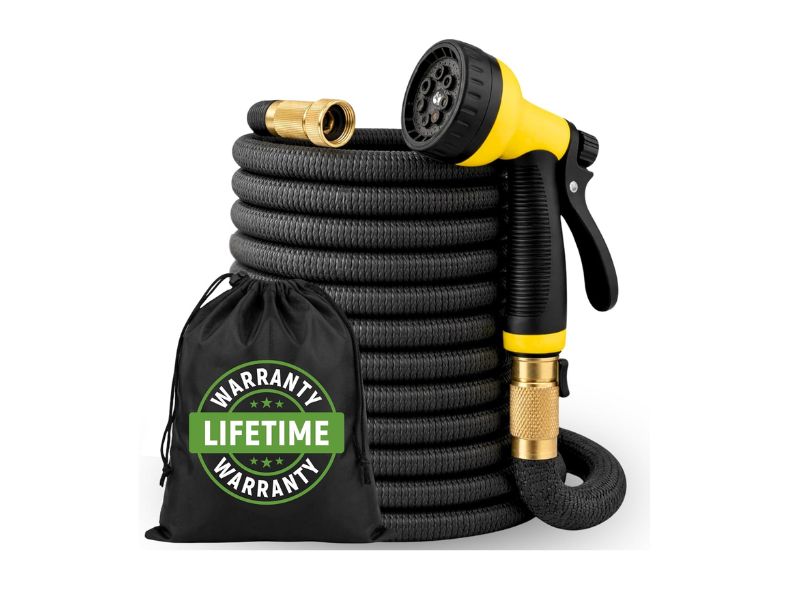
3. J&B XpandaHose 100FT- Best for Large Yards
Key Features
- 100-foot expanded length
- Brass fittings
- Lightweight expandable construction
- Multi-pattern spray nozzle
- Storage bag and accessories
- Listed maximum pressure of 12 bar
- Compact storage relative to its full length
The J&B XpandaHose 100FT is the model I would choose when 50 feet does not reach the entire yard.
Current specification data for this version lists 100 feet of length, approximately 3 pounds of hose weight, brass construction at the fittings, a 12-bar maximum pressure specification, and included watering accessories.
That combination is attractive because a traditional 100-foot hose can become heavy and awkward.
Long hoses are especially inconvenient when you have to carry them:
- Up steps
- Around garden beds
- Across a driveway
- Between front and back yards
An expandable design reduces the amount of hose you physically handle when it is drained.
The 100-foot reach makes more sense for:
- Larger suburban yards
- Long driveways
- Detached garages
- Backyard vegetable gardens
- Multiple garden zones
than purchasing a 50-foot hose and constantly moving the connection point.
The brass fittings are another plus.
When a hose is 100 feet long, users often pull harder on it because the spigot is farther away.
That can increase mechanical stress around the ends.
I still would not use the fittings as handles for dragging the hose.
Pull the fabric-covered hose body gently instead.
The included multi-pattern nozzle adds versatility.
For plant watering, I prefer gentler spray patterns.
For cleaning a driveway or rinsing tools, a concentrated stream is more appropriate.
One caution with a 100-foot expandable hose is pressure.
Longer hoses naturally introduce more flow resistance, and expandable designs also require enough pressure to reach their working length.
If your home has unusually weak outdoor water pressure, a shorter hose may deliver a more satisfying stream.
The XpandaHose is therefore most appealing when you genuinely need the extra distance.
Do not buy 100 feet merely because it sounds better than 50 feet.
Extra length can mean:
- More material to drag
- Greater pressure loss
- More storage bulk
- More opportunity for abrasion
Match hose length to the farthest location you actually need to reach.
What I Like
- Excellent 100-foot reach
- Much easier to store than a traditional long hose
- Brass fittings
- Lightweight construction
- Included nozzle and storage accessories
- Useful for larger properties
What I Do Not Like
- Longer hose can reduce perceived flow
- Needs adequate water pressure to expand properly
- More fabric can contact rough ground
- Unnecessary for small patios or compact yards
The J&B XpandaHose 100FT is my choice for large-yard watering where long reach is essential but a heavy 100-foot conventional hose would be difficult to manage.
4.TheFitLife Expandable Garden Hose 50FT– Best Triple-Core Option
Key Features
- 50-foot working length
- Triple-core latex construction
- Metal fittings
- Multi-pattern spray nozzle
- Lightweight body
- Compact when drained
- Approximately 2.1-pound listed hose weight
- Designed for flexible yard and garden use
TheFitLife 50FT is a strong alternative for buyers who place extra emphasis on the expandable inner tube.
The indexed specification for this exact 50-foot model lists triple-core latex construction, metal fittings, approximately 2.1 pounds of weight, and a maximum pressure specification around 6 bar.
The inner tube matters because it repeatedly expands and contracts.
Every watering session subjects it to:
- Pressure
- Stretching
- Relaxation
- Temperature changes
A multi-layer core is intended to provide more structural support than a very basic single-layer design.
The outer sleeve still matters too.
The textile layer protects the flexible inner tube from:
- Soil
- Pavement
- Light abrasion
- Plant stems
- General handling
but I would not intentionally drag any fabric-covered expandable hose across sharp gravel every day.
For normal household use, the 50-foot length is versatile.
It gives enough reach for:
- Flower beds
- Decks
- Cars
- Small lawns
- Raised-bed gardens
without the pressure and handling compromises of a very long 100- or 150-foot hose.
Its low drained weight is one of its most attractive features.
A lightweight hose can be particularly useful for anyone who dislikes wrestling with thick traditional hose coils.
It also makes end-of-season storage easier.
Drain it, let it contract, and place it in a shaded storage location.
TheFitLife is also supplied with a multi-pattern spray head on common configurations.
That is useful for switching between plant watering and cleaning tasks without changing attachments.
The main consideration is pressure.
Indexed specifications indicate that pressure is important for achieving proper extension, and owners with lower-pressure water systems may not see the same working length as users on stronger municipal supplies.
That is worth thinking about if your property uses a well pump with relatively low pressure.
What I Like
- Triple-core latex construction
- Very lightweight
- Metal fittings
- Easy to store
- Useful 50-foot size
- Multi-pattern nozzle setup
What I Do Not Like
- Low water pressure can limit expansion
- Outer fabric still needs protection from abrasion
- Not intended to remain permanently pressurized
TheFitLife 50FT is the collapsible hose I would consider when low weight and a multi-layer expandable core are the main priorities.
5.Aterod Expandable Garden Hose 50FT- Best Compact Value
Key Features
- Approximately 50-foot working length
- Contracts to roughly 17 feet
- Three-layer latex inner core
- Polyester exterior casing
- Solid-brass fittings
- Shut-off valve
- Multi-function spray nozzle
- Roughly 2.8-pound tested weight
The Aterod 50FT is my fifth pick, but it has one particularly valuable advantage: its construction has been examined in hands-on durability testing.
In Bob Vila’s testing, the hose expanded from approximately 17 feet to about 52 feet, used a three-layer latex core, had a protective polyester exterior, and weighed about 2.79 pounds. The fittings were solid brass.
The durability testing was notably demanding.
The tester dragged the pressurized hose around landscaping, struck the fittings against concrete, left it outside in hot weather, and even drove over it during the evaluation without producing a leak.
That does not mean I recommend deliberately driving over your hose.
It does provide useful evidence that the construction is more substantial than the flimsiest expandable designs.
The brass couplings are another reason I like this model.
The tested fittings remained intact after impacts against concrete, and the hose also includes a shutoff control at the end.
That shutoff is convenient when changing accessories because you do not always need to walk back to the spigot first.
The Aterod is also extremely compact after draining.
A 17-foot resting length that grows to around 50 feet means much less hose needs to be stored when water pressure is removed.
That makes it appealing for:
- Small sheds
- RVs
- Patios
- Balconies with outdoor taps
- Garage cabinets
The main weak point identified in testing was the included spray nozzle.
The hose itself tested strongly, while the lightweight plastic nozzle was considered less impressive.
That is not a dealbreaker for me because spray nozzles are easy to replace.
I would rather have a solid hose with an average nozzle than the reverse.
One other limitation is sprinkler use.
Expandable hoses retract when pressure disappears. Hands-on testing noted that this behavior can make them awkward with traditional freestanding sprinklers because the shrinking hose can pull on the sprinkler when water is shut off.
For handheld watering, however, the design works very well.
What I Like
- Triple-layer latex core
- Solid-brass fittings
- Very compact after draining
- Lightweight
- Strong hands-on durability results
- Convenient shutoff valve
What I Do Not Like
- Included nozzle is relatively basic
- Less ideal for fixed sprinklers
- Needs full drainage before storage
- Outer textile layer still deserves careful handling
The Aterod 50FT is my value-oriented choice when you want a lightweight collapsible hose with brass fittings and a proven compact-storage design.
Collapsible Hose Comparison
| Product | Length | Core / Construction | Fittings | Nozzle | Best Use |
| Flexi Hose Expandable Garden Hose | 50 ft | Expandable latex core | Solid brass | Multi-pattern options | Everyday watering |
| Pocket Hose Copper Bullet | 50 ft | Reinforced expandable tubing | Copper-anodized metal | Multi-pattern thumb control | General yard use |
| J&B XpandaHose | 100 ft | Expandable flexible core | Brass | Multi-pattern | Large yards |
| TheFitLife Expandable Hose | 50 ft | Triple-core latex | Metal | Multi-pattern | Lightweight everyday use |
| Aterod Expandable Hose | ~50 ft | Triple-layer latex + polyester | Solid brass | Multi-function | Compact storage |
For most households, I would start with a 50-foot hose because it balances reach, pressure, and portability. A 100-foot model becomes more useful when the extra reach is genuinely needed.
How to Choose the Best Collapsible Hose
Understand How a Collapsible Hose Works
Most collapsible garden hoses are really expandable hoses.
Inside is a flexible tube that stretches under water pressure.
Outside is a woven or braided fabric layer that limits and protects that expansion.
When water pressure is released, the elastic inner tube contracts and pulls the outer jacket back toward its resting length. Expandable hoses commonly extend to several times their stored length while remaining much lighter than traditional garden hoses.
Choose the Correct Length
Common choices include:
- 25 feet
- 50 feet
- 75 feet
- 100 feet
- 150 feet
Do not automatically buy the longest hose.
Measure from the spigot to the farthest location where you actually need water.
Then add reasonable maneuvering room.
25 Feet
Best for:
- Patios
- Balconies
- Small driveways
- Tiny gardens
50 Feet
Best for:
- Typical suburban yards
- Raised beds
- Cars
- Patios
- General household watering
This is the length I would choose most often.
75–100 Feet
Best for:
- Larger lots
- Long driveways
- Distant vegetable gardens
- Detached structures
Longer hoses can be more convenient, but pressure loss becomes more noticeable.
Brass Fittings vs Aluminum vs Plastic
I generally prefer brass fittings on collapsible hoses.
Brass tends to provide a sturdy threaded connection and is common on several of the stronger expandable-hose designs here. Flexi Hose, J&B, TheFitLife, and Aterod all use substantial metal fittings on the models reviewed.
Plastic fittings can still work, but they are not my first choice for a hose that will be frequently connected, dropped, or dragged.
Look at the Inner Core
The flexible core does most of the expanding.
Common designs use:
- Latex
- Multi-layer latex
- Similar elastic polymers
Multi-layer construction can improve resistance to pinholes and pressure fatigue, although build quality matters just as much as the number of layers.
The Outer Sleeve Matters
The fabric jacket protects the inner tube.
Look for tightly constructed polyester or similar abrasion-resistant textile.
The jacket needs to withstand ordinary contact with:
- Concrete
- Soil
- Mulch
- Grass
but no expandable hose should be treated like a steel cable.
Water Pressure Is Important
Expandable hoses depend on pressure.
With weak water pressure, the hose may:
- Expand less
- Feel soft
- Deliver reduced nozzle performance
- Fall short of its rated working length
If your outdoor tap has particularly low pressure, a conventional lightweight hose may be a better fit.
Collapsible Hose vs Traditional Garden Hose
A collapsible hose is better when you prioritize:
- Low weight
- Compact storage
- Easy carrying
- Reduced kinking
A conventional hose remains better when you need:
- Maximum long-term ruggedness
- Continuous pressurization
- High-volume flow
- Permanent outdoor installation
Expandable hoses are convenience tools first.
Are Collapsible Hoses Durable?
Good models can be durable, but their construction is inherently more complex than a simple rubber hose.
They contain a flexible inner tube that repeatedly stretches and contracts.
To maximize life:
- Release pressure after use
- Drain the hose
- Store it out of strong sunlight
- Keep it away from sharp surfaces
- Protect it from freezing conditions
Should You Leave an Expandable Hose Pressurized?
I would not.
Once watering is finished, shut off the spigot and release the remaining water through the nozzle.
This lets the hose contract and removes continuous internal pressure from the flexible core.
Drain the Hose After Every Use
Drainage is especially important before storage.
A drained hose:
- Contracts properly
- Weighs less
- Stores smaller
- Retains less water that could freeze
This habit takes only a few seconds.
Do Collapsible Hoses Kink?
They tend to kink less dramatically than thick vinyl hoses because the pressurized inner tube straightens itself.
However, no hose is literally impossible to twist.
A collapsed hose can still become tangled during storage if it is thrown into a pile carelessly.
Can You Use a Collapsible Hose With a Sprinkler?
You can in some setups, but expandable hoses are less convenient for certain freestanding sprinklers.
When the water shuts off, the hose contracts.
Testing of expandable designs has shown that this contraction can pull a lightweight sprinkler out of position.
For permanent lawn sprinkling, I would generally choose a conventional hose.
Are Collapsible Hoses Good for Car Washing?
Yes.
Their low weight and flexibility make them especially pleasant to move around a vehicle.
A hose that is easier to handle is also less likely to drag a heavy coil across the driveway.
Use an appropriate spray nozzle and keep metal fittings from striking painted surfaces.
Are They Good for Vegetable Gardens?
Yes.
Expandable hoses work particularly well for:
- Raised beds
- Container gardens
- Greenhouse watering
- Hand watering
Use a gentle shower pattern around seedlings and loose soil.
Are They Good for Seniors?
The low drained weight can be a major advantage for anyone who finds conventional hoses difficult to lift or coil.
A lightweight collapsible hose requires much less physical handling after watering.
Are Collapsible Hoses Safe in Winter?
Do not leave water inside a hose during freezing conditions.
Drain it fully and store it in a protected location.
Water expands when it freezes and can damage hose components and fittings.
Store It Out of Direct Sun
UV exposure and heat can age flexible polymers and fabrics.
After draining the hose, store it:
- In a shed
- In a garage
- In a storage bag
- On a shaded hanger
rather than leaving it stretched across a sunny driveway permanently.
Do Not Drag It Across Sharp Surfaces
Fabric protects the inner core from normal handling, but sharp metal, rough masonry edges, thorns, and repeated gravel abrasion can eventually damage the outer sleeve.
Lift or guide the hose around especially rough obstacles.
Watch the Fittings
Before each season, check:
- Washers
- Threaded connections
- Shutoff valves
- Nozzle threads
A worn washer can create a leak that looks much more serious than it actually is.
Replacing an inexpensive gasket may solve the problem.
Common Collapsible Hose Mistakes
Buying Too Much Length
Extra hose means extra friction and handling.
Leaving It Pressurized
Drain and contract it after use.
Storing It Wet in Freezing Weather
Fully drain the hose before winter storage.
Pulling It by the Fittings
Pull gently on the hose body instead.
Dragging It Across Sharp Gravel
Protect the fabric exterior.
Assuming It Will Expand Without Pressure
Low-pressure systems may produce less reach.
Using the Wrong Hose for a Permanent Sprinkler
A conventional hose may be more stable.
Leaving It in Direct Sun All Year
Shaded storage can help preserve flexible materials.
Frequently Asked Questions
What are the best collapsible hoses?
Flexi Hose, Pocket Hose Copper Bullet, J&B XpandaHose, TheFitLife, and Aterod are strong choices.
Each provides pressure-based expansion and compact storage, but they differ in fittings, length, inner-core design, and included accessories.
What is the best collapsible hose overall?
Flexi Hose 50FT is my primary recommendation for most everyday residential watering.
It combines a practical length, lightweight expandable construction, and solid-brass fittings.
What is the best collapsible hose for a large yard?
J&B XpandaHose 100FT is my choice when extra reach is genuinely necessary.
Its 100-foot length provides substantially more coverage while remaining lightweight when drained.
What is the best compact collapsible hose?
Aterod 50FT contracts to roughly 17 feet while expanding to about 50 feet under pressure.
That makes it particularly easy to store in small garages, sheds, or RV compartments.
Are expandable hoses worth buying?
Yes, when low weight and compact storage matter more than maximum heavy-duty durability.
They are particularly convenient for everyday watering, patio cleaning, and vehicle washing.
How long do expandable hoses last?
Service life depends heavily on construction, pressure, abrasion, sunlight, and storage.
Draining the hose and protecting it from prolonged weather exposure can help reduce unnecessary material stress.
Do expandable hoses really reach their advertised length?
They can, but adequate water pressure is required to reach full extension.
Low-pressure systems may produce shorter usable length or reduced firmness.
Why does my expandable hose not fully expand?
Insufficient water pressure is one of the most common reasons.
Check that the spigot is fully open, the nozzle is closed during initial expansion, and there are no restrictive valves or clogged fittings.
Are brass fittings better?
I generally prefer brass because it provides a sturdy threaded connection for repeated outdoor use.
Several of the stronger models here use brass couplings.
Can collapsible hoses kink?
They can twist, but pressure-expanded designs generally resist traditional hose kinking well.
Proper storage also helps prevent tangling when the hose is empty.
Can I leave an expandable hose outside?
Occasional outdoor exposure is expected, but long-term shaded storage is better.
Continuous sun, freezing conditions, and abrasion can accelerate wear.
Can I leave an expandable hose under pressure?
I would release the pressure after every use rather than leaving it continuously pressurized.
This also lets the hose contract for compact storage.
Are expandable hoses good for washing cars?
Yes, their light weight makes them easy to move around a vehicle.
Just keep metal fittings from striking paint or body panels.
Are collapsible hoses good for gardening?
Yes, they work particularly well for hand watering beds, containers, and landscaping.
A multi-pattern nozzle lets you choose a gentle shower for plants or a stronger stream for cleaning.
Are expandable hoses good for sprinklers?
They can work, but retracting hoses are less ideal for lightweight freestanding sprinklers.
As pressure drops, contraction may move the sprinkler.
Is a 50-foot hose long enough?
For many suburban homes, 50 feet provides the best balance of reach and easy handling.
Measure your actual yard before deciding.
Is a 100-foot expandable hose worth it?
Yes, if the farthest watering point genuinely requires that reach.
For smaller yards, the additional length can create unnecessary pressure loss and handling.
How do you store a collapsible hose?
Drain it completely, allow it to contract, and keep it in a dry shaded location.
A storage bag, hanger, or small bin works well.
Can expandable hoses freeze?
Water trapped inside can freeze, so fully drain the hose before cold-weather storage.
Indoor or frost-protected storage is the safer approach in freezing climates.
Why is my collapsible hose leaking at the faucet?
A worn, missing, or poorly seated washer is a common cause of connection leaks.
Check the gasket before assuming the hose itself has failed.
Which collapsible hose should I buy?
Choose Flexi Hose for general use, Pocket Hose for the nozzle, or J&B for long reach.
TheFitLife emphasizes multi-layer construction, while Aterod is a strong compact-storage alternative.
Conclusion
The best collapsible hoses make routine watering easier by solving two of the biggest problems associated with conventional garden hoses: weight and storage bulk. I would focus on realistic length, metal fittings, inner-core construction, outer-sleeve durability, water-pressure requirements, and proper drainage rather than choosing only by the largest advertised length.
The Flexi Hose Expandable Garden Hose 50FT remains my primary recommendation. Its practical 50-foot size, solid-brass fittings, flexible expandable construction, and compact stored footprint make it a strong match for most gardens, patios, and driveways.
The Pocket Hose Copper Bullet 50FT is my preferred alternative when nozzle quality and maneuverability matter. Its lightweight construction and integrated multi-pattern sprayer make it especially convenient for frequent mixed watering and cleaning jobs.
The J&B XpandaHose 100FT is the option I would choose for a larger property where 50 feet simply will not reach.
The TheFitLife 50FT adds a lightweight triple-core design, while the Aterod 50FT combines triple-layer latex construction, brass fittings, and exceptionally compact storage.
For most homes, I would choose Flexi Hose 50FT. For the most convenient spray setup, I would choose Pocket Hose Copper Bullet. For a large yard, I would choose J&B XpandaHose 100FT.

I’m Maya L. Greenwood, a lifelong plant lover who believes anyone can grow something beautiful with the right guidance. After years of testing soil mixes, pruning methods, irrigation tricks, and pest-safe solutions, I started EasyGardenTips.com to turn hard-won lessons into step-by-step advice. From seed starting and container gardens to composting and seasonal checklists, my goal is to make gardening simple, sustainable, and fun.