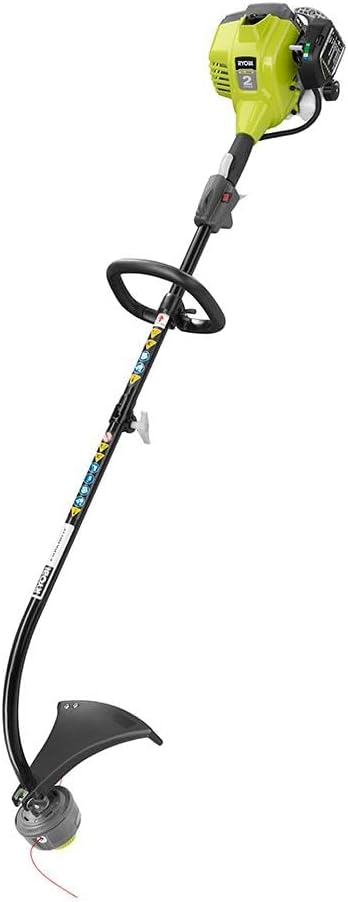
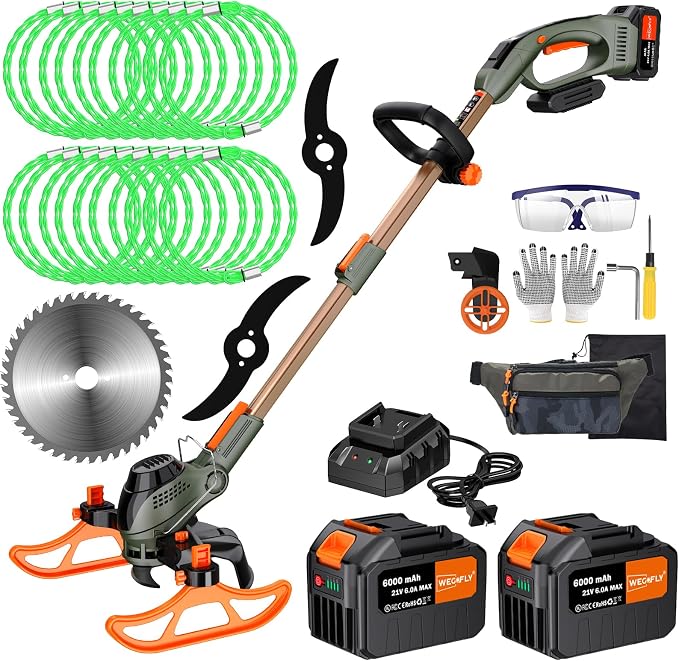
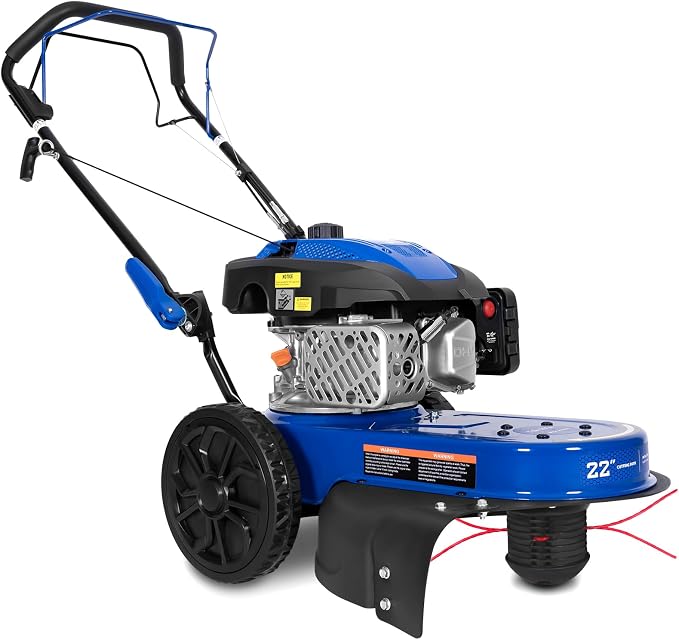
5 Best String Trimmer Brush Cutter Combo Picks for Tough Yards
The best string trimmer brush cutter combo should let you maintain normal lawn edges with nylon line, then switch to a metal brush cutter blade when grass turns into thick weeds, brambles, or woody growth. The best models combine sufficient power, a straight shaft, dependable cutting attachments, and comfortable weight distribution.
My top overall recommendation is the WILD BADGER POWER 26cc 3-in-1 String Trimmer & Brush Cutter. It pairs a 17-inch string trimmer/edger with a 10-inch brush cutter, uses a full-crank 26cc 2-cycle engine, includes a shoulder strap, and has a much larger ownership history than many competing combo tools.
For thicker weeds and more demanding clearing, the PROYAMA 42.7cc 3-in-1 Gas Weed Wacker & Brush Cutter is my heavy-duty pick. Its 42.7cc 2-cycle engine, handlebar controls, double shoulder harness, string head, and multiple metal blades make it better suited to substantial vegetation.
If you want gas power without mixing gasoline and 2-cycle oil, choose the SENIX GTBCU4QL-M 31cc 4-Cycle Brush Cutter & String Trimmer. Its 4QL 4-cycle engine, 17.7-inch string cutting width, 10-inch brush blade, straight shaft, and .095-inch bump-feed line provide a practical middle ground between light trimming and brush clearing.
5 Best String Trimmer Brush Cutter Combo Picks for Tough Yards
| Image | Product Name | Check Price |
|---|---|---|
Best Choice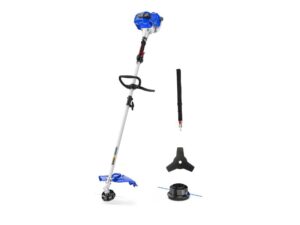 | WILD BADGER POWER 26cc 3-in-1 String Trimmer & Brush Cutter | Check Price |
Second Best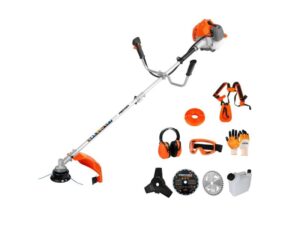 | PROYAMA 42.7cc 3-in-1 Gas Weed Wacker & Brush Cutter | Check Price |
Third Choice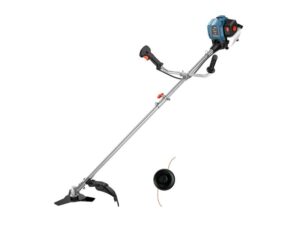 | SENIX GTBCU4QL-M 31cc 4-Cycle Brush Cutter & String Trimmer | Check Price |
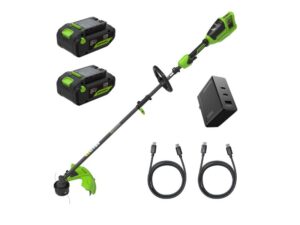 | Greenworks 48V Cordless 2-in-1 Grass Trimmer & Brush Cutter | Check Price |
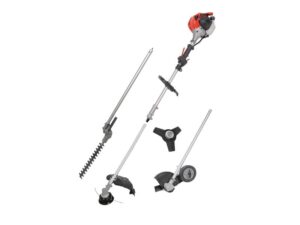 | PRORUN PPCK2 25.4cc 4-in-1 Multi-Tool Combo- Best Multi | Check Price |
What Makes a Good String Trimmer Brush Cutter Combo?
A combo tool needs to perform two very different jobs.
A string trimmer head uses flexible nylon line and is ideal for grass, lawn edges, weeds beside fences, trees, landscaping, and places where a metal blade would be too aggressive.
A brush cutter blade is rigid metal. It is intended for thicker weeds, stalks, dense vegetation, and—in some cases—light woody growth.
That means the strongest combo tools need enough torque to operate both effectively while also providing the correct blade guard, shaft, gearbox, handle, and harness.
I prioritized:
power output, cutting width, included brush blade, trimmer-line diameter, shaft design, ergonomics, starting system, fuel or battery convenience, attachment versatility, buyer history, and overall value.
Best String Trimmer Brush Cutter Combo
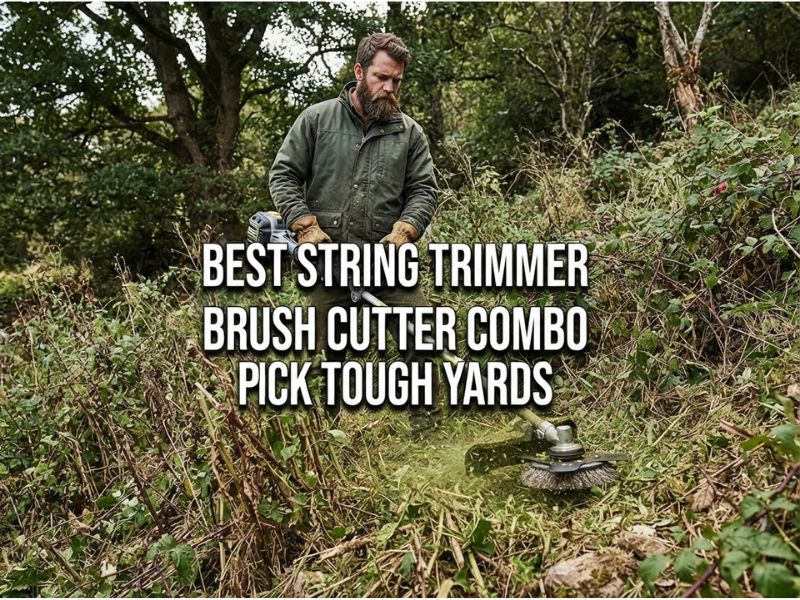
1. WILD BADGER POWER 26cc 3-in-1 String Trimmer & Brush Cutter- Best Overall
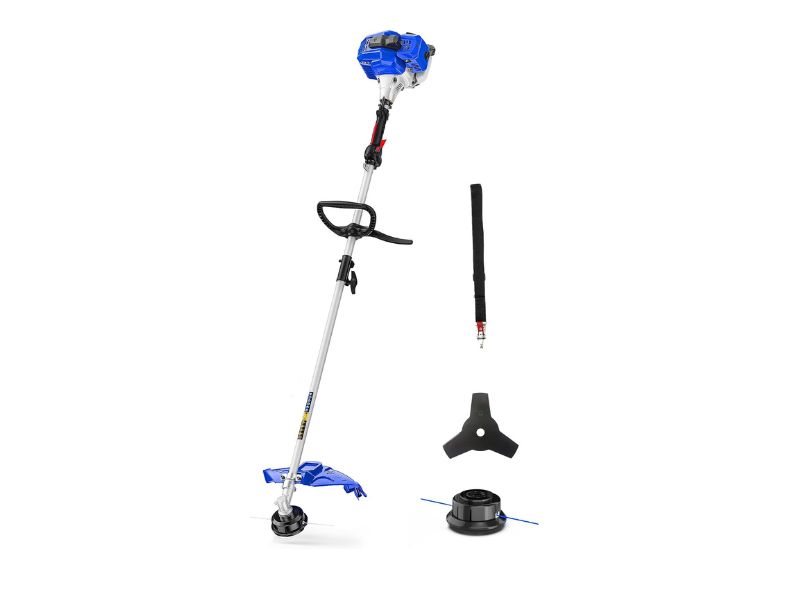
The WILD BADGER POWER 26cc combo earns my top position because it gives homeowners the essential tools they actually need without turning the machine into an overly complicated multi-tool.
Its 26cc full-crank 2-cycle gas engine powers a 17-inch string trimmer/edger and a 10-inch brush cutter blade. The system uses a straight-shaft layout and includes a shoulder strap to help support the machine during longer cutting sessions.
That 17-inch trimming swath is substantial.
For normal lawn maintenance, it lets you move quickly along fences, driveways, trees, and property boundaries rather than making repeated narrow passes.
When the vegetation becomes too thick for nylon line, you can change to the 10-inch metal brush cutter.
That is where the combo format becomes useful.
Instead of buying one machine for lawn trimming and a second engine-powered tool for clearing weeds, one power unit handles both.
The full-crank engine is another advantage. WILD BADGER POWER states that the design is intended to provide improved durability and efficiency compared with simpler half-crank engines. The company also specifies easy-start operation and a tool-free air-filter cover for routine maintenance.
Its ownership history is one of the strongest reasons I ranked it first.
Current indexed product data shows several thousand ratings associated with the B07TSND3VC listing, giving it considerably more user history than many inexpensive combination brush cutters.
The system is also attachment capable.
That gives owners an upgrade path if they later decide they need additional compatible yard-care attachments.
There is a trade-off.
A 2-cycle gas engine requires correct fuel and oil mixing, plus the normal maintenance associated with spark plugs, air filters, carburetors, and fuel storage.
It is also noisier and produces more vibration than a cordless electric model.
But for homeowners who want one proven gas-powered machine for grass trimming, edging, thick weeds, and occasional brush, the WILD BADGER POWER provides the best overall combination.
2. PROYAMA 42.7cc 3-in-1 Gas Weed Wacker & Brush Cutter- Best for Heavy Brush
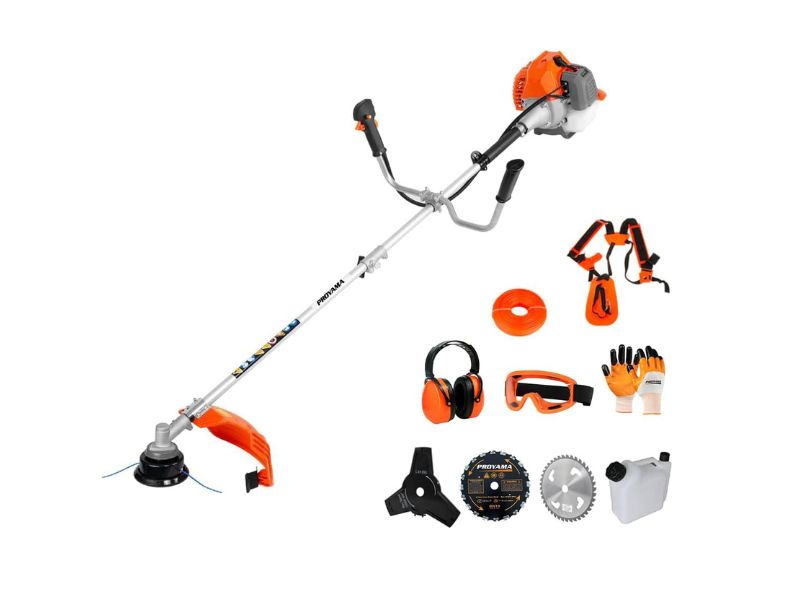
The PROYAMA PBC43 is the machine I would choose when brush cutting matters at least as much as ordinary lawn trimming.
Its 42.7cc 2-cycle engine is substantially larger than the 26cc engine in my first-place recommendation.
Current specifications describe approximately 2 horsepower, a wide string-trimming path, and a system designed to function as a weed eater, grass trimmer, and brush cutter.
The package is particularly attractive because it includes more than a simple string spool.
Current product information lists both 3-tooth and 40-tooth blades, giving you different cutting profiles for dense grass and harder woody vegetation.
The three-tooth blade is the type I would use for coarse weeds, tall grass, and dense non-woody vegetation.
The higher-tooth-count blade is more appropriate when the job involves firmer stems and brush, provided you follow the manufacturer’s operating limits.
A bike-style handlebar provides two-handed control.
That is especially important on a high-displacement brush cutter because the machine develops more rotational force than a small residential string trimmer.
PROYAMA also includes a double shoulder harness.
Instead of supporting the entire tool with your arms, the harness transfers a significant portion of the weight to your shoulders and torso.
That makes wide sweeping cuts easier and helps maintain a consistent blade position.
The shaft can also separate for storage and transportation.
Buyer history is respectable as well, with more than a thousand indexed ratings appearing for the PBC43 platform in current product data.
The primary disadvantage is weight.
A 42.7cc gas engine, metal shaft, handlebar system, cutting head, and fuel tank naturally create a heavier tool than a small 25cc trimmer.
If your only job is maintaining grass beside a suburban driveway, this is more equipment than necessary.
If your property regularly contains thick weeds, brush, overgrowth, coarse grass, and neglected vegetation, the extra power makes much more sense.
3. SENIX GTBCU4QL-M 31cc 4-Cycle Brush Cutter & String Trimmer- Best 4-Cycle Combo
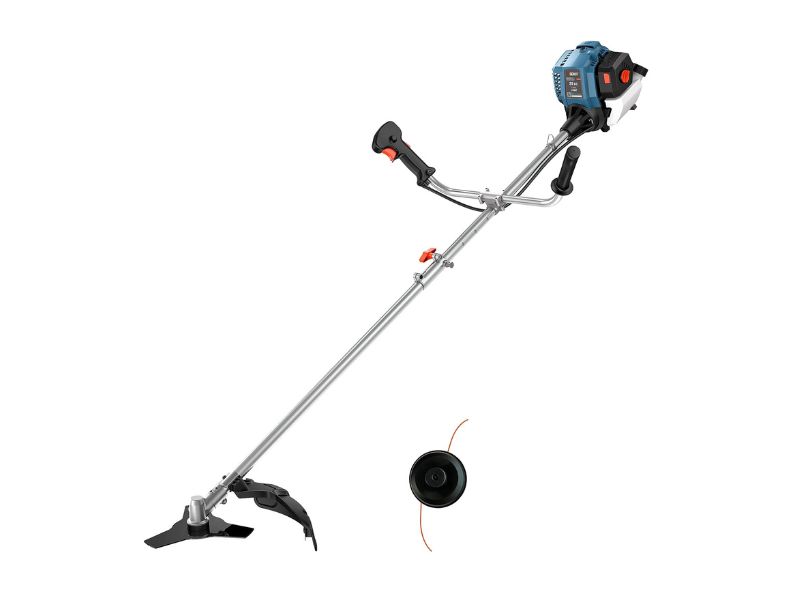
The SENIX GTBCU4QL-M has one major advantage over most inexpensive gas brush cutters: it uses a 4-cycle engine.
That means gasoline and engine oil are stored separately.
You do not need to calculate and prepare a gasoline-to-2-cycle-oil mixture every time you refuel.
The 31cc 4QL full-crank engine powers a 17.7-inch string-trimmer swath and a 10-inch brush cutter blade. SENIX specifies dual .095-inch spiral line with bump feed for regular trimming.
The .095-inch line is important.
Many lightweight residential battery trimmers use .065-inch line, which works well for maintained turf but wears quickly in coarse weeds.
A .095-inch line gives the SENIX considerably more durability in dense grass and heavier lawn vegetation.
When that is no longer enough, you can install the included 10-inch brush blade.
SENIX’s 4QL lubrication technology is also designed to keep the engine lubricated when operated at different angles, helping reduce the positional restrictions commonly associated with some traditional 4-cycle designs.
That is particularly useful on slopes, ditch edges, and uneven ground.
The machine uses a straight 57-inch shaft and D-style front handle.
The straight shaft provides better reach under fences, shrubs, and landscape obstacles compared with short curved-shaft trimmers.
Weight is approximately 15.5 pounds according to current specifications.
That is not especially light, but the additional weight is understandable for a 31cc 4-cycle power unit.
The maximum speed is listed around 7,000 RPM.
The biggest reason to choose this SENIX instead of the PROYAMA is ease of fuel management.
If you dislike premixing fuel but still want gas-powered runtime, rapid refueling, thick .095-inch trimmer line, and a real metal brush blade, the SENIX is a particularly convenient option.
4. Greenworks 48V Cordless 2-in-1 Grass Trimmer & Brush Cutter- Best Cordless
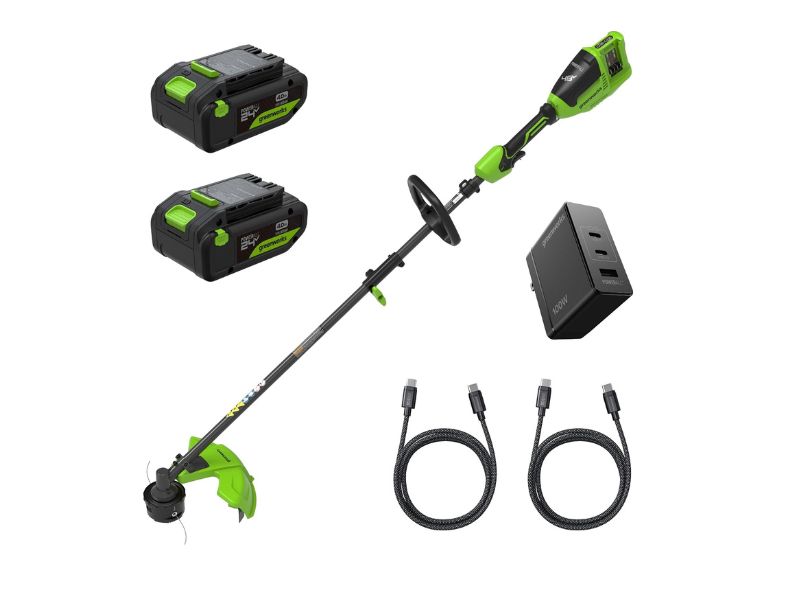
The Greenworks 48V 2-in-1 is the obvious choice for homeowners who want brush-cutting capability but would rather avoid gasoline entirely.
Instead of a combustion engine, it uses two Greenworks 24V lithium-ion batteries together to create a 48V operating platform.
The high-efficiency brushless motor drives both a string-trimmer head and a metal brush-cutter head.
In string-trimming configuration, the cutting width is approximately 38 cm, or about 15 inches.
Switch to the brush blade and cutting diameter is approximately 25 cm, or about 10 inches.
Those dimensions are well matched to residential and light acreage work.
The 15-inch string head covers enough ground for routine mowing cleanup, while the blade gives you a tool for thicker weeds and small shrubs that would overwhelm normal nylon line.
The motor provides up to approximately 6,300 RPM, with a variable-speed trigger and two operating speeds.
That lets you reduce speed during easy grass trimming and increase output when vegetation becomes heavier.
The adjustable U-style handle is another important feature.
Brush cutting requires more control than ordinary edging, and the two-handed arrangement makes it easier to guide the cutting head through dense vegetation.
The major advantage, though, is maintenance.
There is no:
fuel mixing, gasoline storage, carburetor, spark plug, exhaust, pull cord, or warm-up period.
Install charged batteries and squeeze the trigger.
Noise and vibration are also substantially reduced compared with high-displacement 2-cycle equipment.
One purchasing detail deserves attention: the configuration associated with this model has been sold as a body-only unit, with the two 24V batteries and charger purchased separately. Check the exact package contents before ordering.
For buyers already using Greenworks 24V tools, that may be an advantage because existing compatible batteries can potentially be reused.
For someone starting from zero, include the cost of two batteries and a charger when comparing it against gas machines.
Overall, the Greenworks is the best choice here for quiet operation, instant starting, reduced maintenance, and residential brush clearing.
5. PRORUN PPCK2 25.4cc 4-in-1 Multi-Tool Combo- Best Multi-Tool System
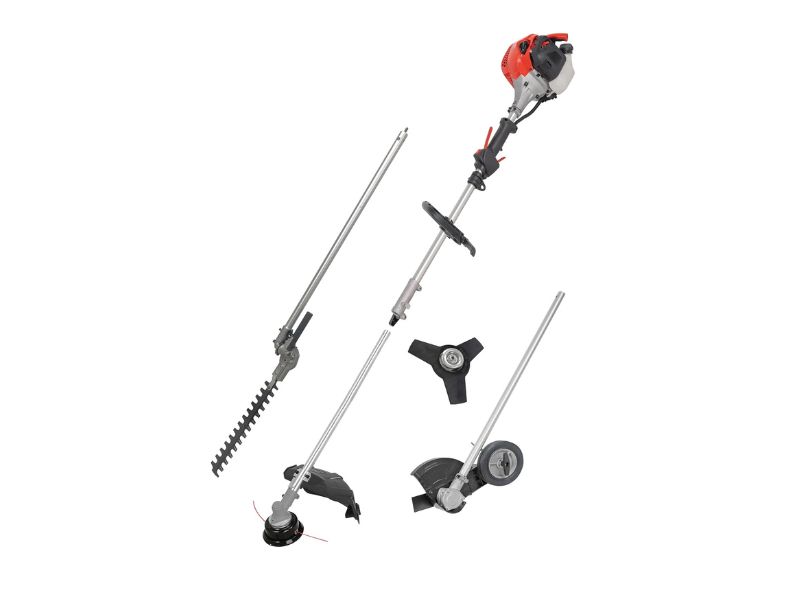
The PRORUN PPCK2 is the most versatile product in this roundup.
Instead of functioning only as a string trimmer and brush cutter, it is a 4-in-1 attachment-capable lawn-care system.
The package includes a 25.4cc gas powerhead plus attachments for string trimming, brush cutting, edging, and hedge trimming.
This makes it particularly attractive when garage space matters.
Four separate gasoline tools would require four engines, four fuel systems, considerably more storage space, and substantially more maintenance.
With the PRORUN, the engine remains the same and you swap the working attachment.
The 25.4cc 2-cycle engine is smaller than the PROYAMA’s 42.7cc unit.
That makes it less specialized for extremely heavy brush, but better balanced as a general residential multi-tool.
The quick-connect attachment system is designed so each head can be installed or removed without a long mechanical setup.
For normal maintenance, install the string head.
When weeds become too thick for line, install the brush cutter.
For sidewalk edges, use the edger.
When hedges need shaping, attach the hedge trimmer.
PRORUN also includes a harness to help support the system during extended work.
The company backs its current system with a 3-year residential and 1-year commercial limited warranty.
Current indexed product data shows the PPCK2 at approximately 24 pounds when the complete packaged system is considered, although operating weight varies with the installed attachment.
Its buyer history is smaller than the WILD BADGER POWER and PROYAMA models.
That is why I ranked it fifth rather than higher.
Still, if your goal is to buy one engine platform and cover several lawn-care jobs, the attachment versatility makes the PRORUN an appealing solution.
String Trimmer Brush Cutter Combo Comparison
| Product | Power Source | Engine/Voltage | String Cutting Width | Brush Cutter | Best For |
| WILD BADGER POWER 26cc | Gas | 26cc 2-cycle | 17 in. | 10 in. | Best overall |
| PROYAMA PBC43 | Gas | 42.7cc 2-cycle | ~18–19 in. class | Multiple blades | Heavy brush |
| SENIX GTBCU4QL-M | Gas | 31cc 4-cycle | 17.7 in. | 10 in. | No fuel mixing |
| Greenworks 48V | Battery | 48V brushless | ~15 in. | ~10 in. | Cordless convenience |
| PRORUN PPCK2 | Gas | 25.4cc 2-cycle | Full-size attachment | Included | Multi-tool versatility |
Gas vs Cordless Brush Cutter Combo
The biggest decision is whether you want gasoline or lithium-ion batteries.
Gas still makes sense for large properties.
You can carry extra fuel and refill in minutes instead of waiting for batteries to charge.
Higher-displacement gas engines also provide strong sustained power for thick vegetation.
The disadvantages are maintenance and noise.
Two-cycle machines require correct fuel mixing, while four-cycle engines need separate oil maintenance.
Both produce exhaust and require fuel storage.
Battery machines are simpler.
There is no choke, primer bulb, carburetor, spark plug, or gasoline.
For a normal residential property, the convenience can easily outweigh the shorter runtime.
The Greenworks is particularly attractive if you already own compatible 24V battery packs.
2-Cycle vs 4-Cycle Gas Engines
A 2-cycle engine produces strong power relative to its size and keeps mechanical design relatively simple.
WILD BADGER POWER, PROYAMA, and PRORUN use this approach.
The drawback is fuel preparation.
Gasoline must be mixed with the correct quantity and type of 2-cycle oil.
Never assume every machine uses the same ratio.
Follow the specification printed in your owner’s manual.
A 4-cycle engine such as the SENIX stores gasoline and lubricating oil separately.
This makes refueling more familiar and eliminates premixing.
The trade-off is additional engine complexity and usually somewhat more weight.
26cc vs 31cc vs 42.7cc
Engine displacement gives a rough idea of the machine’s physical size and power potential.
A 25–26cc engine is an excellent residential compromise.
It provides enough power for string trimming and occasional brush cutting without the weight of a very large engine.
A 31cc engine moves toward heavier work while remaining manageable.
The SENIX combines this displacement with its 4-cycle architecture.
A 42.7cc engine is a different class.
The PROYAMA is better suited to substantial weeds and regular brush clearing but will be heavier and more tiring for casual edging.
Buy for the vegetation you actually have—not the largest engine number on the page.
Straight Shaft Is Better for a Brush Cutter
All serious brush-cutter combos should provide a shaft and gearbox designed to transmit blade forces safely.
A straight shaft also gives you better reach beneath:
shrubs, fences, decks, benches, and low vegetation.
More importantly, straight-shaft machines are commonly engineered around gearboxes capable of operating metal cutting blades.
Do not attempt to install an aftermarket brush blade onto an ordinary lightweight curved-shaft string trimmer unless the manufacturer explicitly approves that configuration.
String Head for Grass
The string trimmer head should remain your default attachment for ordinary lawn work.
Flexible nylon line is safer around:
trees, fence posts, landscape edging, masonry, sidewalks, and other obstacles.
Most of the machines here use bump-feed line systems.
SENIX specifically uses dual .095-inch line, which is thick enough for more demanding residential vegetation.
A string head is also much less likely to produce severe kickback when it contacts an unseen obstacle.
Brush Blade for Heavy Vegetation
Switch to the metal blade when nylon line becomes inefficient.
Good brush-blade applications include:
dense weeds, tall stalks, brambles, heavy grass, thick vegetation, and light woody stems within the manufacturer’s limits.
Metal blades require more attention to safety.
Inspect the work area for rocks, fencing, wire, metal posts, irrigation hardware, and debris before cutting.
A metal blade rotating at several thousand RPM can throw objects with significant force.
Why the Harness Matters
A shoulder strap or harness is not merely a comfort accessory.
Brush cutters are heavier than ordinary lawn trimmers, and metal blades work best when held at a controlled height and angle.
A harness transfers part of the machine’s weight from your arms to your shoulders.
It also helps stabilize the cutting head when sweeping through vegetation.
WILD BADGER POWER, PROYAMA, and PRORUN include support systems with their combo configurations, while other designs use U-handles or shoulder support depending on the package.
For extended brush cutting, I strongly prefer a harness-equipped setup.
Bike Handle vs D-Handle
A bike handle places both hands widely apart.
This gives you excellent leverage when sweeping a heavy brush cutter from side to side.
PROYAMA uses this style and pairs it with a double shoulder harness.
A D-handle is more compact.
It provides better maneuverability for trimming around landscaping and takes less storage space.
SENIX uses the D-handle approach.
For primarily heavy brush cutting, bike handles win.
For a machine that spends most of its time trimming grass, a D-handle can feel more convenient.
How Much Cutting Width Do You Need?
For regular string trimming, approximately 15–18 inches is a strong range.
A wider head covers more lawn during each sweep.
That becomes useful along long fence lines and large properties.
Brush blades are normally narrower.
Approximately 10 inches is common because a metal blade transfers much greater cutting force and produces more rotating mass than flexible nylon line.
Do not install an oversized blade just because the arbor happens to fit.
Use only the blade diameters approved for the machine.
String Trimmer Brush Cutter Combo for Thick Weeds
For genuinely thick weeds, I would choose the PROYAMA first.
Its 42.7cc engine provides considerably more displacement than the 25–31cc machines.
The included metal-blade options also give it more versatility once vegetation becomes too coarse for line.
For moderate weeds, the WILD BADGER POWER provides enough capability while being more practical for normal lawn care.
The SENIX is the better compromise if you want extra gas power without 2-cycle fuel mixing.
Best Combo for Small Residential Yards
For a small maintained yard, heavy gas equipment may be unnecessary.
The Greenworks is much easier to justify if most of the work involves:
grass trimming, edging, occasional tall weeds, and seasonal brush cleanup.
Push-button electric starting is dramatically simpler than maintaining a carbureted gas engine for a tool that might only be used a few times per month.
It is also quieter around neighbors.
Best Combo for Large Properties
For acreage and remote sections of property, gas remains attractive.
Fuel can be carried anywhere and refilled immediately.
The WILD BADGER POWER offers the best general-purpose balance.
The PROYAMA is stronger for genuinely difficult vegetation.
If your property requires trimming, brush cutting, edging, and hedge work, the PRORUN multi-attachment package may reduce how many separate tools you need to transport.
Maintenance Requirements
Gas machines need substantially more maintenance than battery-powered models.
Typical service items include:
air filter cleaning, spark plug inspection, fuel system care, gearbox lubrication, blade inspection, trimmer-line replacement, and proper off-season fuel storage.
Two-cycle models also require correct fuel mixing.
The SENIX eliminates premixing but adds separate engine-oil maintenance.
The Greenworks mainly requires battery care, cleaning, line replacement, and inspection of the blade and cutting head.
Whichever system you choose, never service a cutting attachment while the machine can accidentally start.
Brush Cutter Safety
A metal brush cutter is significantly more aggressive than nylon trimmer line.
Wear eye protection, hearing protection, gloves, long pants, and sturdy closed-toe footwear.
Keep other people and pets well away from the cutting area.
SENIX specifies maintaining approximately 50 feet/15 meters of separation from bystanders during brush-cutter operation.
Inspect the vegetation before cutting.
Hidden wire, rocks, bottles, metal pieces, and fencing can create dangerous projectiles or blade kickback.
Always operate with the manufacturer’s guard installed.
Frequently Asked Questions
What is the best string trimmer brush cutter combo?
WILD BADGER POWER 26cc is my best overall choice for most homeowners.
It combines a 17-inch string trimmer/edger, 10-inch brush cutter blade, 26cc full-crank 2-cycle engine, straight shaft, shoulder support, and strong current buyer history.
Which string trimmer brush cutter combo is best for thick brush?
PROYAMA 42.7cc is my heavy-duty choice.
Its larger 2-cycle engine and multiple metal blade configurations make it better suited to substantial weeds and brush than lower-displacement residential trimmers.
What is the best 4-cycle string trimmer brush cutter combo?
SENIX GTBCU4QL-M is the strongest 4-cycle option in this list.
Its 31cc 4QL engine eliminates premixed fuel while providing a 17.7-inch string head and 10-inch brush blade.
What is the best cordless string trimmer brush cutter combo?
Greenworks 48V is my preferred cordless option here.
It combines a brushless motor, dual 24V battery architecture, approximately 15-inch string cutting path, and approximately 10-inch brush blade.
Is a brush cutter more powerful than a string trimmer?
The power unit may be identical, but the metal blade handles tougher vegetation more effectively.
Nylon line excels at grass and edging. A rigid metal blade transfers cutting force into dense stalks and heavier vegetation.
Can I put a brush cutter blade on any string trimmer?
No. The machine must be specifically designed and approved for metal-blade operation.
The shaft, gearbox, guard, handle, arbor, and operating speed all need to support a blade safely.
Is a straight-shaft trimmer better for brush cutting?
Yes, straight-shaft machines are generally better suited to brush-cutter applications.
They offer additional reach and are commonly designed with gear-drive systems suitable for heavy cutting attachments.
Is 26cc enough for a brush cutter?
Yes, 26cc is sufficient for normal residential brush and thick weeds.
For frequent clearing of extremely dense vegetation, a larger 40cc-class machine can provide additional cutting authority.
Is 42.7cc too much for normal grass trimming?
It can be more power and weight than necessary for a maintained suburban lawn.
A large engine makes sense when heavy vegetation is common. For routine edging, a smaller 25–31cc unit is easier to carry.
Is a 4-cycle brush cutter better than a 2-cycle?
A 4-cycle eliminates fuel mixing, while a 2-cycle usually offers strong power relative to engine weight.
Neither is universally better. Maintenance preference and workload should determine your choice.
Is a battery brush cutter powerful enough?
Modern brushless battery systems can handle dense weeds and moderate brush effectively.
Gas remains convenient for very long sessions because it can be refueled immediately, while battery systems offer easier starting and lower maintenance.
What trimmer line is best for thick weeds?
Around .095-inch line is a strong choice for heavy residential trimming.
It lasts better in coarse vegetation than thin .065-inch line while remaining manageable for many full-size trimmers.
Do I need a harness for a brush cutter?
A harness is highly recommended for heavier machines.
It reduces arm fatigue and improves control over the metal cutting blade during wide sweeping movements.
Can a brush cutter cut small saplings?
Some metal-blade systems can cut light woody stems, but capacity depends on the blade and machine.
Follow the manufacturer’s vegetation and blade limits rather than treating a brush cutter as a chainsaw.
Final Verdict
The best string trimmer brush cutter combo depends primarily on how much of your property is maintained lawn versus genuinely overgrown vegetation.
The WILD BADGER POWER 26cc 3-in-1 is the best overall choice for most homeowners because it combines a full-size string trimmer, brush cutter blade, proven gas engine, shoulder support, and strong buyer history without becoming unnecessarily complicated.
The PROYAMA 42.7cc PBC43 is the better machine when raw cutting capability matters most. Its larger engine, bike handle, harness, and multiple blade options make it particularly suitable for thick weeds and substantial brush.
Choose the SENIX GTBCU4QL-M if you want the refueling convenience of a 4-cycle engine without giving up a genuine metal brush blade and heavy .095-inch trimmer line.
The Greenworks 48V is the best option for buyers who prioritize low maintenance, lower noise, instant electric starting, and cordless convenience.
Finally, the PRORUN PPCK2 makes the most sense when you want one gas engine platform to handle string trimming, brush cutting, edging, and hedge trimming.
For a typical mixed residential property, prioritize a straight shaft, 15- to 18-inch string cutting path, proper metal brush blade, shoulder support, and enough power for your thickest vegetation. Those features matter more than simply choosing the machine with the largest engine or highest voltage.

I’m Maya L. Greenwood, a lifelong plant lover who believes anyone can grow something beautiful with the right guidance. After years of testing soil mixes, pruning methods, irrigation tricks, and pest-safe solutions, I started EasyGardenTips.com to turn hard-won lessons into step-by-step advice. From seed starting and container gardens to composting and seasonal checklists, my goal is to make gardening simple, sustainable, and fun.