5 Best Walk Behind String Trimmer: Best Picks and Key Buying Tips
Finding the best walk behind string trimmer usually comes down to matching cutting power, wheel design, line size, and terrain to the work you actually need to do. These machines are especially useful when tall grass, fence lines, weeds, and light brush make a handheld trimmer too slow or tiring.
My primary recommendation is the BILT HARD Walk Behind String Trimmer because it combines a 170cc four-cycle engine, 22-inch cutting path, steel deck, and flat-free wheels. The SENIX High Wheel Gas Walk Behind Brush is the clear alternative for shoppers who want similar capacity plus adjustable cutting height and a three-year limited warranty.
The five options below were compared by engine capacity, cutting width, line thickness, wheel design, height adjustment, storage features, included accessories, and the practical limitations suggested by the available product information. The ranking favors useful capability for larger, rougher areas rather than simply the lowest weight or simplest design.
Best Walk Behind String Trimmer Picks at a Glance
| Product | Name | Price |
|---|---|---|
 |
BILT HARD Walk Behind String Trimmer | Check Price |
 |
SENIX High Wheel Gas Walk Behind Brush | Check Price |
 |
AMERISUN 22″ Gas Walk Behind String Trimmer | Check Price |
 |
Powersmart 22-Inch 170cc | Check Price |
 |
PROYAMA 170cc Walk Behind Weed Trimmer String | Check Price |
1. BILT HARD Walk Behind String Trimmer
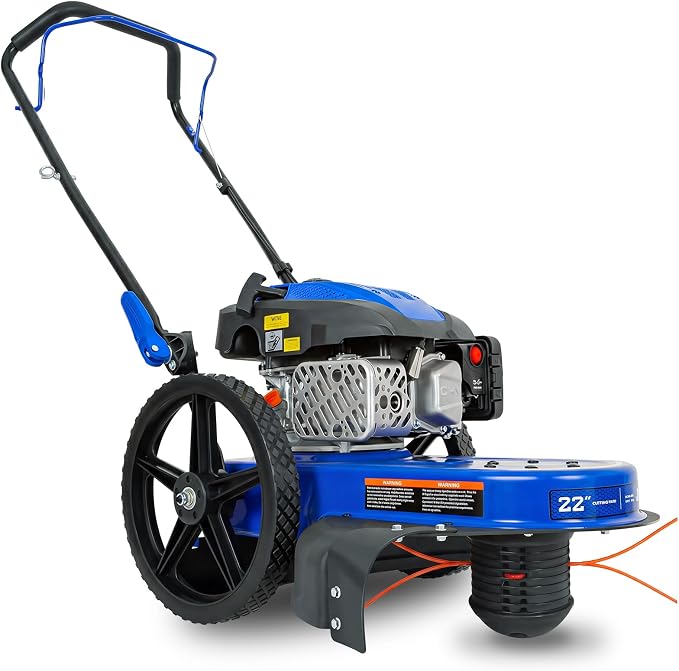
The BILT HARD Walk Behind String Trimmer earns the top position with a strong combination of power, coverage, durability, and access to difficult areas. Its 170cc 4-cycle OHV engine is designed for heavy mowing tasks, while the 22-inch cutting diameter lets you clear a broad path with each pass. That makes it a practical choice for large yards, field edges, fence lines, and overgrown sections where a handheld weed eater would require considerably more time.
A one-piece steel deck gives the machine a sturdier foundation than a lightweight plastic housing, and the heavy-duty nylon line is intended for thick grass and weeds. The 14-inch never-flat wheels are another useful advantage. They eliminate the routine concern of inflating tires and should be well suited to uneven ground, although “all terrain” should not be interpreted as meaning this trimmer is designed for steep slopes or extremely rocky property.
The offset-style access of a walk-behind string trimmer makes it easier to work around obstacles and along fence lines than a conventional mower. BILT HARD also adds a foldable ergonomic handle, which helps reduce the storage footprint and makes the machine easier to place in a shed or garage.
This model is best for property owners who need serious clearing ability but do not need a dedicated brush mower. The trade-offs are the manual recoil start and the ongoing responsibilities of a gasoline engine. You will need to use appropriate fuel, inspect the line, and follow the engine maintenance instructions. Because Amazon does not handle returns of gasoline-related products according to the supplied information, review the seller’s support and return process before purchase.
2. SENIX High Wheel Gas Walk Behind Brush
The SENIX High Wheel Gas Walk Behind Brush is the clearest alternative to the BILT HARD model because it offers nearly the same 22-inch cutting coverage while adding more explicit adjustment and ownership support. Its 160cc four-cycle professional-series engine supplies the power for heavy weeds and brush, and the stated low-vibration, low-emission design should make extended trimming more comfortable than a rougher-running machine.
The included .155-inch line is a substantial choice for thick vegetation. Combined with the 22-inch swath, it allows the trimmer to cover large areas efficiently rather than forcing repeated passes. Fourteen-inch rubber wheels provide clearance and maneuverability across uneven surfaces. They are not flat-free wheels, so owners should expect to monitor tire condition, but rubber wheels can provide a familiar, stable feel during normal yard work.
One of the most useful features is the five-position height adjustment. The cutting range runs from 1.57 to 3 inches, allowing you to choose a shorter cut for maintained areas or a higher setting when moving into taller weeds. This flexibility gives the SENIX a broader operating range than a fixed-height trimmer. The ergonomic handle and fold-down design also support easier operation and storage.
SENIX includes engine oil and 20 inches of replacement string trimmer line, which gives the owner useful supplies for setup and early maintenance. The three-year limited warranty is a meaningful ownership benefit, but warranty coverage still depends on following the required maintenance and usage terms. Choose this model when height control and warranty support matter more than having flat-free wheels or the slightly larger 170cc engine found on the top-ranked option.
3. AMERISUN 22″ Gas Walk Behind String Trimmer
The AMERISUN 22″ Gas Walk Behind String Trimmer places third because it offers a particularly broad height range and practical access features, but the available information provides less detail about included maintenance supplies or warranty coverage than the SENIX. Its 170cc four-cycle OHV engine is built for tall grass, dense weeds, and light brush, with forced-air cooling intended to support consistent operation during demanding work.
The 22-inch cutting path is suitable for large yards, trails, fence lines, and field edges. Its 14-inch high wheels offer useful ground clearance, helping the machine move over uneven terrain and dense vegetation. That wheel size also makes it easier to keep the cutting head at a manageable working height than a small-wheeled garden tool would be.
AMERISUN’s standout feature is the adjustable 1.9-to-4.0-inch cutting height. The higher maximum setting is valuable when the vegetation is especially tall or the ground is uneven, since it can reduce the likelihood of forcing the line into soil and debris. The offset trimmer head is also designed to reach around fences and trees, where a centered cutting head may leave more untrimmed growth.
A folding handle reduces the storage footprint and makes transportation between a garage, shed, or trailer more convenient. This is a good fit for owners who want strong engine capacity and considerable height flexibility for mixed terrain. The trade-off is that the supplied details do not identify included oil, spare line, or a specific warranty, so confirm what arrives with the unit and what the manual requires before starting. As with any gas trimmer, inspect the line and cutting area frequently, and do not assume the machine is intended for heavy woody brush beyond the stated light-brush use.
4. Powersmart 22-Inch 170cc
The Powersmart 22-Inch 170cc is a capable, straightforward option for shoppers who want a large cutting path, thick line, and uncomplicated controls. Its 170cc four-cycle OHV engine uses an easy-start ignition system and auto choke, features that should simplify starting compared with a basic manual-choke arrangement. The power level is appropriate for deep weeds, tall grass, and brush-clearing tasks around larger properties.
A 22-inch cutting swath and heavy-duty .155-inch trimming line give this model the core capacity expected from a walk-behind brush trimmer. The 14-inch wheels are intended to improve movement over rough or uneven terrain, although the supplied information does not describe them as flat-free. The adjustable cutting height ranges from 1.90 to 3.90 inches, offering enough flexibility for maintained grass as well as taller overgrowth.
The folding handle is useful for storage, particularly when the trimmer must share space with other lawn equipment. Powersmart also includes a funnel, two wrenches, a spark plug wrench, ten pieces of .155-inch trimmer line, and a user manual. That accessory package is one of this model’s practical strengths because it gives the owner both basic tools and replacement line instead of requiring an immediate separate purchase.
This model suits homeowners who value an auto choke and a generous supply of replacement line. Its limitations are mostly about what is not specified: the product information does not identify a warranty, wheel construction, or a particularly specialized head design. Plan to verify assembly instructions, oil requirements, and the correct line installation procedure before use. If you regularly trim directly along fences or need a higher maximum cutting setting, the AMERISUN may be a more suitable match; if flat-free wheels are important, the BILT HARD or PROYAMA deserves closer attention.
5. PROYAMA 170cc Walk Behind Weed Trimmer String
The PROYAMA 170cc Walk Behind Weed Trimmer String is a strong-capacity machine that ranks fifth mainly because the available customer sample is smaller and the product information provides fewer details about adjustment or long-term support than several higher-ranked choices. Its 170cc, 3.5kW OHV four-cycle engine is listed at 5 horsepower, 3,600 rpm, and 6.64 foot-pounds of torque. Those figures point to a machine designed for substantial overgrowth rather than light edging.
The 22-inch cutting path and .155-inch heavy-gauge line are well suited to large areas covered in tall grass, thick weeds, and light brush. Large 14-inch flat-free rear wheels should help the trimmer roll over bumps and ruts without the tire maintenance associated with pneumatic wheels. The push-behind layout also gives the operator direct control over speed and direction, which can feel more balanced than carrying a handheld unit for a long clearing session.
PROYAMA adds a tool-free folding handle, making storage in a garage, shed, or vehicle more convenient. The package includes 0.16-inch nylon trimmer lines, a portable side bag, and 450 ml of engine oil. The side bag is a useful detail for keeping replacement line or small supplies nearby while working, while the included oil can simplify initial setup if the stated quantity matches the engine’s requirement.
This is a sensible choice for an owner who prioritizes engine output, flat-free wheels, and included operating supplies. Before purchase, verify the exact replacement-line size because the listing references both .155-inch heavy-gauge line and 0.16-inch included nylon line. Also confirm the oil-fill procedure in the manual rather than assuming the full 450 ml belongs in the crankcase. If you want explicit height adjustment, a stated warranty, or a more established ownership-support profile, one of the higher-ranked models may be a better fit.
How to Choose the Best Walk Behind String Trimmer
Start with the vegetation and property size
A walk-behind string trimmer is most useful when the vegetation is too widespread for a handheld tool but not so woody or dense that a dedicated brush mower is required. Tall grass, fence-line weeds, field margins, trails, and light brush are the common use cases represented by these products. The machine cuts with flexible nylon line, so it is generally more forgiving around posts, trees, and irregular edges than a rigid mower blade.
For a small residential patch, a 22-inch cutting width may not be necessary. On a large lot, however, the wider path can reduce the number of passes and the amount of time spent walking behind the machine. Keep in mind that the advertised width describes the cutting swath under suitable conditions. Dense, wet, tangled, or unusually tall growth may require slower movement and multiple passes regardless of the nominal diameter.
Also distinguish between “light brush” and woody growth. The supplied products are described for grass, weeds, and light brush. They should not automatically be treated as substitutes for a heavy-duty brush cutter with a metal blade. Trying to force flexible line through saplings, rocks, wire, or hidden debris can damage the head and create a safety hazard.
Understand engine size and four-cycle operation
Every model in this roundup uses a four-cycle gasoline engine in the 160cc or 170cc range. That is useful for shoppers who want substantial power without mixing fuel and oil for the combustion system. Four-cycle engines still require engine oil in the crankcase, so “no fuel mixing” does not mean “no oil maintenance.” Follow the specific manual for oil type, fill level, change intervals, and storage preparation.
The 170cc models include BILT HARD, AMERISUN, Powersmart, and PROYAMA. SENIX uses a 160cc engine but pairs it with a .155-inch line, 22-inch swath, and adjustable height. Engine displacement alone does not determine how well a trimmer will work. Cutting-head design, line condition, wheel traction, cutting height, operator pace, and vegetation density all affect real-world results.
Starting features also matter. BILT HARD specifies a manual recoil easy-start ignition system. Powersmart lists easy-start ignition and auto choke. The other supplied descriptions emphasize easy or straightforward starting without providing the same level of detail. If you have limited upper-body strength or strongly prefer simplified cold starts, compare the actual starting procedure in the manual before ordering.
Choose the right cutting width and line
A 22-inch swath is common across all five recommendations. It is wide enough to make efficient progress across open areas while remaining narrower than many traditional mower decks, which helps when working near fences, trees, sheds, and other obstacles. A wider head can still be awkward in cramped spaces, so property layout matters as much as total acreage.
Line thickness is another important specification. SENIX and Powersmart list .155-inch line, while PROYAMA describes .155-inch heavy-gauge line and also references 0.16-inch included line. BILT HARD identifies heavy-duty nylon line without providing a diameter in the supplied data. Thicker line generally suits tougher vegetation, but it must be compatible with the cutting head and engine. Never substitute a larger or differently shaped line simply because it appears stronger.
Keep spare line available before the first major clearing job. Line wears faster when it contacts concrete, stone, metal edging, tree roots, or dry woody stems. Learn how the particular head is loaded and cut replacement pieces to the length specified by the manual. Incorrectly installed or oversized line can cause vibration, poor cutting, or head damage.
Pay attention to height adjustment
Cutting-height adjustment lets you adapt the machine to vegetation and ground conditions. A lower setting can produce a neater result in manageable grass, while a higher setting is safer and more practical for tall weeds, rough ground, or the first pass through an overgrown area. Raising the head can also reduce the chance of scraping soil and throwing stones.
SENIX provides five positions from 1.57 to 3 inches. AMERISUN lists a 1.9-to-4.0-inch range, and Powersmart lists 1.90 to 3.90 inches. BILT HARD and PROYAMA do not provide a cutting-height range in the supplied information. That does not necessarily mean adjustment is unavailable, but it means buyers should verify the mechanism rather than assume it.
Use the highest reasonable setting for an initial pass through unknown growth, then lower the height if the area and conditions allow. Avoid scalping uneven ground. A walk-behind trimmer is easier to control when its wheels remain stable on the surface and the head is not repeatedly striking soil, stones, or hidden objects.
Compare wheel construction and maneuverability
Fourteen-inch wheels appear throughout this group, giving the machines useful ground clearance. Larger wheels can roll over modest bumps and ruts more easily than small caster-style wheels, but they do not eliminate the need to inspect the terrain. Slopes, loose gravel, wet ground, and concealed holes can still affect control.
BILT HARD and PROYAMA specifically identify flat-free wheels. This is convenient for owners who do not want to check air pressure or deal with punctures. SENIX specifies durable rubber wheels, while AMERISUN and Powersmart identify 14-inch wheels without providing the same construction detail. Rubber or pneumatic-style wheels may have different ride and maintenance characteristics, so confirm the exact design if that distinction is important to you.
Walk-behind string trimmers are pushed rather than carried, but they still require turning effort. Before buying, consider gates, narrow passages, trees, landscaping borders, and storage access. A 22-inch machine may clear open ground quickly yet require more maneuvering around closely spaced obstacles. The offset head on AMERISUN and the obstacle-access emphasis of BILT HARD are useful considerations for edge work.
Evaluate storage, transport, and included supplies
All five products include a folding or fold-down handle. This can significantly reduce the storage footprint, but folding the handle does not make a gasoline machine safe to store anywhere. Keep it in a dry, ventilated location away from ignition sources, and follow the manual’s instructions for fuel and seasonal storage.
Transport also deserves attention. These are push machines with engines and steel or heavy-duty cutting components, so moving one into a trailer or vehicle may require more effort than moving a handheld trimmer. Confirm that the folded dimensions and carrying procedure work for your storage space. Never transport a gasoline tool in a way that allows fuel to leak or the machine to shift unsecured.
Included accessories can reduce setup friction. SENIX supplies engine oil and 20 inches of line. Powersmart includes a funnel, two wrenches, a spark plug wrench, ten pieces of .155-inch line, and a manual. PROYAMA includes a side bag, 450 ml of engine oil, and nylon line. BILT HARD and AMERISUN provide fewer accessory details in the supplied information. Compare the package contents with your first-use needs, especially oil and replacement line.
Plan basic setup and maintenance
Before starting any of these trimmers, inspect the machine for shipping damage, assemble the handle as directed, and confirm that all fasteners are secure. Check the oil level with the machine positioned as specified by the manual. Add only the recommended fuel, and do not assume that included oil is already installed. If the manual calls for a particular break-in or inspection procedure, complete it before tackling dense growth.
Routine care typically includes checking engine oil, cleaning debris from the deck and cooling areas, inspecting the spark plug and air filter, and replacing worn line. The exact schedule must come from the manufacturer’s instructions. Grass and weed debris can collect around the cutting head, wheels, and deck, so shut the engine off, disconnect the spark-plug wire when instructed, and wait for moving parts to stop before clearing anything.
Seasonal storage is especially important for gasoline equipment. Use the manual’s guidance on fuel stabilizer, fuel draining, oil changes, and storage position. Stale fuel is a common source of starting trouble, but it is not the only one. A clogged air filter, incorrect oil level, worn spark plug, or improperly loaded line can also reduce performance.
Use sensible safety practices
Wear eye protection, sturdy shoes, long pants, and hearing protection when operating a gas-powered trimmer. Keep people, pets, and bystanders away from the work area. Walk the area first and remove stones, wire, sticks, toys, and other objects that could be thrown by the rotating line. Pay special attention to fence lines, because hidden wire can entangle the head or become a projectile.
Do not operate on slopes or wet ground unless the manufacturer specifically permits it and you can maintain secure footing and control. Push at a controlled pace rather than rushing to force the line through heavy vegetation. If the machine vibrates unusually, loses power, or makes a new noise, stop and investigate after shutting it down safely.
Gasoline engines should be refueled outdoors with the engine cool. Keep fuel away from sparks and open flames, and never smoke during refueling. The exhaust and engine become hot during use, so allow the unit to cool before storage or inspection. These precautions are not optional extras; they are part of owning any gasoline-powered walk-behind trimmer.
When a different tool is the better choice
A walk-behind string trimmer is a middle-ground tool. It is more efficient than a handheld trimmer for broad areas and more forgiving around obstacles than a standard blade mower. It is not necessarily the best solution for a tiny lawn, steep property, manicured edging, or thick woody brush.
For small touch-ups, a handheld battery or gas trimmer may be easier to carry and store. For regularly maintained grass, a conventional mower will usually provide a more uniform finish. For saplings, dense briars, and heavy woody vegetation, a purpose-built brush cutter may be safer and more capable if used with the correct cutting attachment. Select the walk-behind model when its particular advantages—wide flexible-line coverage, push control, and access to rough edges—match the work.
Walk Behind String Trimmer FAQ
What is the best walk behind string trimmer for tall grass and weeds?
The BILT HARD Walk Behind String Trimmer is the strongest overall choice in this roundup because it combines a 170cc four-cycle engine, 22-inch cutting diameter, heavy-duty nylon line, steel deck, and 14-inch flat-free wheels. SENIX is a strong alternative when adjustable cutting height and a three-year limited warranty are especially important.
Are walk-behind string trimmers suitable for brush?
They are suitable for light brush when the product description specifically supports that use. The models here are intended for tall grass, weeds, and light brush, not unlimited woody growth. Remove hidden debris first and avoid forcing nylon line into saplings, wire, rocks, or heavy woody stems.
Is a 22-inch cutting width useful?
A 22-inch cutting path is useful for large yards, field edges, trails, and overgrown areas because it covers more ground per pass. It can be less convenient in narrow spaces, around closely spaced trees, or beside small garden borders, so measure access points and consider the layout of your property.
Do four-cycle walk-behind trimmers require mixed gas?
The four-cycle engines listed here use straight fuel rather than gasoline mixed with oil for combustion. They still require engine oil in the crankcase. Check the owner’s manual for the correct oil type, capacity, inspection method, and change schedule before operating the trimmer.
What line size should I use?
Use the line diameter and type approved for the specific cutting head. SENIX and Powersmart list .155-inch line, while PROYAMA references .155-inch line and included 0.16-inch nylon line. Do not install thicker line unless the manufacturer confirms compatibility, because an oversized line can strain the head and engine.
Which features matter most on uneven ground?
Fourteen-inch wheels, appropriate cutting-height adjustment, stable footing, and manageable machine balance are important. Flat-free wheels can reduce tire maintenance, while a higher cutting setting can help prevent the line from repeatedly striking soil and debris. Even with these features, inspect the terrain and avoid unsafe slopes.
Final Verdict
The BILT HARD Walk Behind String Trimmer is the best overall pick for broad, demanding clearing jobs, thanks to its 170cc engine, steel deck, 22-inch path, and flat-free wheels. Choose the SENIX instead if five-position height adjustment, included oil and line, and a three-year limited warranty better match your priorities.

I’m Maya L. Greenwood, a lifelong plant lover who believes anyone can grow something beautiful with the right guidance. After years of testing soil mixes, pruning methods, irrigation tricks, and pest-safe solutions, I started EasyGardenTips.com to turn hard-won lessons into step-by-step advice. From seed starting and container gardens to composting and seasonal checklists, my goal is to make gardening simple, sustainable, and fun.