5 Best Wheeled String Trimmer: Best Picks and Key Buying Tips
If you want easier control than a handheld weed eater, the best wheeled string trimmer should combine stable wheels, a useful cutting width, manageable power, and a design that matches your yard. Wheeled models can reduce arm and wrist strain, particularly when you are clearing long fence lines, rough edges, slopes, or sections where a conventional mower cannot work well.
For most homeowners, the 14” Wheeled Grass Trimmer Cordless is the strongest overall choice because it combines a lightweight cordless design, detachable wheels, a 14-inch cutting path, two batteries, and several operating configurations. The BLACK+DECKER Weed Eater is the clearest alternative for buyers who want a more established 3-in-1 system with automatic line feeding and included batteries.
The five options below were compared by power source, cutting width, mobility, adjustability, included equipment, maintenance demands, and the kinds of terrain each machine is designed to handle. The rankings reflect how broadly useful each product appears for typical American lawn and property-care needs, while also accounting for important limitations such as battery compatibility and gas-engine upkeep.
Best Wheeled String Trimmer at a Glance
| Product | Name | Price |
|---|---|---|
 |
14” Wheeled Grass Trimmer Cordless | Check Price |
 |
BLACK+DECKER Weed Eater | Check Price |
 |
BILT HARD Self-Propelled Walk-Behind String Trimmer | Check Price |
 |
AMERISUN 22″ Gas Walk Behind String Trimmer | Check Price |
 |
20000RPM Brushless Cordless String Trimmer for Dewalt | Check Price |
1. 14” Wheeled Grass Trimmer Cordless
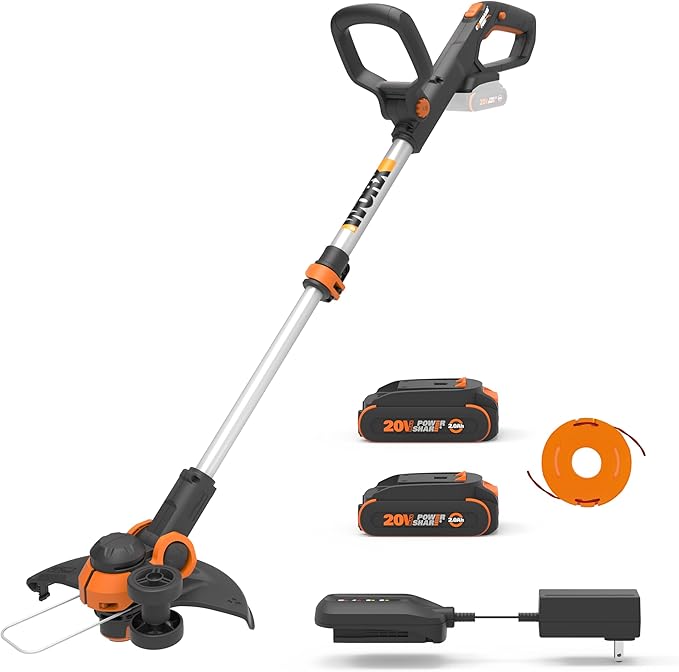
The 14” Wheeled Grass Trimmer Cordless earns the top position by offering an unusually flexible combination of portability, stability, and cutting capacity. Its detachable wheel assembly lets you use it as a wheeled trimmer or remove the wheels for more conventional handheld work. That makes it useful around lawn borders, garden beds, fences, trees, and areas where a small mower is difficult to maneuver.
A 14-inch cutting swath covers a practical amount of ground without making the tool excessively bulky. The advertised brushless motor reaches 20,000 RPM, while the included two-battery setup is designed to keep one battery in use while the other charges. Each battery is listed for approximately 30 to 50 minutes of operation, although actual runtime will vary with grass density, line engagement, and the selected cutting task.
This model is also appealing for users who find handheld trimmers tiring. It weighs about 4 pounds, has larger detachable wheels, and uses a triangular wheel design intended to improve stability. The adjustable head can move from 0 to 90 degrees, and the foldable shaft helps with transport and storage. A removable auxiliary handle, grass guard, safety lock, charger, and eight replacement spools add practical value at setup.
Its trade-offs are mostly related to expectations. A lightweight cordless tool is convenient, but it is not the same as a heavy-duty gas brush cutter for extensive woody growth or large fields. Buyers should also confirm what the included metal blade and accessory configuration are intended to handle before cutting dense material. Charge both batteries fully before a long session, inspect the guard and wheels regularly, and keep replacement spools available. For small to medium properties and users prioritizing comfort, it is the most balanced choice here.
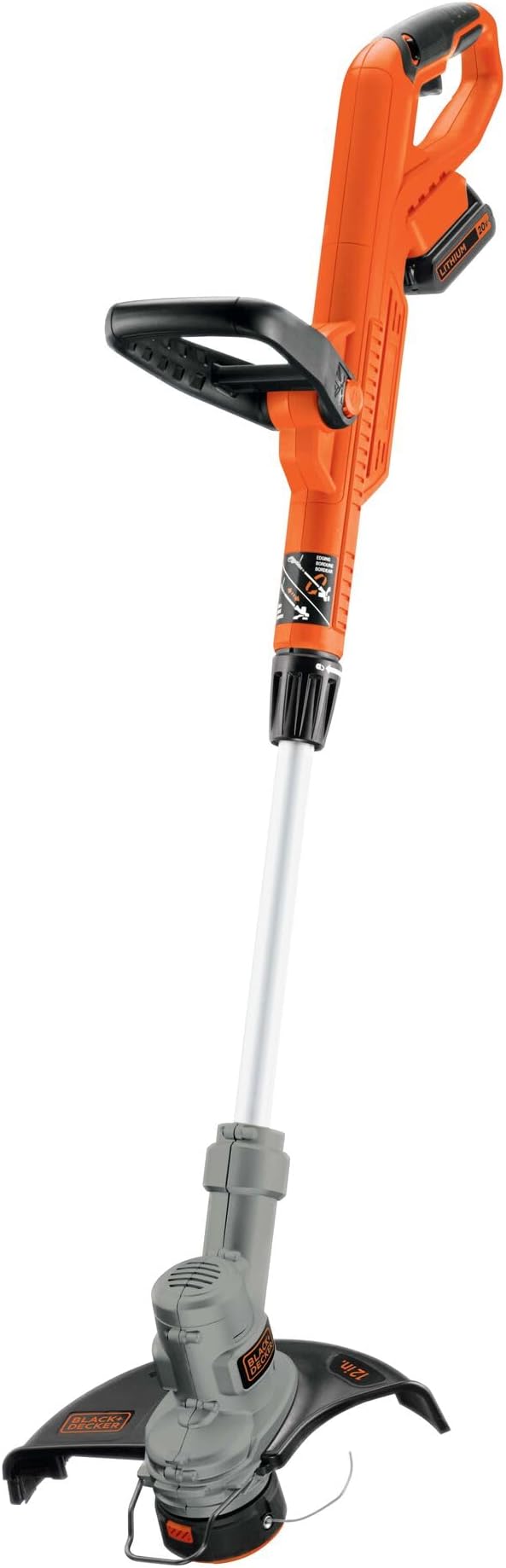
2. BLACK+DECKER Weed Eater
The BLACK+DECKER Weed Eater is the clearest alternative to the top-ranked cordless model because its design is centered on straightforward 3-in-1 versatility. The removable wheeled deck converts the tool between a small push mower, a string trimmer, and an edger. That arrangement is particularly practical for smaller yards, slopes, narrow spaces, and lawn sections that are awkward to reach with a standard walk-behind mower.
Its 12-inch cutting width is narrower than the 14-inch cordless models and much narrower than the two 22-inch gas machines. That can mean more passes on an open property, but it also makes the machine easier to guide around landscaping and tight boundaries. PowerDrive technology is intended to help prevent bogging in dense grass and weeds, while the AFS automatic feed spool reduces the need to stop and manually adjust the line.
The kit includes two LBXR2020 20V MAX lithium-ion batteries, a charger, the detachable MTD100 mower deck, an AF-100 spool, an auxiliary handle, and a guard. Adjustable deck height, trimmer settings, and a pivoting handle allow users to tailor the machine to the task and their preferred working position. The included two-year limited warranty is another useful ownership consideration.
This model holds second place because it offers a well-defined, convenient system, but its smaller cutting path and compact-yard focus limit its usefulness for large overgrown areas. The batteries and automatic feed system also mean owners should use the correct replacement battery and spool design rather than assuming any 20V pack or line cartridge will fit. It is a better choice than a larger gas trimmer when quiet, low-maintenance yard work and easy switching between trimming, edging, and light mowing matter most.
3. BILT HARD Self-Propelled Walk-Behind String Trimmer
The BILT HARD Self-Propelled Walk-Behind String Trimmer ranks third because it is the most capable option in this group for large, rough, or substantially overgrown areas. Its 170cc four-cycle OHV engine and 22-inch cutting diameter are aimed at thick grass, dense weeds, and light brush rather than occasional touch-up work. The wide path can reduce the number of passes required across a larger property.
Self-propulsion is the main reason to consider it. The drive moves at a stated 1.9 mph, allowing the operator to guide the trimmer rather than push its full weight across the lawn. That feature can be especially useful on slopes, uneven ground, and extended trimming sessions. Ten-inch flat-free wheels are intended to roll over bumps, roots, and tighter spaces without the maintenance concern associated with pneumatic tires.
The steel deck adds stability and durability on rough terrain, while side discharge moves cut material away from the cutting path. Eight cutting-height positions, ranging from 1.6 to 3.7 inches, provide more control over how aggressively the machine works through different grass and weed conditions. A manual recoil start is used for the engine, and the handle folds for more compact storage in a shed or garage.
Gas power brings real trade-offs. This machine is heavier and more involved to own than the cordless choices, and operators must be prepared for fuel handling, engine-start procedures, routine maintenance, and the noise and exhaust associated with a four-cycle engine. Its 1.9 mph drive speed may also feel deliberate rather than fast. Before purchase, make sure you have suitable storage and are comfortable following the engine’s maintenance instructions. It is a strong fit for acreage, rough edges, and field-like growth, but excessive woody brush may require a different brush-cutting machine.
4. AMERISUN 22″ Gas Walk Behind String Trimmer
The AMERISUN 22″ Gas Walk Behind String Trimmer is another wide-path gas option for buyers who value coverage and ground clearance. Its 170cc four-cycle OHV engine is designed for tall grass, thick weeds, and light brush, while the 22-inch cutting path helps clear more material per pass. That combination makes it more suitable for fence lines, trails, fields, large yards, and neglected sections than for delicate detail work around small flower beds.
The 14-inch wheels are a notable feature. Their larger diameter provides additional clearance and can make it easier to move through uneven terrain and dense vegetation than a small-wheeled model. An offset trimmer head helps the operator work near fences and trees, where keeping the machine’s body away from an obstacle can be useful. Cutting height adjusts from 1.9 to 4.0 inches, giving the operator room to adapt to different grass and weed conditions.
A foldable handle reduces the storage footprint and can make transport between a garage, shed, trailer, or another property more manageable. Forced-air cooling is included as part of the engine design for consistent operation during demanding yard work. As with other gas-powered walk-behind trimmers, the wide deck and substantial wheels favor open, rough areas rather than precise edging in confined landscaping.
The main reason it sits below the BILT HARD is that the supplied information does not identify a self-propelled drive. Buyers should therefore be prepared to guide or push the machine themselves, particularly over slopes or thick growth. The gas engine also requires more ownership attention than a battery model: use the correct fuel and follow the manufacturer’s storage and maintenance procedures. Check the offset-head clearance before working close to valuable plants, and remember that “light brush” is the stated operating range—not a guarantee for heavy woody stems.
5. 20000RPM Brushless Cordless String Trimmer for Dewalt
The 20000RPM Brushless Cordless String Trimmer for Dewalt is a useful choice for shoppers already invested in the compatible battery platform. It provides a 14-inch cutting path, detachable wheel, and 3-in-1 functionality for trimming, edging, and wheeled use. At about 4 pounds, it is designed to be compact and easier to control than a full-size gas walk-behind machine.
Its brushless motor is advertised at 20,000 RPM, and the cordless format avoids extension cords, gasoline, and direct emissions during operation. The wheel can be attached for added stability or removed when handheld maneuverability is more important. That flexibility can help when a property contains both open lawn edges and hard-to-reach areas around trees, fences, or garden borders. Eight line spools are included, which can reduce the need to purchase refills immediately.
The most important buying detail is also the product’s primary limitation: the battery and charger are not included. This trimmer is designed to work with DEWALT 20V MAX lithium-ion batteries, so it makes the most sense for someone who already owns compatible packs and understands that fit and battery authenticity matter. A buyer starting from scratch will need to account for the separate battery and charger before comparing its overall value with a kit that includes both.
The tool includes a 12-month after-sales service guarantee, and its lightweight construction may appeal to older users or anyone who dislikes the strain of a handheld gas trimmer. Still, battery runtime depends on the pack used and the toughness of the vegetation, so one battery may not cover a long clearing session. Keep the guard, wheel attachment, and spool area clean, and verify the exact DEWALT battery requirements before ordering. It is a sensible platform-compatible alternative, but not the best standalone purchase for a new cordless-tool owner.
How to Choose the Best Wheeled String Trimmer
A wheeled string trimmer sits between a handheld weed eater and a conventional mower. It is designed to carry some of the tool’s weight on wheels while using string instead of a standard mower blade. That makes the category useful for tall grass, fence lines, ditch edges, rough borders, and areas where a lawn mower cannot safely or accurately reach.
The right choice depends less on a single headline specification than on the relationship between power, cutting width, terrain, runtime, and maintenance. A compact cordless model may be ideal for a suburban yard, while a gas walk-behind machine can be more appropriate for a large rural property with persistent overgrowth.
Start with the type of vegetation
First, identify what you actually need to cut. Regular lawn grass and light weeds do not require the same equipment as waist-high growth or dense brush. Cordless wheeled trimmers are generally attractive for routine maintenance, lawn edges, and manageable weed growth. They are quieter and simpler to start than gas models, and they avoid fuel storage.
Gas machines become more compelling when the work area is large, the vegetation is consistently tall, or the cutting session may last longer than a practical battery charge. Both gas models in this roundup use 170cc four-cycle engines and 22-inch cutting paths. Those characteristics favor coverage and heavier work, but they also bring engine noise, exhaust, fuel management, and regular maintenance.
Do not interpret “brush cutter” or “heavy-duty” language as permission to cut anything that resembles a small tree. String trimmers are intended for grass, weeds, and the level of light brush specified by the manufacturer. Thick woody stems can damage line, the head, the guard, or the drive system. Clear hidden wire, rocks, and debris before beginning, regardless of which model you select.
Choose between battery and gas power
Battery power is usually the easiest option for residential maintenance. It starts with the press of a control, produces no direct exhaust during use, and eliminates the need to mix or store fuel. The top-ranked cordless model includes two batteries, which is helpful because one can be charging while the other is operating. The DEWALT-compatible model is different: it requires a separately purchased compatible battery and charger.
Battery runtime is not a fixed promise of how much lawn you can trim. Dense weeds, repeated stops and starts, thick line engagement, and a larger cutting load can use energy faster. Cold weather and older batteries may also affect practical runtime. If you have a small property, one charged pack may be sufficient. For longer sessions, look for a kit with two batteries or budget for a second compatible pack.
Gas power is less dependent on charging infrastructure and can be convenient for extended work, but starting and maintaining the engine require more involvement. Before choosing a gas model, consider where fuel will be stored, whether your storage area is ventilated and appropriate, and whether you are willing to follow the manufacturer’s instructions for oil, air filtration, fuel, and seasonal storage.
Match the cutting width to the property
Cutting width affects productivity and maneuverability. A 22-inch path can cover a broad strip with each pass, which is valuable on open ground or large fields. It can also make the machine wider and less convenient near garden beds, posts, gates, and landscaping. The BILT HARD and AMERISUN models are the coverage-oriented choices in this group.
A 14-inch path is a useful middle ground for residential work. It covers more than a narrow handheld trimmer while remaining easier to place near obstacles. The top-ranked cordless model and the DEWALT-compatible model both use this width. The BLACK+DECKER’s 12-inch path is narrower, but that can be an advantage when precision and compact handling matter more than speed across open ground.
Think about the shape of your work area, not only its total size. A wide cutting path helps on a long, unobstructed fence line. A smaller path may save time when you are constantly repositioning around trees, landscaping stones, and narrow side yards.
Consider wheel design and propulsion
Wheels reduce the amount of weight held by your arms, but they do not automatically make every terrain easy. Larger wheels generally handle bumps, roots, and uneven ground more confidently than small wheels. The AMERISUN uses 14-inch wheels, while the BILT HARD uses 10-inch flat-free wheels. Flat-free construction can be convenient because there is no pneumatic tire to inflate or repair.
Detachable wheels offer a different advantage. On the cordless models, the wheel assembly can be removed when you need handheld access or a different trimming angle. This gives the tool more versatility, though it also means the attachment must be installed securely and checked periodically for wear or looseness.
Self-propulsion is particularly valuable on slopes and larger properties. The BILT HARD’s drive moves at a stated 1.9 mph, allowing the operator to guide the machine with less pushing effort. A model without self-propulsion may still roll well, but the operator remains responsible for moving it forward. Be realistic about your strength, terrain, and session length when comparing these designs.
Look for adjustability that solves a real problem
Adjustability should improve access or comfort rather than simply add features. A pivoting handle, adjustable shaft, and auxiliary handle can help different users maintain better control. The top-ranked cordless model has a head angle that adjusts from 0 to 90 degrees, which can help reach corners or approach slopes at a more useful angle.
Cutting-height adjustment matters most when you are dealing with changing vegetation or terrain. The BILT HARD offers eight positions from 1.6 to 3.7 inches, while the AMERISUN adjusts from 1.9 to 4.0 inches. A higher setting can help when entering tall growth, while a lower setting may suit more controlled maintenance. Begin conservatively in unfamiliar vegetation rather than forcing the head into a dense patch at the lowest setting.
A folding handle is valuable if the trimmer must share space with vehicles, tools, or seasonal equipment. Before buying, consider whether the folded dimensions will actually fit your storage area. Compact storage is useful only when the locking and folding process remains simple enough that you will use it consistently.
Understand 3-in-1 claims
In this category, 3-in-1 usually refers to some combination of wheeled trimming, handheld trimming, edging, or compact mowing. The exact conversion process matters. A removable wheel deck, such as the BLACK+DECKER system, is different from a detachable wheel attachment on a lightweight trimmer. Both can be useful, but they may feel different when used around obstacles or across open grass.
Read the included-accessory list carefully. A kit may include a guard, auxiliary handle, wheel or deck, spool, charger, and batteries—or it may omit one of the most expensive pieces, as with the DEWALT-compatible model’s battery and charger. Confirming what is in the box prevents an apparently convenient cordless purchase from becoming unusable until additional equipment arrives.
Also consider whether you truly need every operating mode. If you mainly maintain fence edges, a stable wheeled trimmer may be enough. If you want one tool for edging, trimming, and small-lawn mowing, a convertible design can justify its added complexity. More modes can also mean more parts to install, clean, store, and inspect.
Pay attention to line feeding and replacement parts
Line management is a small detail that can strongly affect ownership. The BLACK+DECKER uses an AFS automatic feed spool, which is intended to keep trimming moving without frequent manual line adjustments. The other cordless models list replacement spools in their packages, but buyers should still verify the correct spool format before ordering refills.
Keep the spool housing free of packed grass and inspect the line after working around curbs, rocks, or fencing. Worn or incorrectly installed line can reduce cutting performance and increase vibration. Never substitute a line or accessory simply because it appears close in size; follow the product’s specified replacement guidance.
Gas walk-behind models may use durable nylon line suited to a wider cutting path. Their larger heads can cover more area, but the line still needs inspection after contact with hard objects. Shut the machine down according to the manufacturer’s procedure before clearing wrapped vegetation or examining the cutting head.
Use safety features and good operating habits
A safety lock or start interlock is useful because it helps prevent accidental activation. The top-ranked cordless model includes a safety lock button that must be used with the switch. Even with such a feature, keep hands, feet, clothing, and bystanders away from the cutting area, and remove the battery or follow the specified shutdown procedure before servicing the head.
Wear eye protection, sturdy closed-toe footwear, long pants, and hearing protection when appropriate. Flying stones and line fragments can travel beyond the immediate cutting area. Keep children and pets away, especially when trimming near fences or landscaping that can hide debris.
For wheeled use, maintain a controlled pace and avoid turning sharply on a slope. Walk-behind gas trimmers can be difficult to control if they begin moving downhill. Do not use a wheeled trimmer on terrain that is too steep, wet, unstable, or obstructed for safe footing. A lighter cordless machine may be easier to reposition, but its smaller design does not eliminate these hazards.
Plan for maintenance and seasonal storage
Cordless maintenance is comparatively simple: remove the battery before cleaning, brush grass from the guard and wheel assembly, inspect the line head, and store batteries according to the battery maker’s instructions. Avoid leaving the machine exposed to rain or storing a battery in extreme heat. Check the shaft, handle, and wheel connection before each session.
Gas models need a more deliberate routine. Follow the engine manual for oil checks or changes, air-filter care, fuel recommendations, spark-plug service, and storage preparation. A folding handle helps reduce the storage footprint, but it does not replace proper engine storage. Let the machine cool before placing it in an enclosed area, and keep fuel away from ignition sources.
Maintenance also includes the working environment. Remove string, vines, and grass wrapped around the head rather than continuing to operate with restricted movement. Inspect steel decks, guards, fasteners, and wheels after rough use. Small problems are easier to correct before they become a cutting-head, wheel, or engine issue.
Choose based on operator comfort
Weight, handle position, wheel stability, and vibration all affect whether a tool is pleasant enough to use regularly. A four-pound cordless model can be attractive for someone with limited upper-body endurance, wrist discomfort, or a preference for quick cleanup. The wheels still need to roll smoothly and remain stable, so inspect the attachment rather than relying on weight alone.
A gas machine can reduce the need to carry batteries, but its size and engine may require more physical control. Self-propulsion helps, yet the operator still guides the machine, manages turns, and handles uneven terrain. If more than one person will use the trimmer, adjustable handles and simple controls become more important.
Whenever possible, think about the entire path of a normal job: carrying the unit from storage, attaching the wheel or deck, starting it, trimming the boundary, clearing clippings, and putting it away. The best design on paper may not be the best ownership fit if setup or storage becomes a constant frustration.
Best Wheeled String Trimmer FAQ
Are wheeled string trimmers easier to use than handheld models?
They can be, especially when wheels carry part of the tool’s weight and the work area is relatively open. Wheeled designs may reduce arm fatigue during long passes, but they still require steering and lifting when crossing obstacles or changing direction. A detachable-wheel model offers more flexibility when both wheeled stability and handheld access are needed.
Is a cordless or gas wheeled string trimmer better?
Choose cordless for quieter, simpler residential maintenance and choose gas when you need longer continuous operation, a wide cutting path, or more capacity for consistently heavy growth. Cordless models require battery planning, while gas models require fuel and engine maintenance. Neither power source is automatically better for every property.
What cutting width is best for a wheeled string trimmer?
A 12- to 14-inch width is generally easier to maneuver around residential landscaping and narrow boundaries. A 22-inch width is more efficient on open ground, large yards, trails, and fields. Measure the spaces you trim most often instead of choosing solely by the largest advertised path.
Can a wheeled string trimmer replace a lawn mower?
Some compact 3-in-1 products are designed to perform limited small-lawn mowing as well as trimming and edging. They are not necessarily a substitute for a full-size mower on a large lawn, and a string trimmer will produce a different finish from a conventional mower. Check the product’s intended use, cutting width, deck or wheel configuration, and height adjustment before treating it as your primary mower.
Do wheeled string trimmers work on slopes?
They can work on mild slopes when the operator has secure footing and the machine remains easy to control. Self-propelled drive can reduce pushing effort, but it does not make steep or slippery terrain safe. Avoid wet, unstable, or excessively steep areas and follow the manufacturer’s slope guidance.
What should I check before buying a cordless model?
Confirm whether the battery and charger are included, which battery platform the tool uses, the expected runtime, the replacement spool format, and whether the wheel assembly is detachable. The DEWALT-compatible model in this roundup does not include a battery or charger, while the top-ranked cordless model and BLACK+DECKER kit include battery equipment.
How do I maintain a wheeled string trimmer?
Disconnect the battery or shut down the engine before cleaning or servicing. Remove grass and wrapped vegetation from the head, guard, and wheels; inspect fasteners and line; and store the tool in a dry location. Gas models additionally require the engine maintenance and seasonal storage procedures specified in their manuals.
Final Verdict
The 14” Wheeled Grass Trimmer Cordless is the best all-around pick for most homeowners because it combines a 14-inch path, detachable wheels, two batteries, adjustable positioning, and lightweight cordless operation. Choose the BLACK+DECKER Weed Eater if its automatic feed system and compact 3-in-1 design better match your yard. For large, rough properties, the BILT HARD and AMERISUN gas models provide wider coverage, while the DEWALT-compatible trimmer makes the most sense for buyers who already own the required battery platform.

I’m Maya L. Greenwood, a lifelong plant lover who believes anyone can grow something beautiful with the right guidance. After years of testing soil mixes, pruning methods, irrigation tricks, and pest-safe solutions, I started EasyGardenTips.com to turn hard-won lessons into step-by-step advice. From seed starting and container gardens to composting and seasonal checklists, my goal is to make gardening simple, sustainable, and fun.