5 Best Commercial Cordless String Trimmer: Pro-Grade Picks
The best commercial cordless string trimmer needs more than a high-voltage battery and a wide cutting head. For daily landscaping work, I look for a brushless motor, strong sustained torque, 0.095-inch or heavier line capability, a commercial-size cutting swath, good balance, variable-speed control, and a battery platform that can support repeated work throughout the day.
My primary recommendation is the Makita XRU18PT 36V LXT Brushless 17-Inch Cordless String Trimmer. Its 30cc gas-equivalent performance, 17-inch cutting swath, three operating speeds, Automatic Torque Drive Technology, steel drive shaft, and dual 18V LXT battery system make it the strongest overall choice for landscaping crews and demanding property maintenance.
For users who want a purpose-built commercial platform, the EGO Power+ STX3800 56V Commercial Series String Trimmer is particularly attractive. Its commercial brushless motor, carbon-fiber drive shaft, 15-inch swath, heavy-duty line compatibility, and support for a commercial backpack battery make it well suited to extended trimming sessions.
I also recommend the DEWALT FLEXVOLT DCST970X1 60V MAX Brushless String Trimmer for contractors already invested in the FLEXVOLT platform. It combines a gear-drive system, high-efficiency brushless motor, variable-speed trigger, 15-inch cutting path, and compatibility with 0.095-inch line in a straightforward heavy-duty package.
Best Commercial Cordless String Trimmer
| Image | Product Name | Check Price |
|---|---|---|
Best Choice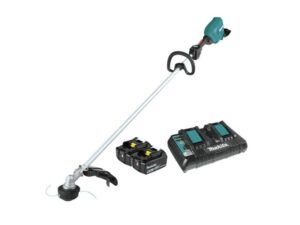 | Makita 36V LXT Brushless 17-Inch Cordless String Trimmer | Check Price |
Second Best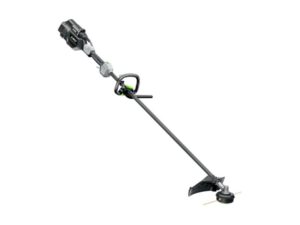 | EGO Power+ 56V Commercial Series String Trimmer | Check Price |
Third Choice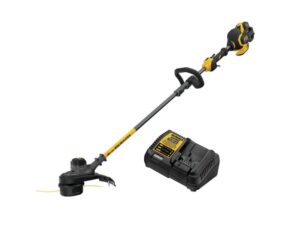 | DEWALT FLEXVOLT 60V MAX Brushless String Trimmer | Check Price |
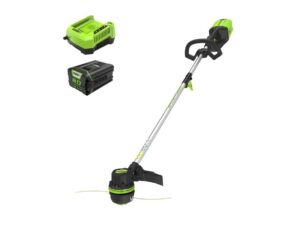 | Greenworks 80V 16-Inch Brushless Cordless String Trimmer | Check Price |
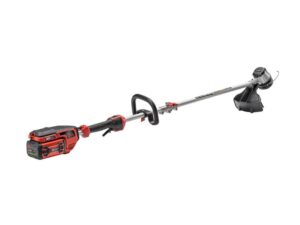 | PRORUN 60V 16-Inch Brushless Cordless String Trimmer | Check Price |
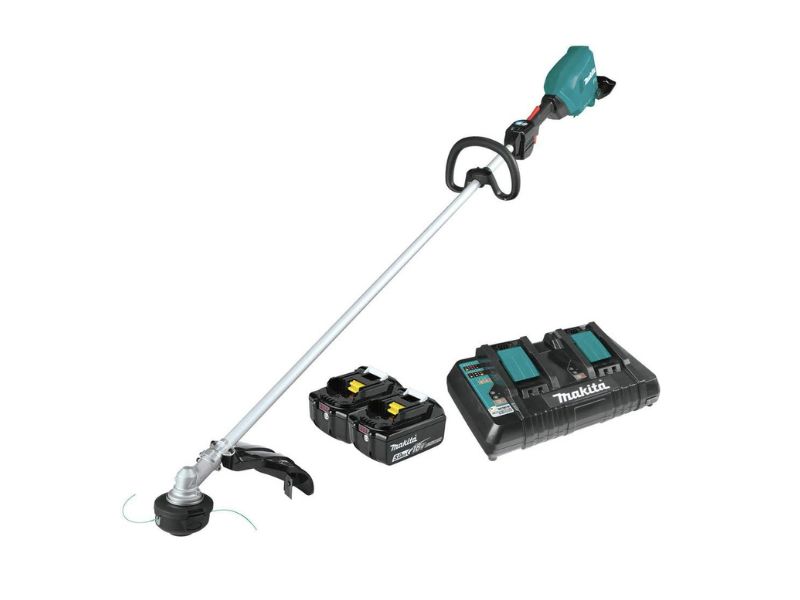
1. Makita 36V LXT Brushless 17-Inch Cordless String Trimmer- Best Overall
Key Features
- 36V operation using two 18V LXT batteries
- Makita-built BL brushless motor
- Power equivalent to approximately a 30cc gas string trimmer
- Large 17-inch cutting swath
- Three speed ranges
- Up to approximately 6,000 RPM
- Automatic Torque Drive Technology
- Variable-speed trigger
- Reverse-rotation function for clearing tangled vegetation
- Steel drive shaft
- Electronic controls for power management
- Kit includes two 18V 5.0Ah LXT batteries
- Dual-port rapid charger
The Makita XRU18PT is my first choice because it approaches cordless trimming from a genuinely professional perspective rather than simply scaling up a homeowner weed eater.
Its 17-inch cutting swath immediately separates it from compact residential machines.
Commercial landscaping crews spend a tremendous amount of time walking long fence lines, trimming around commercial buildings, maintaining apartment complexes, and clearing vegetation that a mower cannot reach.
An extra inch or two of cutting diameter can increase productivity over hundreds of yards of trimming.
The XRU18PT combines that large cutting path with a Makita-built brushless motor engineered to provide performance comparable to a 30cc gas string trimmer.
For commercial use, that gas-equivalent power class is meaningful.
Many professional two-stroke string trimmers fall somewhere in the mid-20cc to low-30cc range. A battery trimmer designed around that workload has a better chance of handling:
- Dense turf
- Tall grass
- Fence-line weeds
- Thick lawn edges
- Overgrown commercial properties
- Repeated daily trimming
without feeling like a homeowner tool being pushed beyond its intended job.
36V Power From Two 18V LXT Batteries
Makita powers this trimmer using two 18V LXT batteries simultaneously, creating a 36V operating system.
This architecture has one major commercial advantage:
You are not forced into a completely separate battery platform solely for the trimmer.
A landscaping or construction business already using Makita 18V LXT tools may have batteries that also work with:
- Drills
- Impact drivers
- Circular saws
- Reciprocating saws
- Blowers
- Hedge trimmers
- Chainsaws
- Other outdoor equipment
The XRU18 requires two packs at once, so battery management becomes important.
A commercial crew should ideally have enough charged battery pairs to rotate through the workday rather than depending on one set.
Automatic Torque Drive Technology
One of the best features is Automatic Torque Drive Technology, often abbreviated as ADT.
Grass does not create a consistent motor load.
The trimmer may spend several minutes cutting easy lawn edges and then suddenly encounter a dense patch of weeds.
Running at maximum motor speed continuously wastes energy.
ADT allows the system to adjust operating speed according to the cutting load.
When resistance increases, power can rise.
When cutting becomes easier, the system can operate more efficiently.
That type of electronic power management is particularly useful in commercial cordless equipment because runtime and productivity have to be balanced constantly.
Three Speed Settings
Makita also gives the operator three manual speed ranges:
- Approximately 4,000 RPM low
- Approximately 4,600 RPM medium
- Approximately 6,000 RPM high
Low speed is useful for normal grass maintenance where maximum torque is unnecessary.
Medium offers a useful general-purpose compromise.
High is appropriate when the line encounters heavy vegetation.
Professional operators benefit from this flexibility because not every account requires maximum output.
Using the correct speed can help conserve battery capacity while reducing unnecessary noise and line consumption.
Reverse Rotation
Long grass has a tendency to wrap around the trimmer head and shaft.
Stopping work to manually clear tangled vegetation reduces productivity.
Makita’s reverse function briefly changes head rotation so wrapped grass can be released more easily.
This is especially useful when trimming:
- Drainage areas
- Tall ornamental grasses
- Neglected lots
- Dense weeds
- Long fibrous vegetation
It is a small feature that becomes much more valuable when the tool is used every day.
Steel Drive Shaft
The XRU18 uses a steel drive shaft.
For a commercial tool, I like that decision.
The shaft transmits power from the rear motor to the cutting head and needs to tolerate repeated:
- Acceleration
- Deceleration
- Heavy vegetation contact
- Transport
- Daily vibration
Makita specifically emphasizes the steel shaft for reduced vibration and longer equipment life.
Durability in this area matters more to a professional crew than shaving a few ounces from the tool.
Commercial Cutting Width
The 17-inch cutting path is particularly productive on commercial turf.
A wide swath lets an experienced operator cover substantial ground with each controlled sweep.
However, a larger swath also increases load because more line is moving through vegetation.
That is why the motor, battery output, and cutting width need to be considered together.
A cheap trimmer with an oversized cutting head can bog badly.
The XRU18 has the motor architecture to make better use of its width.
Battery Strategy
The kit uses two 5.0Ah LXT batteries.
For occasional residential use, one battery pair may be adequate.
For commercial work, I would plan around battery rotation.
A professional battery strategy might include:
- One pair operating
- One pair cooling after use
- One or more pairs charging
- Additional charged packs available in the truck
This reduces downtime and avoids expecting one battery pair to carry an entire workday.
What I Like
- Strong 30cc gas-equivalent power class
- Large 17-inch cutting swath
- Brushless motor
- Three operating speeds
- Automatic Torque Drive adjusts performance to load
- Reverse function helps clear wrapped grass
- Steel drive shaft
- Variable-speed trigger
- Uses widely established 18V LXT batteries
- Two 5.0Ah batteries included in the kit
- Excellent choice for demanding landscape maintenance
What I Do Not Like
- Requires two batteries simultaneously
- Battery rotation becomes more complicated for large crews
- Wider cutting system uses more energy under heavy load
- Tool can feel substantial during long trimming sessions
- Dedicated commercial battery systems may offer simpler fleet management
The Makita XRU18PT offers the strongest overall combination of cutting capacity, gas-replacement power, electronic motor control, durability, and battery-platform flexibility. I would choose it for contractors who need serious trimming capability but also want batteries that work across a large professional tool ecosystem.
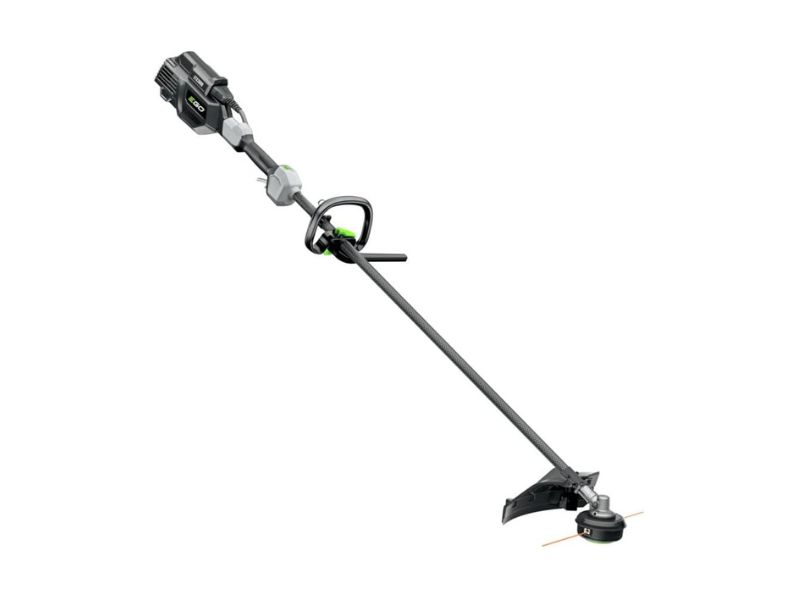
2. EGO Power+ 56V Commercial Series String Trimmer- Best for Extended Commercial Use
Key Features
- 56V commercial cordless platform
- High-efficiency brushless motor
- Rear-mounted motor
- Carbon-fiber drive shaft
- 15-inch cutting width
- Up to approximately 5,800 RPM
- Compatible with approximately 0.095- to 0.105-inch line
- Variable-speed trigger
- Soft-start system
- Bump-feed trimmer head
- Designed for professional landscape work
- Compatible with EGO commercial backpack-battery configurations
The EGO STX3800 is fundamentally different from ordinary residential EGO string trimmers.
It belongs to the company’s commercial equipment line and was developed around the needs of professional crews.
The strongest evidence of that commercial intent is the power architecture.
Rather than simply attaching a homeowner battery to a lightweight trimming head, EGO designed the STX3800 to work with higher-capacity commercial battery configurations, including its backpack system.
That can dramatically change how cordless outdoor equipment is used during a workday.
Commercial Backpack Battery Capability
One of the primary limitations of professional cordless equipment is runtime.
A homeowner may trim for ten or fifteen minutes.
A landscape employee may run a trimmer repeatedly over several hours.
Large backpack batteries move much of that energy storage away from the trimmer itself.
This can provide two advantages:
Longer working time
and
better weight distribution
Instead of placing an enormous battery directly on the rear of the trimmer, the battery can be carried using an appropriate harness system.
For extended professional trimming, this is one of the strongest designs available.
Carbon-Fiber Drive Shaft
The STX3800 uses a carbon-fiber drive shaft.
Carbon fiber is well suited to this application because it combines:
- High stiffness
- Low weight
- Corrosion resistance
- Good strength
Commercial trimming is extremely repetitive.
Even small ergonomic improvements become significant when a tool is operated across multiple properties every day.
Reducing shaft mass helps offset the structural weight required for a durable commercial motor and gearbox.
15-Inch Cutting Width
The EGO has a 15-inch cutting width, smaller than Makita’s 17-inch platform.
This means it covers somewhat less vegetation with each sweep.
That is not necessarily a major disadvantage.
A 15-inch head can be easier to control around:
- Landscaping
- Trees
- Curbs
- Fences
- Irrigation components
- Building edges
The narrower swath can also reduce motor load compared with a very wide commercial head.
Heavy-Duty Trimmer Line
Commercial string trimmer line has to survive constant abrasion.
Thin residential line can disappear quickly when repeatedly striking:
- Concrete
- Chain-link fence
- Stone
- Curbs
- Rough weeds
The STX3800 is built around approximately 0.095- to 0.105-inch line, depending on the head and configuration being used.
That is a proper professional line class.
0.095-inch line works well for routine mowing-and-trimming crews.
Moving toward 0.105 inch can improve durability when vegetation becomes rougher, though heavier line naturally adds more motor load.
Brushless Motor
EGO uses a high-efficiency brushless motor.
Commercial outdoor power equipment benefits greatly from brushless architecture because there are no traditional carbon motor brushes requiring periodic wear replacement.
Electronic control can also maintain performance more efficiently as cutting load changes.
For professional fleets, lower routine motor maintenance is an important advantage.
Rear Motor Design
The motor sits toward the rear rather than adding all of its mass near the cutting head.
That helps balance the long shaft.
A front-heavy trimmer forces your supporting arm to constantly counteract the cutting head.
During a short homeowner session, the difference may seem minor.
During professional use, balance becomes one of the most important specifications you cannot see in a simple voltage comparison.
Variable Speed
The variable-speed trigger lets an operator feather power depending on the job.
This is important because experienced commercial operators rarely need full throttle during every second of trimming.
Reducing output around delicate obstacles can:
- Improve control
- Reduce line breakage
- Reduce battery demand
- Decrease thrown debris
Full output remains available when heavier vegetation demands it.
Quiet Commercial Work
Battery trimmers create substantially less engine noise than traditional gasoline two-stroke equipment.
The cutting line still generates noise, so the machine is not silent.
However, removing the gasoline engine can be particularly useful when servicing:
- Schools
- Hospitals
- Hotels
- Office properties
- Residential communities
- Early-morning accounts
Noise-sensitive commercial environments are one of the strongest reasons professional crews are moving toward battery equipment.
What I Like
- Purpose-built commercial platform
- Brushless motor
- Strong carbon-fiber drive shaft
- Heavy commercial line compatibility
- Backpack-battery capability for long work sessions
- Rear motor helps improve balance
- Variable-speed trigger
- Bump-feed head
- Excellent fit for noise-sensitive properties
- Low routine motor maintenance
What I Do Not Like
- 15-inch swath is narrower than several competitors
- Commercial backpack battery adds substantial system cost
- Battery and charger may need to be purchased separately
- Dedicated commercial system is less attractive for occasional residential users
- Older commercial architecture is not as feature-rich as newer premium trimmers
The STX3800 makes the most sense for a crew that prioritizes extended runtime, commercial ergonomics, heavy-duty line, and a dedicated professional battery setup rather than simply choosing the widest cutting head.
3. DEWALT FLEXVOLT 60V MAX Brushless String Trimmer- Best Heavy-Duty Value
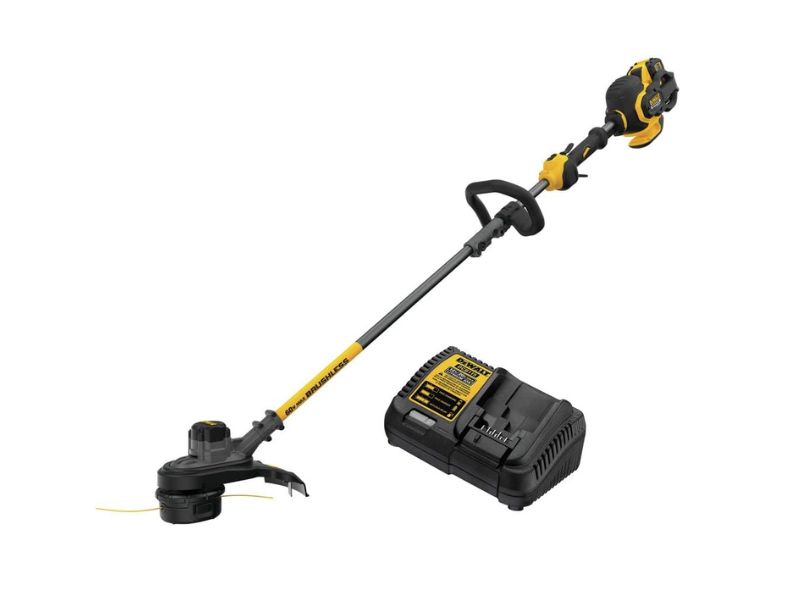
Key Features
- 60V MAX FLEXVOLT platform
- High-efficiency brushless motor
- Gear-drive design
- 15-inch cutting swath
- Accepts 0.080- and 0.095-inch line
- Variable-speed trigger
- Hi/Lo speed selector
- Bump-feed head
- Heavy-duty straight-shaft design
- FLEXVOLT battery included in kit
- Battery can also support compatible 20V MAX tools
- Built for demanding overgrowth
DEWALT’s DCST970X1 is a straightforward heavy-duty trimmer without a huge list of gimmicks.
Its key strengths are the FLEXVOLT battery system, gear-driven head, brushless motor, and robust cutting setup.
DEWALT specifically designs this model to work through tough overgrowth and withstand repeated heavy-duty usage.
That makes it appropriate for contractors who need professional-level trimming but may not need a specialized landscape-only battery fleet.
60V FLEXVOLT System
FLEXVOLT batteries are unusual because their internal configuration allows them to operate at different voltage levels depending on the tool.
The battery can power compatible 60V MAX equipment while also working with a broad range of 20V MAX tools.
For contractors, that flexibility can be extremely valuable.
A battery purchased for the string trimmer may also become useful with compatible:
- Saws
- Grinders
- Blowers
- Construction tools
- Outdoor equipment
A landscaping company that also performs property repair or construction work may get more battery utilization from FLEXVOLT than from a landscape-only battery ecosystem.
Gear-Drive Cutting System
The gear-drive system helps transfer motor power to the cutting head.
This becomes especially important when vegetation gets dense.
A trimmer that relies heavily on high RPM without adequate torque can slow dramatically in thick grass.
Gear reduction helps the tool produce stronger usable cutting force under load.
For commercial maintenance, I consider this more meaningful than simply having the highest unloaded RPM.
15-Inch Cutting Swath
The DCST970 uses a 15-inch cutting path.
That is enough for professional lawn maintenance without making the head unnecessarily wide around landscaping.
It does not match Makita’s 17-inch productivity, but the more compact cutting path can feel easier around:
- AC units
- Fence posts
- Beds
- Parking islands
- Trees
0.095-Inch Line Support
Although common kits may arrive with 0.080-inch line, the trimmer accepts 0.095-inch line.
For commercial use, I would generally favor 0.095 where conditions justify it.
It lasts longer against abrasive edges and has more cutting mass for thick weeds.
Thin 0.080 line can still be useful where precision matters and vegetation is light.
Hi/Lo Speed Control
The trimmer combines a variable trigger with a Hi/Lo selector.
Low mode helps extend runtime during ordinary grass trimming.
High mode provides additional performance for overgrowth.
This simple two-mode system is not as sophisticated as Makita’s three-speed plus automatic-torque setup, but it is easy to operate.
For a crew with multiple employees, simple controls can actually be an advantage.
Ergonomics
The rear battery and motor positioning help counterbalance the cutting head.
Weight still matters with any 60V machine.
If employees are trimming for long periods, evaluate the complete operating weight rather than looking at the bare tool.
Battery size can change how the trimmer feels substantially.
What I Like
- Strong 60V FLEXVOLT system
- Heavy-duty gear-drive design
- Efficient brushless motor
- Accepts 0.095-inch commercial-style line
- Variable-speed trigger
- Hi/Lo operating modes
- Batteries cross over to a large tool platform
- Good fit for mixed landscaping and contractor fleets
- Straightforward controls
What I Do Not Like
- 15-inch cutting path trails some commercial competitors
- Included 0.080-inch line is lighter than I prefer for difficult trimming
- Larger FLEXVOLT batteries add weight
- Less sophisticated motor-management system than Makita
- Not as purpose-built for all-day landscaping as dedicated commercial platforms
The DEWALT DCST970X1 offers particularly good value for contractors already using FLEXVOLT and 20V MAX tools. It has enough power and line capacity for serious work without locking the buyer into a landscape-only ecosystem.
4. Greenworks 80V 16-Inch Brushless Cordless String Trimmer- Best High-Voltage Option
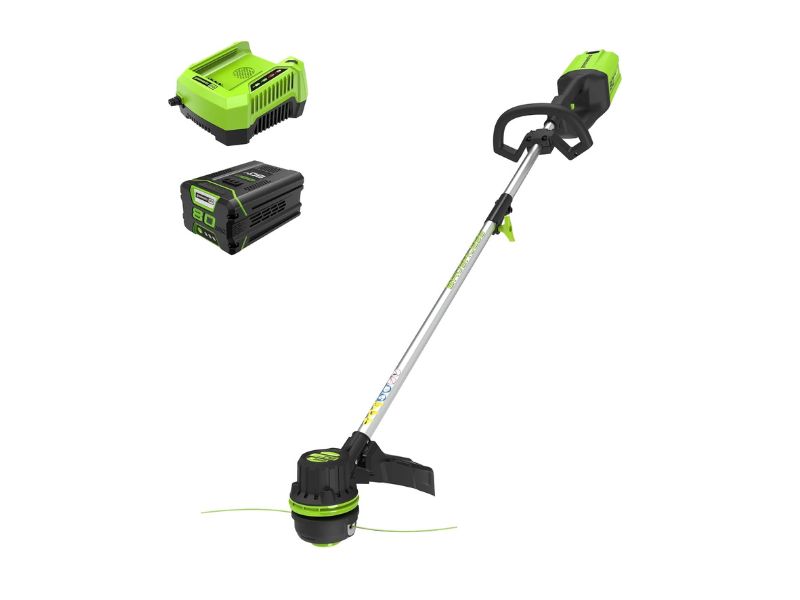
Key Features
- 80V lithium-ion platform
- Brushless motor
- Approximately 16-inch cutting swath
- Straight-shaft design
- Bump-feed cutting head
- Professional-size line capability
- Variable-speed operation
- High-voltage outdoor-equipment battery platform
- Designed for larger properties and demanding vegetation
The Greenworks 80V ST80L210 gives contractors another path toward gas-replacement performance without requiring two separate batteries on the trimmer.
Its 80V battery architecture is designed primarily around outdoor power equipment rather than general construction tools.
That matters because outdoor machines have very different sustained-power requirements from drills and impact drivers.
High Voltage Does Not Automatically Mean More Power
The 80V label is impressive, but voltage by itself should never decide which trimmer you buy.
Electrical power depends on both voltage and current.
Cutting performance also depends on:
- Motor efficiency
- Battery discharge capability
- Gear design
- Cutting-head diameter
- Line size
- Electronic controls
The Greenworks 80V platform should therefore be viewed as a complete system rather than automatically being ranked above a 36V Makita or 60V DEWALT.
16-Inch Cutting Path
A 16-inch cutting swath is a strong commercial size.
It sits between DEWALT’s 15-inch head and Makita’s wider 17-inch configuration.
This gives the Greenworks good productivity while retaining reasonable control.
For routine weekly maintenance, 16 inches is an excellent compromise.
Brushless Motor
The brushless drivetrain improves efficiency and eliminates traditional motor-brush maintenance.
Cordless outdoor power tools spend long periods under sustained load, so motor efficiency has a direct relationship with:
- Heat generation
- Battery consumption
- Runtime
- Component stress
For demanding string-trimmer use, brushless technology is something I would consider essential rather than optional.
80V Equipment Ecosystem
Greenworks’ high-voltage outdoor platform can support other compatible equipment.
A landscaping business may be able to build a fleet around products such as:
- Blowers
- Chainsaws
- Mowers
- Hedge trimmers
- Other outdoor tools
Fleet standardization is important.
A commercial crew benefits when batteries can move between machines rather than every tool requiring a different charger and battery.
Bump Feed
The trimmer uses a bump-feed head, a familiar system for professional operators.
Tap the head on the ground while the line is rotating and additional line advances.
Commercial crews often prefer a robust bump-feed system because it is simple, easy to understand, and can be serviced without complicated electronics.
What I Like
- Powerful 80V battery platform
- Brushless motor
- Productive 16-inch cutting path
- Straight shaft works well around obstacles
- Bump-feed operation
- Good choice for large properties
- Outdoor-focused battery ecosystem
- Strong alternative to gasoline equipment
What I Do Not Like
- Older platform design than some newer commercial trimmers
- 80V battery ecosystem is primarily outdoor-equipment focused
- Battery weight needs to be considered
- Not as advanced electronically as Makita’s ADT system
- Commercial users should verify battery and charger configuration carefully
The Greenworks 80V is best for buyers who want a high-voltage outdoor-equipment platform with a commercial-size cutting head and intend to use compatible batteries across several lawn-care machines.
5. PRORUN 60V 16-Inch Brushless Cordless String Trimmer- Best Budget Commercial Pick
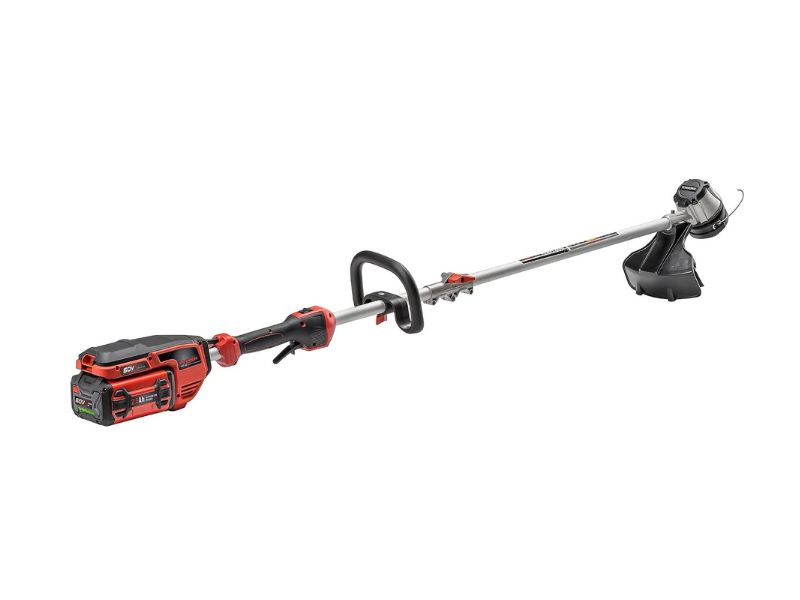
Key Features
- 60V battery platform
- High-efficiency brushless motor
- Commercial-grade torque design
- 16-inch cutting swath
- Dual-feed 0.095-inch line
- Up to approximately 6,000–6,200 RPM
- Variable-speed trigger
- Hi/Lo speed control
- Quick-Wind bump head
- Approximately 45-minute stated runtime
- 2.5Ah battery and charger included
- About 9 pounds fully configured in manufacturer specifications
- Folding shaft for transport and storage
- Two-year commercial warranty
PRORUN is the least established professional platform among these five, but the PST160H has specifications that line up surprisingly well with commercial use.
Most importantly, it supports 0.095-inch line, a 16-inch cutting path, a brushless drivetrain, and a two-year commercial-use warranty.
Those are much more meaningful signals than simply labeling a lightweight homeowner weed eater as “professional.”
60V Brushless System
The 60V architecture gives the brushless motor enough electrical headroom for thick residential and light commercial vegetation.
PRORUN describes the system as delivering commercial-grade torque and motor life.
I would still place Makita and EGO above it for established professional fleet use, but the core configuration is appropriate for serious trimming.
16-Inch Swath
The 16-inch cutting width is excellent for a machine in this class.
You get enough coverage for long edges and open weed patches without an unusually oversized guard.
The head accepts 0.095-inch line, which is another key commercial feature.
Variable Speed and Two Modes
Like DEWALT, PRORUN combines a variable trigger with high and low operating ranges.
Low mode is useful for:
- Normal lawn grass
- Edging near sensitive objects
- Extending runtime
High provides more cutting speed for thicker vegetation.
This is a practical control setup with very little learning curve.
Quick-Wind Bump Head
Downtime matters in commercial work.
Traditional spool loading can become irritating when it needs to be done several times per week.
PRORUN’s Quick-Wind bump head is designed to accept replacement line quickly without turning every reload into a long maintenance task.
Lightweight Design
One of the more interesting specifications is the relatively low weight.
A trimmer around the 9-pound class can be much easier to use over an extended session than a heavy commercial platform with a large rear battery.
Weight affects:
- Forearm fatigue
- Shoulder fatigue
- Control
- Edging precision
- Productivity late in the day
Maximum power is valuable, but professional operators also need to remain productive after hours of work.
45-Minute Runtime
The included 2.5Ah battery is rated for up to roughly 45 minutes under suitable operating conditions.
Do not expect 45 minutes of continuous maximum-load trimming through waist-high vegetation.
Commercial runtime changes dramatically with:
- Line length
- Grass density
- Speed setting
- Ambient temperature
- Battery condition
For commercial use, I would add another battery rather than depending on one 2.5Ah pack.
Commercial Warranty
The two-year commercial warranty is especially important.
Many consumer cordless tools have impressive residential warranties that shrink dramatically or disappear under business use.
A manufacturer explicitly listing commercial warranty coverage gives contractors greater confidence that the product is intended for more than occasional backyard work.
What I Like
- 60V brushless platform
- Good 16-inch cutting swath
- Uses 0.095-inch line
- Variable-speed trigger
- Hi/Lo modes
- Quick-Wind bump head
- Relatively lightweight
- Battery and charger included
- Useful runtime for the supplied battery
- Two-year commercial warranty
What I Do Not Like
- Smaller professional ecosystem than Makita or DEWALT
- 2.5Ah battery is modest for full-day landscaping
- Less established commercial service network than major professional OPE brands
- Two-speed control is basic compared with Makita
- Large commercial crews would need multiple batteries
PRORUN is the option I would choose for a small landscaping company or serious property-maintenance user who wants commercial-oriented specifications without immediately investing in a premium fleet platform.
Commercial Cordless String Trimmer Comparison
| Product | Battery Platform | Cutting Swath | Line Capacity | Speed Control | Key Commercial Advantage | Best Use |
| Makita XRU18PT | 36V / 2 x 18V LXT | 17 in. | Pro-grade dual line | 3-speed + variable + ADT | 30cc-class power and advanced motor control | Full commercial landscaping |
| EGO STX3800 | 56V Commercial | 15 in. | 0.095–0.105 in. | Variable | Backpack battery and commercial architecture | Extended daily trimming |
| DEWALT DCST970X1 | 60V FLEXVOLT | 15 in. | Up to 0.095 in. | Hi/Lo + variable | Heavy-duty gear drive and broad battery ecosystem | Contractors and mixed fleets |
| Greenworks ST80L210 | 80V | 16 in. | Heavy-duty line class | Variable | High-voltage outdoor platform | Large properties |
| PRORUN PST160H | 60V | 16 in. | 0.095 in. | Hi/Lo + variable | Low weight and commercial warranty | Value-focused professional use |
For maximum overall capability, the Makita XRU18PT offers the best mix of cutting width, motor management, professional construction, and battery flexibility.
EGO becomes particularly attractive for crews that need a purpose-built commercial system and longer runtime strategies, while DEWALT makes sense for contractors already using FLEXVOLT.
What Makes a Cordless String Trimmer Commercial Grade?
A high voltage number does not make a trimmer commercial grade.
Commercial equipment needs to survive repetitive daily operation.
I look for several characteristics.
Brushless Motor
Every trimmer in this article uses or emphasizes brushless motor technology.
That is important because commercial equipment may accumulate dramatically more operating hours than a homeowner tool.
Brushless motors provide:
- Efficient electrical operation
- Electronic power control
- Reduced wear
- Strong torque response
- Lower routine motor maintenance
Heavy-Duty Line
A true professional trimmer should comfortably handle 0.095-inch line for routine commercial work.
Heavy vegetation may justify even larger line where the manufacturer allows it.
Thicker line resists breakage against abrasive surfaces and carries more cutting energy into weeds.
Straight Shaft
Commercial trimmers almost universally favor a straight-shaft design.
Advantages include:
- Better reach
- Easier access beneath shrubs
- Stronger drivetrain layouts
- Professional working posture
- Compatibility with larger cutting heads
Large Cutting Swath
A wider swath increases productivity.
For commercial mowing crews, I generally consider 15 to 17 inches an excellent range.
The Makita’s 17-inch head is especially productive.
Variable Speed
Commercial operators need control, not just maximum output.
A variable-speed trigger lets the user slow the line near vehicles, windows, trees, and landscaping.
It also helps conserve battery capacity during light trimming.
Commercial Cordless vs Gas String Trimmer
Battery equipment has changed dramatically.
Professional cordless trimmers can now compete with traditional gas tools in many maintenance applications.
Cordless Advantages
You eliminate:
- Fuel mixing
- Carburetor problems
- Pull starting
- Spark plugs
- Exhaust fumes
- Engine-idling fuel consumption
Starting is essentially instant.
That can save meaningful time when a crew repeatedly loads, unloads, and restarts tools across multiple properties.
Gas Advantages
Gas still offers extremely fast refueling.
Pour fuel into the tank and work continues.
Battery fleets require:
- Charged packs
- Chargers
- Electrical access
- Battery rotation
For all-day commercial cordless operation, battery logistics have to be planned as carefully as fuel logistics once were.
15-Inch vs 17-Inch Cutting Swath
A 17-inch trimmer covers more vegetation per pass.
That increases productivity on:
- Long fence lines
- Roadside areas
- Commercial turf
- Open overgrowth
A 15-inch trimmer provides more control in tighter spaces.
Neither is automatically better.
Commercial crews working mostly large open properties will appreciate Makita’s width.
A crew maintaining detailed ornamental landscaping may prefer the control of a 15-inch system.
0.080 vs 0.095 vs 0.105 Trimmer Line
0.080-Inch
Best for:
- Normal residential grass
- Light edging
- Delicate areas
It wears faster against abrasive commercial surfaces.
0.095-Inch
This is my preferred general commercial line size.
It balances:
- Cutting power
- Durability
- Motor load
- Line capacity
0.105-Inch
Useful for:
- Tough weeds
- Rough vegetation
- Frequent fence contact
Only use it if the trimmer head and manufacturer specifically approve the diameter.
Rear Motor vs Front Motor
A rear motor can improve balance by placing mass closer to the user’s hands and battery.
It also lets manufacturers use a mechanical drive shaft through the trimmer tube.
Professional operators often prefer this traditional architecture because it feels more like a gasoline straight-shaft trimmer.
Front-motor systems can reduce drivetrain complexity but put more mass near the cutting end.
There are good designs of both types.
Runtime Matters Differently for Professionals
A homeowner asks:
“Can I finish my yard?”
A commercial crew needs to ask:
“Can this battery system keep multiple workers productive all day?”
That requires considering:
- Number of batteries
- Charge time
- Charger capacity
- Vehicle charging
- Battery cooling
- Simultaneous tools
- Spare-pack inventory
A 45-minute battery can still work commercially if another charged battery is ready before the first one is depleted.
Battery Recharge Time
Runtime alone is incomplete.
Suppose a battery runs for 40 minutes but needs three hours to recharge.
Several packs may be required.
A system that runs for 40 minutes and recharges rapidly can operate continuously with fewer batteries.
Commercial buyers should evaluate runtime-to-charge-time ratio rather than runtime alone.
Battery Heat Management
Lithium-ion batteries generate heat under high continuous load.
String trimming through dense vegetation can produce substantial current draw.
Hot batteries may reduce output or delay charging until cell temperature falls.
Commercial fleets benefit from:
- Multiple battery packs
- Ventilated charging areas
- Fast chargers designed for the platform
- Battery systems with effective thermal management
Avoid leaving batteries in closed vehicles under extreme summer heat.
Balance Is More Important Than Weight Alone
A specification sheet may tell you that one trimmer weighs a pound less than another.
That does not necessarily mean it feels lighter.
Balance determines how much force your arms need to keep the cutting head at the correct height.
A well-balanced trimmer distributes weight between:
- Rear battery
- Motor
- Shaft
- Front handle
- Cutting head
Commercial operators should consider using an approved shoulder strap where appropriate.
Noise-Sensitive Commercial Properties
Battery trimmers are especially valuable around:
- Hospitals
- Schools
- Apartment complexes
- Hotels
- Offices
- Retirement communities
A traditional gas trimmer produces significant engine noise even before the cutting line touches grass.
Cordless equipment eliminates the combustion-engine component.
This can extend the hours when landscaping crews can operate without generating as much disturbance.
Commercial String Trimmer Maintenance
Cordless tools require less engine maintenance, but they still need regular inspection.
Trimmer Head
Check:
- Bump mechanism
- Spool wear
- Line eyelets
- Head cracks
Guard
Do not remove the guard simply to create an oversized cutting swath.
The guard contributes to operator protection and often carries the line-cutting blade that maintains correct line length.
Drive Shaft and Gearbox
On shaft-driven trimmers, inspect and service these components according to manufacturer guidance.
Cooling Openings
Brushless motors and electronic controllers still generate heat.
Keep cooling passages free from grass and debris.
Battery Contacts
Keep electrical terminals dry and reasonably clean.
Remove the battery before maintenance.
Common Mistakes When Buying a Commercial Cordless Trimmer
Buying by Voltage Alone
An 80V model is not automatically stronger than a well-designed 36V machine.
Ignoring Line Diameter
A supposedly powerful trimmer restricted to very light line may be frustrating in commercial vegetation.
Buying Only One Battery
One battery rarely creates a true full-day commercial system.
Ignoring Charger Speed
Downtime can become more expensive than the battery itself.
Overlooking Ergonomics
Professional operators may hold the trimmer for hours.
Handle position and balance matter.
Buying a Consumer Tool for Daily Crew Use
A homeowner trimmer can have impressive short-term power but may not be engineered for daily operating hours.
Look at:
- Commercial warranty
- Shaft construction
- Gearbox design
- cooling
- battery system
- serviceability
Frequently Asked Questions
What is the best commercial cordless string trimmer?
The Makita XRU18PT offers the strongest overall balance of professional power, cutting width, motor control, and durability.
Its 30cc gas-equivalent brushless drivetrain, 17-inch cutting swath, three speed settings, Automatic Torque Drive, reverse rotation, and steel drive shaft make it particularly well suited to serious landscape maintenance.
Can cordless string trimmers really replace gas commercially?
Yes, modern professional cordless trimmers can replace gas for many mowing-and-trimming crews.
The main limitation is no longer cutting power in many cases. Battery inventory, recharge times, heat management, and daily energy requirements are usually the bigger considerations.
What voltage is best for a commercial string trimmer?
There is no single best voltage because motor design and battery output matter as much as voltage.
Professional platforms range from dual-18V systems through 56V, 60V, and 80V designs. Compare real cutting capability rather than voltage labels.
Is 0.095 trimmer line good for commercial use?
Yes, 0.095-inch line is one of the most practical diameters for general commercial landscaping.
It handles grass and moderate weeds well while offering significantly better durability than lighter residential line.
Is 0.105 trimmer line better?
0.105-inch line is tougher but also places more load on the motor and battery.
Use it for difficult vegetation only when the trimmer manufacturer approves that diameter.
What cutting swath is best for commercial trimming?
Approximately 15 to 17 inches provides a strong balance of productivity and control.
A 17-inch head works particularly well on open properties, while 15 inches can feel more manageable around detailed landscaping.
Are brushless string trimmers better for professionals?
Yes, brushless motors are generally the preferred design for commercial cordless equipment.
They provide efficient electronic control, strong power delivery, and eliminate traditional motor-brush wear.
How many batteries does a commercial landscaper need?
The answer depends on runtime, recharge speed, workload, and how many battery-powered tools are operating simultaneously.
A professional fleet should have enough capacity that employees do not stop working while waiting for batteries to charge.
Is Makita good for commercial landscaping?
Yes, the XRU18 platform is specifically designed around professional-grade cutting power and heavy-duty construction.
The broader LXT battery ecosystem can also be attractive to businesses that use Makita tools beyond lawn care.
Is EGO commercial equipment good for landscaping crews?
EGO’s commercial platform is specifically designed around professional outdoor-power applications.
Models such as the STX3800 use commercial architecture, heavy line, brushless power, and backpack-battery capability for extended operation.
Is DEWALT FLEXVOLT good for a landscaping business?
Yes, especially for contractors who already use DEWALT batteries across outdoor and construction equipment.
The DCST970 combines a heavy-duty gear drive, brushless motor, and 0.095-inch line compatibility with the versatile FLEXVOLT battery platform.
Is a 15-inch string trimmer large enough for commercial use?
Yes, 15 inches is enough for professional maintenance, particularly around landscaped commercial properties.
A wider 16- or 17-inch swath mainly improves coverage speed on open areas.
How long should a commercial cordless trimmer battery last?
Individual battery runtime can range widely, and continuous commercial productivity matters more than one-pack runtime.
Choose a battery and charging system that allows packs to rotate without leaving operators idle.
Do commercial cordless trimmers need maintenance?
Yes, although they eliminate most gasoline-engine maintenance.
You still need to service the trimmer head, line, guard, drive components, cooling vents, handles, fasteners, batteries, and chargers.
Which commercial cordless trimmer is the lightest?
Weight varies by battery configuration, so compare complete operating weight rather than bare-tool numbers.
PRORUN is particularly light in this group, while backpack-battery systems can shift heavy battery mass away from the hands.
Are battery string trimmers quieter than gas?
Yes, eliminating the combustion engine substantially lowers operational noise.
Cutting line still creates sound, but cordless equipment is generally much better suited to noise-sensitive commercial properties.
Conclusion
Choosing the best commercial cordless string trimmer requires looking beyond battery voltage and marketing claims. A professional machine has to combine sustained cutting power, commercial line capacity, productive cutting width, battery management, ergonomics, brushless efficiency, and construction that can tolerate daily landscaping work.
My primary recommendation is the Makita XRU18PT 36V LXT Brushless 17-Inch Cordless String Trimmer. Its 30cc-equivalent performance, 17-inch cutting path, three speed modes, Automatic Torque Drive Technology, reverse function, and steel drive shaft give it the strongest overall commercial package.
The EGO Power+ STX3800 Commercial Series String Trimmer is particularly attractive for crews prioritizing extended runtime and a purpose-built commercial battery architecture. Its carbon-fiber shaft, heavy-duty line capability, rear motor, and backpack-battery compatibility make it well suited to long professional trimming sessions.
The DEWALT DCST970X1 is an excellent option for contractors already using FLEXVOLT, while the Greenworks 80V ST80L210 provides a strong high-voltage outdoor-equipment platform.
For smaller landscaping businesses looking to reduce initial investment, the PRORUN PST160H combines a 16-inch swath, 0.095-inch line, brushless power, manageable weight, and commercial warranty coverage.
For demanding daily landscape maintenance, I would start with Makita and build the battery inventory around the actual number of trimming hours your crew needs to cover.

I’m Maya L. Greenwood, a lifelong plant lover who believes anyone can grow something beautiful with the right guidance. After years of testing soil mixes, pruning methods, irrigation tricks, and pest-safe solutions, I started EasyGardenTips.com to turn hard-won lessons into step-by-step advice. From seed starting and container gardens to composting and seasonal checklists, my goal is to make gardening simple, sustainable, and fun.