5 Best Backyard Hose: Durable Picks for Easy Outdoor Watering
Are you looking for the best backyard hose for watering plants, cleaning patios, running a sprinkler, or washing outdoor equipment? My primary recommendation is the Flexzilla Garden Hose 5/8 in. x 50 ft. because its flexible hybrid-polymer construction, standard 5/8-inch diameter, and easy handling make it exceptionally versatile for everyday backyard work.
If reducing weight is more important, I would consider the zero-G 4001-50 5/8-Inch x 50-Foot Garden Hose. Its woven construction is designed to be substantially lighter than a conventional hose while retaining the flow characteristics of a regular 5/8-inch design.
For homeowners who frequently fight hose twisting near the faucet, the Giraffe Tools 5/8-Inch x 50-Foot Hybrid Garden Hose is another strong option. Its hybrid construction, rotating grip, and abrasion-resistant design make it particularly convenient around landscaping and garden beds. I evaluated five hoses in total so you can choose according to your yard size, watering style, and preferred balance of weight and durability.
5 Best Backyard Hose for Everyday Outdoor Watering
| Image | Product Name | Check Price |
|---|---|---|
Best Choice | Flexzilla Garden Hose 5/8 in. x 50 ft. | Check Price |
Second Best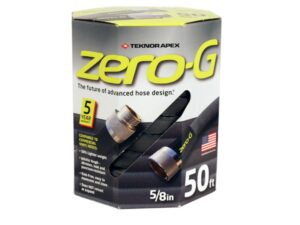 | Zero-G 5/8-Inch x 50-Foot Garden Hose | Check Price |
Third Choice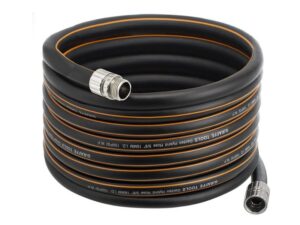 | Giraffe Tools 5/8-Inch x 50-Foot Hybrid Garden Hose | Check Price |
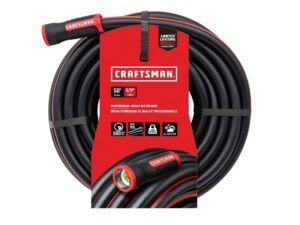 | Craftsman Professional Grade 5/8-Inch x 50-Foot Water Hose | Check Price |
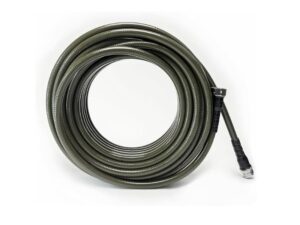 | Water Right 50-Foot Polyurethane Garden Hose | Check Price |
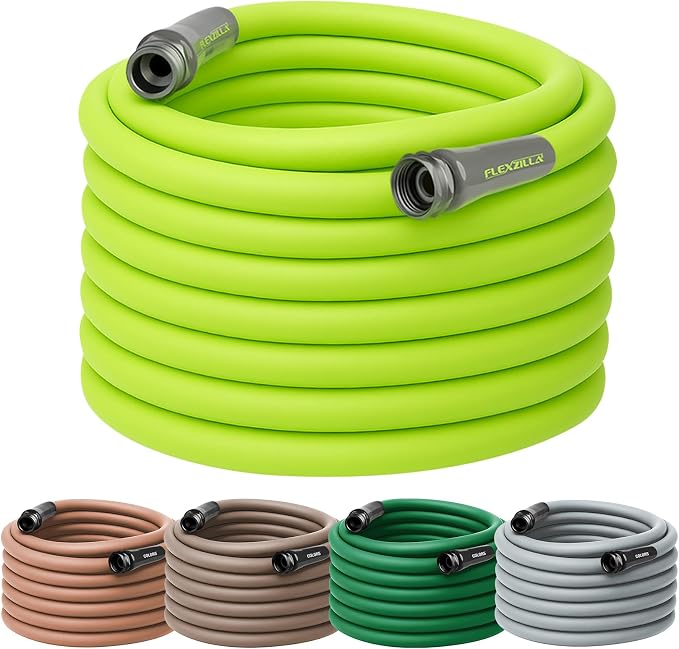
1. Flexzilla Garden Hose 5/8 in. x 50 ft.- Best Overall
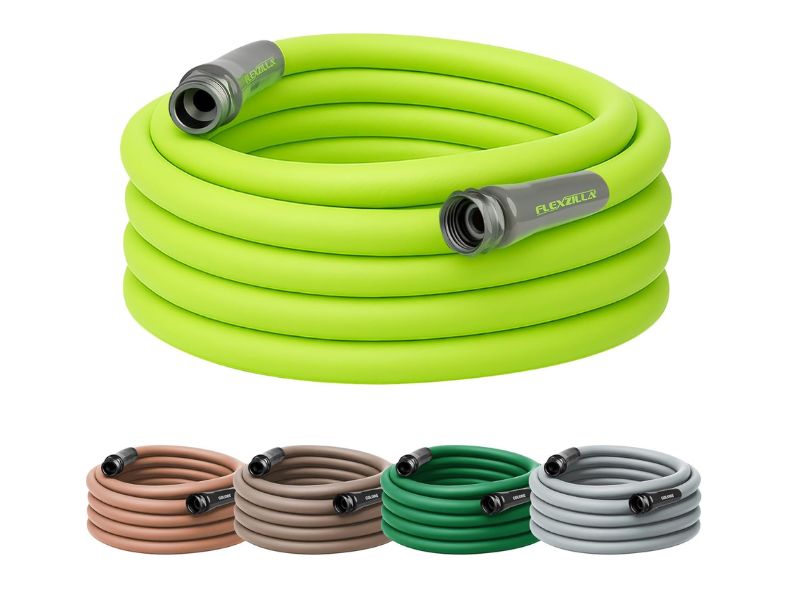
The Flexzilla 5/8-inch x 50-foot model is my first choice for the typical backyard because it balances nearly every characteristic that matters: manageable weight, good water flow, flexibility, durable fittings, and easy coiling.
Its 5/8-inch internal diameter is particularly important. That size provides noticeably better water volume than narrow lightweight hoses while avoiding much of the bulk associated with a 3/4-inch hose. For watering flower beds, connecting a sprinkler, rinsing a deck, or washing a vehicle, 5/8 inch is an excellent general-purpose diameter.
Flexzilla uses a flexible hybrid-polymer construction rather than traditional heavy rubber. The manufacturer states that the hose has zero memory, allowing it to lie relatively flat instead of continually trying to return to its stored shape. Its outer cover is abrasion resistant, while the fittings are crush-resistant anodized aluminum. Maximum working pressure is listed at 150 PSI at 70°F.
Another advantage is its ability to stay flexible across changing weather conditions. A stiff hose is frustrating around shrubs, corners, raised beds, and patio furniture because it tends to pull back toward the spigot. A more flexible hose follows your path much more naturally.
The 50-foot length is also a practical middle ground. It provides sufficient reach for many suburban backyards without creating the unnecessary weight, storage bulk, and pressure loss associated with automatically choosing a 100-foot hose. Flexzilla identifies its HFZG550YW model as a 50-foot, 5/8-inch hose using standard garden-hose fittings.
What I Like
- Flexible hybrid-polymer construction
- Full-size 5/8-inch diameter
- Good balance between durability and weight
- Zero-memory design helps it lie flatter
- Abrasion-resistant outer cover
- Crush-resistant aluminum fittings
- Easy to maneuver around beds and landscaping
- Suitable for sprinklers, nozzles, and general washing
What I Do Not Like
- It is not as compact as a collapsible fabric-style hose.
- The bright exterior may not appeal to homeowners wanting a subtle hose beside landscaping.
- A 50-foot model may still be too short for very large properties.
Best for: Homeowners wanting one dependable hose for general backyard watering, lawn sprinklers, cleaning, and garden maintenance.
2. zero-G 4001-50 5/8-Inch x 50-Foot Garden Hose- Best Lightweight Full-Flow Hose
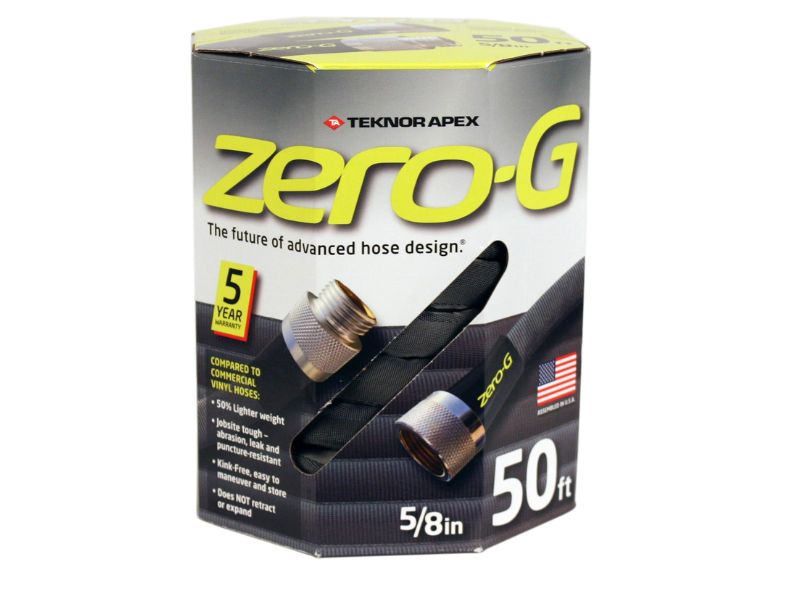
The zero-G 4001-50 is my preferred alternative when carrying and dragging a conventional hose feels unnecessarily tiring.
Its standout characteristic is weight. The manufacturer describes zero-G as up to 50% lighter than standard garden hoses, which can make a considerable difference when repeatedly moving the hose across a patio, garden, lawn, or driveway.
Importantly, this is still a 5/8-inch x 50-foot hose. You are therefore not achieving low weight simply by switching to a very narrow tube with substantially reduced water volume. The design is intended to provide flow comparable with a conventional 5/8-inch hose.
Instead of relying on a thick traditional rubber exterior, zero-G uses a woven outer jacket designed to resist punctures and abrasion. The inner construction remains flexible, while commercial-grade crush-resistant couplings help protect a common weak point on frequently used hoses.
This construction also makes the hose relatively compact when empty. That is useful if your storage area is small or you do not want a large coil dominating the side of the house.
I particularly like it for homeowners who carry their hose between different parts of a property rather than keeping it permanently connected to one reel. It is also a sensible choice for people who find conventional rubber hoses cumbersome.
One distinction is worth understanding: zero-G is not an expandable hose. It does not dramatically lengthen when pressurized and shrink when drained. Its lightweight construction simply allows it to pack flatter and handle differently from a conventional round hose.
What I Like
- Significantly lighter than many conventional hoses
- Maintains a useful 5/8-inch diameter
- Compact when drained
- Woven cover resists abrasion and punctures
- Kink-resistant construction
- Crush-resistant fittings
- Works with common nozzles and sprinklers
- Easier to carry across larger yards
What I Do Not Like
- The woven construction feels different from a traditional round hose.
- It does not retain a perfectly round form when unpressurized.
- People who prefer thick rubber may find it less substantial in the hand.
Best for: Anyone wanting strong everyday water flow without dragging a heavy conventional hose around the backyard.
3.Giraffe Tools 5/8-Inch x 50-Foot Hybrid Garden Hose- Best for Twist and Kink Control
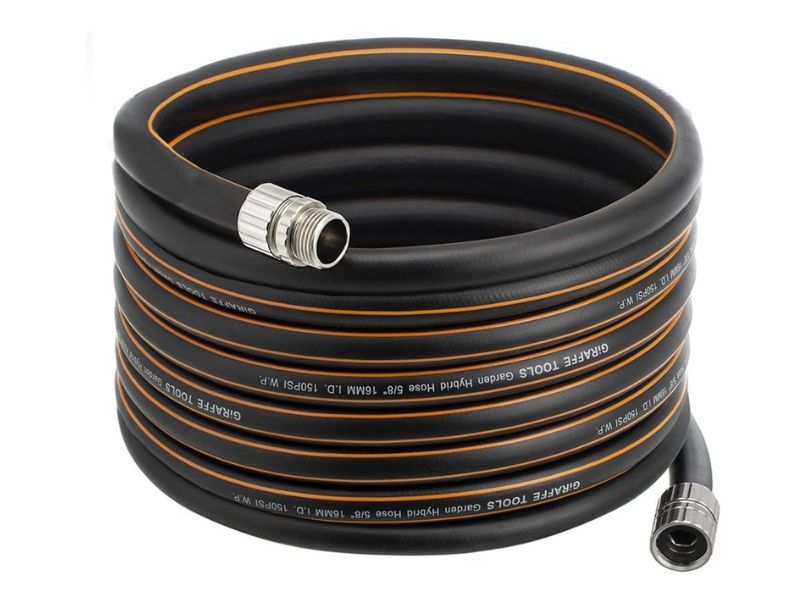
The Giraffe Tools 5/8-inch x 50-foot hybrid hose earns my third position because it focuses heavily on one of the most annoying backyard watering problems: twisting.
A hose often develops torsional tension as you drag it across a lawn or walk around landscaping. Eventually that tension creates loops, bends, or kinks. Giraffe Tools incorporates a movable swivel handle that allows the hose to rotate more naturally while also giving you a larger gripping surface when connecting it to the faucet.
The hose itself uses a three-layer hybrid polymer construction combining qualities associated with rubber and polymer materials. According to the manufacturer, it is designed to remain flexible while resisting abrasion and avoiding the strong shape memory that makes some hoses difficult to coil.
Its 5/8-inch diameter also keeps it appropriate for general backyard jobs rather than limiting it to gentle container watering. You can connect common spray nozzles, watering wands, sprinklers, and other standard garden attachments.
The 50-foot model makes particular sense for landscaped yards containing corners, trees, planters, or patio furniture. Those are situations where a hose is constantly being redirected and twist resistance becomes more valuable than it would be on a simple straight run.
The primary tradeoff is that a substantial hybrid hose will not feel quite as minimal as an ultra-light woven model. However, buyers who prioritize conventional handling and connection control may prefer that more structured feel.
What I Like
- 5/8-inch diameter supports useful everyday flow
- Rotating grip helps manage twisting
- Three-layer hybrid construction
- Abrasion-resistant exterior
- Flexible for maneuvering around obstacles
- Easy-to-grip connection area
- Available in multiple lengths
- Suitable for regular lawn and garden use
What I Do Not Like
- Not as compact as an empty woven hose.
- More hose structure means additional bulk compared with ultra-light options.
- You still need good storage habits to prevent unnecessary twists.
Best for: Landscaped backyards where the hose frequently travels around corners, garden beds, furniture, trees, and other obstacles.
4.Craftsman Professional Grade 5/8-Inch x 50-Foot Water Hose- Best for Frequent Yard Work
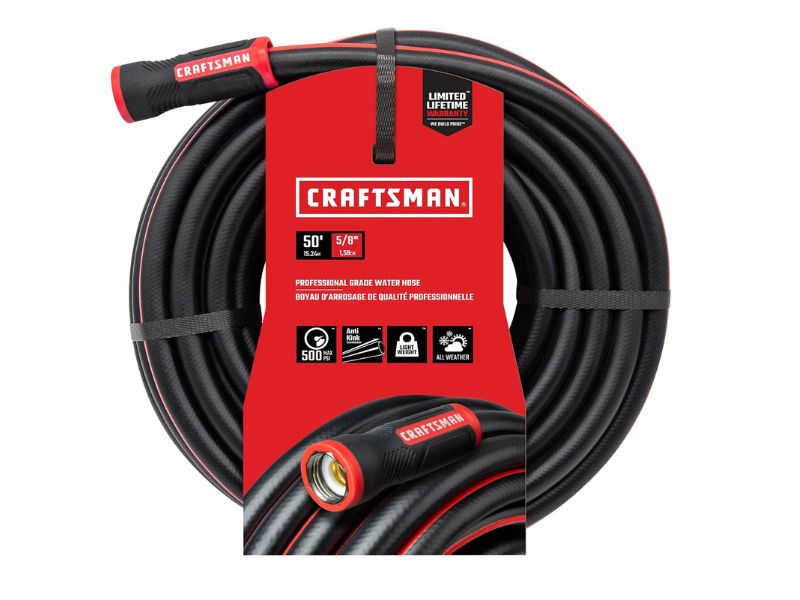
The Craftsman Professional Grade hose is a strong choice for homeowners who regularly use a hose for more than occasional plant watering.
This 50-foot model has a 5/8-inch diameter and uses what the manufacturer calls Polyfusion technology, combining polyurethane and PVC. The resulting hybrid-polymer construction is intended to deliver heavy-duty performance while weighing less than a traditional construction-grade hose.
The hose also uses anodized aluminum crush-resistant couplings and large bi-material grips. Those oversized connection points are useful if you frequently change between a nozzle, sprinkler, watering wand, or another attachment.
Its zero-memory construction is intended to minimize the tendency to twist back into a stored position. The material also remains flexible in below-freezing conditions, which is useful for homeowners who occasionally perform outdoor cleanup during colder months.
I see this as a particularly practical option for users who expect their hose to move between lawn care, landscaping, patio rinsing, outdoor cleanup, and other routine household jobs.
Compared with zero-G, it has a more conventional hybrid-hose character. Compared with a traditional rubber hose, however, the hybrid construction reduces some of the weight and stiffness that can make heavy-duty hoses cumbersome.
What I Like
- Professional-grade hybrid construction
- Standard 5/8-inch diameter
- Good choice for frequent outdoor use
- Large grips simplify connections
- Crush-resistant aluminum couplings
- Abrasion-resistant exterior
- Zero-memory design
- Flexible in cold conditions
What I Do Not Like
- Not as compact as fabric-style alternatives.
- Buyers seeking the absolute lightest possible hose have better options.
- Heavy-duty capability may be unnecessary for occasional patio watering.
Best for: Homeowners regularly using one hose for lawn care, landscaping, cleanup, sprinklers, and other outdoor chores.
5.Water Right 50-Foot Polyurethane Garden Hose- Best for Garden Beds and Easy Handling
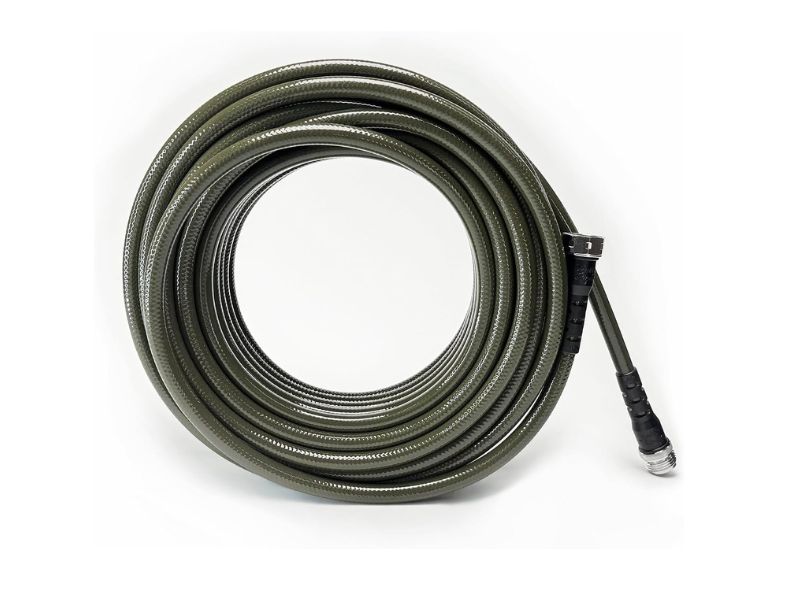
The Water Right 400 Series takes a different approach from the first four recommendations. Instead of maximizing water volume, it prioritizes very low weight, clean materials, and comfortable everyday watering.
The hose has a 7/16-inch internal diameter, considerably narrower than the 5/8-inch hoses above. Water Right specifies a flow of approximately 4 gallons per minute at 40 PSI. That is enough for hand watering, container gardens, raised beds, patio plants, and many household tasks, but buyers should recognize that this is intentionally not a maximum-flow hose.
Its major advantage is weight: the manufacturer lists the 50-foot hose at only about 3 pounds. That makes it particularly appealing for users who dislike dragging a heavy wet hose around delicate plants.
The hose is manufactured from polyurethane and uses lead-free chrome-plated brass fittings. Water Right also identifies the material as drinking-water safe and free from lead, BPA, and phthalates.
For intensive lawn irrigation, filling large containers quickly, or operating demanding sprinklers, I would choose one of the 5/8-inch models instead. But for careful plant watering, the lighter Water Right can be far more pleasant to handle.
What I Like
- Extremely lightweight for a 50-foot hose
- Flexible polyurethane construction
- Comfortable around flowers and garden beds
- Drinking-water-safe materials
- Lead-free brass fittings
- Easy to carry and store
- Excellent for containers and raised beds
What I Do Not Like
- 7/16-inch diameter limits maximum flow
- Not my first choice for demanding sprinklers
- Slower for filling large tubs or containers
- Buyers needing maximum water delivery should choose 5/8 inch
Best for: Gardeners who prioritize lightweight handling, plant watering, containers, raised beds, and smaller backyard spaces.
Backyard Hose Comparison Table
| Product | Length | Diameter | Construction | Main Strength | Best Use |
| Flexzilla Garden Hose | 50 ft | 5/8 in. | Hybrid polymer | Best balance of flexibility and flow | General backyard use |
| zero-G 4001-50 | 50 ft | 5/8 in. | Flexible core with woven jacket | Lightweight full-flow design | Carrying around larger yards |
| Giraffe Tools Hybrid Garden Hose | 50 ft | 5/8 in. | Three-layer hybrid | Swivel grip and twist control | Landscaped yards |
| Craftsman Professional Grade Water Hose | 50 ft | 5/8 in. | Polyurethane/PVC hybrid | Durable frequent-use construction | Yard work and cleanup |
| Water Right 400 Series | 50 ft | 7/16 in. | Polyurethane | Extremely lightweight | Garden beds and containers |
Quick Comparison
For most homes, I would choose Flexzilla because it offers the strongest overall combination of useful water flow, flexibility, fitting durability, and everyday handling.
Choose zero-G when hose weight is your biggest complaint but you still want the capacity of a 5/8-inch hose. Choose Giraffe Tools when twisting around obstacles is particularly troublesome.
The Craftsman Professional Grade model makes sense for frequent multipurpose yard work, while Water Right is the specialist choice for gardeners who value very low weight more than maximum flow.
How I Selected These Backyard Hoses
I focused on factors that directly affect how pleasant and effective a hose is during real backyard use rather than selecting five hoses with nearly identical specifications.
The biggest considerations were internal diameter, usable length, construction material, flexibility, kink resistance, fitting design, abrasion resistance, weight, flow capability, storage convenience, and suitability for common outdoor attachments.
I also prioritized product diversity. For example, the Water Right 400 Series deliberately represents the lightweight low-flow end of the category, while zero-G offers a lighter construction without dropping to the same narrow internal diameter.
For the average property, I consider 5/8 inch x 50 feet the most versatile starting configuration. A 5/8-inch hose generally provides enough volume for sprinklers and cleaning while remaining easier to handle than larger 3/4-inch hoses. Longer hoses create additional friction loss, so buying significantly more length than you actually need can reduce performance.
Complete Buying Guide: How to Choose a Backyard Hose
Choose the Correct Hose Diameter
Diameter has a major influence on water volume.
A 5/8-inch hose is the safest general-purpose choice for most homeowners. It provides enough flow for watering, conventional sprinklers, rinsing vehicles, and outdoor cleanup without becoming excessively bulky.
A smaller hose such as 7/16 or 1/2 inch is easier to carry but provides less volume. These smaller diameters are excellent for flower beds, containers, patio gardens, and gentle hand watering.
A 3/4-inch hose makes more sense when maximum water delivery is important, such as long irrigation runs or filling large containers. However, the larger diameter increases weight and storage bulk. Flexzilla notes that 3/4-inch hoses can move substantially more water than 5/8-inch models at equivalent pressure, while the 5/8-inch format remains the more balanced residential choice.
Buy Only the Length You Need
Longer is not automatically better.
A 25-foot hose may be perfect when the spigot is beside a small patio or garden. A 50-foot hose is a versatile option for many backyards. A 75- or 100-foot model becomes useful when the faucet is far from your planting or cleaning area.
Extra length creates several disadvantages:
- More weight
- More material to coil
- Greater storage requirements
- More friction loss
- More opportunities for tangles and kinks
Measure from the outdoor faucet to the farthest place you regularly need to reach, then allow a modest amount of additional length for maneuvering.
Understand Hose Materials
Hybrid Polymer
Hybrid hoses combine characteristics of multiple synthetic materials to deliver flexibility without the full weight of rubber.
The Flexzilla and Craftsman models are good examples of this approach. Hybrid construction can be particularly useful when you want a conventional round hose that remains reasonably easy to handle.
Woven or Fabric-Reinforced Hoses
Fabric-style hoses can reduce weight dramatically.
The zero-G demonstrates this approach with a flexible inner structure surrounded by a tough woven jacket. These hoses can become much more compact when water pressure is removed.
Polyurethane
Polyurethane works especially well when low weight and flexibility are priorities. The Water Right model demonstrates how a polyurethane hose can remain extremely manageable even at 50 feet.
Rubber
Traditional rubber remains attractive for demanding environments because of its ruggedness and temperature resistance, but it is typically heavier than newer hybrid materials. For routine backyard watering, many homeowners will appreciate the weight savings offered by hybrid construction.
Pay Attention to Kink Resistance
No hose is completely immune to poor handling.
The best designs reduce kinking by using flexible material, low-memory construction, rotating fittings, or reinforced internal structures.
When using any hose, completely straighten large loops before turning the water on. If a kink develops, reduce tension rather than repeatedly pulling harder from the far end.
Check the Couplings
Hose fittings receive a surprising amount of abuse.
Look for crush-resistant metal couplings, quality threads, durable washers, and enough gripping area to tighten a connection without tools.
A large grip is particularly helpful for anyone with limited hand strength or when fittings are wet.
Consider Water Flow Before Choosing an Ultra-Light Hose
A hose can become lighter in two fundamentally different ways.
One method is improving the materials while maintaining a 5/8-inch internal diameter, as with zero-G. Another is reducing the internal diameter, as with the 7/16-inch Water Right.
Both approaches are legitimate, but they serve different buyers.
For sprinklers and faster filling, I prefer 5/8 inch. For careful hand watering, the convenience of a narrow lightweight hose can outweigh the lower flow.
Think About Your Main Attachment
A simple spray nozzle places relatively modest demands on a hose.
Lawn sprinklers, longer watering wands, pressure-sensitive irrigation devices, and multiple connected hoses benefit more from good flow.
If you routinely operate a sprinkler at the far end of a long hose, prioritize diameter and avoid unnecessary hose length.
Do Not Confuse Working Pressure With Burst Pressure
These specifications are different.
Working pressure describes the pressure under which a hose is designed to operate. Burst pressure represents the much higher pressure at which structural failure may occur under testing conditions.
A large burst-pressure number should therefore never be interpreted as the recommended everyday operating pressure.
Backyard Hose Sizing and Setup Guidance
For a normal residential property, start by measuring the actual distance from the faucet to your farthest watering location.
If that distance is approximately 35 to 40 feet, a 50-foot hose usually provides a comfortable margin. If the farthest location is only 15 feet away, choosing 50 or 100 feet unnecessarily increases clutter.
Connect the female end securely to the outdoor faucet with a good hose washer installed. Hand-tightening is normally sufficient when the fitting and washer are in good condition.
Before attaching a demanding sprinkler, uncoil the hose fully. Tight coils and partial kinks restrict flow and can make a perfectly adequate hose seem weak.
Turn the water on gradually and check both connection points for leakage. If the faucet connection drips, inspect the washer before aggressively tightening the fitting.
When using multiple connected hoses, remember that additional length increases friction. If you routinely need a 100-foot run, a good 5/8-inch hose is generally preferable to joining several narrow lightweight hoses.
How to Maintain a Backyard Hose
A quality hose can deteriorate prematurely when it remains continuously pressurized, sits in direct sunlight unnecessarily, or freezes with water trapped inside.
After watering, turn off the faucet and release pressure through the nozzle. Drain as much water as practical before storage.
Coil the hose in broad loops instead of forcing it into small, tight circles. This minimizes stress and makes the next use easier.
Inspect the washers inside the fittings periodically. A cheap worn washer is often responsible for a leak that homeowners mistakenly attribute to the entire hose.
Avoid repeatedly driving vehicles, wheelbarrows, or heavy equipment over the hose. Even when the outer cover appears undamaged, repeated crushing can weaken internal layers.
Before freezing weather, disconnect and drain the hose. Store it somewhere protected whenever practical.
Common Backyard Hose Buying and Usage Mistakes
Buying Too Much Hose
A 100-foot hose sounds more versatile than a 50-foot hose, but the additional length means additional weight, friction, storage bulk, and tangling.
Choosing a Small Diameter for a Demanding Sprinkler
A very lightweight narrow hose can perform beautifully for watering flowers but disappoint when connected to a high-flow lawn sprinkler.
Leaving the Hose Permanently Pressurized
Turn the water supply off after use. Constant pressure places unnecessary stress on fittings, washers, and hose construction.
Pulling a Kinked Hose Harder
Dragging harder often tightens the kink. Walk toward the affected area and straighten the hose instead.
Ignoring the Hose Washer
When water leaks from the faucet connection, inspect the rubber washer first. Replacement is inexpensive and often immediately fixes the problem.
Buying Based Only on Weight
Low weight is useful, but it should be balanced against flow, durability, and your intended watering equipment.
Storing a Hose Full of Water During Freezing Conditions
Trapped water expands when frozen and can damage the hose or fittings. Drain the hose before long-term winter storage.
Frequently Asked Questions
What is the best backyard hose for most homeowners?
A flexible 5/8-inch, 50-foot hybrid hose is the strongest general-purpose choice.
That combination provides enough water volume for plant watering, sprinklers, vehicle washing, and routine backyard cleanup without the bulk associated with much longer or wider hoses. Among my five recommendations, Flexzilla offers the best overall balance because it combines a standard 5/8-inch diameter with flexible hybrid-polymer construction and durable fittings.
Is a 50-foot hose long enough for a backyard?
A 50-foot hose is sufficient for many small and medium residential backyards.
Measure from your outdoor faucet to the farthest point you regularly water. If that distance is comfortably below 50 feet, there is little reason to carry and store a longer hose. For large yards or properties where the faucet is poorly positioned, 75 or 100 feet may be necessary. Remember that increasing length also increases friction loss and reduces convenience.
Is a 5/8-inch or 3/4-inch garden hose better?
A 5/8-inch hose provides the better balance for most normal household watering jobs.
A 3/4-inch hose can deliver substantially greater water volume, which makes it useful for long runs and high-volume applications. However, the larger diameter adds weight and bulk. For a typical backyard using a nozzle, watering wand, or lawn sprinkler, 5/8 inch usually provides sufficient flow while remaining considerably easier to store and maneuver.
Does hose length reduce water pressure?
Longer hoses increase friction loss and can reduce performance at the far end.
The effect becomes more noticeable when you combine long distance with a small internal diameter or a demanding attachment. This is why buying a 100-foot hose when you only need 40 feet can be counterproductive. For longer watering runs, choosing an adequate internal diameter is especially important.
Are lightweight garden hoses durable?
A well-designed lightweight hose can still provide excellent durability for everyday backyard use.
Weight alone does not determine strength. Modern hoses use hybrid polymers, polyurethane, reinforced fabric, and woven jackets to reduce unnecessary material while protecting the water-carrying core. For example, zero-G combines its lightweight design with an abrasion- and puncture-resistant outer cover, while Flexzilla uses an abrasion-resistant hybrid-polymer construction.
What hose diameter is best for a lawn sprinkler?
A 5/8-inch hose is usually the safest residential choice for operating lawn sprinklers.
Its larger water pathway provides greater potential flow than narrow garden hoses while remaining easier to manage than a 3/4-inch design. If you are using an especially demanding sprinkler over a long distance, the larger 3/4-inch size may provide an advantage. Avoid pairing a long, narrow hose with equipment requiring significant water volume.
Are expandable hoses good for backyard use?
Expandable hoses can be convenient, but they are not automatically the best choice for every yard.
They are appealing because they store compactly and weigh very little. However, buyers who prioritize predictable flow and a more conventional hose feel may prefer a hybrid or woven non-expanding hose. The zero-G model in this guide is useful for illustrating the difference: it is lightweight and compact but does not depend on expansion and contraction for operation.
How can I prevent my garden hose from kinking?
Straighten large loops before pressurizing the hose and avoid pulling against existing twists.
A flexible, low-memory hose helps considerably, as does a rotating grip such as the design used by Giraffe Tools. During storage, create broad loops instead of tightly winding the hose. When a kink occurs, walk back toward the restriction and straighten it directly rather than continuing to pull from the nozzle end.
Should I leave my garden hose connected all year?
Disconnecting and draining the hose before freezing weather is the safer long-term practice.
Even hoses designed to remain flexible in cold weather can contain trapped water. Water expands as it freezes, potentially stressing fittings, washers, and internal layers. Turn off the faucet, release the pressure, drain the hose, and store it protected from prolonged winter exposure whenever practical.
What is the easiest hose for an older homeowner to handle?
A lightweight hose with large, easy-grip fittings generally requires the least physical effort.
The Water Right 400 Series is exceptionally light at roughly three pounds per 50 feet, although its smaller 7/16-inch diameter sacrifices some flow. zero-G is another attractive choice because it reduces hose weight while retaining a 5/8-inch diameter. The better choice depends on whether minimum carrying weight or stronger water delivery matters more.
Can I use a backyard hose for drinking water?
Use only a hose whose manufacturer specifically identifies its materials as drinking-water safe.
A hose suitable for watering plants is not automatically intended for potable-water applications. Water Right specifically describes its polyurethane material as drinking-water safe and states that it is lead-, BPA-, and phthalate-free. zero-G is also identified as drinking-water safe by the manufacturer and product documentation.
How often should a garden hose be replaced?
Replace a hose when deterioration causes persistent leaks, bulging, cracking, or unreliable connections.
There is no universal replacement schedule because lifespan varies with construction, climate, water pressure, sun exposure, storage, and frequency of use. Periodically inspect the full hose and its fittings rather than replacing it solely because of age. Before discarding a leaking hose, check whether a simple worn connector washer is the actual problem.
Conclusion
Choosing the best backyard hose becomes much easier once you match the hose diameter, length, construction, and weight to the jobs you actually perform.
My primary recommendation is the Flexzilla Garden Hose 5/8 in. x 50 ft. Its 5/8-inch diameter provides useful everyday flow, while the flexible hybrid-polymer construction makes it easier to maneuver than a traditional heavy hose. For a homeowner who wants one hose for watering beds, running a sprinkler, washing a vehicle, and general outdoor cleanup, it is the most balanced choice here.
The zero-G 4001-50 is the alternative I would choose when low carrying weight is a priority but you do not want to sacrifice the advantages of a 5/8-inch hose. The Giraffe Tools Hybrid Garden Hose is particularly useful in landscaped yards where twisting and frequent direction changes are common.
For more demanding routine yard work, the Craftsman Professional Grade Water Hose offers a sturdy hybrid design and user-friendly connections. If your main job is carefully watering vegetables, flowers, raised beds, or patio containers, the ultra-light Water Right 400 Series may be more comfortable despite its lower flow.
For the majority of backyards, start with a 5/8-inch x 50-foot hose and only move longer, wider, or narrower when your specific watering needs justify the tradeoff.

I’m Maya L. Greenwood, a lifelong plant lover who believes anyone can grow something beautiful with the right guidance. After years of testing soil mixes, pruning methods, irrigation tricks, and pest-safe solutions, I started EasyGardenTips.com to turn hard-won lessons into step-by-step advice. From seed starting and container gardens to composting and seasonal checklists, my goal is to make gardening simple, sustainable, and fun.