3 Best LED Grow Lights for 1 Plant for Focused Indoor Growth
Buying a huge grow panel for one plant is usually unnecessary. The best LED grow light for 1 plant should concentrate useful light over a single canopy while giving you enough control over distance, intensity, photoperiod, and coverage to match that plant as it grows.
For one plant, fixture geometry often matters more than raw wattage. A properly positioned 10W–25W compact light can make far more sense than a powerful tent fixture that wastes most of its output on the floor, walls, or empty space around the pot.
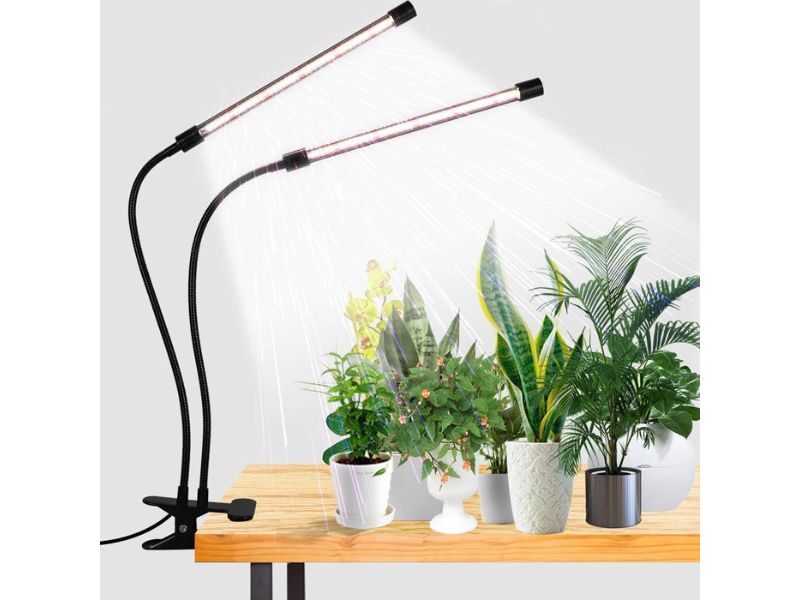
My primary recommendation is the GooingTop 6000K Full Spectrum Grow Light. I would choose it for most single-plant setups because it combines 6000K white/red LEDs, five brightness levels, flexible gooseneck positioning, clamp mounting, and 4/8/12-hour automatic timing.
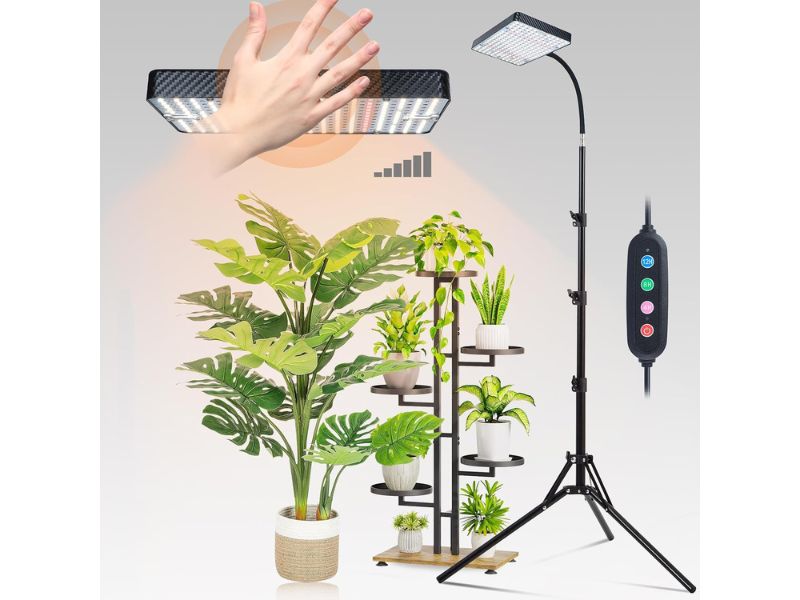
I would choose the FECiDA Smart 25W Standing Grow Light for a larger floor plant or a plant that may quickly outgrow a tiny pot-mounted lamp. Its current configuration provides 25W actual power, 24–64-inch height adjustment, and 4/8/12/16/20-hour timer options, giving it substantially more physical range than a compact clip lamp.
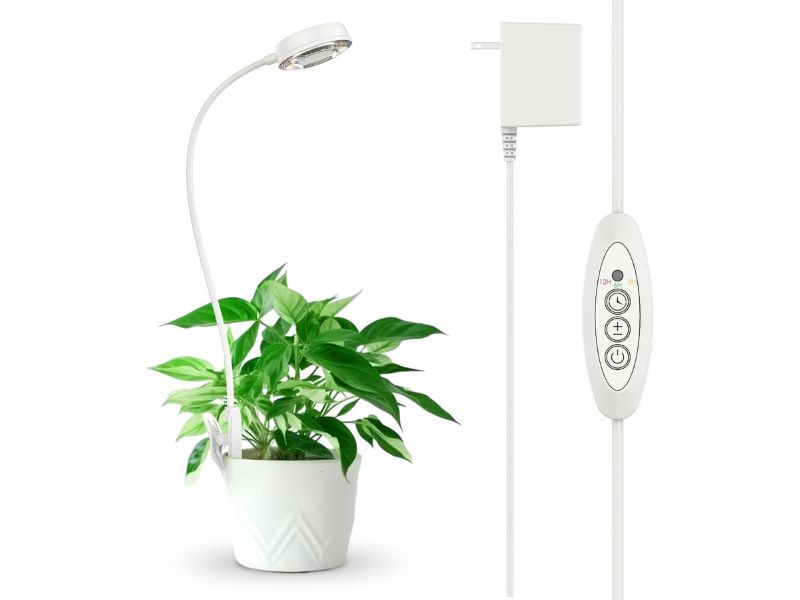
For one small desk, windowsill, or bedside plant, I would choose the SANSI 10W Pot Clip Grow Light. It clips directly to the pot and combines 10W actual power, 4000K full-spectrum output, four brightness levels, and a 3/6/12-hour timer.
3 Best LED Grow Lights for 1 Plant
1. GooingTop 6000K Full Spectrum Grow Light
Key Features
- 6000K full-spectrum-style output
- White and red LEDs
- Five brightness levels
- 4/8/12-hour automatic timer
- Flexible gooseneck
- Clamp mounting
- Compact footprint
- Designed for indoor plants
The GooingTop is my primary recommendation because it gives one-plant growers excellent control over where the light actually lands.
The current U.S. Amazon listing describes a 6000K plant lamp using white and red LEDs, five brightness levels, a strong clamp, flexible gooseneck positioning, and automatic 4-, 8-, and 12-hour timer settings.
For one plant, that flexible neck can matter more than having a much higher wattage fixture.
A plant does not benefit from photons hitting:
- The wall
- The desk
- Empty shelf space
- The floor
The goal is to place the illuminated area over the actual leaves.
That makes GooingTop particularly useful for:
- Pothos
- Philodendron
- Peperomia
- African violets
- Young Monstera
- Small herbs
- Small succulents
- Young houseplants
The clamp can attach to a desk, shelf, side table, or plant stand while leaving the pot itself untouched.
That is helpful if the plant is in:
- A lightweight nursery pot
- A decorative ceramic pot
- A hanging-style container
- A container without a suitable rim for pot-mounted lights
The five brightness settings provide another important advantage.
One plant can change significantly over time.
A recently rooted cutting may have only a few leaves.
Months later, the same plant may have doubled its canopy diameter.
Instead of replacing the fixture immediately, you can adjust:
brightness + distance + lamp angle.
Those three variables give the GooingTop more flexibility than a fixed-output bulb.
The 6000K output looks cool and daylight-like rather than intensely purple. The current listing also combines the white LEDs with red LEDs rather than relying on cool white alone.
For a home or office, I generally prefer white-spectrum grow lights because they make it easier to inspect natural plant color.
You can more easily notice:
- Yellow foliage
- Pale new growth
- Brown edges
- Pest damage
- Bleaching
- Water-related stress
without turning off the grow lamp.
The built-in timer is another practical feature.
A consistent photoperiod is easier to maintain when the light turns on and off automatically.
The 4-, 8-, and 12-hour options make the GooingTop especially convenient when it supplements a window.
For example, a plant receiving several hours of daylight may need only supplemental artificial light rather than a full artificial day.
The limitation is total coverage.
This is still a compact lamp.
It works well when one plant has a relatively modest canopy.
A large Monstera, fiddle-leaf fig, citrus tree, or mature floor plant may eventually become too wide for a single small gooseneck head.
That is when the FECiDA standing light becomes more attractive.
What I Like
- Flexible positioning
- Five brightness levels
- Integrated timer
- Easy clamp installation
- White-looking spectrum
- Good for many compact houseplants
- Does not occupy pot space
What I Do Not Like
- Limited coverage for large mature plants
- 12 hours is the longest built-in timer option
- Requires a nearby surface for the clamp
The GooingTop is the light I would choose for most individual desk, shelf, and tabletop plants because it balances positioning, dimming, timing, and compact size particularly well.
2. FECiDA Smart 25W Standing Grow Light
Key Features
- 25W actual power
- Standing grow-light design
- 24–64-inch height adjustment
- Full-spectrum plant lighting
- 4/8/12/16/20-hour timer
- Designed for indoor plants and bonsai
- Useful for taller single plants
- No shelf or pot clip required
The FECiDA Smart Standing light is the option I would choose when “one plant” means something larger than a small pothos on a desk.
Its current Amazon listing identifies it as a 25W standing grow light adjustable from approximately 24 to 64 inches, with timer choices of 4, 8, 12, 16, or 20 hours.
That height range changes what the fixture can realistically illuminate.
A pot clip works brilliantly on a six-inch plant.
It becomes much less convenient when the plant grows two or three feet tall.
The FECiDA’s stand allows the light source to rise as the plant grows.
I would consider it particularly useful for:
- Larger Monstera
- Rubber plants
- Fiddle-leaf figs
- Young citrus
- Taller bonsai displays
- Mature philodendrons
- Medium-size palms
- Larger indoor herbs
The 25W actual input also gives it more power headroom than the selected 10W SANSI.
Wattage does not directly tell you plant-level PPFD, but actual input still gives important context.
All else being reasonably comparable, a 25W single-plant fixture has more electrical capacity available than a 10W pot lamp.
The real value, however, is the combination of output and positioning.
Suppose you have a plant that starts at 18 inches tall.
You can position the fixture relatively close.
As the plant grows, extend the stand toward its 64-inch upper range.
That makes the light adaptable over a longer period.
The wide timer range is another major strength.
While GooingTop stops at 12 hours, FECiDA currently offers 4/8/12/16/20-hour settings.
That gives you much more control when artificial lighting provides most or all of the plant’s daily light.
A plant near a bright window might use a shorter supplemental schedule.
A plant in a windowless room may require a substantially longer artificial photoperiod depending on fixture intensity and species.
A timer does not tell you how many photons the plant receives, so I would not automatically select the longest setting.
Instead, coordinate:
fixture distance + output + hours/day.
The standing design also solves a common practical problem.
Not every room has a shelf or table positioned exactly where the plant needs light.
A self-supporting fixture can work beside a floor pot without requiring you to:
- Drill into the ceiling
- Clamp onto furniture
- Attach hardware to the pot
That makes it particularly suitable for living-room floor plants.
The tradeoff is physical footprint.
A standing fixture naturally occupies more room than a pot clip.
If you are lighting one tiny succulent on a crowded desk, the FECiDA would be unnecessarily large.
What I Like
- 25W actual power
- Excellent height range
- Suitable for taller plants
- Up to 20-hour timer option
- Does not require shelf mounting
- Can adapt as the plant grows
- Better choice for medium-to-large individual plants
What I Do Not Like
- Takes more floor space
- Excessive for a very small plant
- More visible in a living room than a tiny pot light
- Careful positioning is still required to keep output centered on the canopy
The FECiDA Smart Standing light is my choice for one medium or larger indoor plant where height adjustment and longer timer options are more useful than an ultra-compact fixture.
3. SANSI 10W Pot Clip Grow Light
Key Features
- 10W actual input
- 4000K full-spectrum output
- Pot-mounted clip
- Four brightness levels
- 3/6/12-hour timer
- Compact design
- SANSI ceramic LED technology
- Designed specifically for individual indoor plants
The SANSI 10W Pot Clip is the most purpose-built single-pot option here.
Its current U.S. Amazon listing specifies 10W power, 4000K full-spectrum output, four dimming levels, and 3-, 6-, and 12-hour automatic timing.
The fixture attaches directly to the pot.
That means you do not need:
- A desk edge
- A nearby shelf
- A separate stand
- Ceiling hardware
The plant and light effectively become one small setup.
I would consider it especially useful for:
- African violets
- Peperomia
- Small pothos
- Small philodendrons
- Bonsai
- Herbs
- Compact succulents
- Young plants
The 10W input is modest, but that is not automatically a disadvantage.
For one small canopy, efficient use of a compact illuminated area can be more sensible than using a high-wattage light that spreads most of its output beyond the leaves.
The key is distance.
A 10W plant light positioned close to one small canopy can provide useful supplemental light.
The same fixture positioned several feet away would be much less effective.
The 4000K spectrum has a more neutral white appearance than GooingTop’s cooler 6000K configuration.
For bedrooms, offices, and living rooms, some users may find 4000K easier to live with for long daily periods.
Color temperature alone should not decide the purchase, though.
I would prioritize:
- Actual useful intensity
- Distance
- Coverage
- Timer
- Dimming
before choosing between 4000K and 6000K.
The four brightness levels are particularly useful because pot-mounted lights usually sit relatively close to foliage.
If a newly placed plant shows signs of excessive intensity, you can reduce output instead of immediately rebuilding the setup.
The built-in 3/6/12-hour timer is also convenient for supplemental lighting.
For a plant receiving daylight through a window, 6 or 12 hours of supplemental operation may be more appropriate than leaving the lamp running continuously.
The limitation is obvious: this is a genuinely small light.
A Monstera or large rubber plant will eventually outgrow its useful footprint.
If the canopy extends far beyond the lamp, outer leaves receive less light.
That is when I would move to a wider or taller fixture.
What I Like
- Clips directly onto the plant pot
- Very small footprint
- 10W actual input
- Four dimming levels
- Integrated timer
- Neutral 4000K light
- Excellent for desks and windowsills
What I Do Not Like
- Limited to small canopies
- Pot rim needs to support the clip
- 12-hour maximum built-in timer
- Too small for many mature floor plants
The SANSI 10W Pot Clip is the model I would choose when one compact plant needs its own dedicated grow light with the smallest practical footprint.
LED Grow Lights for One Plant Comparison
| Product | Format | Actual Power | Intensity Control | Timer | Best Use |
| GooingTop 6000K | Clamp/gooseneck | Compact class | 5 levels | 4/8/12 hr | Most small-to-medium plants |
| FECiDA Smart Standing | Floor/standing | 25W | Adjustable setup | 4/8/12/16/20 hr | Taller individual plants |
| SANSI Pot Clip | Pot-mounted | 10W | 4 levels | 3/6/12 hr | One compact pot |
GooingTop provides the most flexible everyday positioning, FECiDA offers the greatest height and photoperiod flexibility, and SANSI creates the smallest self-contained single-pot setup.
How to Choose the Best LED Grow Light for 1 Plant
Match the Light to Mature Plant Size
Do not buy only for the plant’s current size.
A six-inch young Monstera can become a much larger canopy.
Think about where the plant is likely to be several months from now.
For a permanently compact plant, SANSI may be enough.
For a plant likely to become taller, FECiDA gives you more adjustment range.
Fixture Placement Matters More With One Plant
When lighting one plant, you have an advantage:
You can aim almost all of the useful output at that single canopy.
This reduces wasted light.
Center the fixture over the plant whenever practical rather than shining strongly from one side.
Best Grow Light for One Houseplant
For a typical pothos, philodendron, peperomia, or similar houseplant, I would choose GooingTop.
It gives you enough positioning and brightness control to adapt to different leaf shapes without needing a floor stand.
Best Grow Light for One Small Plant
I would choose SANSI 10W Pot Clip.
Its direct pot mounting keeps the setup compact and minimizes wasted desk space.
Best Grow Light for One Large Plant
I would choose FECiDA Smart Standing.
The 24–64-inch adjustable range makes it far more suitable for a tall plant than either compact clip fixture.
Best Grow Light for One Monstera
For a young Monstera, GooingTop works well.
As the plant becomes taller and wider, FECiDA becomes the more practical option.
A mature Monstera can eventually outgrow both, depending on canopy size.
Best Grow Light for One Pothos
GooingTop is my first choice.
A small pothos can also work well with SANSI.
Because pothos often trails or climbs, position the lamp over the active leaf canopy rather than simply over the center of the pot.
Best Grow Light for One African Violet
SANSI is particularly attractive because African violets remain compact.
The pot-mounted format can illuminate the rosette from overhead while taking almost no surrounding space.
Best Grow Light for One Succulent
SANSI can work for one small succulent, but intensity and distance deserve attention.
Many succulents require more usable light than shade-adapted tropical houseplants.
Watch for etiolation, including stretched or unusually open new growth.
Best Grow Light for One Bonsai
For a small bonsai, SANSI or GooingTop can be convenient.
For a taller display or tree with a broader canopy, the 25W FECiDA provides more positioning headroom.
Best Grow Light for One Herb Plant
GooingTop or SANSI can work for compact basil, mint, parsley, or similar herbs.
For sun-loving herbs, make sure the lamp is close enough to provide meaningful intensity.
A weak light placed far away can still produce stretched growth.
Full Spectrum Is Useful, but Not Enough by Itself
“Full spectrum” does not guarantee that a grow light is strong enough.
All three selected products are marketed around broad plant-growing spectra, with GooingTop using 6000K white/red output and SANSI specifying 4000K full-spectrum lighting.
Intensity and placement still determine whether the leaves receive enough photons.
4000K vs 6000K for One Plant
Both can support indoor plants.
4000K generally looks more neutral.
6000K looks cooler and more daylight-like.
I would choose based on fixture performance and the appearance you prefer in the room rather than assuming one color temperature is universally superior.
Dimming Is Extremely Useful for Single Plants
A single plant often sits close to its light.
That makes output adjustment particularly valuable.
GooingTop gives you five brightness levels, while SANSI provides four.
Dimming allows the lamp to adapt as:
- Leaves expand
- Seasons change
- Window light changes
- The fixture moves closer
How Long Should a Grow Light Run for One Plant?
There is no universal timer setting.
The correct duration depends on:
- Plant species
- Light intensity
- Natural daylight
- Growth stage
- Fixture distance
A plant already receiving strong window light may need only supplemental LED exposure.
A plant relying entirely on artificial lighting may need a longer artificial day.
Do Not Run It 24/7 by Default
More hours do not automatically compensate for poor intensity.
Most ordinary indoor plants should receive a regular dark period.
If the plant stretches under a normal schedule, check fixture strength and distance before simply leaving the light on continuously.
Signs One Plant Needs More Light
Possible symptoms include:
- Stretching
- Long internodes
- Leaning toward the lamp
- Smaller pale new leaves
- Slow growth
For succulents, unusually stretched new growth is particularly useful evidence.
Signs the Light May Be Too Strong
Watch for:
- Pale upper foliage
- Bleaching
- Curling
- Dry localized patches
- Stress concentrated near the lamp
Increase distance or reduce brightness gradually.
Overhead Positioning Helps Symmetry
One plant lit entirely from one side may lean toward the fixture.
Placing the lamp more directly overhead usually encourages more balanced growth.
This is particularly useful for:
- African violets
- Succulent rosettes
- Bonsai
- Compact foliage plants
Grow Light vs Window Light
A grow light does not have to replace a window.
It can supplement one.
A plant near an east-facing or north-facing window may need only enough artificial light to improve its daily total.
In that situation, a small dimmable lamp makes more sense than a high-output panel.
Pot Clip vs Desk Clamp vs Standing Light
Pot Clip
Best when:
- The plant is small
- Desk space is limited
- The pot has a suitable rim
Desk Clamp
Best when:
- You want greater aiming flexibility
- Several pot styles are used
- A shelf or table edge is available
Standing Light
Best when:
- The plant is tall
- No suitable clamp surface exists
- You need greater height adjustment
Actual Watts Still Matter
SANSI is a 10W fixture, while the selected FECiDA standing light is 25W.
That does not automatically make FECiDA better.
It makes it more suitable when a larger canopy needs greater output headroom.
Match wattage and coverage to the actual plant.
Electricity Use of a 10W Grow Light
At 12 hours per day:
0.01 kW × 12 = 0.12 kWh/day
Over 30 days:
3.6 kWh/month
That is one advantage of properly matching a small fixture to one small plant.
Electricity Use of a 25W Grow Light
At 16 hours daily:
0.025 × 16 = 0.4 kWh/day
Over 30 days:
12 kWh/month
Actual consumption may vary with operation and controls.
One Plant Does Not Need a 100W Panel by Default
A 100W grow light can certainly be used over one plant.
But for most houseplants, that is unnecessary unless the plant is:
- Large
- Very high-light
- Fruiting
- Occupying a substantial canopy
A compact targeted lamp usually provides a cleaner and more energy-conscious setup.
When to Upgrade to a Bigger Grow Light
Upgrade when the existing light can no longer illuminate the entire active canopy.
Common signs include:
- Outer leaves consistently leaning inward
- Center growth remaining compact while edges stretch
- The light cannot be raised high enough
- A mature plant becomes wider than the useful beam
At that point, coverage—not simply brightness—has become the problem.
Common Single-Plant Grow-Light Mistakes
Buying Far Too Much Power
Match output to one canopy.
Mounting a Weak Light Too Far Away
Keep useful photons focused on the leaves.
Lighting Only One Side
Overhead positioning usually produces more balanced growth.
Ignoring Mature Plant Size
Plan for future canopy width and height.
Running the Lamp 24 Hours
Provide an appropriate dark period.
Choosing Only by Kelvin Rating
Intensity and positioning matter more.
Assuming Full Spectrum Means High Intensity
Spectrum and output are different specifications.
Keeping the Same Setting Forever
Adjust as the plant grows and seasonal window light changes.
Frequently Asked Questions
What is the best LED grow light for 1 plant?
GooingTop 6000K is my primary choice for most individual indoor plants.
Its flexible clamp, five brightness settings, and automatic timer make it adaptable to many compact houseplant setups.
Which light is best for one small plant?
SANSI 10W Pot Clip is my preferred choice for one compact pot.
It clips directly to the container and combines 10W output with four brightness levels and automatic timing.
Which light is best for one large plant?
FECiDA Smart Standing is the most practical option for a taller individual plant.
Its stand adjusts from approximately 24 to 64 inches, allowing the fixture to rise as the canopy grows.
Is 10W enough for one plant?
Yes, for one compact plant when the fixture is close and correctly positioned.
Ten watts is not enough for every species or canopy size, but a targeted 10W light can make sense for small indoor plants.
Is 25W enough for one plant?
Yes, 25W provides substantial headroom for many medium-size individual houseplants.
The required output still depends on plant species, distance, and natural daylight.
Do I need a 100W grow light for one plant?
Usually not for an ordinary compact houseplant.
A 100W fixture becomes more reasonable when the single plant has a large or high-light canopy.
Is GooingTop good for one plant?
Yes, especially when flexible positioning and dimming are priorities.
The selected model combines five brightness levels with a clamp and flexible gooseneck.
Is SANSI good for one plant?
Yes, the 10W Pot Clip is specifically designed around compact individual plants.
It attaches directly to the pot and provides 4000K full-spectrum lighting.
Is FECiDA good for one plant?
Yes, particularly when the plant is too tall for a small pot-mounted lamp.
The standing design gives you substantially more height adjustment than compact clips.
What color grow light is best for one plant?
Broad white-spectrum light is the most practical choice for most indoor plants.
It supports plant growth while keeping leaf color easy to inspect.
Is 4000K good for plants?
Yes, 4000K broad-spectrum lighting can work well for many houseplants.
The selected SANSI uses a 4000K full-spectrum configuration.
Is 6000K good for plants?
Yes, 6000K cool-white lighting can support vegetative indoor plant growth.
The selected GooingTop combines 6000K output with white and red LEDs.
How close should a grow light be to one plant?
The correct distance depends on fixture output, beam spread, dimming, and plant sensitivity.
Start with manufacturer guidance and adjust gradually according to new growth and leaf response.
How many hours should a grow light stay on?
The right photoperiod depends on intensity, plant species, and existing window light.
Use a consistent timer schedule rather than switching the lamp on and off randomly.
Can a grow light stay on 24 hours?
I would not use 24-hour lighting as the default for ordinary houseplants.
Provide a regular dark period and improve daytime intensity if the plant is stretching.
Should the light be directly above the plant?
Overhead placement is usually the best starting point for balanced, symmetrical growth.
Side lighting can encourage leaves and stems to lean toward the lamp.
Do one-plant grow lights need dimming?
Dimming is highly useful because compact fixtures often sit close to the foliage.
It gives you more control without needing to move the lamp constantly.
Do I need a timer?
A timer is one of the most useful convenience features for a single-plant light.
All three selected options provide integrated timing in their current configurations.
Which light takes up the least space?
SANSI Pot Clip has the smallest overall setup because it mounts directly on the pot.
No separate desk clamp or floor stand is required.
Which light gives the most height adjustment?
FECiDA Smart Standing provides the greatest height range among these three selections.
Its current specification covers approximately 24 to 64 inches.
Which grow light should I buy for one plant?
Choose GooingTop for flexibility, FECiDA for height, or SANSI for the smallest footprint.
The right choice depends primarily on the plant’s mature canopy size and where the pot sits.
Conclusion
The best LED grow light for 1 plant should concentrate useful light over the actual canopy instead of wasting electricity on a much larger growing footprint. For most individual plants, I would prioritize fixture placement, canopy coverage, dimming, timer flexibility, adjustable height, and realistic actual power before looking at oversized grow panels.
The GooingTop 6000K remains my primary recommendation. Its flexible clamp and gooseneck, five brightness levels, white/red spectrum, and built-in timer make it highly adaptable to a typical pothos, philodendron, African violet, young Monstera, herb, or other compact houseplant.
The FECiDA Smart 25W Standing Grow Light is my choice for a larger plant. Its 25W input, freestanding design, 24–64-inch adjustment range, and broad 4/8/12/16/20-hour timer options allow the fixture to adapt as a plant grows taller.
The SANSI 10W Pot Clip is the minimalist alternative. Its 10W power, 4000K full-spectrum output, four brightness levels, and direct pot mounting make it particularly useful for a single compact plant on a desk, windowsill, or bedside table.
For most one-plant setups, I would choose GooingTop. For a taller or larger plant, I would choose FECiDA Smart Standing. For the smallest possible dedicated setup, I would choose SANSI 10W Pot Clip.

I’m Maya L. Greenwood, a lifelong plant lover who believes anyone can grow something beautiful with the right guidance. After years of testing soil mixes, pruning methods, irrigation tricks, and pest-safe solutions, I started EasyGardenTips.com to turn hard-won lessons into step-by-step advice. From seed starting and container gardens to composting and seasonal checklists, my goal is to make gardening simple, sustainable, and fun.