3 Best 200 Watt LED Grow Light for Indoor Growing
A 200W LED grow light provides enough output to move beyond basic propagation while remaining practical for home growers. It can support vegetable seedlings, herbs, leafy greens, houseplants, and larger indoor canopies without the electricity use and heat load of a 300W or 400W fixture.
The best 200 watt LED grow light should combine useful canopy coverage with adjustable intensity, efficient full-spectrum output, sensible thermal management, and a fixture shape that matches the intended growing area.
My primary recommendation is the Spider Farmer SF1000 2-Pack 200W LED Grow Lights. I would choose this setup for most growers because it supplies 200W total output through two independently positionable 100W panels, along with dimming, full-spectrum lighting, and a published 2.5 µmol/J system PPE. The two-panel format is particularly useful for rectangular shelves and 2×4-style growing areas.
I would choose the VIVOSUN LumaLight 200W LED Grow Light when I wanted one integrated fixture rather than two separate panels. It combines 200W full-spectrum output, 25–100% manual dimming, GrowHub/app compatibility, high-intensity uniform PPFD positioning, IP65 construction, and 2×4/3×3-style coverage.
The Spider Farmer SF1000D 2-Pack 200W LED Grow Light is the alternative I would choose when enhanced PPFD distribution and flexible dual-panel positioning are priorities. Its current Amazon listing specifies 200W total power, dimming, upgraded 2026 diodes, enhanced PPFD, approximately 3×6 vegetative coverage, and 2×4 flowering positioning.
3 Best 200 Watt LED Grow Lights Reviewed
| Image | Product Name | Check Price |
|---|---|---|
Best Choice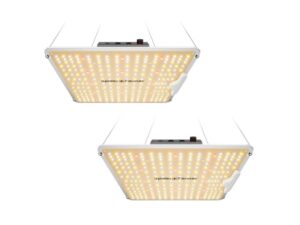 | Spider Farmer SF1000 2-Pack 200W LED Grow Lights | Check Price |
Second Best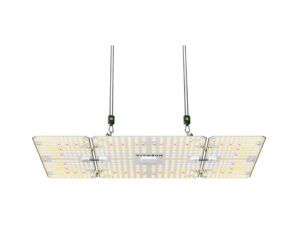 | VIVOSUN LumaLight 200W LED Grow Light | Check Price |
Third Choice | Spider Farmer SF1000D 2-Pack 200W LED Grow Light | Check Price |
1. Spider Farmer SF1000 2-Pack 200W LED Grow Lights
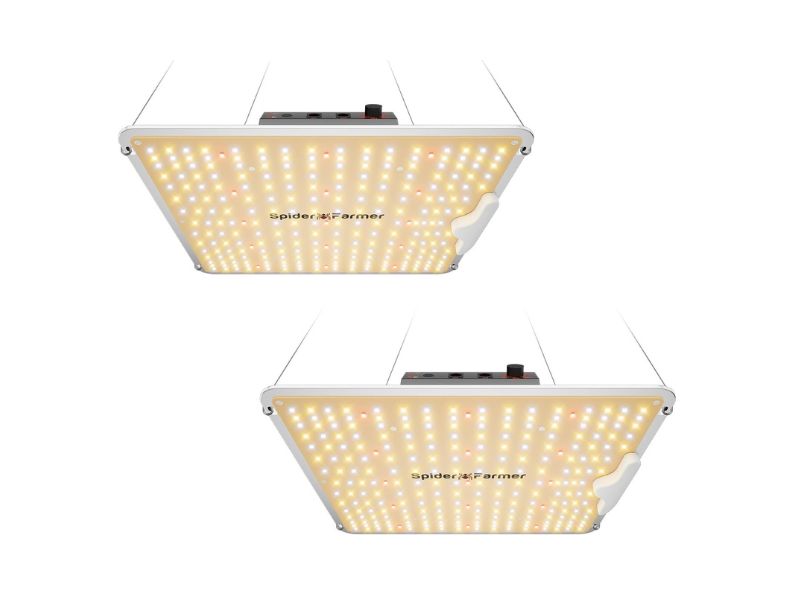
Key Features
- 200W total system power
- Two 100W LED panels
- Full-spectrum output
- Dimmable operation
- Published 2.5 µmol/J system PPE
- Independent fixture positioning
- Suitable for seed starting through later growth
- Strong fit for rectangular canopies and 2×4-style setups
The Spider Farmer SF1000 two-pack is my primary recommendation because splitting 200 watts between two fixtures creates much more placement flexibility than concentrating the entire electrical input into one center-mounted board.
The current Amazon listing describes this package as a 200W dimmable full-spectrum system made from two SF1000 fixtures and specifies approximately 2.5 µmol/J system PPE.
That two-light design matters in real growing spaces.
A rectangular shelf does not naturally match a small square fixture. With two SF1000 panels, you can position one over each half of the canopy.
This works particularly well for:
- Tomato seedlings
- Pepper seedlings
- Herbs
- Lettuce
- Brassicas
- Houseplants
- Multiple seedling trays
- Compact vegetable gardens
If plants occupy only part of the shelf, the lights can also be moved closer together rather than wasting output on empty space.
That flexibility is especially useful during propagation.
A grow area can change dramatically over a few weeks.
At first, you may have two compact nursery flats.
Later, transplanted tomatoes and peppers can spread across a much larger footprint.
Two adjustable panels can follow that changing canopy more easily than one rigid fixture.
The published 2.5 µmol/J PPE is another important specification.
PPE measures how efficiently electrical energy becomes photosynthetically useful photon output.
It is a better efficiency metric than comparing lights by wattage alone.
Two fixtures can consume the same 200 watts while producing different amounts of usable plant light.
Dimming also makes this setup useful for seedlings.
You do not need to operate both panels at maximum brightness over freshly emerged plants.
Start conservatively.
As seedlings develop true leaves and occupy more canopy area, increase output gradually.
This is particularly useful for tomatoes and peppers because they may remain indoors for several weeks and quickly outgrow small propagation lamps.
The dual-panel configuration can also help reduce center hotspots.
Instead of producing one intense center zone, two fixtures can be spaced to distribute light more evenly.
That improves consistency across:
- Center plants
- Edge plants
- Corner seedlings
A uniform canopy is particularly useful when you want seedlings to reach transplant size at approximately the same time.
The biggest disadvantage is installation complexity.
You have:
- Two fixtures
- Two hanging positions
- More cables
- More height adjustments
For growers who want one clean overhead unit, the VIVOSUN LumaLight is simpler.
But for flexibility, I prefer the two-panel approach.
What I Like
- True 200W total system
- Two independently positionable panels
- Published 2.5 µmol/J system PPE
- Excellent rectangular-canopy flexibility
- Dimmable output
- Strong seedling-to-mature growth potential
What I Do Not Like
- Requires two hanging positions
- More cables than a single fixture
- Proper panel spacing takes some adjustment
The Spider Farmer SF1000 two-pack is the 200W setup I would choose for most growers because it combines efficient full-spectrum output with unusually flexible canopy positioning. It is particularly practical for shelves, 2×4-style spaces, and vegetable seedlings that expand significantly before transplanting.
2. VIVOSUN LumaLight 200W LED Grow Light
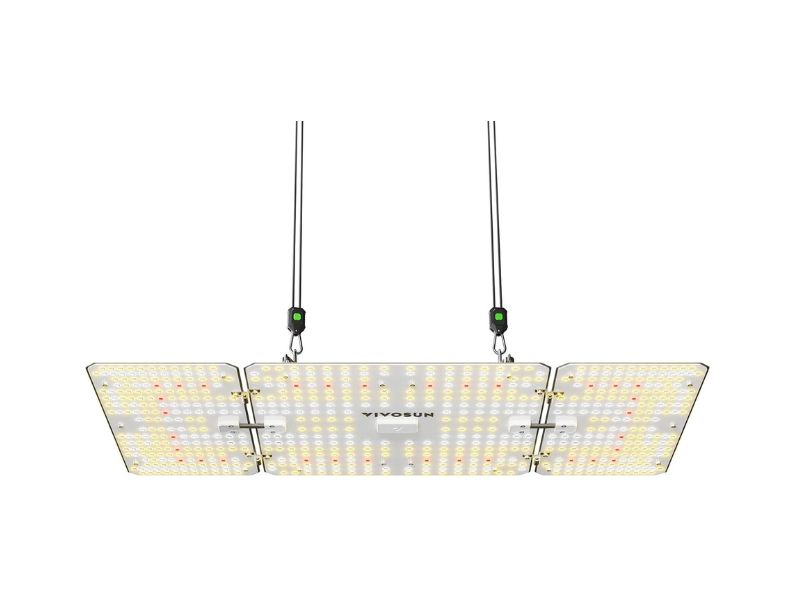
Key Features
- 200W actual power class
- Full-spectrum LEDs
- 3000K and 5000K white
- Red and far-red output
- 25%, 50%, 75%, and 100% dimming
- GrowHub/app compatibility
- Uniform-PPFD diode layout
- IP65 protection
- Designed for approximately 2×4/3×3 grow spaces
The VIVOSUN LumaLight is the cleaner choice for growers who want the entire 200W system contained in one fixture.
Its current Amazon listing identifies it as a 200W full-spectrum grow light for indoor plants, seedlings, vegetables, and bloom, with compatibility for roughly 2×4/3×3 grow tents.
The spectrum combines:
- 3000K
- 5000K
- 660nm red
- 730nm far red
That makes the fixture useful across several growth stages rather than limiting it to propagation.
For seedlings, the white portions provide broad useful illumination.
As plants mature, the overall spectrum remains suitable for larger vegetative and reproductive growth.
The four-level dimmer is one of the most useful features.
You can choose approximately:
- 25%
- 50%
- 75%
- 100%
That gives a straightforward way to adapt a 200W fixture to plants with very different light requirements.
For freshly emerged seedlings, I would not start automatically at 100%.
At close range, 200W of efficient LED output can be excessive.
Instead, begin at a conservative intensity and increase it as plants develop.
This approach works well for:
- Tomatoes
- Peppers
- Eggplants
- Herbs
- Lettuce
- Leafy vegetables
- Indoor houseplants
The LumaLight also emphasizes uniform PPFD distribution.
That is important because total output alone does not guarantee a good growing environment.
Plants need useful photons across the entire canopy, not just directly beneath the middle of the fixture.
A strong center hotspot paired with weak corners can produce uneven growth.
The current listing says VIVOSUN uses a strategic diode layout to create more balanced intensity from center to edge.
Another advantage is GrowHub compatibility.
With compatible VIVOSUN control hardware, the light can participate in app-based scheduling and remote intensity adjustment.
That can be useful when you want to coordinate:
- Daily lighting schedules
- Dimmer changes
- Other environmental equipment
- Remote grow-room management
Smart control is optional rather than essential.
A normal external timer and manual dimmer can still produce excellent results.
The LumaLight also carries IP65 dust and water protection in the current listing.
That is useful in humid growing environments, but it should not encourage careless electrical practices.
Keep plugs, controllers, power strips, and wall connections away from standing water and runoff.
The biggest limitation compared with the Spider Farmer two-pack is physical flexibility.
One fixture stays one fixture.
You cannot separate it into two independent growing zones.
However, if your plants always occupy one rectangular canopy, the simpler single-fixture installation may be preferable.
What I Like
- Integrated 200W design
- Four-level dimming
- Full-spectrum white/red/far-red output
- Smart GrowHub compatibility
- Uniform canopy emphasis
- IP65 protection
What I Do Not Like
- Less modular than two 100W panels
- Smart features require compatible hardware
- Full output can be excessive for young seedlings
The VIVOSUN LumaLight is my preferred option when I want one clean 200W fixture with straightforward dimming, smart-control potential, and strong environmental protection.
3. Spider Farmer SF1000D 2-Pack 200W LED Grow Light
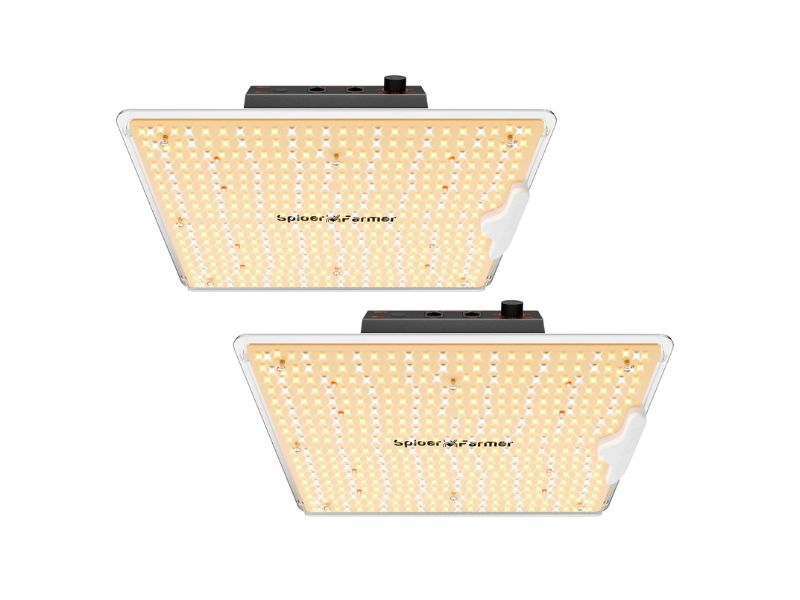
Key Features
- 200W total output
- Two SF1000D panels
- Dimmable full-spectrum lighting
- Updated 2026 diode design
- Enhanced PPFD distribution
- Approximately 3×6 vegetative coverage
- Approximately 2×4 flowering coverage
- Flexible dual-fixture positioning
- Seedling-to-harvest positioning
The Spider Farmer SF1000D two-pack is another strong 200W option, particularly when canopy distribution is a priority.
Its current Amazon listing identifies the package as 200W total, with two dimmable full-spectrum SF1000D fixtures featuring updated 2026 diodes and enhanced PPFD performance.
Spider Farmer positions the two-pack around approximately:
3×6 vegetative coverage
and
2×4 flowering coverage.
Those two footprints should not be interpreted as contradictory.
Vegetative plants typically tolerate a broader footprint because they often require lower photon density than demanding mature flowering or fruiting plants.
This distinction is useful when evaluating any grow-light coverage claim.
The SF1000D two-pack again benefits from the advantages of separate fixtures.
You can:
- Space them evenly over a 2×4 area
- Move them closer over a narrower canopy
- Separate them across two shelves
- Adjust one differently from the other
That is difficult with one rigid 200W board.
The enhanced PPFD distribution is particularly relevant to seedling trays.
PPFD measures the density of photosynthetically active photons reaching a particular area of the canopy.
Good distribution helps ensure seedlings near the outer cells are not significantly weaker than seedlings under the center of the light.
That matters for:
- Tomato trays
- Pepper trays
- Lettuce flats
- Brassicas
- Herbs
- Mixed vegetable propagation
The updated diode arrangement also aims to improve the amount and distribution of useful light reaching plants.
Dimming adds stage-to-stage versatility.
A 200W total setup can handle substantially more than early seedlings.
For newly emerged plants, use lower intensity.
As vegetables develop larger canopies, increase output gradually.
Eventually, the same lighting system can support plants well beyond the seedling phase.
This makes the SF1000D two-pack useful for growers who want to avoid purchasing:
- A propagation light.
- Then a larger vegetative light.
- Then another fixture several weeks later.
One appropriately sized dimmable system can cover several stages.
The main disadvantage is similar to the standard SF1000 two-pack.
Two fixtures require more mounting work than one.
There is also potential confusion between SF1000 and SF1000D versions.
For this selection, the exact two-pack is associated with ASIN B0B4P1PJLY.
What I Like
- True 200W total system
- Two independently positionable fixtures
- Updated diode platform
- Enhanced PPFD distribution
- Dimmable output
- Useful 2×4 flowering orientation
- Excellent for long seedling trays
What I Do Not Like
- Requires dual mounting
- Product-family names can be confusing
- More cabling than a one-piece fixture
The SF1000D two-pack is an excellent choice when I want flexible 200W coverage with a particular emphasis on distributing usable light evenly across a rectangular canopy.
200 Watt LED Grow Light Comparison
| Product | Power | Format | Dimming | Smart Control | Coverage Focus | Main Strength |
| Spider Farmer SF1000 2-Pack | 200W total | Two panels | Yes | Basic/manual | 2×4-style | Flexible positioning |
| VIVOSUN LumaLight | 200W | Single fixture | 25–100% | GrowHub compatible | 2×4/3×3 | Integrated smart fixture |
| Spider Farmer SF1000D 2-Pack | 200W total | Two panels | Yes | Basic/manual | 2×4 bloom / broader veg | PPFD distribution |
The Spider Farmer SF1000 two-pack offers the most flexible all-around layout, VIVOSUN provides the cleanest single-fixture installation, and the SF1000D two-pack focuses strongly on broad PPFD distribution.
How to Choose the Best 200 Watt LED Grow Light
Verify Actual Power
Grow-light model numbers can be misleading.
A model named “SF1000” is not a 1000W electrical fixture.
The SF1000 two-pack reviewed here is marketed as 200W total, meaning roughly 100W per panel.
Always look for:
- Actual wattage
- Input power
- Wall draw
when estimating electricity consumption or sizing timers.
Is 200W Enough for a 2×4 Grow Tent?
For many indoor plants, yes.
A 2×4 area contains eight square feet.
Two 100W fixtures can be positioned along the length of that canopy, which is one reason the Spider Farmer two-pack is appealing.
VIVOSUN also specifically positions the LumaLight 200W around 2×4/3×3 grow tents.
The exact suitability depends on the crop and desired PPFD.
Is 200W Enough for a 3×3 Grow Tent?
It can be, particularly for:
- Seedlings
- Herbs
- Leafy greens
- Vegetative plants
- Moderate-light crops
A full 3×3 high-light fruiting canopy may need more total photon output depending on the fixture and crop.
Always evaluate PPFD rather than assuming footprint alone tells the full story.
200W vs 150W Grow Light
Moving from 150W to 200W increases electrical input by about one-third.
That additional capacity can provide:
- More photon output
- Better edge coverage
- Greater mature-plant headroom
- Larger useful canopy
But efficiency matters too.
A very efficient 150W fixture can narrow the practical gap with a less efficient 200W light.
200W vs 300W Grow Light
A 300W fixture provides 50% more nominal electrical input than 200W.
That becomes useful for:
- Larger grow tents
- Higher PPFD targets
- Mature fruiting plants
- Larger canopies
The tradeoffs are greater heat and electricity consumption.
For a 2×4 propagation or moderate-intensity vegetable setup, 200W is often easier to manage.
One 200W Fixture vs Two 100W Fixtures
This is one of the most important buying decisions.
One 200W Fixture
Advantages:
- Fewer cables
- One hanging point
- Cleaner installation
- Centralized dimmer
Two 100W Fixtures
Advantages:
- Better positioning flexibility
- Easier rectangular coverage
- Can serve different plant groups
- Can be separated into different growing areas
That flexibility is why the Spider Farmer SF1000 two-pack is my primary recommendation.
What Is PPE?
PPE means Photosynthetic Photon Efficacy.
It measures plant-light output per joule of electrical energy.
The Spider Farmer SF1000 two-pack publishes 2.5 µmol/J system PPE.
Higher PPE generally means more photosynthetically useful photons from the same electrical input.
What Is PPFD?
PPFD measures the density of photosynthetically useful photons reaching a specific area of plant canopy.
It changes when you change:
- Hanging height
- Dimmer setting
- Fixture spacing
- Reflective walls
That makes PPFD much more useful for final setup than wattage alone.
Why Uniform PPFD Matters
Imagine 24 tomato seedlings spread across a nursery flat.
If the center receives strong light while the outer cells receive much less, the plants will not develop uniformly.
You may end up with:
- Short center seedlings
- Tall edge seedlings
- Plants leaning inward
- Different transplant readiness
This is why the SF1000D’s emphasis on enhanced PPFD distribution is relevant.
Dimming Is Important at 200W
Two hundred watts of efficient LEDs can provide far more intensity than seedlings require.
Dimming gives you control.
For seedlings:
Use reduced output.
For larger vegetative plants:
Increase intensity.
For mature high-light plants:
Use higher output when appropriate.
This makes a dimmable fixture significantly more versatile than a fixed-output design.
Best 200W LED Grow Light for Seedlings
For one or two nursery flats, I favor the Spider Farmer SF1000 two-pack.
The fixtures can be placed separately over each tray and run at reduced intensity.
For one fixed rectangular canopy, VIVOSUN LumaLight provides a cleaner setup.
Best 200W LED Grow Light for Vegetable Seedlings
Tomatoes, peppers, eggplants, and brassicas often begin under very modest light but can grow rapidly.
A 200W system gives enough headroom to continue using the same fixture until transplanting.
I particularly like dual panels for vegetable seedlings because canopy shape changes rapidly.
Best 200W Grow Light for Tomatoes
Tomatoes can become leggy quickly when lighting is insufficient.
For a long tomato tray, I would choose either Spider Farmer two-pack because the panels can be distributed across the canopy.
Start at lower intensity and increase output as leaf area develops.
Best 200W Grow Light for Peppers
Pepper seedlings often remain indoors for many weeks.
That makes additional lighting reserve useful.
A dimmable 200W system can continue supporting peppers even after they become too large for small clip lights.
Best 200W Grow Light for Lettuce
Lettuce generally benefits more from broad, even moderate light than extreme center intensity.
The SF1000D two-pack’s enhanced PPFD distribution is particularly useful for this type of flat canopy.
Best 200W Grow Light for Herbs
A 200W fixture can illuminate a substantial herb growing area.
For basil, parsley, cilantro, mint, and similar crops, I would generally use the dimmer rather than running maximum output automatically.
Full Spectrum Is the Most Versatile Choice
All three selected products provide broad full-spectrum lighting.
That makes them useful for:
- Seedlings
- Vegetative growth
- Herbs
- Leafy greens
- Mature plants
White full-spectrum lighting also makes leaf color easier to inspect than strongly purple grow lights.
What About Far Red?
The VIVOSUN LumaLight includes far-red alongside white and red wavelengths.
Far-red can influence plant morphology and developmental responses.
However, spectrum extras should not distract from fundamentals.
A plant with inadequate PPFD will not suddenly thrive simply because the fixture includes far-red.
Prioritize:
- Intensity.
- Coverage.
- Photoperiod.
- Plant environment.
How High Should a 200W Grow Light Be?
There is no universal hanging distance.
It depends on:
- Fixture geometry
- Dimmer level
- Plant species
- Growth stage
- Reflective tent walls
Use the manufacturer’s recommendations first.
Then observe the plants.
Signs of too little light can include:
- Stretching
- Long internodes
- Weak stems
- Strong leaning
Signs of excessive intensity can include:
- Bleaching
- Leaf curling
- Pale patches
- Stressed growth
Adjust gradually.
How Long Should a 200W Grow Light Run?
Duration depends on crop and intensity.
Vegetable seedlings often use roughly 14–18 hours of daily lighting, followed by a regular dark period.
Mature plants can require different schedules.
Use an external timer or compatible smart controller for consistent operation.
Electricity Use of a 200W Grow Light
At full output:
200W = 0.2 kW
At 16 hours per day:
0.2 × 16 = 3.2 kWh per day
Over 30 days:
3.2 × 30 = 96 kWh
Multiply 96 by your electricity rate per kWh to estimate monthly lighting cost.
Dimming may reduce actual usage.
Heat From a 200W LED Grow Light
LEDs are efficient but not heat-free.
A 200W grow light still contributes significant thermal energy to a compact tent or room.
Maintain:
- Exhaust ventilation
- Canopy circulation
- Space around the driver
- Clear airflow around the fixture
Do not assume LEDs eliminate the need for ventilation.
IP65 Protection
The VIVOSUN LumaLight currently lists IP65 dust and water protection.
That is useful in humid growing environments.
However, IP65 does not mean every electrical component in the setup can be exposed to water.
Keep:
- Power strips
- Timers
- Wall outlets
- Smart controllers
- Cable connections
dry.
Do You Need Smart Control?
Not necessarily.
Smart control is useful for:
- Remote scheduling
- Brightness adjustments
- Automation
- Coordinating several devices
VIVOSUN’s LumaLight supports compatible GrowHub/app functionality.
If you only need the light to run the same schedule every day, a basic timer works perfectly well.
Common 200W Grow Light Buying Mistakes
Confusing Model Number With Wattage
Always verify actual input power.
Buying by Wattage Alone
Compare efficiency and PPFD distribution too.
Ignoring Dimming
Full 200W output can be excessive for seedlings.
Focusing Only on Center PPFD
Edge plants need useful light too.
Assuming Every 3×3 Claim Means the Same Thing
Vegetative and mature high-light requirements differ.
Hanging the Fixture Too High
Insufficient canopy PPFD can still cause stretching.
Hanging It Too Close
LEDs can cause light stress without obvious heat burn.
Ignoring Ventilation
Two hundred watts still adds heat to the room.
Frequently Asked Questions
What is the best 200 watt LED grow light?
The Spider Farmer SF1000 two-pack is my primary recommendation for flexible 200W coverage.
It combines two 100W panels with dimming, full-spectrum output, and 2.5 µmol/J system PPE while allowing each fixture to be positioned independently.
Is a 200W LED grow light enough?
Yes, 200W provides substantial output for seedlings, herbs, vegetables, and compact indoor gardens.
Actual usable coverage depends on efficiency, PPFD target, crop, hanging height, and fixture geometry.
Is 200W enough for a 2×4 grow tent?
Yes, 200W can work very well for many 2×4-foot growing applications.
Spider Farmer positions its two-panel packages around a 2×4 flowering footprint, while VIVOSUN also lists LumaLight 200W for 2×4 use.
Is 200W enough for a 3×3 tent?
It can be for seedlings, herbs, vegetative growth, and moderate-light crops.
Demanding mature plants may require higher PPFD than one 200W fixture provides evenly across all nine square feet.
Is 200W too much for seedlings?
It can be at full intensity and close range, so dimming is important.
Begin at lower output and increase intensity as seedlings develop larger leaves.
Is two 100W grow lights better than one 200W light?
Two 100W lights offer more positioning flexibility, while one 200W fixture is simpler.
The better configuration depends on the shape of your canopy.
Which 200W grow light is best for rectangular coverage?
The Spider Farmer SF1000 two-pack is particularly flexible across long rectangular growing areas.
The two panels can be spaced independently along the length of a shelf or tent.
Which 200W grow light has smart control?
The VIVOSUN LumaLight supports compatible GrowHub and app-based control.
That allows lighting schedules and intensity to be adjusted through VIVOSUN’s ecosystem.
Which 200W grow light has IP65 protection?
The VIVOSUN LumaLight currently specifies IP65 dust and water resistance.
This is useful in humid growing environments, although electrical connections should still remain dry.
Which 200W grow light focuses on PPFD distribution?
The Spider Farmer SF1000D two-pack explicitly emphasizes enhanced PPFD distribution.
Its updated diode layout is designed to improve light absorption and canopy uniformity.
Is 200W good for tomato seedlings?
Yes, 200W provides substantial headroom for tomato seedlings that remain indoors several weeks.
Use dimming during early growth and increase output gradually as the canopy expands.
Is 200W good for pepper seedlings?
Yes, especially because peppers may remain indoors longer than many vegetables.
A dimmable 200W system can continue supporting them well beyond the early propagation stage.
Can I grow herbs under 200 watts?
Yes, 200W can cover a substantial herb canopy and often does not need full intensity.
Dimming lets you match output to the growing area.
Can I grow lettuce under 200 watts?
Yes, 200W provides ample potential light for a compact lettuce garden.
Uniform moderate PPFD is usually more useful than maximum center intensity.
What does 2.5 µmol/J mean?
It measures photosynthetic photon output produced per joule of electrical energy.
Spider Farmer publishes 2.5 µmol/J system PPE for the current SF1000 two-pack.
What is PPFD?
PPFD measures the density of photosynthetically active photons reaching the plant canopy.
It changes with hanging distance, dimming, fixture spacing, and measurement location.
Is PPFD more important than wattage?
PPFD is more directly related to the usable light reaching your plants.
Wattage tells you electricity consumption, while PPFD describes canopy-level photon density.
How much electricity does a 200W grow light use?
At full output for 16 hours daily, it consumes approximately 3.2 kWh per day.
That equals about 96 kWh over 30 days.
How many hours should a 200W grow light run?
The correct schedule depends on crop, PPFD, growth stage, and available natural light.
Vegetable seedlings often use long daily photoperiods followed by a regular dark period.
Do I need a timer for a 200W grow light?
Yes, a timer makes a consistent daily lighting schedule much easier to maintain.
Use an appropriately rated external timer unless the fixture’s compatible controller provides scheduling.
Should I leave a 200W grow light on 24 hours?
No, continuous lighting is unnecessary for most normal indoor-growing applications.
Use an appropriate photoperiod and maintain a regular dark period.
Conclusion
The best 200 watt LED grow light should provide enough photon output for a meaningful indoor canopy while giving you control over intensity, distribution, and daily operation. I would prioritize dimming, PPFD uniformity, fixture geometry, full-spectrum output, efficiency, and realistic canopy size rather than selecting by wattage alone.
The Spider Farmer SF1000 two-pack remains my primary recommendation. Its 200W combined output, dual 100W panels, 2.5 µmol/J system PPE, dimming, and flexible positioning make it particularly well suited to rectangular shelves, 2×4-style spaces, vegetable seedlings, and changing plant canopies.
The VIVOSUN LumaLight 200W is the cleaner single-fixture alternative. Its full-spectrum design, 25–100% dimming, uniform-PPFD layout, IP65 protection, and GrowHub compatibility make it particularly attractive when you want one integrated smart-ready light.
The Spider Farmer SF1000D two-pack is the option I would choose when enhanced PPFD distribution and dual-panel flexibility are especially important. Its current 200W configuration uses updated diodes and is positioned around approximately 2×4 flowering coverage.
For most buyers searching specifically for a dependable 200 watt LED grow light, I would start with the Spider Farmer SF1000 2-Pack. If I preferred one integrated fixture, I would choose the VIVOSUN LumaLight 200W, while the SF1000D 2-Pack is a strong alternative for broad, even rectangular coverage.

I’m Maya L. Greenwood, a lifelong plant lover who believes anyone can grow something beautiful with the right guidance. After years of testing soil mixes, pruning methods, irrigation tricks, and pest-safe solutions, I started EasyGardenTips.com to turn hard-won lessons into step-by-step advice. From seed starting and container gardens to composting and seasonal checklists, my goal is to make gardening simple, sustainable, and fun.