3 Best LED Grow Light for Orchids: Better Growth and Reblooming Indoors
Orchids can survive in a dim room for a surprisingly long time, but surviving and blooming are not the same thing. The best LED grow light for orchids should provide enough usable light for healthy leaves, roots, and flower production without concentrating so much intensity on the foliage that it causes stress or leaf burn.
Light requirements also vary considerably by orchid type. Phalaenopsis and many Paphiopedilum orchids tolerate relatively low light, while Cattleya, some Dendrobium, and many Vanda-type orchids need considerably more. The American Orchid Society therefore emphasizes matching light quantity and distance to the actual orchid rather than using one fixed setup for every plant.
My primary recommendation is the GooingTop 6000K Full Spectrum LED Grow Light. I would choose it for one or two Phalaenopsis, Paphiopedilum, or other tabletop orchids because its 6000K white/red spectrum, 10W actual LED draw, 5-level dimming, flexible gooseneck, strong clip, and 4/8/12-hour timer make intensity and placement easy to adjust.
I would choose the Barrina T5 4FT Full Spectrum Grow Lights for an orchid shelf or larger collection. The selected package supplies eight 4-foot fixtures at 20W each, giving you much broader coverage than a single clip lamp and allowing fixtures to be arranged above multiple plants.
The GE PAR38 Balanced Spectrum LED Grow Light is the option I would choose when stronger directional light is needed for a larger orchid, a brighter-growing Cattleya-type plant, or a compact display where installing bar lights is inconvenient. GE specifies 32W actual draw and 50 μmol/s PPF from its PAR38 grow bulb.
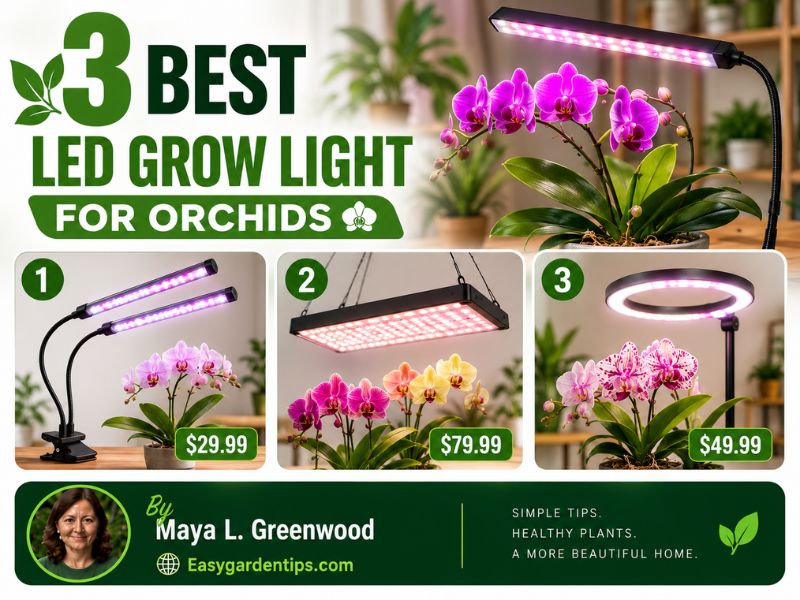
3 LED Grow Lights for Orchids Reviewed
| Image | Product Name | Check Price |
|---|---|---|
Best Choice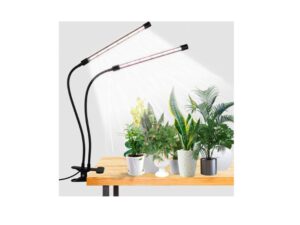 | GooingTop 6000K Full Spectrum LED Grow Light | Check Price |
Second Best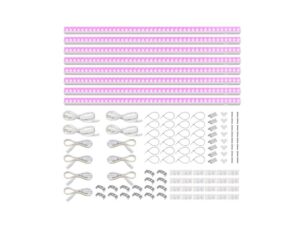 | Barrina T5 4FT Full Spectrum Grow Lights | Check Price |
Third Choice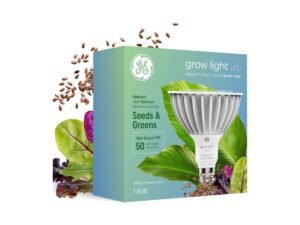 | GE PAR38 Balanced Spectrum LED Grow Light | Check Price |
1. GooingTop 6000K Full Spectrum LED Grow Light
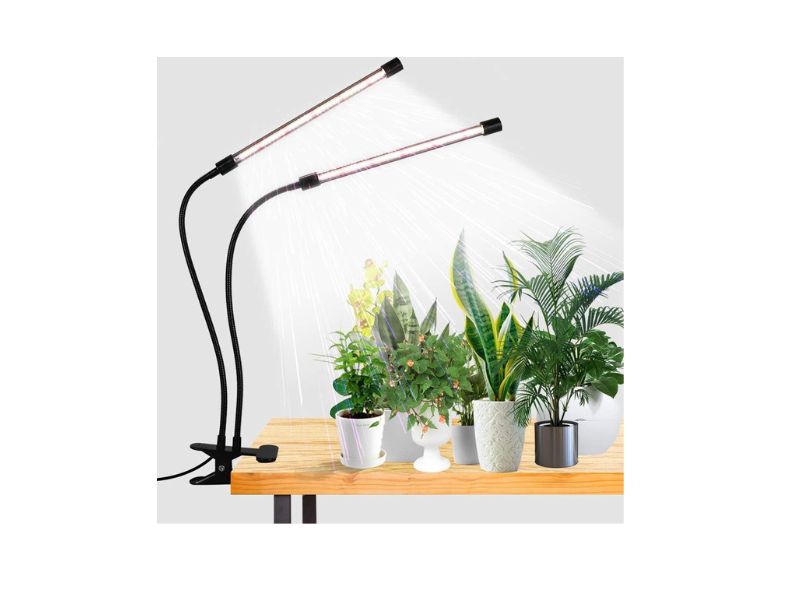
Key Features
- 6000K full-spectrum-style white light
- 74 white + 10 red LEDs
- Approx. 10W actual LED draw
- Up to 2500 lumens listed
- 5 brightness levels
- 4/8/12-hour automatic timer
- Flexible gooseneck
- Strong clip mount
- USB or AC-powered setup
- CRI up to 95
The GooingTop is my primary recommendation because orchids are unusually sensitive to placement, and this design makes placement much easier than a fixed ceiling or shelf fixture.
Amazon currently lists the lamp with a 6000K spectrum using 74 white and 10 red LEDs, along with a CRI up to 95. The light draws about 10 watts and uses a flexible gooseneck mounted to a clamp.
That combination is particularly useful for a single orchid.
A Phalaenopsis sitting on a desk, side table, windowsill, or plant stand does not necessarily need an entire four-foot shelf fixture. What it needs is a light that can be positioned directly over the leaves at an appropriate distance.
The gooseneck lets you change both the distance and angle as the plant grows.
That matters because artificial light intensity changes dramatically with distance. The American Orchid Society specifically emphasizes the relationship between plant position and available light when growing indoors.
The GooingTop also provides five dimming levels.
I consider that one of its strongest orchid-specific advantages.
Low-light orchids such as many Phalaenopsis can be started at a moderate setting rather than being exposed immediately to the lamp’s maximum output.
If leaf growth looks dark green and soft or flowering remains weak, intensity can then be increased gradually.
Conversely, if leaves begin developing bleached patches or other light-stress symptoms, you can reduce intensity or increase the distance.
The built-in timer provides 4-, 8-, and 12-hour cycles that repeat every 24 hours while power remains connected.
For orchids, I would generally favor the 12-hour setting when the lamp is the plant’s primary artificial light source.
That gives the plant a consistent day/night rhythm without leaving the lamp on continuously.
Orchids benefit from a real dark period, so 24-hour lighting is not a good substitute for appropriate daytime intensity.
The 6000K appearance is also relatively pleasant in a living space.
Instead of producing the intense purple color associated with older red-and-blue grow lights, it looks more like cool white daylight.
That makes it easier to use near:
- Desks
- Kitchen counters
- Living-room shelves
- Bedroom plant stands
- Office orchids
The light is best suited to one or a few relatively compact orchids.
Its 10W actual draw means I would not choose a single GooingTop lamp to illuminate an entire shelf packed with mature Cattleya, Vanda, or Dendrobium plants.
For those applications, broader and stronger coverage is preferable.
What I Like
- Excellent for one or two orchids
- Adjustable light intensity
- Flexible lamp positioning
- Built-in repeating timer
- Pleasant white appearance
- Easy to use without installing permanent fixtures
What I Do Not Like
- Limited coverage for a large orchid collection
- 10W output may be insufficient for high-light orchids at long distance
- Clip requires a suitable shelf, table, or stand
The GooingTop is the light I would choose for a typical indoor Phalaenopsis setup. Its combination of dimming, timer control, and flexible positioning makes it much easier to fine-tune than a fixed high-output lamp.
2. Barrina T5 4FT Full Spectrum Grow Lights
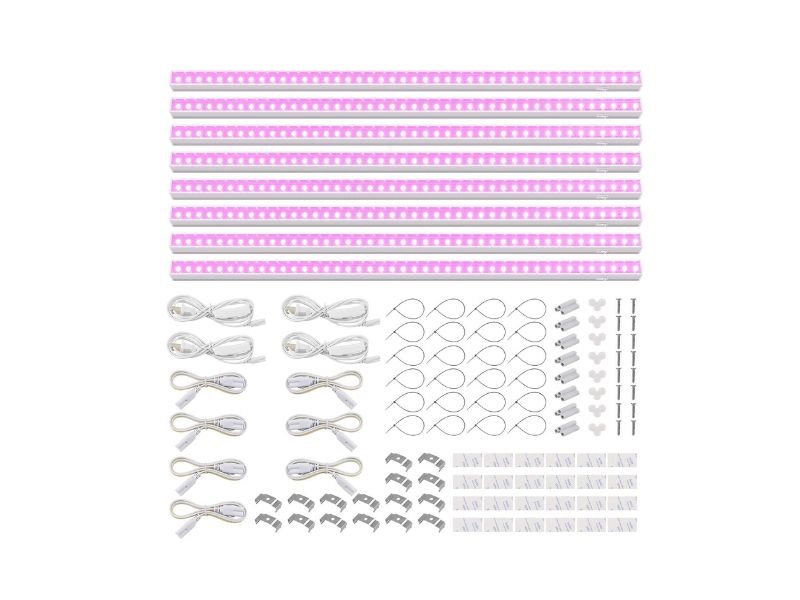
Key Features
- Eight 4-foot LED fixtures
- 20W per fixture
- 160W total package output
- Full-spectrum grow-light design
- Wide shelf coverage
- Plug-and-play installation
- Separate on/off control
- Flexible mounting options
- Suitable for racks and greenhouse shelving
The Barrina T5 system is the better option when you have several orchids rather than one plant.
The selected package contains eight 4-foot fixtures, each rated at 20W, for a total package rating of 160W.
That format is much more practical for orchid shelves.
Instead of creating one bright spot over a single pot, linear fixtures spread light across a long growing area.
That is useful for collections containing:
- Multiple Phalaenopsis
- Dendrobiums
- Oncidiums
- Paphiopedilums
- Smaller Cattleyas
- Seedlings and divisions
The main advantage is coverage consistency.
Orchid shelves often fail because the plants directly beneath a bulb receive plenty of light while plants near the edges remain shaded.
Long T5-style LED bars reduce that problem.
You can also arrange more than one fixture above a shelf when growing higher-light orchids.
For low- to moderate-light orchids, fewer active bars or greater mounting distance may be appropriate.
For Cattleya or brighter-growing Dendrobium types, additional fixtures and closer spacing can increase intensity.
That flexibility is important because orchid genera do not all have the same light requirements.
The American Orchid Society places many orchids in intermediate light conditions while noting that Cattleya-related and some Vandaceous orchids need substantially brighter exposure.
The Barrina system therefore makes the most sense when you want to create a dedicated growing environment rather than illuminate one decorative orchid.
A wire rack with one or two fixtures per shelf can create a much more uniform growing area than several clip lights pointing from different angles.
Another benefit is heat distribution.
LED bars generally spread heat over a larger fixture area rather than concentrating it in one bulb.
That does not mean the leaves should touch the lights.
Maintain enough clearance for airflow and check leaf temperature when experimenting with mounting height.
The selected Barrina version is also full spectrum and currently holds a strong position in Amazon’s plant-light fixture category.
The main drawback is installation.
A four-foot grow-light system requires:
- A shelf or rack
- Mounting points
- Nearby electrical power
- Cable organization
- Enough room above the orchids
It is not nearly as convenient for one orchid sitting beside a sofa.
What I Like
- Excellent coverage for multiple orchids
- Eight independent 20W fixtures
- Easy to scale intensity by adding fixtures
- Strong fit for plant shelves and racks
- Better light uniformity than a single bulb
- Useful for mixed orchid collections
What I Do Not Like
- Overkill for one Phalaenopsis
- Requires mounting space
- Timer may need to be added separately depending on setup
- High-light configurations require careful distance adjustment
The Barrina T5 is the model I would choose for an orchid shelf, rack, or growing room. It gives you far more control over coverage than a clip lamp and can be scaled for different orchid genera.
3. GE PAR38 Balanced Spectrum LED Grow Light
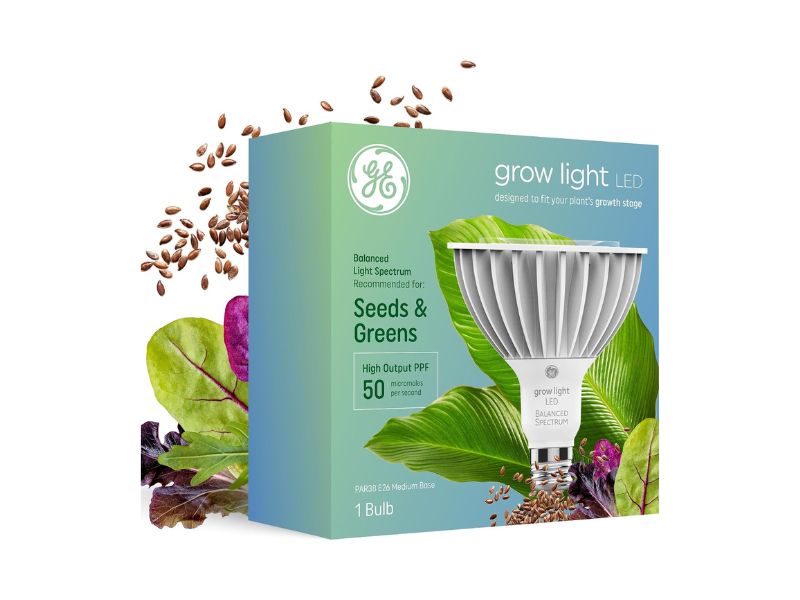
Key Features
- 32W LED grow bulb
- PAR38 directional flood format
- 50 μmol/s PPF
- Balanced plant-light spectrum
- White-looking output
- Standard bulb-style installation
- Rated life up to 25,000 hours
- Strong directional illumination
The GE PAR38 is the most straightforward choice when you want a single stronger bulb rather than a complete grow-light fixture.
GE’s current Amazon specification lists the bulb at 32W with 50 μmol/s PPF.
PPF, or photosynthetic photon flux, is more useful than a simple wattage comparison because it describes how many photosynthetically active photons the fixture produces each second.
That still does not tell you how much light actually reaches the orchid.
For that, distance, beam spread, and placement matter.
A PAR38 bulb is inherently directional.
That makes the GE particularly good for:
- One larger orchid
- Two or three closely grouped pots
- A floor-standing orchid display
- A Cattleya that needs more light than nearby Phalaenopsis
- Supplemental winter lighting near a window
Amazon describes the bulb as providing a balanced spectrum with a high output of 50 micromoles per second.
The light also appears relatively natural compared with purple grow lamps.
That matters for orchids because they are often displayed in living areas specifically for their flowers.
I would much rather view a white Phalaenopsis flower under a balanced white grow bulb than under intense magenta lighting.
The GE also gives you greater freedom over the fixture.
You can place it in a suitable lamp, pendant, track-light fixture, or reflector arrangement rated for the bulb.
That allows the same bulb to work in several different home setups.
The tradeoff is that the bulb itself does not provide built-in dimming or an automatic grow-light schedule like the GooingTop.
I would pair it with a suitable external timer.
Placement also needs more care because 32W concentrated into a directional PAR38 beam can create substantially higher intensity close to the plant than a small clip lamp.
This is especially relevant for Phalaenopsis.
These orchids generally prefer lower light than Cattleya or many Vanda-type plants.
Start farther away and move the light closer gradually rather than placing a strong bulb only a few inches above the foliage.
What I Like
- Strong directional output
- Clearly published 50 μmol/s PPF
- 32W actual LED power
- Natural-looking balanced spectrum
- Flexible fixture options
- Good for larger or brighter-growing orchids
What I Do Not Like
- No integrated timer
- No built-in dimmer
- More concentrated light requires careful placement
- Standard socket fixture must be supplied separately
The GE PAR38 is the option I would choose when I need more concentrated light than a clip lamp can provide but do not want to install a complete shelf-light system.
LED Grow Light for Orchids Comparison
| Product | Light Format | Output | Timer | Dimming | Coverage | Best Use |
| GooingTop 6000K | Clip/gooseneck | 10W LED | 4/8/12H | 5 levels | Small | 1–2 Phalaenopsis or tabletop orchids |
| Barrina T5 4FT | Linear bars | 8 × 20W | External timer recommended | By fixture arrangement | Large | Orchid shelves and collections |
| GE PAR38 | Directional bulb | 32W / 50 μmol/s PPF | External timer | Fixture dependent | Medium | Larger or higher-light orchids |
The three products solve different orchid-lighting problems. The GooingTop offers the easiest fine control for a small setup, the Barrina covers an entire shelf, and the GE PAR38 provides stronger directional light where one growing area needs more intensity.
How to Choose the Best LED Grow Light for Orchids
Identify Your Orchid Before Choosing the Light
This is the most important step.
“Orchid” describes an enormous plant family, not one set of growing requirements.
Common indoor types include:
Phalaenopsis: generally lower-light.
Paphiopedilum: many varieties prefer lower to intermediate light.
Oncidium: commonly intermediate light.
Dendrobium: requirements vary, with many types preferring brighter conditions.
Cattleya: generally higher-light than Phalaenopsis.
Vanda: many types prefer substantially stronger light.
The American Orchid Society specifically separates orchid genera according to different window and light conditions, so one fixed lamp distance should not be applied to every orchid.
Best Grow Light for Phalaenopsis Orchids
For a typical moth orchid, I would start with the GooingTop.
Its dimming control is useful because Phalaenopsis does not need the same intensity as a Cattleya.
Place the light above the leaves rather than shining horizontally from the side.
Start at moderate brightness and watch the plant over several weeks.
A Phalaenopsis getting inadequate light may remain very dark green and fail to flower reliably.
Too much concentrated light can lead to bleaching or damaged areas.
Gradual adjustment is safer than dramatic changes.
Best Grow Light for Cattleya Orchids
I would lean toward the GE PAR38 or a multi-bar Barrina setup.
Cattleya-type orchids generally need stronger light than Phalaenopsis.
A higher-output directional bulb can work for one plant, while multiple Barrina bars provide better uniformity for several Cattleyas on a shelf.
The American Orchid Society places Cattleya-related orchids among plants suitable for brighter south-window-type conditions compared with many lower-light orchids.
Best Grow Light for Dendrobium Orchids
Dendrobium is too broad a genus for one universal rule.
Some types prefer relatively bright growing conditions.
For those, I would use the GE PAR38 or Barrina shelf system.
For smaller Dendrobiums that already receive considerable window light, a GooingTop may work well as supplemental winter illumination.
Best Grow Light for an Orchid Shelf
The Barrina T5 is the clear choice of these three.
Long linear fixtures provide better coverage across a shelf than a single bulb.
If you have several shelves, fixtures can be divided among them and controlled through an external timer.
Keep similar-light orchids together.
For example, avoid putting a low-light Phalaenopsis directly beside a high-light Cattleya under exactly the same intense lamp arrangement unless the placement compensates for those differences.
Full Spectrum vs Purple Grow Lights
A full-spectrum or broad white grow light has two practical advantages.
First, it provides wavelengths useful to plants.
Second, it makes orchids look natural in the home.
Orchid flowers are often grown for their detailed coloration, so white-light LEDs make the display substantially more pleasant than old-style red/blue grow lamps.
Full spectrum does not automatically mean the lamp is powerful enough.
A weak full-spectrum lamp positioned too far from the leaves can still provide inadequate light.
Wattage Is Not Enough
Do not choose an orchid light solely from wattage.
A 10W lamp close to one Phalaenopsis may be more useful than a 30W lamp several feet away.
Important variables include:
- Actual wattage
- Beam angle
- Distance from leaves
- Coverage area
- PPF or PPFD
- Daily operating time
- Orchid species
The GE is useful because it publishes 50 μmol/s PPF, providing more plant-light information than a wattage figure alone.
Understand PPF and PPFD
PPF measures the total photosynthetically active photons produced by a light each second.
PPFD measures how many of those photons actually reach a square meter of growing surface each second.
For plant placement, PPFD is usually more directly useful.
A bulb can have strong PPF but produce very different PPFD depending on:
- Distance
- Reflector
- Beam angle
- Fixture orientation
- Coverage area
This is why lamp distance matters so much.
How Long Should LED Grow Lights Stay On for Orchids?
A 12-hour photoperiod is a practical starting point for many indoor orchid setups, especially when artificial light supplies most of the plant’s illumination.
The GooingTop conveniently provides a built-in 12-hour timer.
Do not leave orchids under grow lights continuously for 24 hours.
Plants need a dark period as part of their normal biological cycle.
If the orchid receives substantial natural daylight, supplemental grow-light time can be adjusted accordingly.
Distance Matters as Much as Brightness
Moving a grow lamp closer can dramatically increase light reaching the leaves.
Moving it farther away reduces intensity.
Therefore, there is no universally correct statement such as “every orchid grow light should be 12 inches away.”
A 10W clip lamp and a 32W PAR38 bulb behave very differently.
Start conservatively and observe the plant.
Signs Your Orchid May Need More Light
Common warning signs include:
- Very dark green foliage
- Weak or stretched growth
- Long periods without reblooming
- New leaves becoming smaller
- Healthy roots but consistently poor flowering
Lack of light is a common reason orchids fail to rebloom, although watering, temperature, nutrition, and plant maturity can also affect flowering.
Signs the Grow Light May Be Too Strong
Watch for:
- Pale or bleached patches
- Yellow-green areas that develop rapidly
- Dry burned spots
- Reddish or purplish stress pigmentation in some orchids
- Leaves that feel unusually hot beneath the lamp
If these appear, increase lamp distance or reduce intensity.
With the GooingTop, lowering the brightness setting is easy.
With the GE bulb, increasing distance is usually the simplest adjustment.
Use a Timer
Consistency matters more than manually switching a grow light on whenever you remember.
The GooingTop includes an automatic repeating timer.
For the Barrina and GE setups, I would add an external plug timer or smart plug.
A predictable schedule gives the orchid a stable day/night cycle.
Do Orchids Need Darkness at Night?
Yes, orchids should receive a genuine dark period.
Do not leave a grow light running around the clock.
Day length is also part of the environmental information plants use, while certain orchids rely on nighttime conditions and temperature changes as part of their flowering cycle.
Keep Air Moving
Adding grow lights can slightly raise leaf and surrounding-air temperatures.
Orchid roots and leaves generally benefit from air movement.
A small fan on low speed can help prevent stagnant conditions in a densely packed orchid shelf.
Do not point a strong fan directly at the plants continuously.
Gentle circulation is the goal.
Grow Lights Do Not Replace Proper Watering
More light generally increases plant activity and can increase water use.
A plant moved from a dim shelf into a stronger LED setup may dry faster.
Check the roots and potting medium rather than blindly maintaining the old watering schedule.
Orchids should not remain constantly waterlogged simply because a grow light is running.
Keep Water Away From Electrical Connections
Orchid growing involves frequent watering and often elevated humidity.
Keep:
- Power strips
- Plugs
- LED drivers
- Timers
- Extension connections
away from standing water.
Create drip loops in electrical cords where practical so water cannot run directly down a cable into a receptacle.
Common Orchid Grow-Light Buying Mistakes
Buying the Brightest Light Available
More light is not automatically better for Phalaenopsis.
Ignoring Orchid Type
Different orchid genera can need substantially different intensity.
Mounting the Light Too Far Away
A grow light cannot help much if very little usable light reaches the leaves.
Putting a Strong Lamp Too Close
Concentrated LED light can stress or burn orchid foliage.
Leaving the Light On 24 Hours
Provide a consistent dark period.
Choosing by Wattage Alone
PPF, PPFD, coverage, and distance matter too.
Using One Small Clip Lamp for an Entire Shelf
Choose linear fixtures when broad coverage is needed.
Expecting Light Alone to Force Flowers
Temperature, watering, plant maturity, roots, and nutrition also affect blooming.
Frequently Asked Questions
What is the best LED grow light for orchids?
The GooingTop 6000K clip light is my primary choice for most home orchid owners.
Its 10W LED system, five brightness levels, flexible gooseneck, and built-in 4/8/12-hour timer make it easy to adjust for one or two orchids.
What grow light is best for Phalaenopsis orchids?
An adjustable moderate-output full-spectrum light is ideal for most Phalaenopsis setups.
I prefer the GooingTop because its dimming and gooseneck let you adjust intensity gradually instead of forcing a fixed high-output light onto a lower-light orchid.
What grow light is best for Cattleya orchids?
A stronger directional bulb or multi-fixture shelf system is usually more appropriate.
The GE PAR38 supplies 32W and 50 μmol/s PPF, while multiple Barrina bars can cover a larger Cattleya collection.
Can orchids grow completely under LED lights?
Yes, orchids can be grown indoors using properly selected artificial lighting.
The American Orchid Society specifically provides guidance for growing orchids under lights, emphasizing light quality, intensity, and placement.
Are full-spectrum LED lights good for orchids?
Yes, a suitable full-spectrum LED can support orchid growth and flowering indoors.
Intensity and distance still need to match the orchid genus; “full spectrum” alone does not guarantee the light is appropriate.
Is 6000K good for orchids?
Yes, 6000K white grow lighting can work well for indoor orchids.
The GooingTop uses a 6000K white/red LED arrangement that gives plants broad-spectrum-style illumination while looking relatively natural in a home.
How many hours should orchids be under a grow light?
Around 12 hours daily is a practical starting point for many indoor setups.
Adjust the schedule according to orchid type and the amount of natural daylight already reaching the plant.
Can I leave an orchid grow light on all night?
No, orchids should receive a regular dark period.
Continuous 24-hour illumination is not necessary and can interfere with the plant’s natural day/night cycle.
How far should an LED light be from an orchid?
Distance depends on lamp intensity, beam spread, and the orchid species.
Start farther away with stronger lamps and move closer gradually while watching leaf color and temperature.
Can LED grow lights burn orchid leaves?
Yes, concentrated LEDs can damage foliage when intensity is excessive or the lamp is too close.
The American Orchid Society specifically notes that LEDs can create localized high-intensity damage if plants are positioned too close.
Do Phalaenopsis need less light than Cattleya?
Yes, Phalaenopsis generally prefers lower light than Cattleya-type orchids.
That is why dimmable fixtures are particularly useful when growing moth orchids indoors.
Is a 10W grow light enough for orchids?
It can be enough for one lower-light orchid when positioned appropriately.
The GooingTop’s 10W output is best suited to a compact growing area rather than an entire orchid shelf.
Is a 32W grow bulb too strong for an orchid?
Not necessarily, but distance becomes more important with a stronger directional bulb.
The GE PAR38 is rated at 32W and 50 μmol/s PPF, so I would begin conservatively with lower-light orchids and adjust placement gradually.
What LED grow light is best for multiple orchids?
The Barrina T5 system is the strongest option here for a shelf collection.
Its eight 4-foot, 20W fixtures provide broad linear coverage that is easier to distribute across several pots.
Should grow lights shine from above orchids?
Yes, overhead placement usually produces more natural and even plant growth.
Side lighting can encourage leaves and flower spikes to lean strongly toward the lamp.
Do orchids bloom better with grow lights?
They can when inadequate natural light is the factor preventing reliable flowering.
Insufficient light is a common reason otherwise healthy orchids fail to rebloom.
Can I use a regular LED bulb for orchids?
Possibly, but a documented grow bulb gives you more confidence about useful plant-light output.
The GE PAR38, for example, provides an actual PPF specification rather than relying only on household-lamp lumens.
Are purple grow lights better for orchids?
Not necessarily; full-spectrum white LEDs can provide effective plant light with better visual comfort.
For orchids displayed in living spaces, I generally prefer white full-spectrum lighting.
Do orchids need red light for flowering?
Red wavelengths contribute to photosynthesis, but orchids need an appropriate overall light environment.
A balanced spectrum plus suitable intensity, darkness, temperature, and healthy growth is more useful than focusing on one color alone.
Conclusion
The best LED grow light for orchids depends mainly on the orchid genus and the size of your growing area. A single Phalaenopsis on a table does not need the same lighting system as ten Cattleyas on a rack, so I would prioritize adjustable intensity, appropriate coverage, plant-to-light distance, spectrum, and a consistent timer schedule over simply buying the highest-wattage lamp.
The GooingTop 6000K Full Spectrum LED Grow Light remains my primary recommendation for most home orchid owners. Its 10W LED output, five brightness levels, flexible gooseneck, clip mounting, and 4/8/12-hour timer make it particularly easy to fine-tune for Phalaenopsis and other lower- to moderate-light orchids.
For an orchid collection, I would choose the Barrina T5 system. Its eight 4-foot, 20W fixtures provide the broad, even coverage needed across shelves and allow growers to increase or reduce fixture density depending on the orchids being grown.
The GE PAR38 is the strongest choice when one growing area needs concentrated output. Its 32W draw and 50 μmol/s PPF make it particularly useful for larger or higher-light orchids when positioned carefully.
For one or two typical indoor orchids, I would choose the GooingTop. For a full orchid shelf, I would move to the Barrina T5, while the GE PAR38 is the better fit when stronger directional light is needed.

I’m Maya L. Greenwood, a lifelong plant lover who believes anyone can grow something beautiful with the right guidance. After years of testing soil mixes, pruning methods, irrigation tricks, and pest-safe solutions, I started EasyGardenTips.com to turn hard-won lessons into step-by-step advice. From seed starting and container gardens to composting and seasonal checklists, my goal is to make gardening simple, sustainable, and fun.