3 Best LED Grow Lights Under $100: Capable Options Compared
Finding a useful grow light on a limited budget requires more than choosing the fixture with the largest advertised wattage. Light distribution, actual power consumption, intensity control, spectrum, installation requirements, and the size of the growing area all determine whether a product will work for its intended plants.
The best LED grow lights under $100 can support anything from houseplant collections to seedlings and compact indoor crops, but the three products reviewed here serve different arrangements. Two are concentrated overhead panels, while the third is a modular set of four-foot bars designed for wider shelves and benches.
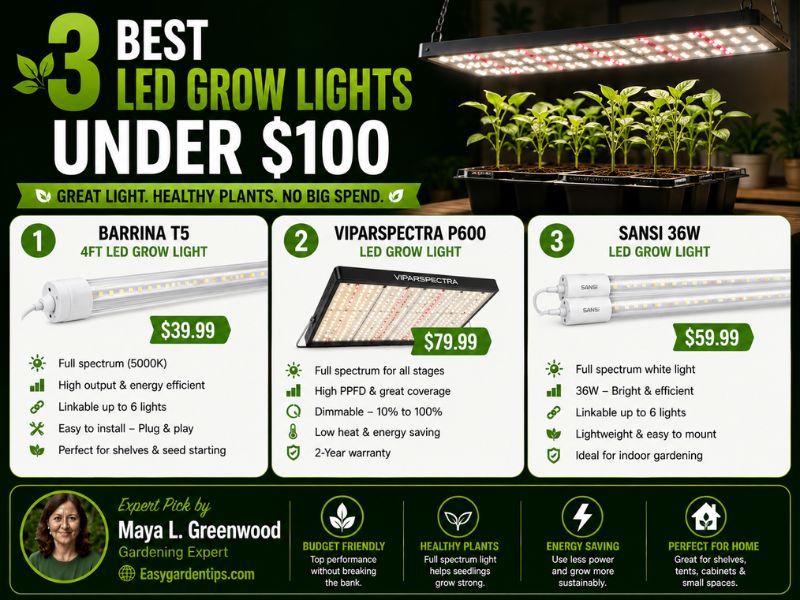
My primary recommendation is the VIPARSPECTRA P1000 100W Dimmable LED Grow Light. I prefer it for most buyers because it combines a practical 100-watt output, adjustable intensity, full-spectrum diodes, passive cooling, and a daisy-chain connection in one compact panel.
The MARS HYDRO TS600 100W Dimmable LED Grow Light is a worthwhile alternative for buyers who want another compact overhead panel with a reflective hood and straightforward controls. It works especially well over a small, clearly defined canopy.
I would consider the Barrina T8 4FT 42W Full-Spectrum Grow Light 6-Pack when the growing area is long rather than square. Its six separate bars can be distributed across plant racks, seedling shelves, or a wide propagation bench instead of concentrating all available light in one location.
Best LED Grow Lights Under $100 Reviewed
| Image | Product Name | Check Price |
|---|---|---|
Best Choice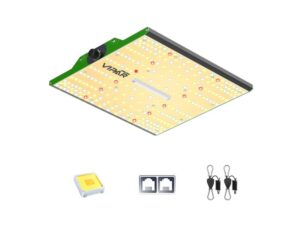 | VIPARSPECTRA P1000 100W Dimmable LED Grow Light | Check Price |
Second Best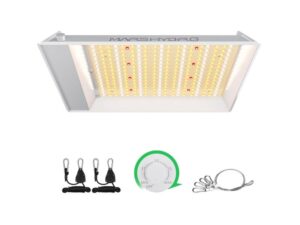 | MARS HYDRO TS600 100W Dimmable LED Grow Light | Check Price |
Third Choice | Barrina T8 4FT 42W Full-Spectrum Grow Light 6-Pack | Check Price |
The ranking favors horticultural usefulness rather than the greatest number of included fixtures. The VIPARSPECTRA takes first place because its dimmer and compact panel format suit the broadest range of buyers. The MARS HYDRO offers a similarly focused arrangement, while the Barrina set is more specialized but considerably more flexible across long shelves.
1. VIPARSPECTRA P1000 100W Dimmable LED Grow Light
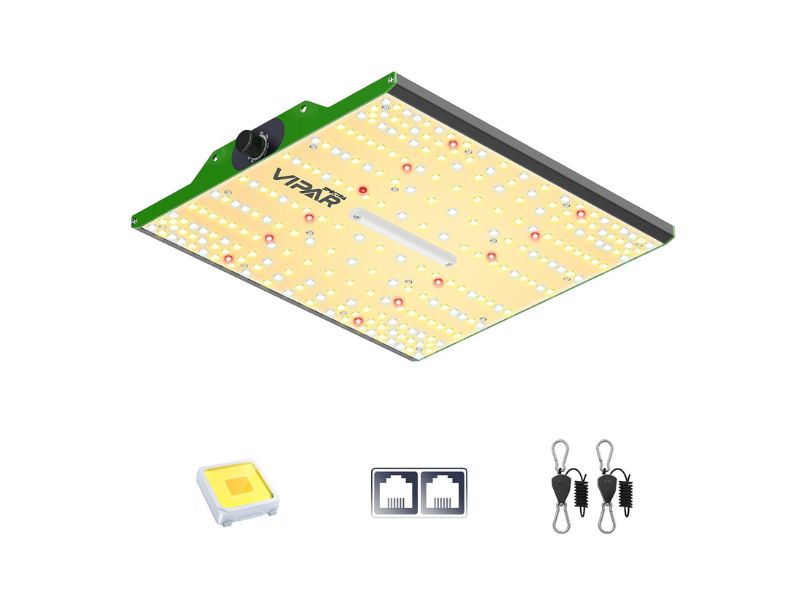
Key Features
- Approximately 100 watts of actual power
- Adjustable output through an onboard dimmer
- White full spectrum with red and far-red wavelengths
- Fanless aluminum heat-dissipation design
- Daisy-chain power connection
- Manufacturer-rated coverage for compact growing areas
- Hanging hardware included
The VIPARSPECTRA P1000 offers the best overall balance in this group. It is powerful enough for a concentrated indoor growing area but remains adjustable for seedlings, foliage plants, and other specimens that do not need its maximum output.
Its spectrum combines 3000K and 5000K white diodes with 660nm red and 730nm far-red wavelengths. That combination makes the panel suitable for multiple growth stages without requiring separate vegetative and flowering modes. The light appears predominantly white, making it easier to examine leaf color, pests, nutrient symptoms, and moisture conditions than it would be beneath an older purple fixture.
The dimmer is one of the P1000’s most meaningful advantages. A fixed-output light can only be adjusted by raising it, shortening the operating period, or moving plants. With this model, users can begin at a conservative intensity and increase output as seedlings mature or established plants acclimate.
VIPARSPECTRA describes the panel as suitable for approximately 2.5-by-2.5-foot vegetative coverage and 2-by-2-foot flowering coverage at its specified mounting distances. These are useful planning figures, but coverage should never be treated as a guarantee. High-light flowering plants require stronger and more uniform illumination than shade-tolerant foliage, and intensity always decreases toward the perimeter.
The aluminum body dissipates heat without a cooling fan. Fanless operation means there is no fan noise and one fewer moving component to maintain. The upper surface still needs clearance, however, and the fixture should not be enclosed against a shelf or ceiling.
Its daisy-chain feature helps users expand a growing area later. Several compatible fixtures can share a power-linking arrangement, reducing cable clutter. Every connected system must still remain within the manufacturer’s specified connection limit and the capacity of the household circuit.
The P1000 is most appropriate for a compact grow tent, a propagation table, a square plant shelf, or a grouped collection positioned beneath one mounting point. It is less convenient for plants spread across several rooms or for a long rack that would require multiple panels.
This model earns the first position because its output can be adapted to the plants rather than forcing every plant to accept full intensity. I recommend it for buyers who want one capable light that can move from seed starting to established vegetative growth and compact flowering applications.
2. MARS HYDRO TS600 100W Dimmable LED Grow Light
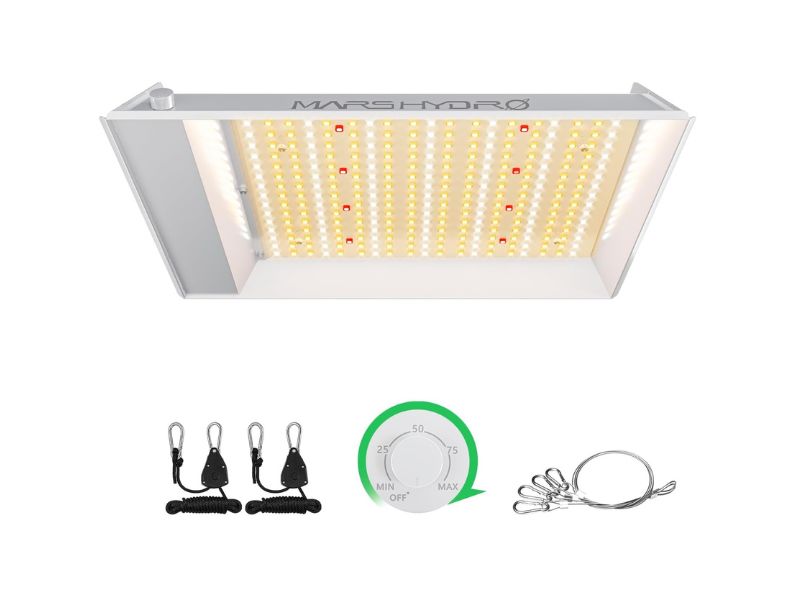
Key Features
- Approximately 100-watt power draw
- Full-spectrum LED configuration
- Updated dimmable design
- Reflective hood around the panel
- Fanless passive cooling
- Compact overhead footprint
- Intended for seedlings, vegetative growth, and flowering
The MARS HYDRO TS600 is another focused 100-watt panel for a small indoor canopy. Its reflective hood distinguishes its physical design from a flat board-style light. The angled perimeter is intended to redirect some outward-moving light toward the growing area and reduce lateral spill.
This design works best when the panel is centered over a compact, relatively even canopy. Short plants can be elevated on stable risers so that taller neighbors do not receive substantially more intensity. Maintaining a level canopy improves uniformity and makes better use of a small fixture.
The current dimmable configuration provides more flexibility than a fixed-output panel. Young seedlings can begin under reduced intensity, after which the output can be increased gradually. This also helps accommodate leafy houseplants that would not benefit from the same light level as sun-loving herbs or flowering crops.
The full-spectrum output is suitable for an entire growth cycle. White light makes the growing area easier to work around and allows foliage to be inspected without switching off the fixture. Supplemental red wavelengths support the photosynthetic spectrum needed during later growth stages.
Like the VIPARSPECTRA panel, the TS600 is fanless. Passive cooling keeps operation quiet, but heat still accumulates around the driver and metal body. It should hang in open air with adequate clearance above and around it. A small circulation fan may be useful in an enclosed growing space, though it should move air gently rather than blowing continuously at tender seedlings.
The reflective hood has practical tradeoffs. It helps define the downward beam, but the panel still produces a central area with greater intensity than its outer edges. It cannot deliver flowering-level performance evenly across every square inch of a large tent simply because its light remains visible there.
The TS600 requires overhead suspension. Users need a stable shelf, frame, ceiling hook, or grow-tent crossbar that can safely carry the fixture. Adjustable ratchet hangers make it easier to change the mounting height as plants grow.
I would choose this product for a small dedicated indoor garden where straightforward overhead coverage matters more than a modular installation. It is a strong alternative to the P1000, but the VIPARSPECTRA’s expansion-oriented daisy-chain feature and clearly established control arrangement give it a slight advantage for the broadest audience.
3. Barrina T8 4FT 42W Full-Spectrum Grow Light 6-Pack
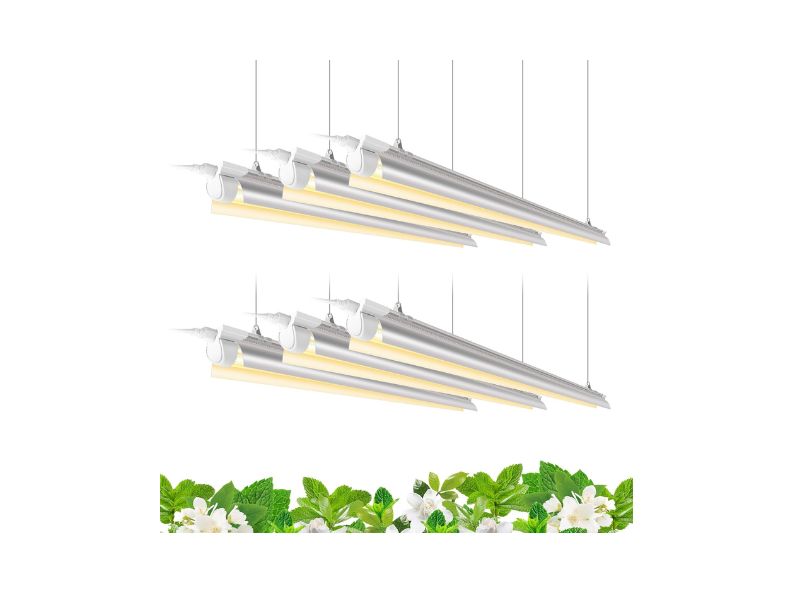
Key Features
- Six separate four-foot LED grow-light bars
- 42 watts per bar
- Full-spectrum yellow-white light
- Linkable modular installation
- Individual on/off switches
- V-shaped reflectors
- Aluminum housings
- Mounting clips, connection cables, and power cords included
The Barrina T8 set is designed for a fundamentally different growing space. Instead of using one square panel, it distributes illumination across six four-foot bars. This makes it better suited to long shelves, propagation racks, workbenches, or several narrow growing levels.
Each bar consumes 42 watts. Using all six simultaneously creates a substantially larger connected lighting load than either 100-watt panel. Buyers should therefore consider not only the initial budget but also the intended operating configuration and ongoing energy use.
The modular design allows the bars to be arranged in several ways. Two or three can be mounted above one shelf, with the remaining units serving another level. Alternatively, multiple bars can be placed side by side over a broad bench to improve uniformity. The included linking cables simplify layouts where fixtures are mounted in a row.
Barrina uses an aluminum housing for heat dissipation and a reflector to direct more light toward the plant area. The bars still require open airflow and secure attachment. Lightweight adhesive mounting methods may be convenient, but mechanical clips are generally preferable where heat, humidity, dust, or valuable plants make detachment unacceptable.
The four-foot length is excellent for standard-sized racks but becomes awkward in a compact tent or small apartment corner. Measure the mounting surface before choosing this system. Space is also needed for power cords, connection cables, and safe bends at the ends of each fixture.
The set uses individual switches rather than a centralized dimmer. Intensity can be managed by changing the number of active bars, adjusting mounting height, or increasing the spacing between fixtures. This provides broad control over coverage, though it is less precise than turning a dimmer knob.
For seedling shelves, linear bars can create more consistent illumination than one bright panel positioned far above the rack. They can be mounted relatively close to a wide, level tray while distributing light along its length. The exact distance should be adjusted according to plant response and the number of active bars.
I would select the Barrina T8 set for a multi-shelf rack, long bench, or extensive propagation area. It ranks third only because its four-foot dimensions and higher total connected consumption make it less universally convenient. For the correct layout, however, it can be more useful than either compact panel.
Comparison Table
| Product | Fixture Type | Actual Power | Intensity Control | Spectrum | Cooling | Installation | Suitable Growing Shape | Main Limitation |
| VIPARSPECTRA P1000 | Compact panel | About 100W | Built-in dimmer | White, red, and far red | Fanless aluminum body | Hanging | Small square canopy | Edges receive less intensity |
| MARS HYDRO TS600 | Hooded panel | About 100W | Built-in dimmer | Full-spectrum white | Fanless passive cooling | Hanging | Compact tent or table | Requires an overhead support |
| Barrina T8 4FT 6-Pack | Six linear bars | 42W per bar | Number of active bars and height | Full-spectrum yellow-white | Aluminum housings | Clips or hanging hardware | Long shelves and racks | No centralized dimmer |
The two panels are the logical choices for one concentrated growing zone. Their dimmers simplify acclimation, and their roughly 100-watt draw is easier to plan around than operating six separate bars.
The Barrina set becomes more compelling as the growing space gets longer or gains multiple levels. Its advantage is not maximum intensity at one central point; it is the ability to distribute several light sources across a larger structure.
How I Would Match These Lights to Different Growers
For a First Compact Grow Setup
I would begin with the VIPARSPECTRA P1000. Its dimmer lets a beginner correct an overly aggressive setting without rebuilding the suspension system. It also offers enough concentrated output to remain useful if the collection progresses from tolerant foliage to herbs, seedlings, or more demanding plants.
For a Small Tent or Enclosed Growing Corner
The MARS HYDRO TS600 provides a focused downward beam and a reflective hood suited to a defined space. It should be centered carefully, with plants arranged by height and light requirement.
For Seedling Racks
The Barrina bars are easier to distribute across long trays. Two bars per shelf can create three illuminated levels, although the optimal number depends on shelf depth, plant type, and mounting distance.
For Scattered Houseplants
None of these products is ideal when plants occupy separate rooms. A concentrated panel cannot redirect its output around a home, and four-foot bars need long mounting surfaces. Several smaller bulbs or compact fixtures may be more appropriate for widely separated plants.
For Flowering or Fruiting Plants
The VIPARSPECTRA and MARS HYDRO panels are the more practical choices for a compact flowering canopy. High-light crops should remain near the central area, and the grower should confirm that plant-level intensity is sufficient instead of relying only on a broad coverage claim.
Buying Guide for LED Grow Lights Below a Fixed Budget
Decide Whether the Budget Covers One Light or the Entire Setup
The fixture is only one part of a safe growing station. Hanging hardware, a timer, a circulation fan, a power meter, a rack, reflective material, and surge protection can all affect the completed cost.
A model near the spending limit may be less practical if it requires extensive new hardware. Conversely, a slightly more capable light may prevent the need for an immediate upgrade. Plan the complete installation before comparing fixtures.
Because market prices change, confirm the current total rather than assuming that a product historically associated with this category will always remain within it.
Measure the Growing Footprint
Record the actual plant area, not the dimensions of the room. A group covering 24 by 24 inches has different requirements from a four-foot seedling shelf.
For a panel, measure both width and depth. For linear bars, measure shelf length and depth, then determine how many parallel fixtures are needed. A single bar may illuminate a narrow strip but leave the front and back rows comparatively weak.
Also measure vertical clearance. The installation must accommodate the fixture body, mounting hardware, recommended hanging distance, pots, and mature plant height.
Compare Actual Wattage
Actual wattage estimates electricity consumption and the total heat that must be managed. It is more informative than a large “equivalent” number based on older lamp technology.
However, two 100-watt fixtures can perform differently. Diode efficiency, driver losses, reflector design, spectrum, and beam distribution influence the amount of usable light reaching the canopy.
A wattage figure should therefore be evaluated alongside photosynthetic photon flux, intensity maps, coverage dimensions, and mounting recommendations.
Understand PPF and PPFD
PPF, measured in micromoles per second, is the total amount of photosynthetically useful light emitted by the fixture. It indicates total output but does not show where those photons land.
PPFD, measured in micromoles per square meter per second, describes photon density at a particular surface. A PPFD map is more useful than one central reading because it shows how quickly intensity falls toward the edges.
PPFD changes with hanging distance. Lowering a light generally increases intensity but reduces its effective footprint and may worsen central hotspots. Raising it expands coverage while weakening the light reaching every plant.
Measurements supplied by different companies may use different rooms, meters, wall reflectivity, and mounting conditions. Treat them as planning aids rather than perfectly standardized comparisons.
Consider Daily Light Integral
Daily light integral, or DLI, combines intensity with operating duration. The calculation is:
DLI = PPFD × operating seconds per day ÷ 1,000,000
If an area averages 200 µmol/m²/s for 12 hours, it receives approximately 8.6 mol/m²/day. Extending the schedule to 16 hours raises that figure to roughly 11.5 mol/m²/day.
Duration can compensate for moderately low intensity to a point, but an extremely weak light cannot be transformed into a high-performance fixture simply by leaving it on continuously. Plants also benefit from a regular dark period.
Match Output to Plant Requirements
Low-light houseplants can maintain growth under modest supplemental intensity. Examples include snake plants, ZZ plants, and some pothos cultivars. They still need light, despite the misleading “low-light plant” label.
Moderate-light plants include many tropical foliage species, common herbs, and young starts. They generally respond to brighter, consistent illumination but may not need the maximum output of a 100-watt panel.
Succulents, cacti, compact vegetable seedlings, flowering plants, and fruiting crops tend to require stronger light. They should occupy the central, more intense region of a panel or sit beneath multiple properly spaced bars.
Look for Useful Dimming
A dimmer allows the same fixture to serve plants at different life stages. It also makes acclimation easier and reduces the need to move a heavy panel repeatedly.
Dimming is particularly valuable when vertical clearance is limited. If a plant grows close to the fixture, reducing output can provide temporary protection while the arrangement is modified.
Linear bars often lack conventional dimming. Their output can be adjusted in larger steps by switching individual units on or off. That approach works for shelves but offers less precise control.
Evaluate Spectrum Without Marketing Hype
Plants primarily use wavelengths within the photosynthetically active radiation range of approximately 400–700 nanometers. Blue and red regions are especially influential, but green wavelengths also penetrate foliage and contribute to photosynthesis.
A balanced white full-spectrum light is practical for most indoor growing. It supports plant growth while allowing the grower to inspect natural leaf color. There is normally no need to change between separate blue and red modes for ordinary houseplants.
Far-red wavelengths beyond 700nm can influence plant morphology and flowering responses, but their presence does not automatically make a fixture superior. Overall intensity, uniformity, and schedule remain more important for most buyers.
Examine Coverage Shape
A small panel produces a roughly square or rectangular footprint with its strongest intensity near the center. It is appropriate for compact tents and grouped plants.
Linear fixtures create a long, narrow band. Several bars mounted in parallel can cover a wide shelf with good uniformity. This design is often preferable for propagation trays and rack systems.
Coverage should be matched to the canopy rather than the floor. Empty space between pots wastes light, while overlapping leaves create shaded lower growth. Arrange plants deliberately and change the layout as they mature.
Account for Heat
LED grow lights convert less energy into heat than many older technologies, but every watt eventually becomes heat within the room. A 100-watt fixture contributes approximately the same overall heat load as any other 100-watt electrical device operating in that space.
Passive fixtures rely on metal surfaces and surrounding air to dissipate heat. Keep their heat sinks free from dust and provide clearance above the fixture.
The combined 252-watt draw of six 42-watt bars creates more total room heat than one 100-watt panel. Distributing that heat across several fixtures may lower the temperature of each housing, but the total energy still enters the room.
Consider Noise
All three selected products use passive cooling rather than integrated fans, so they do not add fan noise themselves. This is helpful in bedrooms, offices, and living spaces.
A separate circulation or exhaust fan may still be necessary in a tent or warm growing room. Select its size according to the enclosed volume and required airflow rather than the light’s fanless label.
Check Expansion Options
The P1000 supports daisy-chain power linking, which can simplify a future multi-panel arrangement. Expansion must follow the manufacturer’s maximum linked-fixture limit and household electrical capacity.
The Barrina bars are inherently modular. A shelf can begin with a limited number of active bars and use additional included units as the growing area expands.
Before buying, consider whether future expansion will use the same shape of growing space. Adding another square panel does not efficiently solve a four-foot shelf problem, while adding more long bars may be awkward in a compact tent.
Installation and Setup
Build a Stable Mounting System
Panels should hang from a support rated for more than the fixture’s weight. Adjustable ratchet hangers make height changes easier, but the overhead hook, shelf, or tent frame remains the critical structural component.
Linear bars should be attached with secure clips or suitable hanging hardware. Adhesive strips can weaken because of heat, humidity, dust, or surface texture. Do not mount a light where failure could drop it into wet trays.
Begin Higher or Dimmer
New plants should not be placed immediately under maximum output unless they were previously grown under comparable intensity. Begin with a conservative setting and watch the upper leaves over several days.
Gradually lower the fixture or increase the dimmer setting. This acclimation process is particularly important for tender seedlings, recently shipped plants, and houseplants moved from a dark room.
Keep the Canopy Level
A tall plant directly beneath a panel may receive excessive light while short neighbors stretch. Use stable risers to elevate shorter pots or group plants by height.
The risers should resist water damage and support the pot securely. Avoid unstable stacks that could collapse during watering.
Use a Consistent Timer
A timer prevents missed schedules and reduces daily work. Common starting photoperiods range from 12 to 16 hours, depending on plant type, light intensity, and natural daylight.
Test whether the fixture returns to its previous setting after the timer restores power. Some electronic controls require manual reactivation, while simple dimmer knobs typically preserve their physical setting.
Route Cords Safely
Keep power connections away from irrigation lines, humidifiers, drainage trays, and the floor beneath pots. Create a drip loop where appropriate so water travels below an electrical connection rather than toward it.
Do not run cords beneath rugs or through doorways where they can be crushed. Avoid connecting several extension cords together. If the existing outlet is not conveniently located, revise the growing position or obtain qualified electrical guidance.
Energy-Use Calculations
Monthly energy consumption can be estimated with:
Monthly kWh = watts ÷ 1,000 × daily operating hours × 30
A 100-watt panel operated for 14 hours per day consumes approximately 42 kWh each month.
One 42-watt Barrina bar on the same schedule consumes approximately 17.6 kWh. All six bars consume roughly 105.8 kWh monthly when operated together.
Multiply the result by the electricity rate on the utility bill. For example, at $0.18 per kWh, 42 kWh costs approximately $7.56. Actual consumption can differ slightly from the rated figure and changes when a dimmer is used.
A plug-in energy meter provides a more reliable measurement. It can also reveal whether the actual reduction at a partial dimmer setting matches expectations.
Maintenance and Electrical Safety
Disconnect the light from power before cleaning, repositioning, or inspecting it. Allow the housing and driver to cool first.
Dust LED surfaces, reflectors, and heat sinks with a soft cloth according to the manufacturer’s instructions. A dusty panel delivers less light and retains more heat.
Inspect cords, plugs, connection cables, suspension points, and housings periodically. Stop using a fixture that develops a damaged cord, loose connector, unusual odor, visible heat damage, or persistent flickering.
Grow lights should not be assumed waterproof. Keep them away from misting nozzles and prevent water from reaching electrical connections. Water plants below the fixture rather than lifting open containers near energized equipment.
Confirm that linked fixtures and accessory timers do not exceed their rated loads. The total wattage of every device on the same circuit matters, including fans, heaters, humidifiers, and pumps.
Common Buying and Usage Mistakes
Choosing the Highest Advertised Equivalent
Equivalent wattage does not provide a consistent horticultural measurement. Use actual power and photon data instead.
Assuming the Entire Visible Footprint Is Equally Strong
A plant may be visibly illuminated at the edge while receiving far fewer photons than one beneath the center. Use intensity maps and arrange demanding plants accordingly.
Buying Bars for a Square Tent
Four-foot fixtures are poorly matched to many compact tents. Measure every dimension before choosing a long light.
Buying a Panel for Several Long Shelves
One panel cannot distribute light evenly through solid shelf levels. Each level generally needs its own light source.
Using Maximum Output Immediately
More light is not always better. Sudden exposure can bleach foliage and stress seedlings. Increase intensity gradually.
Neglecting Operating Cost
A multi-bar package may fit the purchase budget but consume more electricity when every fixture operates daily. Calculate total connected wattage before installation.
Ignoring the Dark Period
Continuous lighting rarely provides a proportional benefit. Use a predictable schedule that includes darkness.
Mounting With Inadequate Hardware
A falling light can damage plants, create an electrical hazard, and injure people or pets. Use mechanical mounting methods appropriate for the surface and fixture weight.
Frequently Asked Questions
Are LED grow lights under $100 powerful enough?
Yes, many can support compact growing areas when properly sized and positioned. A 100-watt panel can provide useful intensity over a small canopy, while several linear bars can cover long shelves. They are not substitutes for large commercial fixtures, and their strongest flowering coverage is normally smaller than their general vegetative footprint.
Which grow light provides the best overall value below this budget?
The VIPARSPECTRA P1000 offers the most balanced combination for most buyers. Its 100-watt output, dimmer, fanless body, full spectrum, and daisy-chain connection suit seedlings, foliage plants, and compact flowering areas. The Barrina set can be more useful for shelves, but it requires substantially more installation space.
Is 100 watts enough for indoor plants?
Yes, 100 watts can be sufficient for a compact, appropriately arranged canopy. Shade-tolerant houseplants can cover a larger area than high-light flowering crops under the same fixture. Performance depends on diode efficiency, hanging height, spectrum, and distribution, so actual wattage should never be interpreted without considering the growing footprint.
How large an area can a 100-watt grow light cover?
Plan around roughly a compact 2-by-2-foot high-intensity area. Some fixtures illuminate a larger vegetative footprint, but the outer area receives lower intensity. Coverage also changes with hanging height. Measure plant-level PPFD where accuracy matters and place flowering or sun-loving plants near the center.
Is the VIPARSPECTRA P1000 better than the MARS HYDRO TS600?
The P1000 is the more broadly adaptable choice, although both serve compact canopies. Its dimmer and daisy-chain capability make gradual adjustment and later expansion straightforward. The TS600 remains a practical alternative for users who prefer its hooded panel design and intend to illuminate one small, fixed growing area.
Are T8 grow lights good for seedlings?
Yes, multiple T8 bars can provide even coverage across long seedling trays. Mount the bars parallel to the tray and use enough fixtures to cover its depth. Watch for stretching or bleaching, then adjust the distance or number of active bars. A timer ensures that every tray receives a consistent daily photoperiod.
How many Barrina T8 bars should I use per shelf?
Two bars are a reasonable starting point for many standard-depth seedling shelves. Narrow shelves may need only one, while deeper shelves or high-light plants may require three or more. Bar spacing, mounting height, reflectivity, and plant type affect the result, so observe growth and measure intensity when possible.
How far should a 100-watt LED panel hang above plants?
Follow the model-specific guidance and begin at a conservative distance. Seedlings and shade-adapted plants generally need less intensity than established flowering plants. Use the dimmer as well as height adjustments, and watch for stretching, pale new growth, bleaching, curling, or excessive leaf temperature.
Do I need a timer for these grow lights?
Yes, a timer provides a consistent schedule and prevents unnecessary continuous operation. Select a timer rated for the connected load and confirm that the fixture automatically restarts when power returns. Keep the timer dry and include all linked bars or panels when calculating the electrical load.
Can I leave LED grow lights on for 24 hours?
A regular dark period is preferable for most plants. Continuous illumination increases energy use and can interfere with normal plant responses without delivering proportional growth. Many setups operate for 12–16 hours daily, but the correct schedule depends on intensity, species, growth stage, and natural window light.
Do budget LED grow lights produce much heat?
They produce less concentrated radiant heat than older lamps but still warm the room. A fixture’s electrical consumption ultimately becomes heat. Maintain clearance around passive heat sinks, provide airflow, and remember that six 42-watt bars create a larger total heat load than one 100-watt panel.
Can I use these lights for houseplants?
Yes, but dimming and distance must be adjusted for the plants’ requirements. A panel is suitable for a grouped collection, while long bars work over shelves. Shade-tolerant foliage may need reduced output or greater distance. Introduce stronger lighting gradually, especially when plants previously occupied a dim location.
Will these lights work for flowering plants?
Yes, within a compact footprint where plant-level intensity remains sufficiently high. Position flowering plants near the strongest central region of a panel and maintain an appropriate schedule. Linear bars can support flowering plants when enough units are closely and evenly arranged, but broad coverage reduces intensity if fixtures are spaced too far apart.
Can grow lights be connected to a smart plug?
Yes, provided the smart plug is rated correctly and the light restarts automatically. Test the fixture after interrupting and restoring power. Include every linked light when determining the load, keep electrical components dry, and avoid combining high-wattage equipment through an underrated adapter.
Should I prioritize wattage or PPFD?
Prioritize usable PPFD across the intended canopy while considering actual wattage and efficiency. Wattage estimates energy consumption, but it does not show how much light reaches each plant. A PPFD map reveals distribution more effectively, though measurement conditions must be considered when comparing data from different manufacturers.
Conclusion
The best LED grow lights under $100 are not interchangeable simply because they occupy a similar purchasing category. The correct choice depends primarily on whether the growing space is compact and square or long and divided into shelves.
The VIPARSPECTRA P1000 remains my primary recommendation. Its approximately 100-watt draw, full-spectrum output, dimmer, fanless construction, and daisy-chain feature create the most versatile package for a compact grow tent, propagation table, or grouped plant collection.
The MARS HYDRO TS600 is a practical alternative for one defined canopy. Its hooded panel directs light downward, and the current dimmable configuration allows intensity to be adapted as plants mature.
The Barrina T8 4FT 6-Pack is the better structural match for long racks and multi-level seedling shelves. Its separate bars allow light to be distributed where plants actually sit, although operating all six increases energy consumption and requires considerably more mounting space.
Before purchasing, measure the growing footprint and available height, confirm the current product remains within the intended spending limit, and calculate the complete setup cost. Secure the fixture properly, keep electrical connections away from water, automate the schedule with a compatible timer, and acclimate plants gradually. For the broadest combination of control, performance, and future flexibility, I would choose the VIPARSPECTRA P1000.

I’m Maya L. Greenwood, a lifelong plant lover who believes anyone can grow something beautiful with the right guidance. After years of testing soil mixes, pruning methods, irrigation tricks, and pest-safe solutions, I started EasyGardenTips.com to turn hard-won lessons into step-by-step advice. From seed starting and container gardens to composting and seasonal checklists, my goal is to make gardening simple, sustainable, and fun.