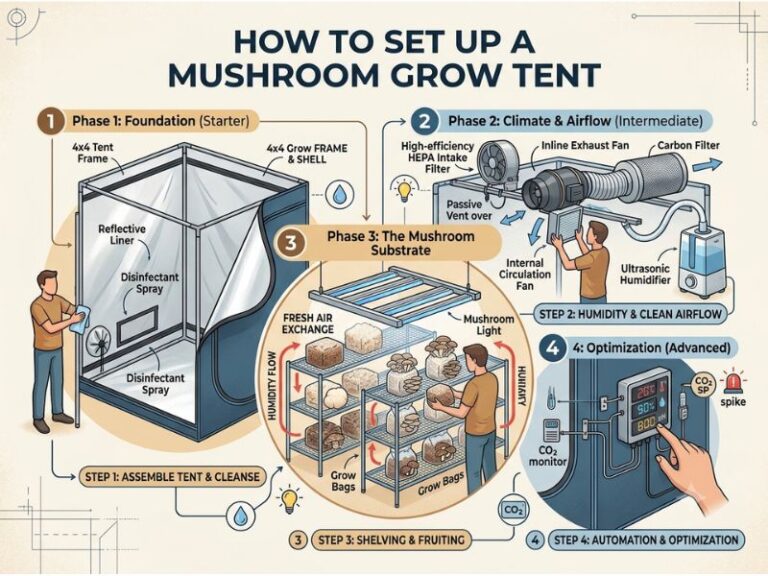
Best Grow Tent Accessories: 3 Smart Upgrades for Better Grows
The best grow tent accessories are not necessarily the products that add the most technology to your setup. The most useful accessories solve everyday problems: knowing the actual temperature and relative humidity, keeping air moving through a dense canopy, supporting plants as they become larger, organizing equipment, and making routine maintenance easier.
That is why my top three picks cover three completely different jobs.
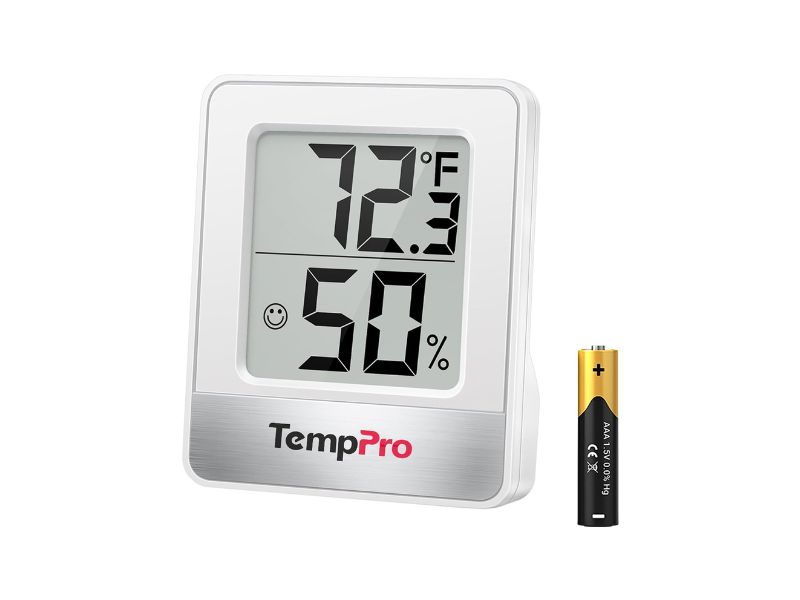
My first recommendation is the TempPro TP49 Digital Hygrometer Thermometer. It is a compact temperature and humidity monitor with an exceptionally established Amazon customer-feedback history. It refreshes readings every 10 seconds, offers several mounting options, and is simple enough to keep at canopy level without adding another complicated controller or app to the tent. Amazon specifically lists grow tents and greenhouses among its suitable environments.
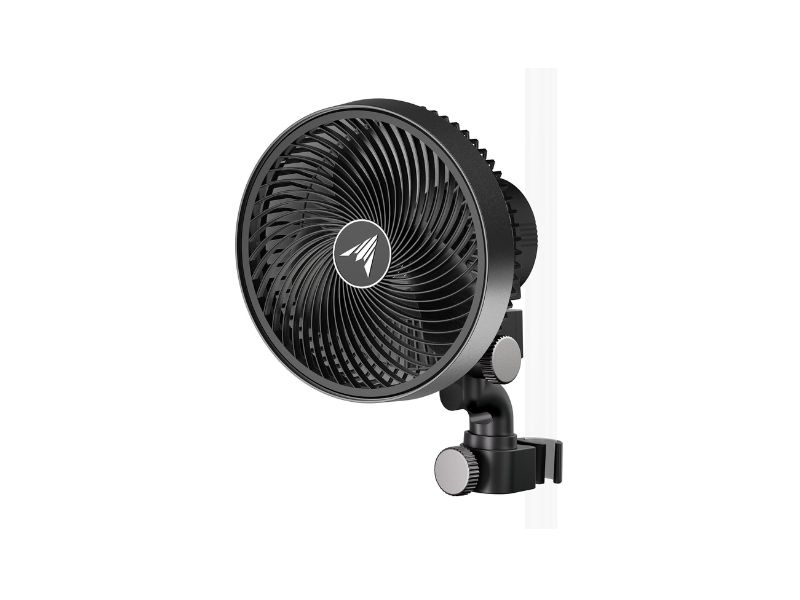
For airflow, the AC Infinity CLOUDRAY S6 Grow Tent Clip Fan is the accessory I would add next. Its redesigned 6-inch platform combines a long-life EC motor, 10 fan speeds, 10 oscillation settings, dynamic wind modes, and IP54 environmental protection. That makes it much easier to create gentle canopy movement without occupying valuable floor space.
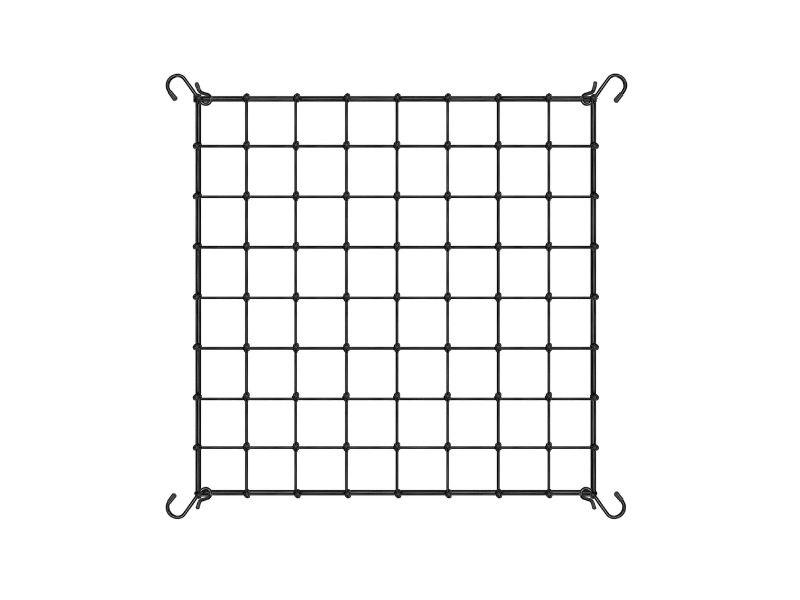
The VIVOSUN 4×4 Elastic Trellis Netting completes the group. Its elastic 4×4-foot design attaches with four hooks and creates approximately 3.9-inch square openings for supporting and organizing plant growth. It is simple, reusable, and particularly useful once branches begin spreading across more of the tent.
These products were ordered using current Amazon rating and review strength together with grow-tent usefulness. Instead of giving you three versions of the same accessory, the list covers environment monitoring, air circulation, and canopy management.
3 Best Grow Tent Accessories
| Image | Product Name | Check Price |
|---|---|---|
Best Choice | empPro TP49 Digital Hygrometer Thermometer | Check Price |
Second Best | AC Infinity CLOUDRAY S6 Grow Tent Clip Fan | Check Price |
Third Choice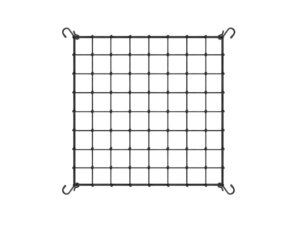 | VIVOSUN 4×4 Elastic Trellis Netting | Check Price |
A grow tent can function without dozens of add-ons. The accessories worth buying are the ones that make the environment easier to understand or maintain.
For most indoor gardeners, I would prioritize accessories in roughly this order:
- Know what the environment is doing.
- Maintain useful air movement.
- Organize and support the plants.
- Add automation and convenience afterward.
That approach prevents you from spending heavily on gadgets while overlooking basic temperature, humidity, or airflow problems.
1. TempPro TP49 Digital Hygrometer Thermometer
Key Features
- Digital temperature display
- Relative humidity monitoring
- Approximately 10-second refresh rate
- Temperature accuracy around ±1°F
- Humidity accuracy around ±2–3% RH
- Tabletop, magnetic, or hanging placement
- Compact LCD display
The TempPro TP49 earns the first position because almost every grow-tent decision becomes easier when you know the actual temperature and humidity around the plants.
The TP49 is deliberately simple. There is no complex controller platform to configure and no need to pair it with the rest of your equipment. Place it in the tent, position it appropriately, and you have an immediate reference for two of the most important environmental variables.
Amazon specifies a 10-second refresh rate, temperature accuracy around ±1°F and humidity accuracy around ±2–3% RH. It can sit on a surface, attach magnetically, or hang from an appropriate location, which makes canopy-level placement relatively easy as plants change height.
That last point matters. Temperature and humidity near the floor can differ from conditions closer to a warm light or dense canopy. Having a small monitor that can move upward with the plants is more useful than permanently placing one at the bottom of the tent.
What I Like
- Extremely easy to use
- Strong Amazon customer confidence
- Compact enough for small tents
- Multiple placement options
- Fast reading updates
What I Do Not Like
- No remote Wi-Fi monitoring
- Does not automatically control fans or humidifiers
For a basic grow tent, this is one of the first accessories I would add. Measuring the environment is far better than trying to judge temperature and humidity by how the room feels.
2. AC Infinity CLOUDRAY S6 Grow Tent Clip Fan
Key Features
- 6-inch clip-on circulation fan
- Brushless EC motor
- 10 speed levels
- 10 oscillation settings
- Dynamic wind modes
- IP54 environmental protection
- Compatible with the AC Infinity UIS ecosystem
The CLOUDRAY S6 earns second place because internal air circulation is one of the easiest grow-tent conditions to overlook.
An inline exhaust fan exchanges air between the tent and the room, but it does not guarantee that air moves evenly around every leaf. Dense foliage can still create stagnant pockets.
The CLOUDRAY solves that problem without consuming floor space. Its clamp attaches to a grow-tent pole, while the oscillating head can sweep across a selected area. AC Infinity provides 10 fan speeds, 10 oscillation ranges, and dynamic modes that vary airflow rather than producing one constant blast.
The updated model also carries an IP54 rating, giving it additional resistance to dust and moisture in the type of humid environment where an ordinary desk fan may be less comfortable operating continuously. AC Infinity also supports connection to compatible UIS controllers for deeper automation.
What I Like
- Excellent speed control
- Adjustable oscillation
- Does not use floor space
- Environmental resistance suits tent use
- Can integrate with compatible controllers
What I Do Not Like
- More sophisticated than a basic fixed clip fan
- Strong airflow still needs careful positioning around young or delicate plants
The CLOUDRAY S6 is a strong upgrade once you have basic environmental monitoring covered and want more consistent airflow around the canopy.
3. VIVOSUN 4×4 Elastic Trellis Netting
Key Features
- 4 × 4-foot elastic net
- Approximately 3 mm elastic construction
- Four rust-resistant hooks
- Approximately 3.9 × 3.9-inch mesh openings
- Can be cut to fit
- Reusable design
- Suitable for climbing and spreading plants
VIVOSUN’s elastic trellis net takes third place because it is inexpensive, simple, and surprisingly useful once plants start occupying more of the tent.
A trellis helps separate and support branches rather than allowing everything to lean into the same area. For climbing plants, tomatoes, cucumbers, peas, and other species that benefit from physical support, it can also make better use of the horizontal canopy area.
VIVOSUN’s 4×4 model uses elastic thread around 3 mm in diameter and comes with four hooks. The mesh openings are approximately 3.9 inches square, which leaves room to guide branches through the net while still reaching the plants for pruning and maintenance. The manufacturer also allows the material to be cut when a smaller footprint is needed.
The elastic design is particularly convenient inside a tent because it can stretch between frame poles rather than requiring a rigid garden structure.
What I Like
- Very easy to install
- Uses vertical and horizontal tent space efficiently
- Reusable
- Large openings preserve maintenance access
- Useful for supporting a broad canopy
What I Do Not Like
- Becomes inconvenient if plants need to be removed frequently
- A heavily filled trellis can make individual containers harder to move
For plants that benefit from support or training, a trellis is one of the simplest ways to turn an empty tent frame into part of the growing system.
Grow Tent Accessories Comparison
| Product | Main Purpose | Best Placement | Major Advantage | Main Limitation |
| TempPro TP49 | Temperature and humidity monitoring | Near canopy level | Simple environmental feedback | No remote automation |
| AC Infinity CLOUDRAY S6 | Internal air circulation | Tent pole near canopy | Highly adjustable airflow | Requires careful positioning |
| VIVOSUN 4×4 Trellis Net | Plant and branch support | Across tent frame | Uses canopy space efficiently | Limits easy plant removal |
These three accessories address different stages of grow-tent management rather than competing directly with each other.
If I were setting up an empty tent, the hygrometer would help me understand the environment, the fan would improve circulation, and the trellis would become useful once the plants were large enough to need support.
Which Grow Tent Accessories Do You Actually Need?
It is easy to turn a simple indoor garden into a collection of equipment.
You can buy:
- Smart controllers
- Sensors
- Clip fans
- Cameras
- Trellis nets
- Ratchet hangers
- Timers
- Humidifiers
- Dehumidifiers
- Runoff trays
- Tool organizers
- Pruning tools
- Watering systems
- Leak detectors
Some of them can be extremely helpful.
You probably do not need all of them on day one.
The best approach is to divide accessories into essential information, environmental control, plant management, and convenience.
Start With Environmental Information
Before buying equipment designed to change the tent environment, you need some way to know what that environment is doing.
Temperature and relative humidity are the obvious starting measurements.
Penn State notes that indoor plant humidity requirements vary by species and environment rather than there being one universal humidity number for every plant. That is an important reason to measure conditions instead of chasing a generic target.
A small hygrometer such as the TP49 gives you immediate answers to questions like:
- Is the tent getting significantly warmer after the light turns on?
- Does humidity rise after watering?
- Does the exhaust fan noticeably change conditions?
- Is the tent substantially more humid than the surrounding room?
Those observations help guide future purchases.
Where Should a Grow Tent Hygrometer Go?
The primary temperature and humidity monitor should normally sit close to the active plant canopy rather than permanently remaining on the floor.
Avoid putting it directly:
- In front of a circulation fan
- Beside the exhaust opening
- At the passive intake
- Against a tent wall
- Under a humidifier mist stream
- Immediately beside a hot light driver
Any of those locations can give you a reading that reflects a local microclimate instead of the broader plant environment.
As plants grow taller, move the monitor with them.
The TP49’s hanging and magnetic placement options make that adjustment easier.
Do You Need a Smart Hygrometer?
Not necessarily.
A smart sensor becomes useful if the tent is located somewhere you do not visit frequently.
Bluetooth or Wi-Fi monitoring can provide:
- Remote readings
- Historical graphs
- Alerts
- Data logging
But a simple digital monitor still answers the most important question whenever you inspect the tent: what are the current temperature and humidity?
For a first grow-tent accessory, simplicity can be an advantage.
Grow Tent Circulation Fan vs Inline Fan
These two fans are often confused, but they have different jobs.
Inline Exhaust Fan
An inline fan connects to ducting.
Its job is to exchange air between the tent and the room.
It helps with:
- Heat removal
- Humidity management
- Fresh-air exchange
- Carbon filtration
- Negative pressure
Circulation Fan
A clip or oscillating fan moves air inside the tent.
It helps reduce still pockets around the leaves.
University of Minnesota Extension recommends good air movement around plants as part of managing moisture and plant-disease conditions, particularly where leaves might otherwise remain in stagnant humid air.
A tent can therefore benefit from both types of fan.
The exhaust changes the air.
The circulation fan distributes that air around the canopy.
Why Clip Fans Work Well in Grow Tents
Floor space is valuable.
A fan sitting on the ground competes with:
- Containers
- Drain trays
- Reservoirs
- Humidifiers
- Watering equipment
A pole-mounted clip fan keeps that space available.
It can also be moved vertically as the plants grow.
The CLOUDRAY S6 uses a compact clamp specifically designed for grow-tent poles and provides adjustable oscillation ranges so the sweep can be restricted when a full 90-degree movement would hit a tent wall or another piece of equipment.
How Strong Should Canopy Airflow Be?
More wind is not automatically better.
The goal is air circulation, not repeatedly bending plants with maximum fan power.
Young plants generally need less force than a dense mature canopy.
AC Infinity’s 10-speed design is useful because you can begin with gentle movement and increase airflow as plant structure and canopy density increase. Its dynamic modes can also vary airflow rather than holding one constant level.
Look for gentle leaf movement across the area rather than one plant receiving a continuous blast.
Should the Fan Blow Above or Below the Canopy?
Both zones can matter.
A young, open canopy may only need one fan moving air across the leaves.
As plants become larger, dense foliage can restrict movement underneath.
A larger setup may benefit from:
- Air moving across the upper canopy
- Additional gentle circulation underneath
You do not necessarily need multiple fans immediately.
Add another only when the canopy develops areas where air remains obviously stagnant.
Why a Trellis Net Can Be Useful
A trellis converts the grow-tent frame into a plant-support structure.
Instead of letting plants occupy space randomly, you can guide branches into separate sections of the canopy.
University of Minnesota Extension notes that staking and trellising vining crops can improve management and make plant problems easier to observe, while better plant spacing supports useful air movement.
Inside a tent, a trellis can help:
- Support long branches
- Separate overlapping growth
- Use horizontal canopy area
- Prevent top-heavy plants from falling
- Keep fruiting branches supported
The VIVOSUN elastic net’s approximately 3.9-inch openings are large enough that you can still reach through them during normal maintenance.
What Grow Tent Size Works With a Trellis?
Choose the net according to the inside tent footprint.
Common combinations include:
- 2×2 net for a 2×2 tent
- 2×4 net for a 2×4 tent
- 3×3 net for a 3×3 tent
- 4×4 net for a 4×4 tent
- 5×5 net for a 5×5 tent
VIVOSUN currently offers the elastic design across several of these common dimensions.
Do not assume a larger net is always better.
Too much loose material can be harder to tension evenly.
How High Should You Install a Trellis?
There is no universal height because plants differ substantially.
The trellis should be positioned where it can actually support or organize developing branches.
Installing it too early and too low can make:
- Watering difficult
- Container removal difficult
- Lower-plant maintenance awkward
Installing it too late means branches may already be tangled.
A useful approach is to install the net before the canopy becomes difficult to manipulate, but leave enough lower space to access the pots comfortably.
Ratchet Hangers Are Another Useful Accessory
Although they are not one of the three ranked products, adjustable ratchet hangers are among the most useful small grow-tent accessories.
They allow you to change the height of:
- LED grow lights
- Carbon filters
- Some fans
- Other hanging equipment
A fixed chain can work, but a ratchet system makes repeated height adjustments much faster.
That becomes particularly useful as plants grow toward the light.
Before hanging equipment, always confirm the weight capacity of both the ratchet and the tent’s support bar.
A Timer Can Simplify Grow Light Control
A basic timer can switch grow lights and other equipment according to a repeatable schedule.
Smart controllers can go much further, but many simple setups only need reliable scheduled switching.
If you use a timer, confirm that its electrical rating is appropriate for the equipment connected to it.
Do not assume that a small household timer can safely carry every light, fan, pump, and heater in a complete grow setup.
Runoff Trays Protect the Tent Floor
Even a grow tent with a removable floor liner benefits from controlling water at the container.
Individual saucers or runoff trays can catch drainage before it spreads across the tent floor.
They make it easier to:
- Inspect runoff
- Remove spilled water
- Keep containers separated from standing moisture
- Clean the tent
For indoor container plants, drainage remains important. University of Minnesota Extension recommends containers with drainage openings so excess water can escape rather than remaining around the root zone.
A runoff tray should catch that drainage without allowing the pot to sit submerged indefinitely.
Tool Organizers Reduce Floor Clutter
Many tents have fabric tool pouches attached to the outside or inside wall.
They are useful for storing lightweight items such as:
- Pruning scissors
- Plant ties
- Measuring tape
- pH accessories
- Labels
- Small probes
Keeping tools in one location sounds trivial until the canopy fills most of the tent.
The less equipment scattered across the floor, the easier the space is to water and clean.
Do You Need a Humidifier?
Only if the actual environment requires one.
This is exactly why the hygrometer is ranked first.
Penn State emphasizes that plant humidity needs vary, and not every indoor plant benefits from the same RH level.
Do not buy a humidifier just because grow tents often contain one.
Measure first.
Then decide whether humidity is genuinely too low for the species being grown.
Do You Need a Dehumidifier?
The same rule applies.
As plants become larger, transpiration can add substantial moisture to an enclosed garden.
But a small tent does not automatically require a dehumidifier.
Sometimes increasing exhaust airflow or improving the surrounding room environment is enough.
If the entire room is humid, controlling the room may be more effective than placing a warm-running dehumidifier on the limited tent floor.
Cameras Can Be Useful but Are Not Essential
A camera is a convenience accessory.
It can help remotely confirm:
- Lights are operating
- Fans are spinning
- Plants have not fallen
- Irrigation has not visibly leaked
It cannot replace direct inspection.
Pests, root problems, subtle nutrient symptoms, and soil moisture often need closer examination than a remote camera provides.
For a first grow tent, I would spend money on accurate environmental monitoring and airflow before buying a camera.
Should You Buy a Smart Environmental Controller?
A smart controller becomes attractive once you have several compatible devices.
It can potentially coordinate:
- Inline fans
- Clip fans
- Humidifiers
- Lighting
- Heating
- Other environmental equipment
The advantage is automation.
The disadvantage is ecosystem dependence.
For example, AC Infinity’s CLOUDRAY S6 can integrate into its UIS platform, but the fan works without requiring the entire control ecosystem.
If you are new to grow tents, adding automation gradually can make troubleshooting easier.
Electrical Safety Matters With Accessories
Grow tents combine electricity with:
- Water
- Humidity
- Metal frames
- Pumps
- Fans
- Lighting
Keep power strips and electrical connections away from runoff areas.
Route cords so that water cannot easily travel along them toward plugs.
Avoid overloading outlets, extension cords, timers, or controllers.
If a device has specific installation requirements regarding moisture, mounting orientation, or electrical load, follow those instructions rather than assuming that every product marketed for indoor growing can be installed anywhere in the tent.
How to Choose Grow Tent Accessories
Buy for a Real Problem
Start by identifying what is missing.
Examples:
Problem: You do not know whether humidity is high.
Accessory: Hygrometer.
Problem: Leaves barely move in the rear corner.
Accessory: Circulation fan.
Problem: Branches are leaning into one another.
Accessory: Trellis or plant supports.
Buying around real problems produces a much more useful setup than collecting accessories because they appear in other people’s tents.
Match the Tent Size
A 6-inch oscillating clip fan might be useful in a 4×4.
The same fan can feel physically large in a tiny propagation enclosure.
Likewise, a 4×4 trellis belongs in an appropriate square footprint rather than being forced into a 2×4.
Protect Floor Space
Accessories mounted to:
- Tent poles
- Roof bars
- Exterior walls
generally preserve more growing area.
This becomes increasingly important in small tents.
Think About Maintenance
Ask whether you can still:
- Water plants
- Remove containers
- Clean the floor
- Adjust the light
- Inspect rear branches
after the accessory is installed.
A perfectly filled tent can be much harder to maintain than one with some intentionally unused space.
Accessories for a 2×2 Grow Tent
A 2×2 has very limited physical space.
Prioritize compact accessories:
- Small hygrometer
- Compact clip fan
- Light ratchet hangers
- Small runoff trays
A full trellis can work if the plant requires support, but understand that once branches are woven through it, container removal becomes more complicated.
Floor-mounted equipment should be kept to a minimum.
Accessories for a 2×4 Grow Tent
The rectangular layout makes wall and pole mounting especially useful.
A temperature/humidity monitor can sit near canopy level, while one or two clip fans can circulate air lengthwise.
A 2×4 trellis works naturally when plants are arranged in a row.
Because the tent is shallow, reaching rear equipment is generally easier than in a deep square tent.
Accessories for a 3×3 Grow Tent
A 3×3 has enough room to benefit from more equipment without becoming immediately crowded.
Useful additions include:
- Hygrometer
- Oscillating clip fan
- Ratchet hangers
- 3×3 trellis
- Drain trays
- Basic controller
As the canopy fills the entire nine-square-foot area, pay closer attention to lower-canopy airflow and maintenance access.
Accessories for a 4×4 Grow Tent
A 4×4 is large enough that environmental differences can develop between areas of the tent.
One small hygrometer provides a useful reference, but you may eventually want to compare conditions in multiple locations.
The CLOUDRAY S6 is particularly well matched to this footprint because its adjustable oscillation can cover a broad section of the canopy, while VIVOSUN’s 4×4 trellis is dimensioned specifically for this class of tent.
A mature 4×4 may also justify additional airflow beneath the canopy.
Accessories for a 5×5 Grow Tent
The larger footprint gives you more room but also creates more opportunities for uneven airflow.
Useful equipment can include:
- Multiple environmental sensors
- More than one circulation fan
- Stronger plant support
- Larger runoff trays
- Smart control systems
Do not automatically fill the extra floor area with more equipment.
Leaving pathways for maintenance can be more useful than maximizing accessory count.
Common Mistakes When Buying Grow Tent Accessories
Buying Accessories Before Measuring the Tent
Always confirm actual dimensions and pole size.
Adding Automation Before Understanding the Environment
A controller can automate bad settings just as effectively as good ones.
Measure and understand the tent first.
Putting the Hygrometer on the Floor
Canopy-level conditions are often more relevant.
Pointing a Fan Directly at One Plant
Circulate air across an area rather than continuously blasting one spot.
Running the Fan at Maximum Speed Automatically
Use enough airflow to create gentle circulation.
Installing a Trellis Too Early
Make sure you can still access and move the containers while the plants are small.
Installing a Trellis Too Late
Waiting until branches are tangled makes training much harder.
Filling Every Roof Bar With Equipment
Check the tent frame’s hanging capacity and distribute loads sensibly.
Putting Electrical Connections Near Runoff
Keep plugs, controllers, and power strips away from potential water.
Buying Humidity Equipment Without a Hygrometer
Measure before trying to correct an environmental condition.
Forgetting Cleaning Access
Fans, sensors, trays, and trellis material all eventually need maintenance.
Frequently Asked Questions
1. What are the best grow tent accessories?
A temperature/humidity monitor, circulation fan, and appropriate plant-support system are three of the most useful accessories for many grow tents.
The TempPro TP49 provides basic environmental information, the AC Infinity CLOUDRAY S6 improves internal circulation, and VIVOSUN’s elastic trellis helps organize supported plants across the canopy.
2. What grow tent accessory should I buy first?
Start with a reliable temperature and humidity monitor if the tent does not already have one.
Knowing the actual environment makes it easier to decide whether you need stronger ventilation, a humidifier, dehumidification, or other environmental equipment.
3. Is the TempPro TP49 good for a grow tent?
Yes. It is compact, updates readings frequently, and can be hung, mounted magnetically, or placed on a surface.
Amazon specifically describes the TP49 as suitable for environments including grow tents and greenhouses.
4. Where should I put a hygrometer in a grow tent?
Place the main sensor close to canopy height and away from direct airflow or humidifier mist.
Move it upward as the plants grow so the readings remain relevant to the environment around the foliage.
5. Do I need more than one hygrometer?
Not necessarily in a small tent, but additional sensors can reveal differences between locations in a larger enclosure.
Start with one well-positioned monitor and add another if you suspect hot, cool, dry, or humid zones.
6. Do I need a circulation fan if I have an inline fan?
Yes, they perform different jobs.
The inline fan exchanges tent air, while a circulation fan moves air around the plants and helps reduce stagnant zones within the canopy.
7. Is AC Infinity CLOUDRAY S6 good for grow tents?
Yes. It is specifically designed as a grow-tent circulation fan and offers 10 speeds, adjustable oscillation, dynamic wind modes, and IP54 protection.
Its pole clamp also preserves floor space, which is particularly useful in compact tents.
8. How strong should the fan be inside a grow tent?
Use enough airflow for gentle canopy movement without constantly forcing leaves and stems in one direction.
Variable-speed fans make it easier to reduce airflow around young plants and increase circulation as the canopy becomes denser.
9. Should a grow tent fan oscillate?
Oscillation is useful because it distributes airflow across more of the canopy rather than concentrating it in one location.
It is not mandatory, but adjustable oscillation can reduce the need for several fixed-position fans.
10. What does a trellis net do in a grow tent?
A trellis provides physical support and helps distribute climbing or spreading branches across the available canopy area.
It can also keep top-heavy growth from collapsing into neighboring plants.
11. Is VIVOSUN trellis netting reusable?
Yes. VIVOSUN describes its elastic netting as reusable and foldable for storage after use.
The 4×4 version uses elastic thread with four hooks and can also be cut if a smaller section is required.
12. What size trellis net should I buy?
Match the net to the inside footprint of the grow tent whenever possible.
A 4×4 net is a natural fit for a 4×4 tent, while smaller 2×2, 2×4, and 3×3 versions are easier to tension properly in smaller enclosures.
13. Do I need ratchet hangers for a grow light?
They are not mandatory, but adjustable ratchet hangers make repeated light-height changes significantly easier.
Verify the hanger’s weight rating and the capacity of the tent support bar before suspending heavy equipment.
14. Do I need a humidifier in my grow tent?
Only if measured humidity is below the appropriate range for the plants you are growing.
Plant humidity needs vary by species, which is why a hygrometer should come before automatically buying humidity-control equipment.
15. Do I need a dehumidifier?
Only when humidity remains too high after considering ventilation, plant density, watering, and the surrounding room conditions.
In some setups, conditioning the entire room outside the tent is more practical than using valuable floor space for a small dehumidifier.
16. Is a grow tent camera necessary?
No. A camera is useful for remote monitoring but is primarily a convenience accessory.
Basic environmental monitoring, airflow, lighting, drainage, and safe electrical setup usually deserve higher priority.
17. Are smart grow tent controllers worth it?
They can be worthwhile once several compatible environmental devices need coordinated control.
For a simple tent, individual sensors and manually adjustable fans may be easier to understand and troubleshoot.
18. What accessories help keep a grow tent organized?
Pole-mounted fans, tool pouches, ratchet hangers, cable routing, runoff trays, and properly sized plant supports can all reduce clutter.
The main goal is to keep pathways, vents, electrical connections, and maintenance areas accessible rather than filling every available space.
Conclusion
The best grow tent accessories are the ones that solve practical problems instead of simply adding more equipment to the enclosure.
My first recommendation is the TempPro TP49 because understanding temperature and relative humidity gives you a foundation for nearly every other environmental decision. It is compact, easy to reposition, refreshes quickly, and has an exceptionally established Amazon customer-feedback history.
The AC Infinity CLOUDRAY S6 is the next accessory I would add when canopy circulation needs improvement. Its 10 speeds, adjustable oscillation, dynamic airflow options, pole-mounted design, and IP54 protection make it much better suited to the grow-tent environment than an ordinary floor fan.
VIVOSUN’s 4×4 Elastic Trellis Netting addresses a completely different problem. It provides an adjustable support structure for spreading or climbing plants and helps use the available canopy area more deliberately.
After those basics, accessories such as ratchet hangers, runoff trays, timers, tool organizers, cameras, humidifiers, dehumidifiers, and smart controllers can be added when the setup actually calls for them.
Avoid trying to build the most complicated grow tent. Build one that is easy to measure, easy to ventilate, easy to water, and easy to maintain. A few carefully chosen accessories will usually improve the experience more than a tent full of gadgets you rarely use.

I’m Maya L. Greenwood, a lifelong plant lover who believes anyone can grow something beautiful with the right guidance. After years of testing soil mixes, pruning methods, irrigation tricks, and pest-safe solutions, I started EasyGardenTips.com to turn hard-won lessons into step-by-step advice. From seed starting and container gardens to composting and seasonal checklists, my goal is to make gardening simple, sustainable, and fun.