
Wondering how much mulch you need for your garden, flower beds, or landscaping project? Our free Mulch Calculator helps you estimate the right amount in seconds. Choose a rectangular garden bed, circular area, or tree ring, then enter your measurements and desired mulch depth.
The calculator instantly estimates the required volume in liters, cubic yards, and cubic feet, along with the coverage area in square feet. You can also account for existing mulch and add an optional allowance for handling or settling. Whether you’re buying bagged wood chips or ordering bulk landscape mulch, this easy-to-use tool helps you plan your purchase and avoid unnecessary waste.
Mulch Calculator
Find the mulch volume for garden beds, flower borders, round areas, and tree rings. Liters are shown first; cubic yards and cubic feet remain easy to compare.
Layer depth is a planning choice, not a universal plant recommendation. Leave mulch away from tree trunks and plant stems.
Your mulch estimate
VOLUME CALCULATIONHow to Use the Mulch Calculator
The Mulch Calculator helps you determine how much mulch to buy for flower beds, garden borders, trees, shrubs, and landscaping projects. Instead of estimating the amount by eye, you can calculate the required volume using the size of the area and the thickness of the mulch layer.
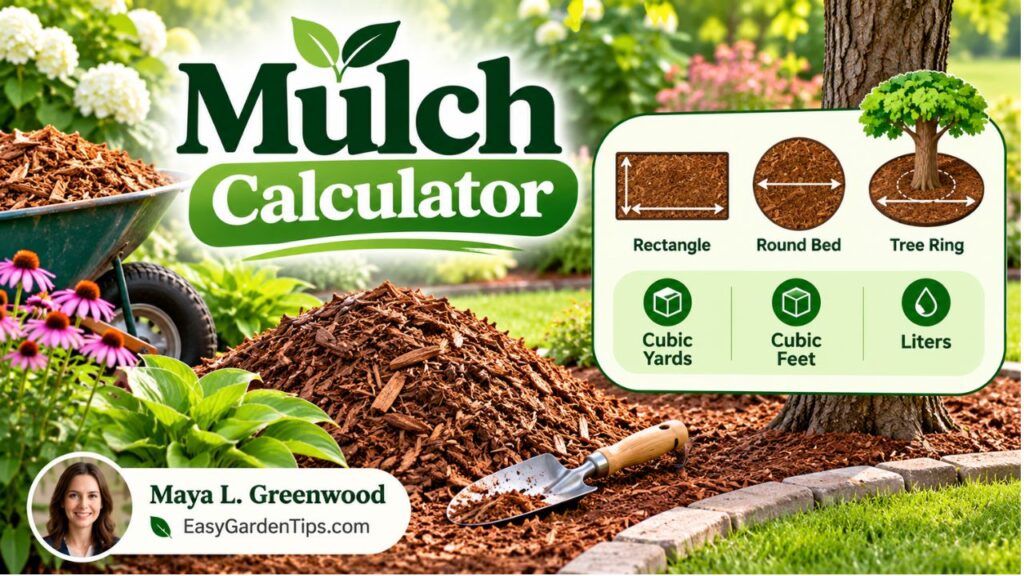
The calculator supports rectangular areas, round garden beds, and circular mulch rings around trees. It also lets you subtract existing mulch and add an optional allowance for handling or settling.
Results are displayed primarily in liters, with cubic yards, cubic feet, and square-foot coverage provided for comparison.
Here’s how to use the calculator.
Step 1: Choose the Area You Want to Mulch
Start by selecting the shape of your landscaping area.
The calculator includes three options.
Rectangle: Choose this for rectangular flower beds, garden borders, raised beds, and most standard landscaping areas.
Round Bed: Select this for circular flower gardens, round planting areas, and other circular spaces.
Tree Ring: Use this option when applying mulch around a tree or shrub while leaving an unmulched opening around the trunk or stems.
Each shape has its own measurement fields.
If your landscaping area has an irregular shape, divide it into smaller sections, calculate each separately, and add the results.
Step 2: Enter Your Garden Bed Measurements
After choosing the shape, enter the required dimensions.
For a rectangular area, enter:
- Length
- Width
For a round garden bed, enter the inside diameter.
For a tree ring, enter:
- Outer mulch ring diameter
- Unmulched inner opening diameter
Measure the actual surface you intend to cover with mulch.
For example, if a flower bed is 12 feet long and 8 feet wide, enter 12 for Length and 8 for Width.
The calculator supports feet, meters, yards, inches, and centimeters for area measurements.
Step 3: Choose the Desired Mulch Depth
Next, decide how thick you want the finished mulch layer to be.
The calculator includes quick depth selections:
- 1 inch
- 2 inches
- 3 inches
- 4 inches
You can also enter a custom depth manually.
Depth can be measured in inches or centimeters.
For many landscape planting beds, approximately 2–3 inches of organic mulch is a useful starting range. The correct thickness depends on the mulch material, soil conditions, and plant type.
Avoid selecting a deeper layer simply because you want to suppress more weeds.
Excessively deep mulch can restrict water and air movement and create problems around plant stems and trunks.
Step 4: Enter the Existing Mulch Thickness
If your garden already has mulch, you may only need to replenish the missing layer.
Enter the current mulch thickness in the Existing Mulch Thickness field.
For example:
- Desired final mulch depth: 3 inches
- Existing mulch depth: 1 inch
The additional mulch required is:
3 − 1 = 2 inches
The calculator estimates the amount needed to add those 2 inches instead of calculating a completely new 3-inch layer.
If your existing mulch already meets or exceeds the desired depth, the calculator shows that no additional mulch is required.
If the existing layer is uneven, measure several representative spots before choosing an average thickness.
Step 5: Select an Optional Extra Mulch Allowance
Some landscaping projects require a little additional material for handling losses, small uneven areas, or settling.
The calculator offers:
- No extra
- 5% extra
- 10% extra
- 15% extra
For example, if the calculated requirement is 500 liters and you select 10% extra:
500 × 1.10 = 550 liters
Your estimated purchase quantity becomes 550 liters.
These percentages are optional planning allowances, not fixed settling rates.
Step 6: Calculate the Required Mulch
Click Calculate Mulch.
The calculator displays:
| Result | What It Means |
|---|---|
| Liters | Total mulch volume to purchase |
| Cubic yards | Useful for bulk mulch orders |
| Cubic feet | Useful for bagged mulch |
| Coverage (sq ft) | Area being mulched |
The result also explains how much new mulch depth you’re adding.
You can use the Copy Estimate button to save the calculation before visiting a garden center or contacting a landscape supplier.
For multiple garden beds, calculate each area separately and add their mulch volumes together.
How Does a Mulch Calculator Work?
A mulch calculator estimates the volume of material needed to cover a measured area to a specified depth.
The basic formula is:
Mulch Volume = Surface Area × Mulch Depth
For rectangular garden beds, surface area is calculated from length and width.
For circular beds, the calculator uses the area of a circle.
For tree rings, it subtracts the inner unmulched area from the outer circular area.
All measurements must use compatible units before calculating volume.
Mulch Calculation Example: 10 × 10 Feet
Suppose you’re preparing a landscaping bed with these measurements:
| Measurement | Value |
|---|---|
| Length | 10 feet |
| Width | 10 feet |
| Desired mulch depth | 3 inches |
| Existing mulch | 0 inches |
| Extra allowance | 0% |
First, calculate the surface area.
10 × 10 = 100 square feet
Convert the mulch depth into feet.
3 ÷ 12 = 0.25 feet
Multiply the area by the depth.
100 × 0.25 = 25 cubic feet
Convert cubic feet into cubic yards.
25 ÷ 27 = 0.9259 cubic yards
Convert the volume into liters.
25 × 28.3168 = 707.92 liters
Final Mulch Estimate:
| Unit | Amount |
|---|---|
| Liters | 707.9 L |
| Cubic feet | 25 cu ft |
| Cubic yards | 0.926 cu yd |
| Coverage area | 100 sq ft |
You’ll need approximately 708 liters of mulch to cover the area at a uniform depth of 3 inches.
These measurements assume a consistent finished layer and don’t include extra material for handling or settling.
How to Calculate Mulch in Cubic Yards
Cubic yards are one of the most common units used for bulk landscaping mulch in the United States.
One cubic yard contains 27 cubic feet.
When your area is measured in square feet and your mulch depth is measured in inches, you can use a simple formula.
Mulch Cubic Yards = Square Feet × Depth in Inches ÷ 324
The number 324 comes from multiplying 12 inches per foot by 27 cubic feet per cubic yard.
Mulch Cubic Yard Calculator Example
Suppose you have a flower bed measuring 200 square feet.
You want to spread mulch 2 inches deep.
Use the formula:
200 × 2 ÷ 324 = 1.2346 cubic yards
You need approximately 1.23 cubic yards of mulch.
That equals approximately 944 liters.
If your supplier accepts quarter-yard increments, you could order 1.25 cubic yards.
If the supplier sells only whole cubic yards, ask about available quantities and plan accordingly.
Don’t automatically round every order to the next whole yard without checking how the material is sold.
Mulch Calculator Cubic Yards Chart
The following chart shows estimated mulch quantities for common landscaping areas.
| Coverage Area | Mulch Depth | Cubic Yards | Approx. Liters |
|---|---|---|---|
| 100 sq ft | 1 inch | 0.31 | 236 L |
| 100 sq ft | 2 inches | 0.62 | 472 L |
| 100 sq ft | 3 inches | 0.93 | 708 L |
| 200 sq ft | 2 inches | 1.23 | 944 L |
| 250 sq ft | 3 inches | 2.31 | 1,770 L |
| 400 sq ft | 2 inches | 2.47 | 1,888 L |
| 500 sq ft | 3 inches | 4.63 | 3,540 L |
| 1,000 sq ft | 3 inches | 9.26 | 7,079 L |
These estimates assume a uniform mulch layer and no existing mulch.
If you’re replenishing an existing layer, calculate only the additional depth required.
Mulch Calculator for Square Feet: Understanding Coverage
Square feet measure the surface area of a landscaping project.
Cubic feet and cubic yards measure how much mulch is needed to cover that area to a particular depth.
For example, a 100-square-foot garden bed doesn’t always require the same amount of mulch.
At 1 inch deep, it requires approximately 236 liters.
At 3 inches deep, it requires approximately 708 liters.
The surface area hasn’t changed. Only the depth has increased.
How Many Square Feet Does One Yard of Mulch Cover?
One cubic yard contains 27 cubic feet of material.
How much area it covers depends on the mulch thickness.
| Mulch Depth | Coverage From 1 Cubic Yard |
|---|---|
| ½ inch | 648 sq ft |
| 1 inch | 324 sq ft |
| 2 inches | 162 sq ft |
| 3 inches | 108 sq ft |
| 4 inches | 81 sq ft |
These are mathematical coverage estimates, not recommendations for each listed depth.
For example, one cubic yard of mulch covers approximately 108 square feet at a 3-inch depth.
At 2 inches deep, the same amount covers 162 square feet.
How to Calculate Mulch Coverage From a Known Quantity
If you already have mulch and want to know how much area it will cover, use:
Coverage (sq ft) = Cubic Yards × 324 ÷ Depth (inches)
Suppose you have 3 cubic yards of mulch and want a 3-inch layer.
3 × 324 ÷ 3 = 324 square feet
You can cover approximately 324 square feet at that depth.
This is useful when deciding whether leftover mulch will cover another garden bed.
Mulch Calculator Formulas for Different Landscaping Shapes
Not every landscape bed is rectangular.
Garden paths, flower circles, tree rings, and curved borders may require different area calculations.
The Mulch Calculator includes three common shapes to simplify these measurements.
Rectangle Mulch Calculator
Rectangular areas are among the easiest to measure.
Use:
Area = Length × Width
Then multiply by mulch depth.
For example, a rectangular flower bed measuring 12 feet by 8 feet has:
12 × 8 = 96 square feet
At a 3-inch mulch depth:
96 × 3 ÷ 324 = 0.8889 cubic yards
That’s approximately 680 liters of mulch.
This calculation works for rectangular landscape borders, many flower beds, and certain raised garden beds.
Round Mulch Calculator
Circular garden beds require a different formula.
Circle Area = π × Radius²
The radius is half the diameter.
Suppose a round flower bed has a diameter of 10 feet.
Its radius is:
10 ÷ 2 = 5 feet
Calculate the area:
3.1416 × 5² = 78.54 square feet
If you want a 2-inch mulch layer:
78.54 × 2 ÷ 324 = 0.485 cubic yards
That’s approximately 371 liters of mulch.
The calculator uses the inside diameter you enter to determine the circular coverage area.
Tree Ring Mulch Calculator
Mulching around trees requires special care because mulch shouldn’t be piled directly against the trunk.
The Tree Ring option calculates an outer circular area and subtracts an inner opening that remains unmulched.
Use:
Mulch Ring Area = π × (Outer Radius² − Inner Radius²)
Both radii must use the same unit.
Suppose:
- Outer mulch ring diameter: 8 feet
- Inner unmulched opening diameter: 2 feet
- Mulch depth: 3 inches
The outer radius is 4 feet, and the inner radius is 1 foot.
Area:
3.1416 × (4² − 1²) = 47.12 square feet
Mulch volume:
47.12 × 3 ÷ 324 = 0.436 cubic yards
That’s approximately 334 liters of mulch.
The inner opening is the entire area you intend to leave free of mulch, not just the diameter of the tree trunk.
This makes the Tree Ring calculator especially useful for planning a proper mulch-free zone around trees and shrubs.
How Much Mulch Do You Need for Landscaping Beds?
The quantity of mulch needed for landscaping depends on the total bed area, intended depth, and amount already present.
Common landscaping projects include:
- Flower beds
- Shrub borders
- Foundation plantings
- Tree rings
- Perennial gardens
- Vegetable garden paths
- Ornamental landscape beds
For each area, measure the surface you actually plan to cover.
Avoid including patios, walkways, large rocks, or other spaces where mulch won’t be placed.
Mulch Calculator for Flower Beds
A flower bed often contains plants that occupy part of the surface.
For most small ornamental plants, calculating the overall bed area is usually a reasonable starting point.
Leave the appropriate space around plant stems and crowns when spreading mulch.
If the bed contains large unmulched sections, subtract those areas from the total.
For example, a 10 × 20-foot flower bed covers 200 square feet.
At a depth of 2 inches, it requires approximately 1.23 cubic yards of mulch.
Mulch Calculator for Shrub Beds
Shrub beds often benefit from organic mulch that reduces evaporation and suppresses weeds.
Measure the entire intended mulch area.
If existing mulch is still present, determine how much additional thickness is required.
For example:
- Desired depth: 3 inches
- Existing depth: 2 inches
- Additional depth: 1 inch
Instead of replacing the entire layer, calculate only the missing inch.
Keep mulch away from the bases of shrubs and avoid burying their crowns.
Mulch Calculator for Garden Borders
Long, narrow garden borders can be calculated as rectangles when their width is reasonably uniform.
For a border measuring 30 feet long and 3 feet wide:
Area = 30 × 3 = 90 square feet
At a 2-inch depth:
90 × 2 ÷ 324 = 0.556 cubic yards
That’s approximately 425 liters.
If the border changes width substantially, divide it into smaller sections.
Mulch Calculator for Irregular Landscape Beds
Curved or irregular beds require a little more preparation.
Divide the space into simple shapes such as rectangles and circles.
Calculate each section separately.
Then add the individual mulch volumes together.
Avoid overlapping sections, or you may count part of the area twice.
For highly irregular beds, a measured area estimate combined with the average intended mulch depth is a practical approach.
How Deep Should Mulch Be in Garden and Landscape Beds?
Mulch depth affects weed suppression, soil moisture, root aeration, and the amount of material required.
The correct thickness depends on the mulch type, plant requirements, and existing growing conditions.
For many organic mulches, 2–3 inches is a practical starting range.
According to Penn State Extension’s Applying Mulches in Home Fruit Plantings, a settled mulch layer of approximately 2–3 inches helps suppress young weeds, reduce evaporation, and allow water to penetrate the soil.
However, not every mulch material should be applied at exactly the same thickness.
Is 1 Inch of Mulch Enough?
A 1-inch layer may provide limited surface protection or improve the appearance of a landscaped area.
However, a thin layer of coarse organic mulch may not suppress weeds as effectively as a suitable thicker layer.
One inch can also be useful when you’re replenishing an existing mulch layer.
For example, if a garden already has 2 inches of mulch and your target is 3 inches, adding 1 inch is appropriate.
Is 2 Inches of Mulch Enough?
A 2-inch mulch layer is a common choice for established planting beds.
It can help reduce exposed soil, limit evaporation, and suppress some weed growth.
The ideal depth depends on the mulch material.
Fine-textured products may require a thinner layer than larger wood chips.
Is 3 Inches of Mulch Too Much?
Three inches is commonly used for many wood-chip and bark-mulch applications.
It can provide useful soil protection when applied correctly.
However, mulch should not be piled around tree trunks, shrub stems, or vulnerable plant crowns.
Before adding more mulch, check the existing thickness.
Should You Apply 4 Inches of Mulch?
Four inches can be appropriate for some coarse mulch materials and specific applications, but it shouldn’t be treated as a universal recommendation.
Fine-textured or compacted mulches may restrict air and water movement when applied too deeply.
The Oregon State University Extension guide to Landscape Maintenance to Conserve Water explains that larger, coarse organic mulches can be applied more deeply than smaller, fine-textured materials.
For tree and shrub beds, follow plant-specific guidance and avoid excessive mulch thickness.
The calculator’s 4-inch quick-depth option is available for projects where that depth is appropriate, not as a recommendation for every garden.
Choosing the Best Mulch for Your Landscaping Project
Mulch materials differ in appearance, decomposition rate, texture, weight, and intended use.
They can generally be divided into organic and inorganic materials.
Wood Chip Mulch
Wood chips are commonly used around trees, shrubs, and perennial planting beds.
They can help moderate soil temperature, reduce evaporation, and protect the soil surface.
Wood chips gradually decompose and contribute organic material to the soil.
Coarse wood chips are often appropriate for wider landscape beds and tree rings.
Shredded Bark Mulch
Shredded bark is popular in ornamental landscaping.
It creates a relatively uniform appearance and can remain in place well in many garden settings.
The size and texture vary by product.
Fine shredded mulch may compact or form a dense layer more easily than coarse wood chips, so appropriate application depth matters.
Pine Bark Mulch
Pine bark is available in different particle sizes.
Larger bark nuggets may be useful for ornamental beds, while smaller pine bark products can serve other landscaping purposes.
Consider wind exposure, slopes, and the size of the planting area when selecting bark nuggets.
Pine Straw Mulch
Pine needles, often called pine straw, are used around certain landscape plants and in regions where the material is readily available.
Pine straw is frequently sold in bales rather than standard cubic-foot bags.
Its coverage can depend on bale size and how loosely or densely the needles are spread.
Use the calculator for a general volume estimate, but confirm the supplier’s stated coverage per bale before purchasing.
Straw Mulch for Vegetable Gardens
Clean, weed-free straw can be useful around vegetables and certain fruit crops.
It can help protect soil from rainfall impact, conserve moisture, and reduce soil contact with produce.
Avoid straw containing excessive weed seeds.
Straw may settle significantly because of its loose structure, so packaged volume and actual coverage can vary.
Shredded Leaf Mulch
Shredded leaves can provide seasonal soil protection and contribute organic matter as they break down.
They can be especially useful in suitable garden beds.
Whole leaves may mat together, particularly when wet.
Shredding can make leaf mulch easier to distribute and manage.
Grass Clipping Mulch
Grass clippings may be used as mulch in certain vegetable gardens when applied in thin layers.
Avoid thick piles of fresh clippings that can mat and restrict air movement.
Don’t use clippings from lawns recently treated with herbicides unless the product label and applicable guidance confirm that the clippings are safe for the intended use.
The University of Minnesota Extension’s Mulching for Soil and Garden Health guide discusses the differences between organic mulches such as wood chips, straw, leaves, and grass clippings, along with their effects on moisture, erosion, and soil health.
Rubber Mulch and Landscape Rock
Rubber mulch and landscape rock are inorganic or manufactured ground-cover materials.
They don’t decompose and enrich the soil in the same way as organic mulch.
Landscape rock may increase soil surface temperatures in some settings.
Rubber mulch also has environmental and management considerations that should be evaluated before using it in planting areas.
The calculator can estimate the geometric volume of a material layer, but the result doesn’t determine the product’s weight or whether the material is appropriate for your plants.
For gravel, stone, or other dense materials, suppliers may use weight-based ordering rather than cubic yards.
Mulch Calculator: Liters vs. Cubic Feet vs. Cubic Yards
Different mulch suppliers use different volume measurements.
The calculator displays liters as the primary result, making it easier to compare packaged quantities.
Cubic feet are useful for smaller bagged mulch products, while cubic yards are common for bulk landscape deliveries.
Mulch Volume in Liters
Liters describe how much space the mulch occupies.
For example, if the calculator estimates that you need 200 liters, you could purchase:
- Ten 20-liter bags
- Five 40-liter bags
- Four 50-liter bags
These combinations provide the same nominal volume.
The actual number of bags depends on what your supplier sells.
Mulch Volume in Cubic Feet
One cubic foot equals approximately 28.32 liters.
Many US garden centers sell mulch in bags labeled by cubic feet.
For example:
- 1 cubic foot ≈ 28.32 liters
- 1.5 cubic feet ≈ 42.48 liters
- 2 cubic feet ≈ 56.63 liters
- 3 cubic feet ≈ 84.95 liters
Check the bag label before deciding how many packages to purchase.
Mulch Volume in Cubic Yards
One cubic yard equals 27 cubic feet or approximately 764.55 liters.
Bulk landscaping suppliers frequently price mulch by the cubic yard.
Mulch Volume Conversion Chart
| Measurement | Equivalent Volume |
|---|---|
| 1 cubic foot | 28.32 L |
| 1 cubic yard | 27 cu ft |
| 1 cubic yard | 764.55 L |
| 1 cubic meter | 1,000 L |
| 100 liters | 3.53 cu ft |
| 500 liters | 0.654 cu yd |
| 1,000 liters | 1.308 cu yd |
These conversions follow the official National Institute of Standards and Technology’s Guide to SI Conversion Factors.
Volume calculations are independent of whether you’re purchasing hardwood mulch, bark chips, or another material.
However, actual packaged volume, settling, and material density may differ.
How Many Bags of Mulch Do You Need?
Once you know the total mulch volume, you can calculate the number of bags needed.
The calculator provides the required mulch volume rather than asking you to select a particular bag size.
This allows you to compare different products and packaging options.
Mulch Bag Calculator Formula
Number of Bags = Required Mulch Volume ÷ Volume per Bag
Round up to the next whole bag when necessary.
How Many Bags of Mulch Are in One Cubic Yard?
One cubic yard contains 27 cubic feet.
The number of bags depends on the bag’s labeled volume.
| Mulch Bag Size | Bags for At Least 1 Cubic Yard |
|---|---|
| 1 cu ft | 27 bags |
| 1.5 cu ft | 18 bags |
| 2 cu ft | 14 bags |
| 3 cu ft | 9 bags |
| 20 L | 39 bags |
| 40 L | 20 bags |
The 2-cubic-foot option requires rounding up because 13.5 bags cannot be purchased as whole bags.
How Many Bags of Mulch for 100 Square Feet?
Suppose you want to cover 100 square feet with a 3-inch layer.
The required volume is:
100 × 3 ÷ 12 = 25 cubic feet
If each bag contains 2 cubic feet:
25 ÷ 2 = 12.5 bags
Round up to 13 bags.
If each bag contains 1.5 cubic feet:
25 ÷ 1.5 = 16.67 bags
Round up to 17 bags.
These examples assume full labeled bag volume and no extra allowance.
How Many Bags of Mulch for 500 Square Feet?
At a depth of 2 inches:
500 × 2 ÷ 12 = 83.33 cubic feet
For 2-cubic-foot bags:
83.33 ÷ 2 = 41.67
You’ll need at least 42 bags.
For a project this size, compare the price of bagged mulch with the delivered cost of bulk mulch.
Bagged Mulch vs. Bulk Mulch: Which Should You Buy?
Both options have advantages depending on the size and accessibility of your project.
When Bagged Mulch Makes Sense
Bagged mulch may be convenient for:
- Small flower beds
- Limited landscaping areas
- Projects with difficult delivery access
- Gardeners who prefer a specific packaged product
- Occasional mulch top-ups
Bagged material can be easier to move in small quantities, but many bags may be expensive and labor-intensive.
When Bulk Mulch Makes Sense
Bulk mulch is often a practical option for larger landscaping projects.
It is commonly delivered by truck and sold by cubic yard.
Bulk delivery may reduce the amount of individual packaging involved.
However, consider:
- Minimum order quantities
- Delivery charges
- Truck access
- Unloading location
- Wheelbarrow or cart access
- Labor required to spread the material
Compare the total delivered cost, not just the advertised price per cubic yard.
How to Calculate the Cost of Mulch
If your supplier charges by cubic yard:
Material Cost = Cubic Yards Ordered × Price per Cubic Yard
Suppose you need 3 cubic yards and the supplier quotes $45 per cubic yard.
3 × $45 = $135
The material cost would be $135 before delivery, taxes, or other charges.
This is a hypothetical pricing example, not a current market price.
Actual mulch prices depend on product type, region, supplier, delivery distance, and quantity.
How Much Mulch Should You Put Around Trees?
Tree mulching requires more than simply spreading material in a circle.
Mulch can help protect tree roots, reduce competition from grass, and conserve soil moisture.
However, mulch piled against the trunk can create serious problems.
According to the University of Maryland Extension’s Mulching Trees and Shrubs guide, mulch should generally remain shallow, approximately 1–3 inches, and be kept away from tree trunks. The guidance recommends keeping mulch about 3 inches from the trunk.
Why You Should Leave a Mulch-Free Tree Ring
Mulch touching the trunk can trap moisture against the bark.
This may contribute to bark decay and create favorable conditions for pests or disease.
Leave an appropriate bare space around the trunk and keep the root flare visible.
The calculator’s Tree Ring option lets you subtract this unmulched inner area from the total circular footprint.
What Is a Mulch Volcano?
A mulch volcano is a mound of mulch piled high against a tree trunk.
This practice can retain excessive moisture against the bark and may contribute to poor root conditions.
Mulch should be spread outward in a relatively even layer instead of being piled upward around the trunk.
How Wide Should a Tree Mulch Ring Be?
The ideal width depends on the tree and available landscaping space.
A wider mulched area can reduce competition from turfgrass and protect roots from mowing equipment.
When practical, extending mulch toward the tree’s canopy drip line can be beneficial.
However, the mulch layer should remain at an appropriate depth and clear of the trunk.
How Much Mulch Do You Need for Raised Garden Beds?
Raised beds may benefit from a surface mulch layer that conserves soil moisture and protects against erosion.
The amount required depends on the bed’s interior surface area and the desired mulch depth.
For example, a 4 × 8-foot raised bed has an area of:
4 × 8 = 32 square feet
At a 2-inch mulch depth:
32 × 2 ÷ 324 = 0.198 cubic yards
This equals approximately 151 liters of mulch.
Important: This is the surface mulch quantity, not the amount of growing soil required to fill the bed.
The mulch sits on top of the soil and may need to be kept away from plant crowns or emerging seedlings.
Best Mulch Materials for Vegetable Raised Beds
Depending on the crop and growing conditions, gardeners may use:
- Clean straw
- Shredded leaves
- Suitable compost
- Untreated organic mulch materials
- Other crop-appropriate surface coverings
Choose a material that allows water movement and doesn’t interfere with seedlings or young plants.
Avoid covering seeds that require light for germination or burying vulnerable plant crowns.
Should You Include Mulch in a Raised Bed Soil Calculation?
Usually, calculate the soil and mulch separately.
If the raised bed is 12 inches high and you want 10 inches of soil plus 2 inches of mulch, use:
- Raised Bed Soil Calculator: 10-inch soil fill depth
- Mulch Calculator: 2-inch mulch layer
This prevents counting the same space twice.
How to Apply Mulch Correctly
After calculating how much mulch you need, follow a consistent application process.
Step 1: Clear Weeds and Debris
Remove unwanted weeds and large debris before applying new mulch.
Mulch can help suppress future weed growth, but established perennial weeds may continue growing through the material.
Address significant weed problems before spreading the new layer.
Step 2: Measure the Existing Mulch
If you’re replenishing an older landscape bed, check the depth of the remaining material.
Don’t automatically add another full 3-inch layer every year.
For example, if the bed already has approximately 2 inches of suitable mulch, adding 1 inch may be enough to restore a 3-inch layer.
Step 3: Calculate the Required Volume
Use the Mulch Calculator to enter the area dimensions and the additional mulch depth required.
For multiple areas with different shapes or depths, calculate each separately.
Copy the estimate before purchasing.
Step 4: Prepare the Landscape Bed
Check the condition of the soil and surrounding plants.
Avoid piling mulch over drainage openings, against siding, or against vulnerable plant crowns.
For tree and shrub beds, keep the trunk and stem bases clear.
Step 5: Spread Mulch Evenly
Distribute the mulch in small piles across the area.
Use a rake or other suitable tool to spread it to the planned depth.
Avoid leaving thick piles in one location and bare sections elsewhere.
Step 6: Keep Mulch Away From Plant Stems
Pull mulch back from the bases of trees and shrubs.
Be careful around young vegetables, herbaceous perennials, and flowers.
Avoid burying stems or crowns beneath a heavy mulch layer.
Step 7: Check the Final Mulch Depth
After spreading, measure the finished thickness in several places.
Some products may settle slightly after exposure to moisture or normal weather.
If necessary, redistribute the material to maintain a consistent layer.
Step 8: Maintain the Mulch Layer
Organic mulch gradually breaks down.
Check the remaining depth periodically and replenish it when needed.
Avoid continually adding new mulch without checking the existing layer.
When Is the Best Time to Apply Mulch?
Mulch can be useful during several parts of the growing season.
The most appropriate timing depends on your climate, soil temperature, crop requirements, and purpose.
Mulching in Spring
Spring mulching can help suppress weeds and conserve moisture.
However, applying thick mulch too early may slow soil warming in cool climates.
For warm-season vegetables, wait until the soil has warmed sufficiently for the crop.
Mulching in Summer
Mulch can help reduce evaporation and moderate soil temperature during warm weather.
It can be particularly useful around established plants in exposed garden beds.
Continue checking soil moisture because mulch doesn’t eliminate the need for watering.
Mulching in Fall
Fall mulching may protect exposed soil, reduce erosion, and help moderate temperature changes.
For certain perennials, winter-protection mulch may be applied after the appropriate seasonal temperature changes.
Follow plant-specific guidance rather than assuming every plant needs a thick winter layer.
When Should Old Mulch Be Replaced?
Old mulch doesn’t necessarily need to be removed every year.
If it remains clean, appropriately textured, and at a suitable depth, you may only need to loosen or replenish it.
Remove mulch when it is contaminated, severely compacted, or otherwise unsuitable.
For most ordinary garden maintenance, topping up a depleted layer is more practical than replacing everything.
Common Mulch Calculation Mistakes to Avoid
The calculator uses accurate volume formulas, but incorrect measurements can still lead to misleading estimates.
Confusing Square Feet With Cubic Yards
Square feet measure area.
Cubic yards measure volume.
You need both the surface area and the mulch depth to calculate the required quantity.
Entering the Wrong Mulch Depth
A 100-square-foot bed at 1 inch deep needs about 0.31 cubic yards.
The same bed at 3 inches deep needs approximately 0.93 cubic yards.
Always verify your intended depth.
Forgetting Existing Mulch
If mulch is already present, measure its remaining thickness before calculating.
Use the Existing Mulch Thickness field to avoid overordering.
Including Unmulched Areas
Patios, stepping stones, hardscape features, and bare areas around trees shouldn’t be counted as mulch-covered space.
Subtract significant unmulched areas when estimating total coverage.
Measuring Tree Rings Incorrectly
For a tree ring, the outer and inner measurements are diameters, not radii.
The inner diameter represents the unmulched circular opening.
Make sure the inner diameter is smaller than the outer diameter.
Mixing Measurement Units
Enter the correct units for length, width, and depth.
If your measurements are in feet but the calculator is set to meters, the result will be incorrect.
Assuming All Mulches Settle the Same Amount
Coarse wood chips, fine shredded bark, and loose straw may settle differently.
The optional extra allowance is only a purchasing adjustment.
It doesn’t measure the actual settling behavior of a specific product.
Buying Mulch by Weight Without Checking Density
Mulch volume and mulch weight are different measurements.
A cubic yard of moist wood chips may weigh more than a cubic yard of dry, loose bark.
If your supplier sells by weight, ask for a product-specific conversion.
Applying Too Much Mulch
Excessively deep mulch can cause problems around roots, stems, and tree trunks.
Select a suitable final depth based on your mulch material and plants.
Don’t assume that deeper mulch always produces better results.
Conclusion
Calculating how much mulch you need is an important step in planning an efficient landscaping project.
Start by measuring the area you want to cover and deciding on an appropriate finished mulch depth.
Use the Mulch Calculator above to estimate the volume in liters, cubic feet, and cubic yards.
If you’re refreshing an existing landscape bed, enter the current mulch thickness so you only calculate the missing material.
For bulk orders, cubic yards are especially useful. For smaller projects, liters and cubic feet help you compare bagged mulch products.
Remember that accurate quantity calculations are only part of successful mulching. Choosing the right material, maintaining a suitable layer thickness, and keeping mulch away from vulnerable plant stems and tree trunks are equally important.
With the right measurements and application practices, you can purchase mulch more confidently, reduce unnecessary waste, and maintain healthier garden and landscape beds.
Mulch Calculator FAQs
How much mulch do I need?
Measure the area you want to cover and select the intended mulch depth.
For rectangular areas, multiply length by width to find the square footage.
Then use:
Cubic Yards = Square Feet × Depth in Inches ÷ 324
The Mulch Calculator performs these calculations automatically.
How much mulch do I need for 100 square feet?
At 2 inches deep, you need approximately 0.62 cubic yards, or 472 liters.
At 3 inches deep, you need approximately 0.93 cubic yards, or 708 liters.
How many cubic yards of mulch do I need for 500 square feet?
At a depth of 2 inches, 500 square feet requires approximately 3.09 cubic yards.
At 3 inches, it requires approximately 4.63 cubic yards.
How much area does 1 cubic yard of mulch cover?
One cubic yard covers approximately:
- 324 square feet at 1 inch deep
- 162 square feet at 2 inches deep
- 108 square feet at 3 inches deep
- 81 square feet at 4 inches deep
Actual coverage may vary with the material and finished layer consistency.
How many 2-cubic-foot bags of mulch make a yard?
One cubic yard contains 27 cubic feet.
27 ÷ 2 = 13.5
You’ll need 14 bags containing 2 cubic feet each to have at least one cubic yard by nominal volume.
How many bags of mulch do I need for a 10 × 10-foot area?
At 3 inches deep, a 10 × 10-foot area needs 25 cubic feet of mulch.
If each bag contains 2 cubic feet, you’ll need at least 13 bags.
Is 2 inches or 3 inches of mulch better?
Both can be appropriate depending on the material and planting conditions.
A 2–3-inch layer is commonly recommended for many organic mulches.
Check the material’s texture and avoid excessive depth around plants.
How much mulch do I need around a tree?
Measure the desired outer mulch ring diameter and the diameter of the inner opening that will remain unmulched.
Select Tree Ring in the calculator.
It subtracts the inner circular area before calculating the required mulch volume.
Should mulch touch a tree trunk?
No.
Keep mulch away from the trunk and leave the root flare visible.
Mulch piled against bark can trap moisture and contribute to decay or other tree-health problems.
Can I use the mulch calculator for raised garden beds?
Yes.
Select Rectangle if your raised bed has a rectangular surface.
Enter the inside length, width, and desired mulch depth.
The result estimates the surface mulch layer, not the growing soil required to fill the bed.
Can I calculate mulch for an irregular-shaped garden?
Yes, by dividing the garden into smaller rectangular or circular sections.
Calculate each area separately and add the results.
Should I add 10% extra mulch?
A 10% allowance may be useful for handling losses, small uneven areas, or expected settling.
However, it isn’t necessary for every project.
The calculator lets you choose 0%, 5%, 10%, or 15% extra.
Can I use the mulch calculator for wood chips?
Yes.
Wood chips can be measured by volume just like other mulch materials.
Choose a suitable depth and enter the area dimensions.
The calculator doesn’t determine the weight of the wood chips.
Can I use this calculator for rubber mulch?
The geometric volume formula also works for rubber mulch.
However, product-specific coverage recommendations and settling behavior may differ.
Follow the manufacturer’s application guidance.
Can I calculate mulch in tons?
Only if you know the density or weight per cubic yard of the specific material.
Cubic yards measure volume, while tons measure weight.
Ask your supplier for a reliable product-specific conversion.
Do I need to remove old mulch before adding new mulch?
Not always.
If the old mulch remains suitable, you can measure its current depth and calculate the missing layer.
Remove material that is contaminated, severely compacted, or otherwise unsuitable.
What is the difference between a mulch calculator and a soil calculator?
A mulch calculator estimates the quantity of surface-covering material needed for a specified area and layer depth.
A soil calculator estimates the growing medium or soil volume required for planting, filling, or leveling.
Both use volume measurements, but they serve different purposes.
Is an online mulch calculator accurate?
The volume calculation is mathematically accurate when the area measurements and depth are correct.
Actual purchasing needs may differ due to uneven surfaces, settling, handling losses, or variations in packaged material.
Use the result as a practical purchasing estimate rather than a guaranteed coverage quantity.