
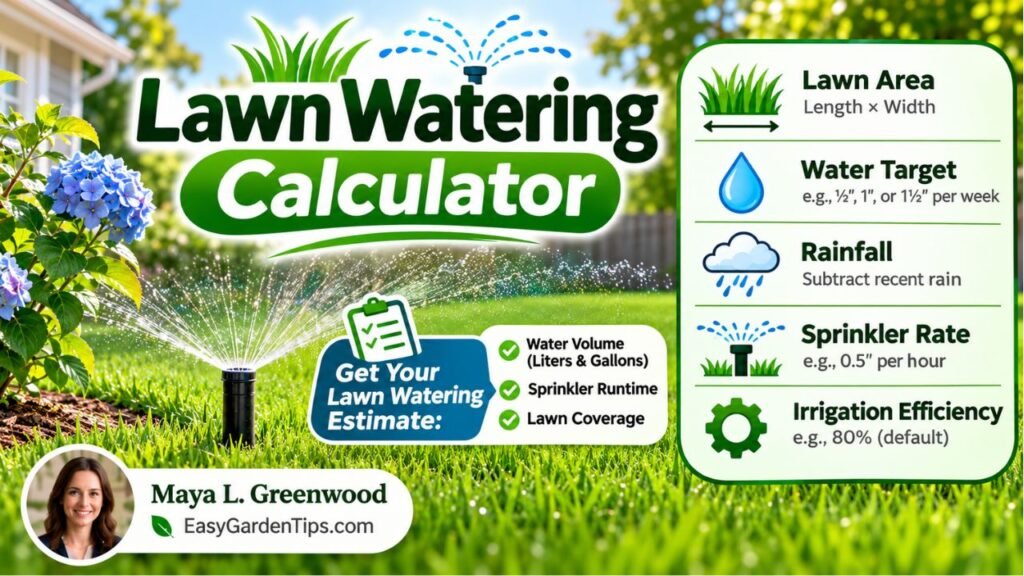
Not sure how much water your lawn needs each week? This free Lawn Watering Calculator estimates irrigation requirements in liters and US gallons based on your lawn size, weekly water target, and rainfall. Enter your lawn’s length and width, choose a water depth, and adjust the estimated sprinkler efficiency. You can also enter your sprinkler’s application rate to calculate approximately how long it should run.
Whether you’re watering a small backyard, maintaining an established lawn, or planning an irrigation schedule, this calculator makes water-use estimates easier. Below, I explain the watering formulas, rainfall adjustments, sprinkler runtime, grass requirements, soil conditions, and practical ways to avoid overwatering.
Lawn Watering Calculator
Estimate how much irrigation water your lawn needs after entered rainfall. Includes US gallons, liters, approximate sprinkler runtime, and efficiency.
Default 1 inch/week is an adjustable example—not a schedule for every lawn. Consider local restrictions, grass type, rainfall, soil moisture, and seasonal weather. Measure sprinkler delivery with catch cups.
Your lawn watering estimate
WEEKLY WATER PLANHow to Use the Lawn Watering Calculator
The Lawn Watering Calculator helps you estimate how much irrigation water your lawn may need during a week after accounting for rainfall. It also calculates the approximate number of gallons and liters required and estimates sprinkler runtime when you enter an application rate.
Whether you’re maintaining a small backyard, adjusting an automatic sprinkler system, or trying to reduce unnecessary outdoor water use, understanding your lawn’s water requirements is an important starting point.
The calculator considers lawn area, weekly water depth, rainfall, sprinkler application rate, and estimated irrigation efficiency.
Results are displayed primarily in liters, with US gallons, total sprinkler runtime, and square-foot coverage shown separately.
The default weekly target is 1 inch of water, but this is an adjustable planning example rather than a requirement for every lawn.
Here’s how to use the calculator.
Step 1: Measure Your Lawn’s Length and Width
Start by measuring the area you want to irrigate.
For a rectangular lawn, measure the length and width.
Suppose your backyard lawn measures:
- Length: 30 feet
- Width: 20 feet
Enter these measurements into the appropriate fields.
The calculator determines the coverage area by multiplying the dimensions:
30 × 20 = 600 square feet
You can choose from these measurement units:
- Feet
- Meters
- Yards
- Inches
- Centimeters
Select the unit that matches your measurements.
For an irregularly shaped lawn, divide the area into smaller rectangular sections and calculate each section separately.
Avoid including patios, driveways, garden beds, or other areas that don’t require lawn irrigation.
Step 2: Choose Your Weekly Lawn Watering Target
Find the field labeled Target Total Water per Week.
This represents the combined depth of water you want your lawn to receive from rainfall and irrigation during the week.
The calculator offers three quick selections:
- ½ inch
- 1 inch
- 1½ inches
You can also enter a custom water depth.
For many actively growing established lawns, approximately 1 inch per week from rainfall and irrigation is a commonly used starting benchmark.
However, the actual requirement depends on grass type, weather, season, soil conditions, and whether you’re allowing the lawn to become dormant.
If your local Extension service recommends a different target, enter that amount instead.
Step 3: Enter the Rainfall Already Received
Next, enter the amount of rain that has fallen during the same weekly planning period.
For example:
- Weekly water target: 1 inch
- Rainfall already received: 0.25 inch
The remaining irrigation requirement before adjusting for efficiency is:
1 − 0.25 = 0.75 inch
The calculator subtracts the entered rainfall automatically.
If the rainfall equals or exceeds your target, the calculator displays zero additional irrigation water.
Important: The tool assumes the rainfall you enter contributes toward the target. Actual effective rainfall may be lower when heavy rain runs off, the ground is already saturated, or water doesn’t infiltrate evenly.
Check soil moisture before deciding whether more watering is necessary.
Step 4: Select Inches or Millimeters
The calculator supports two water depth units:
- Inches
- Millimeters
One inch equals exactly 25.4 millimeters.
For example:
| Inches | Millimeters |
|---|---|
| ¼ inch | 6.35 mm |
| ½ inch | 12.7 mm |
| ¾ inch | 19.05 mm |
| 1 inch | 25.4 mm |
| 1½ inches | 38.1 mm |
When you change the water depth unit, the calculator converts the entered values.
Use the same displayed unit for weekly target, rainfall, and sprinkler application rate.
Step 5: Enter Your Sprinkler Application Rate
Find the field labeled Measured Sprinkler Application Rate / Hour.
This value describes how much water depth your sprinkler applies over one hour.
For example, if the sprinkler applies ½ inch of water per hour, enter:
0.5 inch/hour
A sprinkler’s application rate depends on several factors, including nozzle type, water pressure, head spacing, and system design.
You can estimate the rate using a catch-cup test, which I explain later in this article.
If you don’t know your sprinkler’s rate, enter 0.
The calculator can still estimate total water volume, but it won’t calculate runtime until you provide a valid application rate.
Step 6: Choose the Estimated Irrigation Efficiency
The calculator includes efficiency options of:
- 100%
- 90%
- 80%
- 70%
- 60%
The default is 80%.
This setting represents an approximate allowance for uneven delivery and other irrigation losses.
For example, at 80% efficiency, the calculator estimates that additional gross water application is required to achieve the selected net irrigation depth.
Important distinction: If your sprinkler application rate comes from actual catch-cup measurements on the lawn, that measured rate already reflects the water reaching the collection cups. For a straightforward runtime calculation from that measured rate, use 100% efficiency to avoid applying a second, unsupported loss adjustment.
If you’re using a nominal or theoretical sprinkler rate, an efficiency allowance may be useful as a rough planning assumption.
Actual irrigation efficiency varies by system and should not be assumed to be exactly 80%.
Step 7: Calculate Your Lawn Watering Requirements
Click Calculate Watering.
The calculator displays:
| Result | Meaning |
|---|---|
| Water to Apply (Liters) | Estimated weekly irrigation volume, including the selected efficiency adjustment |
| US Gallons | Equivalent irrigation water quantity |
| Sprinkler Runtime | Approximate total operating time |
| Lawn Coverage | Area in square feet |
It also explains how much additional water depth is needed after subtracting rainfall.
If the result is zero, the entered rainfall already meets the selected weekly target under the calculator’s assumptions.
You can use Copy Estimate to save the calculation.
For another lawn section, enter the new dimensions and calculate again.
How Does the Lawn Watering Calculator Work?
A lawn watering calculator estimates the volume of water needed to apply a particular depth over a measured area.
The calculation begins with the total weekly water target and subtracts rainfall.
Next, it adjusts the remaining irrigation depth using the selected efficiency factor.
Finally, it converts the adjusted water depth into gallons and liters.
Basic Lawn Watering Formula
Net Irrigation Depth = Weekly Water Target − Rainfall
If rainfall exceeds the target, the result is set to zero.
When irrigation efficiency is included:
Gross Irrigation Depth = Net Irrigation Depth ÷ Efficiency (as a decimal)
For example, an 80% efficiency setting is entered into the calculation as 0.80.
The calculated water volume is based on the gross irrigation depth.
Lawn Watering Calculator Example: 30 × 20 Feet
Suppose your lawn has these measurements:
| Input | Value |
|---|---|
| Lawn length | 30 ft |
| Lawn width | 20 ft |
| Weekly water target | 1 inch |
| Rainfall received | 0.25 inch |
| Estimated efficiency | 80% |
| Sprinkler application rate | 0.5 inch/hour |
First, calculate the coverage area:
30 × 20 = 600 square feet
Next, subtract rainfall from the target:
1 − 0.25 = 0.75 inch
Now adjust for estimated efficiency:
0.75 ÷ 0.80 = 0.9375 inch
This is the estimated gross irrigation depth under the selected efficiency assumption.
To calculate gallons:
600 × 0.9375 × 0.6233766 ≈ 350.65 gallons
Convert to liters:
350.65 × 3.785411784 ≈ 1,327.4 liters
Finally, calculate sprinkler runtime:
0.9375 ÷ 0.5 × 60 = 112.5 minutes
Final Lawn Watering Estimate
| Measurement | Result |
|---|---|
| Lawn coverage | 600 sq ft |
| Net irrigation needed | 0.75 inch |
| Adjusted irrigation depth | 0.9375 inch |
| Water volume | 1,327.4 L |
| US gallons | 350.65 gal |
| Total sprinkler runtime | 112.5 minutes |
This example uses the calculator’s 80% efficiency assumption.
If the 0.5-inch/hour application rate was measured directly with catch cups and you use 100% efficiency, the calculated runtime would instead be 90 minutes.
These estimates assume consistent application and do not account for additional water lost to runoff during watering.
Lawn Watering Calculator: Gallons per Square Foot
One of the most useful lawn irrigation conversions is the amount of water needed to apply 1 inch over a square foot.
One inch of water over one square foot equals approximately 0.6234 US gallons.
That is also approximately 2.36 liters.
This conversion makes it possible to calculate lawn watering quantities without knowing sprinkler flow rates.
How to Calculate Lawn Watering Gallons
Use:
Gallons = Lawn Area (sq ft) × Water Depth (inches) × 0.6234
For example, suppose you have a 1,000-square-foot lawn and want to apply 1 inch of water.
1,000 × 1 × 0.6234 = 623.4 gallons
You need approximately 623 gallons to deliver a uniform 1-inch depth over that area before accounting for irrigation losses.
How to Calculate Lawn Watering Liters
Multiply US gallons by 3.785411784.
623.4 × 3.785411784 ≈ 2,360 liters
For a 1,000-square-foot lawn at 1 inch deep:
- Water required: approximately 2,360 liters
- Equivalent: approximately 623 US gallons
This is a water-volume calculation, not a recommendation to apply 1 inch every week regardless of conditions.
Lawn Watering Gallons and Liters Chart
| Lawn Area | Water Depth | US Gallons | Approx. Liters |
|---|---|---|---|
| 500 sq ft | 1 inch | 312 | 1,180 L |
| 1,000 sq ft | ½ inch | 312 | 1,180 L |
| 1,000 sq ft | 1 inch | 623 | 2,360 L |
| 1,000 sq ft | 1½ inches | 935 | 3,540 L |
| 2,500 sq ft | 1 inch | 1,558 | 5,899 L |
| 5,000 sq ft | 1 inch | 3,117 | 11,799 L |
These quantities represent the water physically equivalent to the stated depth and area.
They exclude any additional irrigation-efficiency allowance, rainfall deduction, or runoff.
How Many Gallons of Water for a 5,000-Square-Foot Lawn?
At 1 inch per week:
5,000 × 1 × 0.6233766 ≈ 3,117 gallons
At ½ inch per week:
5,000 × 0.5 × 0.6233766 ≈ 1,558 gallons
Actual irrigation requirements may be lower if rainfall contributes enough moisture or the grass is dormant.
How Much Water Does a Lawn Need Per Week?
A lawn’s water requirement changes with the grass species, climate, temperature, wind, sunlight, root depth, and soil moisture.
The widely used 1 inch per week benchmark is not a universal watering rule.
According to the University of Maryland Extension’s guide to Maintaining an Established Lawn, actively growing lawn grass often performs well with about 1 inch of water per week from rainfall and irrigation combined.
The guide also recommends monitoring soil moisture and watering only as necessary, rather than automatically following a fixed schedule.
Lawn Watering Depth Planning Chart
| Weekly Water Depth | General Planning Context |
|---|---|
| ¼ inch | Very low weekly water input; may be adequate during certain cool or rainy conditions |
| ½ inch | Reduced-demand conditions or some drought-tolerant lawn situations |
| 1 inch | Common benchmark for actively growing established turf |
| 1½ inches | May be needed under some hot, dry, high-demand conditions |
These are planning examples rather than guaranteed requirements.
In some circumstances, lawns need less than ½ inch of supplemental irrigation. In others, particularly during hot, dry, windy weather, water demand may be higher.
If your grass is intentionally being allowed to enter seasonal dormancy, maintaining green growth through regular irrigation may not be necessary.
Does Every Lawn Need One Inch of Water Weekly?
No.
For example, a healthy established cool-season lawn receiving sufficient rain may not require irrigation.
Some drought-tolerant turf species can maintain acceptable conditions with lower water inputs.
A newly established lawn has different moisture requirements from mature turf.
Local Extension recommendations and actual soil moisture observations should guide your target.
How Much Water Does a Lawn Need in Summer?
Summer water demand often increases because of higher temperatures, greater evaporative demand, and longer periods of sunlight.
However, regional differences are substantial.
A lawn in a humid climate with regular rain may need little additional irrigation.
An actively growing lawn in a hot, dry, windy climate may need more.
The University of Minnesota Extension’s Water-Saving Strategies for Home Lawns recommends adjusting lawn watering to soil moisture, grass type, and environmental conditions instead of treating a fixed schedule as mandatory.
How Much Water Does Grass Need in Spring and Fall?
During cooler periods, established grass may require less water because evaporation and plant water demand are often lower.
Rainfall can also provide a substantial portion of the moisture required.
Check soil moisture before starting the sprinklers.
Don’t continue using a peak-summer irrigation schedule automatically during cooler weather.
Lawn Watering Calculator With Rainfall Adjustment
Rainfall is one of the most important variables in a lawn irrigation estimate.
If your lawn receives sufficient useful rainfall, it may not need additional irrigation during the same period.
The calculator subtracts entered rainfall from the weekly target.
How to Subtract Rainfall From Lawn Water Needs
Use:
Net Water Requirement = Target Water Depth − Rainfall Depth
For example:
- Weekly target: 1 inch
- Rainfall: 0.4 inch
Net irrigation requirement:
1 − 0.4 = 0.6 inch
For a 1,000-square-foot lawn:
1,000 × 0.6 × 0.6233766 ≈ 374 gallons
This is approximately 1,416 liters before any efficiency adjustment.
What Happens If It Rains More Than the Weekly Target?
Suppose:
- Weekly target: 1 inch
- Rainfall: 1.5 inches
The mathematical result would be negative.
The calculator prevents this by setting the irrigation requirement to zero.
It doesn’t suggest removing water from the lawn.
However, a 1.5-inch rainfall total doesn’t guarantee that all the water infiltrated the root zone. Check actual soil conditions, especially following intense storms or where runoff occurs.
Does All Rainfall Count Toward Lawn Watering?
Not necessarily.
Some rainfall may run off the surface, especially on compacted soils, steep slopes, or during intense storms.
Some moisture can also evaporate or move beyond the active root zone.
The calculator uses the rainfall number you enter as a direct deduction.
It doesn’t independently measure effective rainfall.
For more accurate planning, combine rainfall records with soil moisture observations.
How to Measure Lawn Rainfall
A rain gauge can provide a useful local measurement.
Place it in an unobstructed location away from buildings, trees, and sprinkler spray.
Read the collected rainfall after an event.
Weather stations and local rainfall reports are useful alternatives, but rainfall can vary between nearby locations.
Use actual rainfall from the relevant planning period rather than treating a forecast as rain that has already occurred.
Lawn Sprinkler Runtime Calculator: How Long Should You Water?
Sprinkler runtime depends on the amount of water you want to apply and the sprinkler’s application rate.
A sprinkler that applies 1 inch per hour needs less time than one that applies ½ inch per hour to deliver the same water depth.
Sprinkler Runtime Formula
Runtime (minutes) = Required Application Depth ÷ Sprinkler Rate (inches/hour) × 60
For example:
- Required application depth: 0.5 inch
- Sprinkler application rate: 0.5 inch/hour
Runtime:
0.5 ÷ 0.5 × 60 = 60 minutes
The sprinkler would need approximately 60 minutes to apply that depth under the stated rate.
This assumes the application rate represents the water actually reaching the intended area.
Sprinkler Runtime Chart
| Desired Water Depth | 0.25 in/hr Sprinkler | 0.5 in/hr Sprinkler | 1 in/hr Sprinkler |
|---|---|---|---|
| ¼ inch | 60 min | 30 min | 15 min |
| ½ inch | 120 min | 60 min | 30 min |
| ¾ inch | 180 min | 90 min | 45 min |
| 1 inch | 240 min | 120 min | 60 min |
These are idealized runtime estimates based on a uniform application rate.
Actual sprinkler coverage may vary considerably.
Why One Sprinkler Needs More Time Than Another
Different sprinklers deliver water at different rates.
Common system types include:
- Oscillating sprinklers
- Stationary spray sprinklers
- Rotary sprinklers
- Impact sprinklers
- In-ground pop-up spray heads
- Rotor heads
A sprinkler’s application rate depends on water pressure, nozzle design, operating condition, head spacing, and overlapping spray patterns.
The same sprinkler may also produce different results when moved to another location.
Don’t assume every sprinkler should run for exactly 20 or 30 minutes.
How to Measure Your Sprinkler’s Water Application Rate
The most useful way to determine how long your sprinkler should run is to measure how quickly it applies water.
This can be done with a catch-cup test.
According to Colorado State University Extension’s Methods to Schedule Home Lawn Irrigation, measuring actual sprinkler precipitation rates is more reliable than assuming a standard runtime for every irrigation system.
Step 1: Prepare Several Identical Containers
Collect several straight-sided containers or irrigation catch cups.
Try to use containers with level, flat bottoms.
Identical containers simplify comparisons across the watering area.
Step 2: Place the Cups Around the Lawn
Distribute the containers across the area served by one sprinkler or irrigation zone.
Include different positions so you can evaluate whether the system applies water evenly.
Avoid placing every cup directly beside a sprinkler head.
Step 3: Run the Sprinkler for a Measured Time
Run the sprinkler for a known duration.
For example, use 15 minutes.
Make sure the system operates normally throughout the test.
Step 4: Measure the Water in Each Cup
Use a ruler to measure the water depth in each container.
Suppose your five cups contain:
| Cup | Water Collected |
|---|---|
| 1 | 0.10 inch |
| 2 | 0.13 inch |
| 3 | 0.12 inch |
| 4 | 0.11 inch |
| 5 | 0.14 inch |
Calculate the average:
(0.10 + 0.13 + 0.12 + 0.11 + 0.14) ÷ 5
Average = 0.12 inch
The sprinkler applied an average of 0.12 inch during 15 minutes.
Step 5: Convert the Measurement to Inches per Hour
Use:
Application Rate = Collected Water Depth × 60 ÷ Test Minutes
0.12 × 60 ÷ 15 = 0.48 inch/hour
Your estimated sprinkler application rate is:
0.48 inch per hour
Enter 0.48 into the calculator when working in inches.
Because this is a measured catch-cup rate, choose 100% efficiency for a basic runtime estimate based on that observed application. Use a separate, justified uniformity or efficiency adjustment only if you understand what additional losses are being accounted for.
Step 6: Check Watering Uniformity
Compare the amounts collected in different cups.
If one cup contains much more water than another, the sprinkler isn’t distributing water evenly.
A single average application rate may hide dry spots and overwatered areas.
Before increasing runtime for the entire lawn, check:
- Sprinkler head alignment
- Nozzle condition
- Water pressure
- Spray obstructions
- Head spacing
- Zone layout
Improving distribution can be more useful than simply applying more water.
Lawn Irrigation Efficiency: What Does 80% Mean?
Irrigation efficiency describes how effectively applied water contributes to the intended irrigation objective.
Not every gallon released by a sprinkler necessarily reaches and remains available in the intended root zone.
Potential losses and inefficiencies include evaporation, wind drift, runoff, overspray, and uneven application.
The calculator uses the selected efficiency as a simple adjustment factor.
Example: 80% Irrigation Efficiency
Suppose your target additional water depth is 0.8 inch.
At 80% assumed efficiency:
0.8 ÷ 0.8 = 1.0 inch
The calculator estimates that you need to apply 1 inch of gross water to achieve an effective 0.8-inch depth.
This is a simplified planning calculation.
Actual sprinkler efficiency must be assessed from system performance and site conditions.
Should You Always Use 80% Efficiency?
No.
The calculator’s default is only an example.
A well-designed and properly maintained irrigation system may perform differently from an older or poorly adjusted sprinkler setup.
Also, a catch-cup test measures water actually reaching the cups, so applying a generic loss factor on top of that measured rate can overestimate watering duration.
For a basic measured-rate runtime calculation, 100% avoids double-counting that delivery adjustment.
How to Improve Lawn Sprinkler Efficiency
Several practical actions may help:
- Adjust sprinklers to avoid watering pavement.
- Repair leaks and damaged sprinkler heads.
- Reduce operation during strong wind.
- Check distribution with catch cups.
- Use rainfall or soil moisture sensors where suitable.
- Adjust watering schedules seasonally.
- Use multiple shorter watering cycles when runoff begins.
The US Environmental Protection Agency’s WaterSense Watering Tips explains how appropriate timing, sprinkler checks, and avoiding runoff can reduce unnecessary outdoor water use.
How Often Should You Water Your Lawn?
Watering frequency should depend on soil moisture, turfgrass type, weather, and whether the lawn is newly established.
For many established lawns, deeper and less frequent irrigation can be more useful than frequent shallow watering.
However, there is no single watering schedule that applies to every property.
Should You Water Your Lawn Every Day?
Established lawns generally don’t need daily irrigation under ordinary conditions.
Frequent shallow watering can encourage roots to remain near the surface and may contribute to poor soil conditions.
However, very sandy soil may require more frequent irrigation than moisture-retentive soil.
Newly seeded and newly sodded lawns also require different watering practices during establishment.
Is Watering Twice a Week Enough?
It may be appropriate for some established lawns.
For example, if a lawn requires 1 inch during the week and you plan two irrigation sessions without rainfall, you could use two ½-inch applications.
However, soil conditions may require a different approach.
Water should be applied slowly enough to infiltrate rather than run off.
Is Watering Once a Week Better?
Deep, infrequent watering can encourage a more resilient root system in many established lawns.
However, applying the entire weekly amount in one session isn’t appropriate when the soil cannot absorb the water without runoff.
Sandy soils may need smaller, more frequent applications.
For clay-rich or sloped areas, shorter cycles with time between them may help improve infiltration.
How to Check Whether Your Lawn Needs Water
Look for signs of water stress, such as:
- Grass developing a dull blue-gray or blue-green color
- Leaf blades becoming narrow or folded
- Footprints remaining visible after walking across the lawn
- Dry soil several inches below the surface
These signs can help you decide whether watering is necessary.
Check soil moisture directly when possible rather than relying only on appearance.
Best Time of Day to Water Your Lawn
Early morning is generally a suitable watering period for many lawns.
Cooler temperatures and lower wind speeds can reduce some water losses.
Morning watering also gives grass foliage time to dry.
Is Morning Watering Better Than Evening?
Often, yes.
Watering early in the morning can reduce unnecessary evaporation and avoid prolonged overnight leaf wetness.
However, local weather, water restrictions, and irrigation system performance also matter.
Can You Water Your Lawn in the Afternoon?
You can, but high temperatures and wind may reduce irrigation efficiency.
If your lawn is experiencing severe water stress, providing necessary water may be more important than waiting for an ideal time.
Avoid wasting water through excessive overspray or runoff.
Should You Water Grass at Night?
Nighttime watering can leave grass foliage wet for extended periods under some conditions.
This may favor certain lawn diseases.
Morning watering is often preferred when schedules allow.
Lawn Watering Needs for Different Grass Types
Different turfgrass species vary in their growth patterns, rooting characteristics, drought tolerance, and water requirements.
The same weekly irrigation target may not be suitable for every lawn.
Kentucky Bluegrass Watering
Kentucky bluegrass is a cool-season turfgrass.
During hot, dry conditions, it may become drought-stressed or enter dormancy.
Water requirements vary by climate, soil, and maintenance goals.
If you want to maintain active green growth, irrigation demand may increase during hot weather.
However, allowing established grass to enter dormancy may be a reasonable water-conservation option in suitable conditions.
Tall Fescue Lawn Watering
Tall fescue can develop relatively deep roots when growing in suitable soil.
This may help it tolerate certain dry conditions.
However, root depth depends on soil compaction, drainage, maintenance, and other factors.
Tall fescue doesn’t automatically require the same water quantity at every location.
Fine Fescue Watering
Some fine fescues are relatively drought-tolerant and can perform well with reduced irrigation under appropriate growing conditions.
Water requirements depend on species, site conditions, and whether the grass is actively growing.
Bermudagrass Watering
Bermudagrass is a warm-season turfgrass.
Its water requirements depend on climate, soil, growth stage, and maintenance intensity.
Warm-season grasses may enter dormancy in cool conditions.
Avoid applying a summer watering target when the turf isn’t actively growing.
Zoysiagrass Watering
Zoysiagrass is another warm-season lawn grass.
Established zoysia can tolerate some dry conditions, although its appearance and growth may change during stress.
Use soil moisture and turf condition to guide irrigation decisions.
Can One Watering Schedule Work for Every Grass Type?
No.
Grass species, climate, rooting depth, soil texture, and seasonal growth patterns all influence water requirements.
Use the calculator’s weekly depth field as an adjustable input rather than treating its default as a universal schedule.
How Soil Type Affects Lawn Watering Requirements
Soil texture and structure influence how quickly water enters the ground and how much moisture remains available to plants.
Two lawns with the same square footage may need different irrigation frequencies.
Watering Lawns With Sandy Soil
Sandy soils often drain relatively quickly.
They may also store less plant-available water than many finer-textured soils.
A lawn growing in sandy soil may need smaller irrigation amounts more frequently.
However, water requirements still depend on temperature, rainfall, grass type, and root depth.
Watering Lawns With Clay Soil
Clay-rich soils can retain substantial water, but dense or compacted clay may absorb irrigation slowly.
Applying water too quickly can cause runoff.
A cycle-and-soak approach may help when infiltration is slower than the sprinkler application rate.
Avoid assuming that a clay lawn needs more water simply because it drains slowly.
Watering Lawns With Loam Soil
Well-structured loam can provide a useful balance between infiltration and water retention.
However, compacted loam may still experience poor infiltration and runoff.
Check actual soil moisture and structure before selecting a watering schedule.
How to Check Lawn Soil Moisture
A soil probe, trowel, or long screwdriver can help you assess moisture below the surface.
For many established lawns, a useful objective is to moisten several inches of the root zone rather than only wetting the grass blades.
The appropriate depth depends on the actual rooting depth and soil conditions.
If the surface is wet but the soil below remains dry, watering may be too shallow.
If the surface is continuously saturated, the lawn may be receiving too much water or have a drainage problem.
Lawn Watering Calculator for New Grass Seed and Sod
New lawns require different irrigation management from established lawns.
During germination and early root development, the growing medium near the soil surface needs consistent moisture.
A single deep irrigation once per week may not be suitable.
According to the University of Maryland Extension’s Starting a New Lawn guide, newly seeded and sodded lawns generally need light, frequent watering during establishment, followed by progressively deeper and less frequent watering as roots develop.
How Often Should You Water New Grass Seed?
New grass seed should remain appropriately moist during germination.
Depending on weather and soil conditions, this may require several light watering sessions during a day.
However, avoid creating puddles, washing away seeds, or keeping the soil continuously saturated.
The correct frequency varies with temperature, wind, humidity, and soil texture.
How Much Water Does New Sod Need?
Freshly installed sod needs moisture to support rooting.
The soil beneath the sod should be adequately moist, and the sod should not dry out before the roots become established.
Watering frequency may be relatively high during the first weeks.
As rooting improves, gradually transition toward deeper and less frequent irrigation.
Can You Use This Calculator for New Lawns?
Yes, for estimating the volume equivalent to a selected water depth over a measured area.
However, it doesn’t automatically generate a seed-germination or sod-establishment schedule.
For new lawns, use appropriate establishment guidance to determine how to divide the total water into individual applications.
Lawn Watering Calculator for Different Lawn Sizes
Lawn size strongly affects the amount of water required.
At a fixed water depth, doubling the lawn area doubles the water volume.
How Much Water for a 500-Square-Foot Lawn?
At 1 inch:
500 × 1 × 0.6233766 ≈ 312 gallons
This is approximately 1,180 liters.
At ½ inch, the volume is approximately half that amount.
How Much Water for a 1,000-Square-Foot Lawn?
At 1 inch:
1,000 × 1 × 0.6233766 ≈ 623 gallons
This equals approximately 2,360 liters.
If rainfall already provides ½ inch, only the remaining ½ inch needs to be considered for irrigation.
How Much Water for a 2,500-Square-Foot Lawn?
At 1 inch:
2,500 × 1 × 0.6233766 ≈ 1,558 gallons
This is approximately 5,899 liters.
If the lawn is divided into multiple irrigation zones, calculate each zone’s area and water needs separately.
How Much Water for a 5,000-Square-Foot Lawn?
At 1 inch:
5,000 × 1 × 0.6233766 ≈ 3,117 gallons
This equals approximately 11,799 liters.
Actual irrigation requirements may be lower when rainfall, dormancy, or reduced seasonal demand is considered.
How Much Water for One Acre of Lawn?
One acre equals 43,560 square feet.
At a uniform depth of 1 inch:
43,560 × 1 × 0.6233766 ≈ 27,154 gallons
That is approximately 102,790 liters.
This is the physical water volume equivalent to 1 inch over an acre, before irrigation-efficiency adjustments.
It doesn’t mean every acre of turf should receive that amount each week.
Lawn Sprinkler Zones: How to Calculate Watering Separately
Many irrigation systems divide a lawn into multiple zones.
Each zone may have different sprinklers, application rates, grass exposure, or soil conditions.
For accurate planning, treat each zone separately.
Example: Two Lawn Watering Zones
Suppose you have:
Zone 1
- Lawn area: 500 sq ft
- Water requirement: 0.5 inch
Zone 2
- Lawn area: 800 sq ft
- Water requirement: 0.75 inch
Zone 1:
500 × 0.5 × 0.6233766 ≈ 156 gallons
Zone 2:
800 × 0.75 × 0.6233766 ≈ 374 gallons
Combined water volume:
156 + 374 ≈ 530 gallons
These values exclude any additional efficiency allowance.
Calculate runtime separately if the zones have different measured sprinkler rates.
Why You Shouldn’t Use One Runtime for Every Zone
Sprinkler zones may differ in:
- Application rate
- Nozzle type
- Water pressure
- Sun exposure
- Soil texture
- Slope
- Plant water requirements
A rotor zone may need a longer runtime than a spray-head zone to deliver the same water depth.
Use actual zone measurements whenever possible.
How to Reduce Lawn Watering Without Damaging Grass
Efficient lawn watering starts with avoiding unnecessary irrigation.
The goal isn’t to apply the largest possible amount of water.
It’s to provide water when needed and minimize waste.
Check Rainfall Before Watering
Use rainfall records and soil moisture observations.
Skip or reduce irrigation when useful rainfall provides adequate moisture.
Water According to Soil Moisture
Avoid running sprinklers simply because a timer is scheduled.
The lawn may already have sufficient moisture.
Fix Leaking or Misaligned Sprinklers
Leaks, broken heads, and overspray can waste substantial water.
Regular inspection can help improve system performance.
Use Cycle-and-Soak Watering
If runoff begins before the desired depth has been applied, divide the runtime into shorter cycles.
Allow water to infiltrate between cycles.
This is particularly useful on slopes and slowly absorbing soils.
Adjust Sprinklers Seasonally
Water needs often change between cooler and hotter months.
Reduce unnecessary watering when temperatures drop or rainfall increases.
Maintain Appropriate Mowing Height
Mowing grass too short can increase stress.
Use mowing heights appropriate for the turf species and season.
Proper mowing can help support a healthier, more resilient lawn.
Consider Smart Irrigation Controls
Rain sensors, soil moisture sensors, and weather-based irrigation controllers can help reduce unnecessary watering.
However, they need to be installed and configured correctly.
Follow local water restrictions and irrigation requirements.
Lawn Watering Cost Calculator: How Much Does Irrigation Cost?
The Lawn Watering Calculator provides water volume rather than automatically calculating a bill.
However, you can use its gallon estimate to estimate irrigation cost when you know your water utility’s rates.
Lawn Watering Cost Formula
Water Cost = Gallons Used ÷ 1,000 × Price per 1,000 Gallons
Suppose your irrigation estimate is 2,000 gallons.
If your hypothetical water rate is $6 per 1,000 gallons:
2,000 ÷ 1,000 × $6 = $12
The estimated water charge would be $12 before other utility fees.
This is only an example, not a current water rate.
Actual costs depend on location, rate tiers, sewer charges, metering, and other utility policies.
Why Sprinkler Efficiency Affects Water Cost
Poor sprinkler efficiency can increase the quantity of water applied.
For example, under a simplified 80% efficiency assumption, the calculated gross application can be 25% greater than the net target.
However, real-world savings from improving efficiency depend on actual system performance.
An efficiency setting in a calculator isn’t a substitute for measuring water use.
Common Lawn Watering Calculator Mistakes to Avoid
Treating One Inch per Week as a Mandatory Rule
The default 1-inch weekly target is an example.
Actual irrigation requirements vary with rainfall, grass type, season, soil conditions, and local guidance.
Forgetting to Subtract Rainfall
If the lawn has already received useful rainfall, the full weekly target may not need to be supplied by irrigation.
Use the Rainfall Already Received field.
Entering the Wrong Lawn Dimensions
Measure the actual turf area.
Don’t include patios, driveways, or other surfaces that don’t require irrigation.
Confusing Inches With Millimeters
One inch equals 25.4 millimeters.
Entering 25.4 as inches instead of millimeters would produce a much larger water-volume estimate.
Confusing Gallons With Liters
One US gallon equals approximately 3.785 liters.
Make sure you understand which unit the result uses.
Using an Unmeasured Sprinkler Rate
Different sprinklers apply different water depths per hour.
Without a reliable application rate, runtime is only a guess.
Use a catch-cup test or suitable verified sprinkler data.
Applying Efficiency Twice
A measured catch-cup rate already reflects actual water collected at the lawn.
Applying a generic efficiency loss on top of that measured rate can overestimate runtime.
Use the efficiency control intentionally and avoid double-counting.
Ignoring Runoff
The mathematical runtime assumes water continues to be applied at the stated rate.
If runoff begins, continuing to water may waste water.
Use shorter irrigation cycles and address poor infiltration where possible.
Using the Same Schedule for New and Established Lawns
Grass seed and fresh sod need different watering practices from established turf.
A weekly water-volume estimate doesn’t determine the best frequency for newly planted grass.
Watering Dormant Grass Like Actively Growing Grass
Some established grasses naturally become dormant during drought or seasonal stress.
Routine irrigation to maintain lush green growth may be unnecessary.
Assuming Brown Grass Always Means Drought
Brown or discolored turf can result from disease, insects, nutrient problems, dormancy, or other stresses.
Check soil moisture and lawn conditions before increasing irrigation.
Ignoring Local Water Restrictions
Some communities limit watering days, times, or outdoor water consumption.
Check applicable regulations before establishing an irrigation schedule.
Conclusion
Understanding how much water your lawn needs can help you maintain healthier grass while avoiding unnecessary irrigation.
The most important starting points are lawn area, appropriate weekly water depth, rainfall, and actual soil moisture.
Use the Lawn Watering Calculator above to estimate irrigation requirements in liters and US gallons.
If you know your sprinkler’s application rate, you can also calculate an approximate runtime and adjust the result according to your irrigation setup.
Remember that a mathematical estimate isn’t a fixed watering schedule.
Grass type, weather, soil conditions, root depth, seasonal dormancy, sprinkler performance, and local restrictions all influence actual water needs.
Check your lawn’s condition before watering, measure sprinkler delivery when possible, and avoid applying water faster than the soil can absorb it.
With accurate measurements and sensible watering decisions, you can reduce wasted water and maintain your lawn more efficiently.
Lawn Watering Calculator FAQs
How much water does my lawn need per week?
Many actively growing established lawns use approximately 1 inch of water per week as a planning benchmark, including rainfall.
However, the actual requirement varies with turfgrass species, weather, soil moisture, and seasonal conditions.
Use local guidance and check whether irrigation is necessary before watering.
How many gallons of water does a lawn need per square foot?
One inch of water over one square foot equals approximately 0.6234 US gallons.
For ½ inch, the volume is approximately 0.3117 gallons per square foot.
How many gallons of water for a 1,000-square-foot lawn?
At 1 inch deep, approximately 623 gallons.
At ½ inch, approximately 312 gallons.
These figures exclude rainfall deductions and irrigation-efficiency adjustments.
How much water does a 5,000-square-foot lawn need?
A uniform 1-inch application over 5,000 square feet equals approximately 3,117 US gallons or 11,799 liters.
Actual irrigation may be lower depending on rainfall and lawn conditions.
How do I calculate lawn watering time?
Divide the required water depth by the sprinkler application rate in inches per hour.
Multiply by 60 to obtain minutes.
For example, ½ inch at ½ inch per hour requires approximately 60 minutes.
How long should I run my lawn sprinkler?
It depends on the sprinkler’s actual application rate and how much water the lawn needs.
A catch-cup test can help determine how much water your system applies during a measured period.
Is 15 minutes of watering enough for grass?
It depends on the sprinkler.
A high-application-rate sprinkler may deliver a meaningful amount of water in 15 minutes.
A slower sprinkler may deliver very little.
Measure the actual water depth rather than assuming a fixed runtime.
Is 30 minutes of sprinkler watering enough?
Possibly.
At 1 inch per hour, 30 minutes applies approximately ½ inch.
At ½ inch per hour, the same 30 minutes applies approximately ¼ inch.
These assume uniform delivery and no additional loss adjustment.
Should I water my lawn every day?
Established lawns generally don’t need frequent shallow watering under ordinary conditions.
However, newly seeded lawns, fresh sod, sandy soils, and certain weather conditions may require different schedules.
Is it better to water grass in the morning or evening?
Early morning is generally preferred because evaporation may be lower and grass foliage can dry during the day.
However, weather and local watering restrictions also matter.
Can rainfall replace sprinkler watering?
Yes.
Useful rainfall contributes to the lawn’s total water requirement.
The calculator subtracts entered rainfall from the weekly target.
Actual effective rainfall may differ from the recorded total because of runoff or other losses.
What happens if my lawn receives more rain than it needs?
The calculator reports zero additional irrigation when entered rainfall equals or exceeds the weekly target.
However, inspect soil moisture before making the final watering decision.
How much water does new grass seed need?
New grass seed generally needs frequent light watering to maintain suitable moisture during germination.
The required amount and frequency depend on the grass species, soil, and weather.
It should not be treated like established turf.
How often should newly laid sod be watered?
Fresh sod usually requires frequent watering during its initial rooting period.
As roots develop, watering can gradually become deeper and less frequent.
Check rooting progress and follow suitable local establishment guidance.
What does 80% sprinkler efficiency mean?
The calculator uses 80% efficiency to estimate additional gross irrigation water beyond the net target.
For example, a 0.8-inch net requirement becomes 1 inch of estimated gross application.
This is an assumption rather than a measured efficiency rating.
How can I measure sprinkler efficiency?
A catch-cup test helps evaluate application rate and distribution uniformity.
A complete irrigation efficiency assessment may also consider wind drift, runoff, evaporation, and water reaching the root zone.
Can I use the calculator for different sprinkler zones?
Yes.
Calculate each zone separately using its lawn area, water requirement, sprinkler rate, and appropriate efficiency assumption.
This is more useful than applying one runtime to every zone.
How much water is one inch of irrigation?
One inch of water over 1,000 square feet equals approximately 623 US gallons or 2,360 liters.
The volume changes proportionally with the area.
How do I convert lawn watering inches to millimeters?
Multiply inches by 25.4.
For example, ½ inch equals 12.7 millimeters.
The calculator supports both measurement systems.
Does sandy soil need more frequent lawn watering?
Sandy soil often stores less plant-available water than finer-textured soils.
It may benefit from smaller, more frequent applications under some conditions.
However, actual needs depend on weather, grass roots, and soil moisture.
Can too much lawn watering damage grass?
Yes.
Excessive watering may contribute to waterlogged soil, poor root aeration, shallow rooting, and certain disease problems.
Use measured soil moisture and lawn condition to guide irrigation.
Can I use this calculator during drought restrictions?
You can use it to estimate water volume.
However, the result doesn’t override local watering restrictions or drought regulations.
Always follow applicable rules.
Is this online Lawn Watering Calculator accurate?
The water-volume and runtime formulas are mathematically consistent with the inputs.
Actual irrigation requirements may differ because of soil moisture, effective rainfall, sprinkler distribution, runoff, and system performance.
Use the result as a planning estimate rather than an automatic watering instruction.