
Not sure whether your garden soil is sandy, silty, clayey, or loamy? Use our free Soil Texture Calculator to identify your soil type using the USDA soil texture classification system. Simply enter your sand, silt, and clay percentages or use the Jar Test option to calculate them from measured soil layers.
The calculator displays your soil texture class on an interactive soil texture triangle, along with helpful information about water movement and moisture retention. Whether you’re preparing a vegetable garden, improving a lawn, or evaluating raised bed soil, this tool makes understanding your soil’s physical composition easier.
Soil Texture Calculator
Find your USDA soil texture class using sand, silt, and clay percentages—or estimate the fractions from a soil jar test. See your sample plotted on the 12-class soil texture triangle.
1. Enter your soil sample
STEP 01Enter lab-measured percentages of the fine-earth mineral fraction (particles below 2 mm). Together they must equal 100%.
Measure the settled sand, silt, and clay layer thicknesses in the same unit (mm, cm, or inches). The calculator estimates percentages from their relative heights.
How do I measure the jar layers?
Disperse a representative mineral-soil sample in water in a clear, straight-sided jar, shake thoroughly, and allow particles to settle. Once distinct layers are visible, measure the thickness of the sand (bottom), silt (middle), and clay (top) layers with the same ruler unit. This is only a rough field estimate; laboratory analysis is more reliable.
Jar-test layers are rough estimates by settled height, not a laboratory particle-size analysis by mass. Results near class boundaries may be uncertain.
Ready — your sample totals 100%.
Method: USDA 12-class texture triangle. For mineral soil fractions, exclude gravel and particles larger than 2 mm.
2. Your soil texture result
STEP 02A balanced mineral-soil texture with sand, silt, and clay in proportions that often support a versatile growing environment.
Particle composition
What this means
Water movement: often moderate, though soil structure and compaction matter.
Moisture holding: generally balanced relative to coarser or finer mineral soils.
How to interpret: Texture describes mineral particle-size proportions—not soil pH, fertility, organic matter, or a direct measurement of drainage. Home jar tests are approximate. For precise results use laboratory particle-size analysis. Reference: USDA NRCS Soil Texture Calculator.
How to Use the Soil Texture Calculator
The Soil Texture Calculator helps you identify your soil’s USDA texture class based on the proportions of sand, silt, and clay. Instead of trying to guess whether your soil is sandy, silty, or clayey, you can enter three measurements and receive a classification using the USDA soil texture triangle.
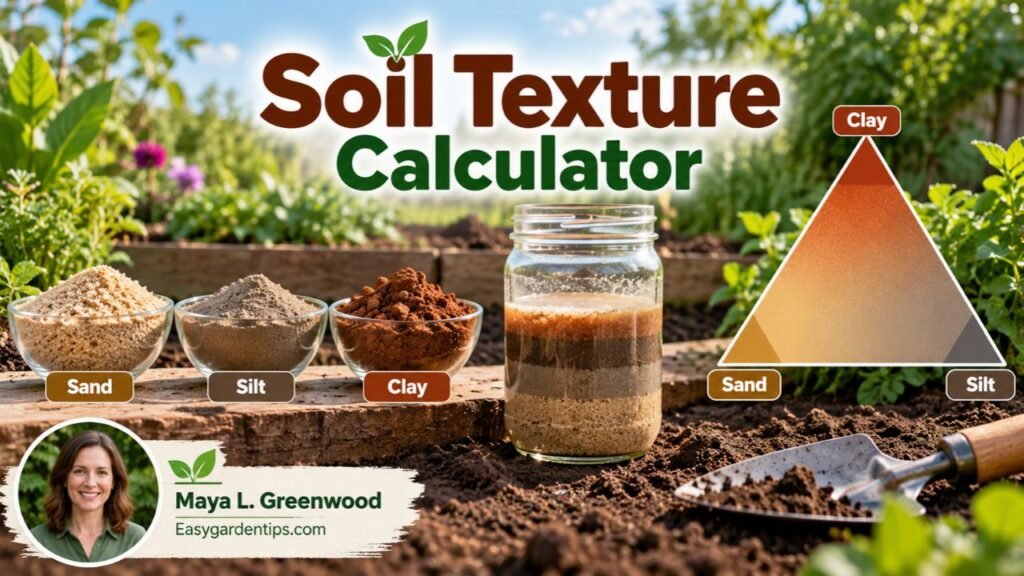
Understanding soil texture is useful when planning a vegetable garden, improving existing garden beds, preparing lawn soil, or investigating drainage and moisture-retention problems.
The calculator supports two input methods: Sand, Silt & Clay Percentages and Jar Test Measurements.
If you already have soil particle percentages from a laboratory report, use the percentage method. If you’re testing soil at home, the Jar Test option can provide an approximate classification based on the thickness of settled soil layers.
Here’s how to use both methods.
Step 1: Choose Your Soil Texture Calculation Method
Start by selecting one of the two available calculation modes.
Sand, Silt & Clay Percentages: Use this option when you already know your soil’s particle percentages. These may come from laboratory particle-size analysis or another reliable soil assessment.
Jar Test Measurements: Choose this option when you’ve performed a home soil sedimentation test and measured the thickness of the settled sand, silt, and clay layers.
The percentage method is preferable when reliable laboratory measurements are available.
Jar testing can be useful for learning about your garden soil, but the results should be considered approximate.
Step 2: Enter Your Soil Particle Percentages
In percentage mode, enter the percentage of sand, silt, and clay in your soil sample.
All three percentages must total 100%.
For example:
| Soil Component | Percentage |
|---|---|
| Sand | 40% |
| Silt | 40% |
| Clay | 20% |
| Total | 100% |
These proportions correspond to a USDA soil texture class of Loam.
The calculator can automatically calculate one component from the other two.
By default, Clay is calculated automatically.
If you enter 40% sand and 40% silt:
100 − 40 − 40 = 20% clay
You can also select Sand or Silt as the automatically calculated component.
If you prefer to enter all three percentages manually, select None — enter all 3.
The calculator checks that the total equals 100%.
Step 3: Use the Soil Texture Jar Test Option
If you’re using a home jar test, switch to Jar Test mode.
Enter the measured thickness of the three settled layers:
- Sand layer
- Silt layer
- Clay layer
You can measure the layers in millimeters, centimeters, or inches, provided you use the same unit for all three.
For example, suppose your settled soil sample contains:
| Layer | Thickness |
|---|---|
| Sand | 2 cm |
| Silt | 2 cm |
| Clay | 1 cm |
| Total | 5 cm |
The calculator converts the measurements into percentages.
Sand:
2 ÷ 5 × 100 = 40%
Silt:
2 ÷ 5 × 100 = 40%
Clay:
1 ÷ 5 × 100 = 20%
The calculated texture class is Loam.
Remember that a jar test estimates soil fractions from settled layer thickness, while standardized laboratory texture analysis determines particle-size proportions more accurately.
Step 4: Calculate Your USDA Soil Texture Class
Once your inputs are ready, click Calculate Soil Texture.
The calculator identifies the texture class corresponding to your sand, silt, and clay percentages.
There are 12 main USDA soil texture classes, including Sand, Sandy Loam, Loam, Silt Loam, Clay Loam, and Clay.
The result appears in a highlighted section below the interactive diagram.
Step 5: Read the USDA Soil Texture Triangle
The calculator displays an interactive USDA Soil Texture Triangle.
The triangle contains 12 regions representing different combinations of sand, silt, and clay.
When you enter valid measurements, the calculator marks your soil’s position on the triangle.
The matching texture region is highlighted so you can see how the classification relates to the proportions of the three mineral particle groups.
Step 6: Understand Your Soil Texture Results
Below the classification, you’ll find a particle composition breakdown showing the percentage of:
- Sand
- Silt
- Clay
The calculator also provides general information about water movement and moisture retention associated with the identified texture class.
These descriptions help explain broad soil behavior, but they are not measurements of your soil’s actual infiltration rate or water-holding capacity.
Factors such as compaction, organic matter, soil structure, and underlying soil layers can substantially change real-world performance.
Step 7: Save or Compare Your Soil Texture Results
Use the Copy My Soil Texture Result button to save your classification and particle percentages.
If you’re comparing soil from several garden locations, test each sample separately.
For example, the soil in a vegetable bed may have a different texture from soil near a driveway or in a lawn.
Recording the results can help you identify differences and make better soil-management decisions.
What Is Soil Texture and Why Does It Matter for Gardening?
Soil texture describes the relative proportions of sand-sized, silt-sized, and clay-sized mineral particles in soil.
These three mineral particle groups differ in size, surface area, and physical behavior.
Their relative amounts influence how soil holds water, allows air movement, supports plant roots, and retains certain nutrients.
Soil texture is one of the fundamental physical characteristics used to describe and classify mineral soils.
The University of Maryland Extension’s Soil Basics guide explains how sand, silt, and clay influence soil behavior and how gardeners can estimate texture through the feel method or a jar test.
Understanding your soil’s texture is useful because different soils have different management needs.
A sandy soil may dry quickly and require more careful moisture management. A clay-rich soil may retain water longer but become difficult to work when wet.
Soil texture alone doesn’t determine whether soil is healthy or fertile. However, it helps explain why certain gardening problems occur.
What Is Sand in Soil?
Sand consists of relatively large mineral particles.
Under the USDA particle-size system, sand particles range from approximately 0.05 to 2 millimeters in diameter.
Sand generally feels gritty when rubbed between your fingers.
Soils dominated by sand often have relatively large pore spaces, especially when loose and uncompacted.
These larger spaces can allow water to move through the soil relatively quickly.
However, sandy soils may also have limited water and nutrient retention.
Common characteristics include:
- Gritty texture
- Relatively rapid drainage in loose soil
- Generally lower water-holding capacity
- Often good aeration
- Potential for nutrient leaching
- A tendency to dry relatively quickly
The actual behavior depends on the size distribution of the sand particles and the soil’s structure.
What Is Silt in Soil?
Silt particles are smaller than sand but larger than clay.
They generally range from approximately 0.002 to 0.05 millimeters.
Silt often feels smooth, floury, or silky when dry.
Silt-rich soils can retain more moisture than many sandy soils, but their structure can be vulnerable to erosion, surface sealing, and crusting.
This is particularly important for gardeners dealing with seedling emergence or compacted soil surfaces.
Common characteristics include:
- Fine, smooth texture
- Moderate to substantial moisture retention
- Vulnerability to erosion
- Potential surface crusting
- Sensitivity to compaction and poor structure
A silt-rich soil isn’t automatically poorly drained, but its performance depends on how the particles are arranged and managed.
What Is Clay in Soil?
Clay consists of extremely small mineral particles measuring less than 0.002 millimeters.
Because clay particles have a very large surface area relative to their size, they strongly influence soil moisture and nutrient behavior.
Clay can help retain water and positively charged plant nutrients.
However, clay-rich soils may drain slowly when poorly structured or compacted.
They can also become sticky when wet and hard when excessively dry.
Common characteristics include:
- Very fine mineral particles
- Sticky or plastic behavior when wet
- Potentially high water retention
- Significant nutrient-holding capacity
- Sensitivity to compaction
- Slow water movement in dense or poorly structured conditions
Clay isn’t inherently bad for gardening.
A well-structured clay soil can support healthy plant growth, while a severely compacted clay soil may restrict roots, air, and water movement.
How Does the USDA Soil Texture Triangle Work?
The USDA Soil Texture Triangle is a classification diagram used to identify mineral soil texture classes from the relative percentages of sand, silt, and clay.
The triangle has three percentage scales.
Each corner represents 100% of one particle type:
- Sand: lower-left corner
- Silt: lower-right corner
- Clay: upper corner
The percentages must total 100%.
Each possible combination corresponds to a point somewhere inside or along the edge of the triangle.
The triangle is divided into 12 regions, each representing a different texture class.
The USDA Natural Resources Conservation Service Soil Texture Calculator is an official reference for determining texture classes from sand, silt, and clay percentages.
How to Read the Soil Texture Triangle
Suppose your soil sample contains:
- 40% sand
- 40% silt
- 20% clay
To classify it manually:
- Locate 40% sand along the sand scale.
- Locate 40% silt along the silt scale.
- Locate 20% clay along the clay scale.
- Follow the corresponding grid lines into the triangle.
- Identify the region where those lines intersect.
The intersection falls within the Loam region.
The online calculator performs this classification automatically and displays the result visually.
Soil Texture Triangle Calculation Example
Consider another sample:
| Component | Percentage |
|---|---|
| Sand | 65% |
| Silt | 25% |
| Clay | 10% |
These values total 100%.
When plotted on the USDA texture triangle, they fall within the Sandy Loam class.
This soil contains a relatively large sand fraction, along with enough finer particles to behave differently from nearly pure sand.
The calculator helps identify these classifications without requiring you to interpret every line on the diagram manually.
How to Calculate Soil Texture Percentages
The basic soil texture percentage formula is:
Particle Percentage = (Amount of One Particle Fraction ÷ Total Amount of All Three Fractions) × 100
The principle applies to each component.
However, the measurement method matters.
Standard USDA texture classes are based on the relative amounts of sand, silt, and clay in the fine-earth mineral fraction, generally determined by particle-size analysis.
Home jar tests use settled layer thickness as a rough substitute and can produce less reliable estimates.
How to Calculate Sand Percentage
For measured jar layers:
Sand % = Sand Layer Thickness ÷ Total Layer Thickness × 100
Suppose the sand layer is 3 centimeters thick and the combined settled layers measure 5 centimeters.
3 ÷ 5 × 100 = 60%
Your approximate sand percentage is 60%.
How to Calculate Silt Percentage
Use the same formula:
Silt % = Silt Layer Thickness ÷ Total Layer Thickness × 100
If the silt layer measures 1.5 centimeters out of 5 centimeters:
1.5 ÷ 5 × 100 = 30%
Your approximate silt percentage is 30%.
How to Calculate Clay Percentage
For a jar test:
Clay % = Clay Layer Thickness ÷ Total Layer Thickness × 100
If the clay layer measures 0.5 centimeters out of 5 centimeters:
0.5 ÷ 5 × 100 = 10%
The estimated composition is:
| Component | Percentage |
|---|---|
| Sand | 60% |
| Silt | 30% |
| Clay | 10% |
| Total | 100% |
This corresponds to a USDA Sandy Loam texture.
What If Sand, Silt, and Clay Don’t Equal 100%?
For a valid texture classification, the three particle percentages must add up to 100%.
For example:
- Sand: 45%
- Silt: 35%
- Clay: 20%
Total = 100%
If you already know two percentages, the calculator can determine the third.
Missing Component = 100 − Sum of the Other Two
If you know 45% sand and 35% silt:
100 − 45 − 35 = 20% clay
If the numbers are inconsistent, check the measurements or laboratory report rather than arbitrarily forcing unrelated values to fit.
How to Perform a Soil Texture Jar Test at Home
A jar test is a practical way to estimate soil texture without specialized laboratory equipment.
The process relies on the fact that sand, silt, and clay particles settle through water at different rates.
Sand generally settles first, followed by silt, while clay remains suspended longer.
The resulting layers can be measured to produce an approximate texture estimate.
The following method is based on the Colorado State University Extension guide, Estimating Soil Texture: Sandy, Loamy, or Clayey.
Step 1: Collect a Representative Soil Sample
Collect soil from the area you want to evaluate.
For a vegetable garden, sample the relevant growing layer.
For a lawn, collect material representative of the soil supporting the grass roots.
If different locations have noticeably different soil conditions, test them separately.
Remove large rocks, roots, leaves, and other debris.
Allow the soil to dry enough that you can break apart the clumps.
The goal is to examine the mineral soil particles rather than large organic fragments.
Step 2: Prepare a Clear Jar
Use a tall, transparent, straight-sided jar with a secure lid.
Straight sides make it easier to measure the thickness of settled layers.
Fill approximately one-quarter of the jar with prepared soil.
Then add water until the jar is approximately three-quarters full.
Colorado State University Extension describes adding a small amount of powdered, non-foaming dishwasher detergent to help disperse soil particles.
Use suitable materials and avoid excessive foam, which makes the layers difficult to observe.
Step 3: Shake the Soil and Water Mixture
Secure the lid tightly.
Shake thoroughly to break apart soil aggregates and distribute the particles through the water.
The Colorado State method recommends shaking vigorously for approximately 10–15 minutes.
Set the jar on a stable, level surface where it won’t be disturbed.
Step 4: Mark the Settled Sand Layer
The larger sand particles settle relatively quickly.
Following the Colorado State method, mark the sand level approximately one minute after the jar is placed on the surface.
This provides the approximate thickness of the sand fraction.
Measure from the bottom of the settled deposit to the marked line.
Step 5: Mark the Settled Silt Layer
Allow the jar to remain undisturbed.
After approximately two hours, mark the top of the sand-plus-silt deposit, following the referenced method.
The silt layer thickness is the distance between the first mark and the second mark.
For example:
- First mark: 2 cm above the bottom
- Second mark: 4 cm above the bottom
The approximate silt thickness is:
4 − 2 = 2 cm
Step 6: Allow the Clay to Settle
Clay particles remain suspended longer than sand or silt.
Depending on the soil, the water may take one to three days—or sometimes longer—to clear sufficiently.
When the final sediment level is visible, mark the top of the settled material.
The clay thickness is the distance between the second mark and the final mark.
Don’t assume the jar is ready simply because the lower layers have formed.
Step 7: Measure the Three Soil Layers
Use a ruler to measure:
- Sand layer thickness
- Silt layer thickness
- Clay layer thickness
Use the same unit for all three measurements.
For example:
| Layer | Thickness |
|---|---|
| Sand | 3 cm |
| Silt | 1.5 cm |
| Clay | 0.5 cm |
| Total | 5 cm |
Enter these values into the calculator’s Jar Test mode.
It will estimate the percentages and identify the corresponding USDA texture class.
How Accurate Is a Soil Texture Jar Test?
A jar test provides an approximate interpretation.
Its accuracy depends on sample preparation, particle dispersion, settling conditions, layer visibility, and measurement technique.
Organic matter, incomplete dispersion, unusual mineral particles, and poorly defined layer boundaries may affect results.
The measured thickness of settled layers is also not identical to the laboratory particle-size proportions by mass used for formal soil classification.
For general gardening education, a jar test can be useful.
For a precise soil texture determination, use a laboratory particle-size analysis.
This distinction is particularly important when a sample is close to the boundary between two texture classes.
Understanding the 12 USDA Soil Texture Classes
The USDA system identifies 12 primary soil texture classes.
Each represents a different range of sand, silt, and clay proportions.
The classifications are:
| USDA Texture Class | General Characteristics |
|---|---|
| Sand | Dominated by coarse sand particles |
| Loamy Sand | Very sandy with a small finer-particle fraction |
| Sandy Loam | Sand-rich, with more silt and clay than loamy sand |
| Loam | Balanced combination of sand, silt, and clay |
| Silt Loam | Substantial silt with smaller amounts of other fractions |
| Silt | Predominantly silt-sized particles |
| Sandy Clay Loam | Considerable sand with a meaningful clay fraction |
| Clay Loam | Moderately fine texture with significant clay |
| Silty Clay Loam | Silt-rich and moderately high in clay |
| Sandy Clay | High clay with substantial sand |
| Silty Clay | High proportions of silt and clay |
| Clay | Clay-dominated mineral soil |
The percentages determine the formal classification.
A texture class name alone doesn’t describe the soil’s complete fertility, structure, drainage condition, or suitability for a particular crop.
Sand and Loamy Sand Soils
Sand and loamy sand are coarse-textured soil classes.
They often allow relatively rapid water movement and may dry quickly.
Gardens with these soils can benefit from moisture-conscious irrigation and appropriate organic matter management.
Avoid assuming that rapid drainage always means ideal growing conditions.
Water and nutrients may move beyond the active root zone before plants can use them.
Sandy Loam Soil
Sandy loam contains a substantial sand fraction but more fine particles than loamy sand.
It can provide useful drainage while retaining more moisture than very coarse sandy soil.
However, actual growing performance depends on organic matter, compaction, soil depth, and rainfall.
Loam Soil
Loam contains sand, silt, and clay in proportions that often provide a favorable balance of physical properties.
A common example is:
- 40% Sand
- 40% Silt
- 20% Clay
Loam doesn’t require exactly equal amounts of all three components.
The USDA loam class covers a range of valid combinations.
Well-structured loam often supports productive gardening, although it can still suffer from poor drainage, compaction, nutrient imbalances, or other limitations.
Silt Loam and Silt Soils
Silt-rich soils often feel smooth and may retain substantial moisture.
However, they may be vulnerable to erosion, surface crusting, and structural damage when handled improperly.
Maintaining organic matter, plant cover, and stable soil aggregates can help improve their management.
Sandy Clay Loam Soil
Sandy clay loam contains considerable sand along with enough clay to influence water and nutrient retention.
Its drainage characteristics can vary substantially depending on soil structure and compaction.
Avoid treating it as simply sandy soil.
The clay fraction may play an important role in how it behaves when wet.
Clay Loam and Silty Clay Loam Soils
These classes have meaningful clay content and can retain water and nutrients.
When well structured, they may support productive growing conditions.
However, they can be difficult to cultivate when excessively wet.
Avoid unnecessary foot traffic or heavy equipment use when the soil is saturated.
Sandy Clay, Silty Clay, and Clay Soils
These classes contain relatively high clay proportions.
They can have substantial moisture retention and nutrient-holding potential.
However, dense clay-rich soil may restrict water movement and root aeration, especially when compacted.
Improving soil structure and managing water carefully are often more useful than attempting to change the mineral texture completely.
Soil Texture vs. Soil Structure: What’s the Difference?
Soil texture and soil structure are closely related, but they describe different properties.
Soil texture refers to the proportions of sand, silt, and clay particles.
Soil structure refers to how individual soil particles are arranged into aggregates and pore spaces.
For example, two soils may both be classified as clay loam but behave very differently.
One may have stable aggregates and good pore connectivity, allowing water and roots to move through the soil.
The other may be heavily compacted, with very limited drainage and aeration.
The NC State Extension Gardener Handbook’s Soils & Plant Nutrients chapter explains the importance of both soil texture and soil structure for gardening and plant growth.
Can You Change Your Soil Texture?
The mineral texture of existing soil is relatively stable.
Adding compost can improve soil structure, biological activity, and water management, but it doesn’t directly turn clay mineral particles into sand particles.
Technically, adding large quantities of different mineral material can change the mixture’s particle proportions.
However, changing the USDA textural class of an entire garden bed through mineral amendments is often impractical.
For most gardens, improving soil structure and organic matter management is a more useful goal.
Can Compost Improve Clay Soil?
Finished compost can improve many clay-rich soils by supporting aggregate formation and biological activity.
Better aggregation may create pore spaces that improve the movement of water, air, and roots.
However, compost does not eliminate the original clay fraction.
A soil can remain classified as clay while becoming easier to manage.
Does Adding Sand Improve Clay Soil?
Adding a small amount of sand to heavy clay is not a reliable general solution.
The outcome depends on the existing texture, the sand particle size, the amount added, and how the materials are mixed.
Changing a clay-heavy soil into a substantially sandier texture may require very large quantities of mineral material.
For ordinary garden improvement, consider organic matter management, drainage conditions, and compaction before adding sand.
How Soil Texture Affects Water Drainage and Retention
Soil texture strongly influences how water moves into and through mineral soil.
Larger particles often create larger pore spaces, while finer particles create smaller pores.
However, particle arrangement, soil aggregation, compaction, organic matter, and subsurface layers also influence water movement.
The Oregon State University Extension guide to Soil-Plant-Water Relationships explains how texture affects infiltration, permeability, water storage, aeration, and nutrient retention.
Water Movement in Sandy Soil
Loose sandy soil often allows water to infiltrate and drain relatively quickly.
This can reduce prolonged saturation but may also increase the risk of drought stress.
Gardeners with sandy soil may need to pay closer attention to watering frequency and moisture conservation.
Organic mulch and suitable organic matter management can help reduce moisture loss.
Water Movement in Silty Soil
Silt-rich soil can provide useful moisture storage.
However, surface crusting and compaction may restrict infiltration.
Protecting the soil surface with suitable mulch or plant cover can help reduce erosion and damage.
Water Movement in Clay Soil
Clay-rich soils contain many small pores that can hold water.
Water movement through compacted clay may be slow.
However, well-structured clay soils may contain cracks, channels, and larger pores that allow water to move more rapidly than expected.
Soil texture gives a general indication, not an exact drainage rate.
Does Loam Have the Best Drainage?
Loam often provides a useful balance between moisture retention and drainage.
However, that balance depends on the soil’s structure and growing conditions.
A compacted loam may drain poorly, while a well-structured clay loam may perform effectively.
The best soil is not determined by texture alone.
How to Improve Different Garden Soil Textures
Identifying your soil texture can help you choose appropriate management practices.
However, improvements should address actual problems rather than assuming every soil of a particular class needs the same treatment.
How to Improve Sandy Garden Soil
If your soil contains a high sand percentage and dries too quickly, consider:
- Incorporating suitable finished compost where appropriate.
- Maintaining organic mulch around plants.
- Monitoring moisture below the soil surface.
- Watering according to plant needs rather than a fixed schedule.
- Keeping living roots or suitable cover crops where practical.
Organic matter can support moisture retention and biological activity.
Avoid adding excessive amendments without evaluating the soil.
How to Improve Clay Garden Soil
If you have compacted or poorly structured clay soil, useful practices may include:
- Adding appropriate organic amendments.
- Avoiding cultivation when the soil is very wet.
- Limiting foot traffic in planting areas.
- Using permanent garden paths.
- Improving drainage where necessary.
- Protecting the soil with mulch or living plants.
If drainage problems are caused by a high water table or a restrictive subsurface layer, surface amendments alone may not solve them.
How to Improve Silty Garden Soil
Silty soils may benefit from management practices that reduce erosion and maintain stable aggregates.
Consider:
- Organic mulch
- Cover crops
- Reduced unnecessary soil disturbance
- Careful watering
- Avoiding compaction
- Maintaining appropriate organic matter
Surface protection is particularly important where heavy rain can cause crusting or erosion.
How to Maintain Loam Soil
Loam often provides favorable physical characteristics, but it still requires maintenance.
Avoid compaction, monitor nutrients, manage irrigation, and replenish organic matter when appropriate.
A loam classification does not eliminate the need for soil testing or good gardening practices.
Soil Texture for Raised Beds, Lawns, and Vegetable Gardens
Soil texture can help you make informed decisions for different growing areas.
However, the interpretation depends on how the soil is being used.
Soil Texture for Raised Garden Beds
Raised beds typically require growing media that provide appropriate drainage, moisture retention, and root support.
If you’re using mineral topsoil in a raised bed, understanding its texture can help explain whether it is unusually sandy, silty, or clay-rich.
But the soil texture triangle does not determine the ideal recipe for a raised bed.
The calculator is intended for mineral soil analysis. It should not be used as a direct classification system for a mostly organic, soilless potting mix.
For raised beds with dense mineral soil, examine compaction and drainage before selecting amendments.
Soil Texture for Vegetable Gardens
Vegetable crops need adequate root space, nutrients, water, and oxygen.
Many vegetables grow well in suitably managed loamy soils.
However, vegetables can also perform successfully in sandy or clay-rich soils when growing conditions are appropriate.
Use the soil texture result to guide further investigation.
For example, a sandy soil may require closer moisture monitoring, while a poorly structured clay soil may need compaction management.
Soil pH and nutrient levels should be evaluated separately.
Soil Texture for Lawns
Soil texture can influence lawn establishment, irrigation, drainage, and root development.
Sandy soils may dry quickly, while dense clay-rich soils may be susceptible to compaction.
However, lawn performance also depends on turfgrass species, soil depth, management, climate, and existing site conditions.
A soil texture result cannot tell you the exact amount of irrigation water or fertilizer to apply.
Soil Texture for Container Plants
Many commercial potting mixes contain substantial amounts of peat, coconut coir, bark, perlite, or other soilless materials.
The USDA soil texture triangle is primarily designed to classify mineral soils based on sand, silt, and clay proportions.
It is not a suitable tool for classifying a typical bark-based orchid mix or peat-based houseplant substrate.
Use product-specific growing medium guidance for container plants.
How Accurate Is an Online Soil Texture Calculator?
The mathematical classification is determined by the input values.
If you provide accurate percentages of sand, silt, and clay, the calculator can identify the corresponding USDA textural class.
However, the reliability of the result depends on the quality of the measurements.
Accuracy With Laboratory Soil Percentages
Laboratory particle-size analysis is generally the better option for precise soil texture classification.
A laboratory may use methods such as sedimentation-based particle-size analysis to determine mineral particle fractions.
If you have measured percentages from a reliable laboratory report, enter them directly into the calculator.
Accuracy With the Soil Jar Test
Jar testing is more approximate.
Several factors can affect the result:
- Incomplete particle separation
- High organic matter content
- Unclear sediment boundaries
- Inaccurate layer measurements
- Insufficient settling time
- Soil particles sticking together in aggregates
- Natural differences between samples
A small measurement difference may change the assigned class when a sample lies near a texture triangle boundary.
For accurate agricultural, engineering, or specialized environmental applications, laboratory testing is preferable.
What the Soil Texture Calculator Cannot Measure
This calculator does not directly determine:
- Soil pH
- Nitrogen, phosphorus, or potassium levels
- Organic matter percentage
- Soil salinity
- Soil contamination
- Soil bulk density
- Soil compaction
- Actual infiltration rate
- Exact water-holding capacity
- Fertilizer requirements
These properties require separate measurements, tests, or assessments.
Soil texture is an important starting point, but it is not a complete soil health analysis.
Common Soil Texture Calculation Mistakes to Avoid
A soil texture calculator is only as useful as the measurements entered.
The following mistakes can make results misleading.
Entering Percentages That Don’t Total 100%
Sand, silt, and clay percentages must total 100% for the fine-earth mineral fraction.
If you enter all three values manually, double-check the total.
Use the auto-calculate option if you know only two values.
Confusing Particle Percentage With Soil Volume
A USDA soil texture classification is based on the proportions of mineral particle-size fractions, normally measured by mass.
It doesn’t mean that 40% of the total field soil volume is physically occupied by sand.
Field soil also includes pore spaces, water, air, organic matter, and potentially coarse fragments.
Including Gravel in the Soil Texture Calculation
Gravel and larger rock fragments are not part of the standard sand, silt, and clay percentages for the fine-earth fraction.
Remove coarse fragments when preparing a home sample.
For laboratory analysis, follow the laboratory’s preparation instructions.
Using a Jar With an Irregular Shape
A jar that narrows or widens significantly may make layer-thickness measurements less representative.
A clear, straight-sided jar is preferable.
Measuring Sediment Before It Settles
Clay particles settle much more slowly than sand.
Measuring the final sediment too early can produce an unreliable clay estimate.
Follow a recognized jar-test procedure and allow sufficient settling time.
Mixing Different Soil Layers
Topsoil and subsoil can have different textures.
Combining samples from unrelated depths or locations may hide important differences.
If you’re investigating a particular problem, collect samples that represent the relevant soil layer.
Assuming Soil Texture Is the Same as Soil Fertility
A soil may have a favorable loam texture but still lack essential nutrients or have an unsuitable pH.
Likewise, a sandy soil may support healthy plants when properly managed.
Texture classification and fertility assessment serve different purposes.
Assuming Clay Soil Is Always Poor for Plants
Clay can contribute useful nutrient-holding and moisture-retention properties.
Poor growing conditions often involve compaction, drainage restrictions, or management problems rather than clay content alone.
Trying to Change Soil Texture With Small Amendments
Adding a modest amount of compost can improve soil structure without meaningfully changing the mineral texture class.
Focus on correcting the soil’s actual limitations instead of attempting to force every garden soil into the Loam category.
Soil Texture Calculator FAQs
What is a soil texture calculator?
A soil texture calculator identifies the USDA textural class of a mineral soil based on its sand, silt, and clay percentages.
It uses the USDA soil texture triangle to classify the sample into one of 12 categories.
How do I calculate soil texture?
Determine the percentages of sand, silt, and clay in your soil.
Make sure the percentages total 100%, then enter them into the calculator.
The tool identifies the corresponding USDA texture class.
What is the soil texture triangle?
The soil texture triangle is a diagram used to classify mineral soils according to their relative percentages of sand, silt, and clay.
It contains 12 USDA soil texture regions.
What is the best soil texture for gardening?
Well-structured loam often provides a useful balance of drainage, aeration, and moisture retention.
However, many plants grow successfully in other soil textures.
The best growing conditions depend on soil structure, nutrients, pH, moisture, climate, and plant requirements.
What is the difference between sand, silt, and clay?
Sand contains the largest mineral particles, silt contains intermediate-sized particles, and clay contains the smallest particles.
Their different particle sizes influence soil texture and many physical properties.
What does 40% sand, 40% silt, and 20% clay mean?
It means those are the relative proportions of the three mineral particle-size fractions.
Under the USDA texture classification system, that combination is Loam.
How do I calculate soil texture from a jar test?
Measure the thickness of the settled sand, silt, and clay layers.
Divide each individual layer thickness by the total thickness of all three layers, then multiply by 100.
Enter the measurements into the calculator’s Jar Test mode to obtain an approximate classification.
How long does a soil texture jar test take?
Sand may settle within minutes, while clay can take days to settle sufficiently.
A commonly used Extension procedure marks sand at approximately one minute, silt at approximately two hours, and the final clay level after the water clears.
The required time varies with the sample.
Is a jar test as accurate as laboratory soil testing?
No.
A jar test provides an approximate texture estimate based on settling and layer measurements.
Laboratory particle-size analysis is preferable when precise proportions or boundary classifications are important.
Can I use a soil texture calculator for raised bed soil?
Yes, if you’re evaluating the sand, silt, and clay composition of a mineral-soil component used in the bed.
However, the USDA triangle is not intended to classify a mostly organic or soilless potting mix.
Can soil texture affect drainage?
Yes.
Texture influences pore-size distribution and water movement.
However, drainage is also affected by soil structure, compaction, organic matter, underlying layers, and other conditions.
Is clay soil always bad for gardening?
No.
Clay can retain moisture and nutrients, which can benefit plant growth.
Problems often arise when clay-rich soil becomes compacted, waterlogged, or poorly structured.
Can I turn clay soil into loam by adding compost?
Compost can improve soil structure and growing conditions, but it doesn’t directly change clay mineral particles into sand or silt.
The formal texture class may remain the same even when the soil becomes easier to manage.
Does the soil texture calculator measure soil pH?
No.
Soil texture and soil pH are different properties.
A separate soil pH test is required to measure acidity or alkalinity.
Can I calculate soil texture without a laboratory test?
You can estimate soil texture using the jar test or a texture-by-feel method.
These approaches are useful for general gardening, but they are less precise than laboratory particle-size analysis.
Why doesn’t my soil texture result match how my soil drains?
Texture isn’t the only factor influencing drainage.
Compaction, soil structure, organic matter, surface sealing, and restrictive subsurface layers may alter water movement.
A soil with a relatively sandy texture can still experience drainage problems under certain conditions.
Does adding sand always improve clay soil drainage?
No.
The result depends on how much sand is added, its particle sizes, the existing soil composition, and how the materials are mixed.
Small additions may not create the desired improvement.
For ordinary gardening, addressing structure, compaction, and drainage conditions is often a more practical approach.
Final Thoughts on Using a Soil Texture Calculator
Understanding soil texture can help you make better decisions about garden preparation, irrigation, soil improvement, and long-term growing conditions.
The most important starting point is knowing the relative proportions of sand, silt, and clay in your soil.
Use the Soil Texture Calculator above to enter laboratory particle percentages or estimate them using measurements from a home jar test.
The calculator identifies your USDA soil texture class and displays its position on an interactive soil texture triangle.
Once you know whether your soil is sandy, silty, loamy, or clay-rich, consider what that result means for your specific gardening conditions.
Remember that soil texture is only one part of soil health. Soil structure, organic matter, nutrients, pH, drainage, and biological activity also affect plant growth.
With reliable measurements and appropriate soil management, you can use your texture classification to better understand your garden soil and make more informed decisions about improving it.