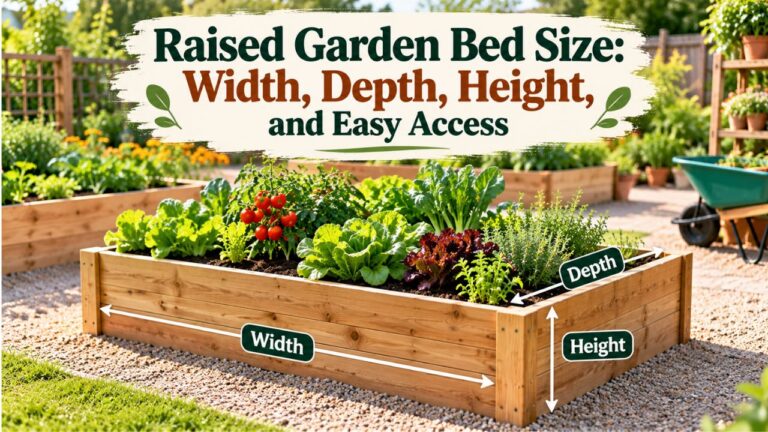
Raised Garden Bed Size: Width, Depth, Height, and Easy Access
For most home vegetable gardens, a raised garden bed measuring 3–4 feet wide, 6–8 feet long, and 10–12 inches high is a practical starting point. A 4-by-8-foot bed works especially well when both long sides are accessible, while a narrower bed is better for gardening from one side.
However, the right dimensions depend on more than the available space. Raised garden bed height affects how comfortably you can plant, weed, and harvest. Soil depth determines how much growing space roots have, particularly when the bed sits on concrete or has a solid bottom.
A shallow, open-bottom raised bed can support many vegetables because their roots can grow into the ground underneath. A waist-height planter needs a different design, with enough growing depth and a comfortable working height.
Choosing the dimensions carefully also helps prevent unnecessary soil expenses, awkward reaching, and poor access between beds.
This guide covers practical raised bed widths and lengths, suitable heights for different gardeners, soil depths for vegetables, and the measurements that make a waist-high raised bed comfortable to use.
How to Choose the Right Raised Garden Bed Size
The best raised garden bed size balances growing space, accessibility, soil depth, and the amount of room available around the structure.
A bed that is too wide becomes difficult to maintain. One that is unnecessarily deep may require more soil than the plants need. A tall bed can make gardening easier, but its height should match the person using it.
For an ordinary backyard vegetable garden, the following dimensions provide useful starting points.
| Measurement | Practical Starting Size |
| Width | 3–4 feet with access from both sides |
| Length | 4–8 feet |
| Standard bed height | 10–12 inches |
| Taller ground-level bed | 18–24 inches |
| Waist-high working height | Approximately 30–36 inches |
| Width with access from one side | About 2 feet |
These measurements are general design recommendations, not fixed requirements. The ideal dimensions depend on the crops, underlying soil, gardener’s reach, and type of raised bed.
A simple 4-by-8-foot bed with 12-inch sides is a useful choice for growing mixed vegetables in a backyard with suitable soil. Smaller 2-by-4-foot or 3-by-6-foot beds work well in compact spaces.
For someone who wants to garden while standing, a taller bed or elevated planter can reduce the amount of bending required.
Raised Garden Bed Width: How Wide Should It Be?
A raised garden bed should be narrow enough that you can reach the planting area without stepping onto the soil.
For most adults, 4 feet is a practical maximum width when the bed is accessible from both sides. If access is possible from only one side, keeping the bed approximately 2 feet wide makes planting and maintenance easier.
Four-Foot-Wide Raised Beds for Two-Sided Access
A 4-foot-wide bed gives gardeners approximately 2 feet of reach from either side.
This arrangement works well for planting vegetables in rows, groups, or intensive garden layouts. Most areas remain accessible without needing to walk inside the bed.
Avoiding foot traffic is important because repeated stepping can compact the growing soil. Compacted soil has less pore space for air and water movement and can make root development more difficult.
A 4-foot width is particularly suitable for:
- Backyard vegetable gardens
- Mixed vegetable planting
- Beds surrounded by walking paths
- Gardens maintained from both long sides
- Growing several crops in the same bed
However, gardeners with shorter arms or limited mobility may find a 3-foot-wide bed more comfortable.
Two-Foot-Wide Raised Beds for One-Sided Access
A 2-foot-wide raised bed is usually more practical when it sits against a fence, wall, or other structure that prevents access from the opposite side.
This width keeps the back of the planting area within a manageable reach.
It is particularly useful for growing herbs, lettuce, spinach, compact peppers, and other crops that fit within narrow planting spaces.
A narrow bed may also work better on patios or in small side yards where wider garden structures would interfere with walkways.
Raised Bed Width for Children and Accessible Gardening
Children and gardeners with limited mobility often benefit from narrower planting areas.
The goal is to allow comfortable access to the center of the bed without excessive leaning, stretching, or twisting.
According to Oregon State University Extension’s accessible gardening guidance, raised beds should generally be no wider than 4 feet for adults or 3 feet for children. The publication also discusses elevated beds and accessible paths for people with mobility limitations.
Practical Tip: Before building a raised bed, mark its proposed width on the ground. Stand or sit where the walkway will be and check whether you can comfortably reach the center.
Raised Garden Bed Length: Choosing 4, 6, or 8 Feet
Raised garden bed length is more flexible than width.
The length does not usually limit access to plants in the same way width does, provided the sides remain reachable. However, very long beds can make movement around the garden less convenient.
Four-Foot-Long Raised Garden Beds
A 2-by-4-foot or 3-by-4-foot bed is suitable for small gardens, patios, and limited planting areas.
These dimensions are manageable for beginners who want to grow a few vegetables or herbs without committing much space.
Short beds are also easier to reposition before filling and generally require less framing material and soil.
Six-Foot-Long Raised Garden Beds
A 3-by-6-foot raised bed offers a useful balance between growing area and accessibility.
It provides enough room for several types of vegetables while remaining compact enough for many residential gardens.
Six-foot beds are particularly practical when several separate planting areas are planned.
Eight-Foot-Long Raised Garden Beds
A 4-by-8-foot raised bed provides 32 square feet of growing area.
This size is useful for a household vegetable garden and can accommodate multiple crops when spacing requirements are followed.
Longer sides may need additional structural support, particularly if the bed is tall or built from materials that can bow under soil pressure.
An eight-foot bed should also have enough clearance around its ends so gardeners do not need to make unnecessarily long trips around the structure.
A useful approach is to choose the length based on the available space after accounting for walking paths, rather than filling every available foot with the bed itself.
Raised Garden Bed Height: How Tall Should the Frame Be?
Raised garden bed height is the vertical distance from the surrounding ground to the top of the bed frame.
For ordinary vegetable gardening on suitable ground, a height of approximately 10–12 inches is a practical choice. Taller designs may improve accessibility or provide more contained growing soil.
Six- to Eight-Inch Raised Garden Beds
A 6–8-inch raised bed can work for many vegetables when it has an open bottom and sits over healthy, well-drained soil.
The plants are not limited to the soil inside the frame because their roots may continue into the ground below.
This low design requires less imported soil and fewer construction materials.
However, the bed offers limited relief from bending and may not provide enough contained growing depth where the underlying ground is compacted, contaminated, or otherwise unsuitable.
Ten- to Twelve-Inch Raised Garden Beds
A 10–12-inch raised garden bed is a useful general-purpose option.
It provides room for amended soil, allows excess water to move downward when the underlying ground drains properly, and is suitable for many common vegetables.
This height works particularly well when the bed is installed over usable garden soil.
For gardeners who prefer a traditional low raised bed, a 12-inch frame often balances construction cost with growing space.
Eighteen- to Twenty-Four-Inch Raised Garden Beds
An 18–24-inch raised bed offers additional contained soil depth and places the planting surface higher above the ground.
This can be helpful for gardeners who prefer not to bend as far or for sites where the soil beneath the bed is unsuitable for root growth.
Taller beds can also accommodate larger root systems within the frame.
However, increasing the height increases the amount of fill required if the bed is filled with growing soil from the bottom to the planting surface.
The sidewalls must be strong enough to resist the pressure of the soil, particularly after watering.
Thirty- to Thirty-Six-Inch Raised Garden Beds
Raised beds approximately 30–36 inches tall may be comfortable for gardeners who want to perform more tasks while standing.
These taller designs are often described as waist-high raised beds.
The ideal working height depends on a person’s height, arm length, and preferred gardening position.
A raised bed at this height may be constructed as a full-depth ground-based structure or as an elevated planter supported by legs.
The second design can provide a comfortable working height without requiring soil throughout the entire space beneath the planting container.
Raised Bed Depth: How Much Soil Do Vegetables Need?
Raised bed depth refers to the actual depth of usable growing soil, which is not always the same as the height of the bed frame.
This difference is especially important for raised beds built over existing ground, concrete patios, and elevated planter boxes.
Roots need enough suitable growing space to access water, nutrients, and oxygen. The amount of contained soil required depends on whether roots can extend below the raised bed.
Soil Depth for Raised Beds on Existing Ground
An open-bottom raised bed placed over suitable garden soil gives roots access to the soil beneath the frame.
For example, a bed containing 10 inches of improved soil does not necessarily limit plant roots to those 10 inches.
Roots can continue growing downward if the underlying soil is loose enough, drains adequately, and does not contain harmful contaminants.
This is why relatively shallow raised beds can support vegetables that develop substantial root systems.
If the ground is heavily compacted, loosening it before filling the bed may help improve root penetration and drainage.
Soil Depth for Raised Beds on Concrete or Hard Surfaces
A raised bed installed on concrete, pavement, or another hard surface needs enough growing medium inside the structure to support its plants.
Roots cannot access deeper soil beneath an impermeable surface.
The University of Maryland Extension’s raised-bed vegetable gardening guide recommends at least 8 inches of growing depth for leafy greens, beans, and cucumbers on hard surfaces, and 12–24 inches for peppers, tomatoes, and squash.
These recommendations provide a useful basis for selecting bed depth when roots cannot grow into the ground.
Recommended Raised Bed Soil Depth by Vegetable
The following ranges are practical planning guidelines for raised beds with a restricted bottom. Individual plant varieties and growing conditions can affect the depth required.
| Vegetable | Suggested Growing Depth |
| Lettuce and spinach | At least 8 inches |
| Radishes | 8–12 inches |
| Bush beans | At least 8 inches |
| Cucumbers | At least 8 inches |
| Carrots | 12–18 inches for many full-length varieties |
| Peppers | 12–24 inches |
| Tomatoes | 12–24 inches |
| Squash | 12–24 inches |
For carrots, the appropriate depth depends heavily on the variety. Short or round carrots need less vertical space than long-rooted varieties.
Tomatoes and squash may also benefit from more growing volume than the minimum depth alone suggests, particularly in elevated containers that cannot draw moisture from surrounding garden soil.
A wider planter can provide more total root space, but it cannot fully compensate for insufficient vertical depth for a long root crop.
Does a Deeper Raised Bed Always Grow Better Vegetables?
Not necessarily.
Additional soil depth can increase available rooting space and moisture storage, but it does not automatically improve plant growth.
A properly prepared shallow bed over healthy ground may perform very well because plant roots can use the native soil beneath it.
By contrast, a deep bed filled with poorly draining, compacted, or unsuitable material can still create problems.
Soil quality, drainage, watering, and plant requirements are more important than making every raised bed as deep as possible.
Waist Height Raised Bed: Dimensions for Comfortable Gardening
A waist height raised bed is designed to bring the planting area closer to a comfortable standing position.
It can reduce the need for repeated kneeling and deep bending, making gardening more manageable for people who prefer an elevated working surface.
However, the best height is determined by the gardener rather than a universal measurement.
What Is the Best Height for a Waist-High Raised Garden Bed?
Approximately 30–36 inches is a useful starting range for many standing gardeners, with the final height chosen to suit the individual.
A bed that is comfortable for a tall adult may be too high for someone shorter.
The objective is to place the planting surface at a height that allows comfortable movement without constantly raising the shoulders or leaning forward.
A useful way to select the height is to:
- Stand upright in a relaxed position.
- Bend your elbows slightly as though planting or removing weeds.
- Measure a comfortable working position near your hands.
- Compare that measurement with the planned top edge and soil surface.
- Consider the height of mature plants and the tools used for maintenance.
The soil surface may sit below the rim, so take that difference into account.
Waist-High Raised Beds With Legs
An elevated planter with legs is often a practical solution for waist-height gardening.
Instead of filling a 36-inch-tall structure entirely with soil, the design supports a planting container at a comfortable working height.
For example, an elevated planter could have:
- An overall working height of approximately 34 inches
- A 2-by-4-foot planting area
- A 12–16-inch-deep planting container
- A properly supported base beneath the growing medium
- Drainage openings that allow excess water to escape
The exact planting depth should match the crops being grown.
This construction can reduce the amount of soil required compared with a completely filled, waist-high ground bed.
However, the legs, joints, and base must support the weight of wet soil, plants, and water without shifting or sagging.
Waist-High Raised Beds for Seniors and Limited Mobility
Raised beds can make gardening more accessible for people who find repeated kneeling or bending uncomfortable.
A narrow raised planter with a suitable working height may allow a person to plant, water, and harvest while standing.
For seated gardening, the layout must also account for wheelchair or chair positioning.
A planter that is suitable for standing may not work well for a wheelchair user if the base prevents close access.
Important design details include:
- Comfortable reach to the growing area
- Adequate knee and foot clearance when needed
- Stable construction
- Firm, level surrounding paths
- Sufficient room to approach and turn
- A planting surface that suits the user’s seated position
For a wheelchair user, an elevated planter with an open area beneath the growing container may provide better access than a solid, fully filled raised bed.
The best accessible design should be measured around the person who will use it, including their preferred standing or seated position.
Raised Garden Bed Size for Different Garden Spaces
The right dimensions also depend on where the bed will be installed.
A backyard, patio, and narrow side yard may require different arrangements even when the same vegetables are being grown.
Small Backyard Raised Beds
For a small backyard, a 3-by-6-foot raised bed is often a manageable choice.
It provides room for several crops without taking up as much space as a 4-by-8-foot structure.
Multiple smaller beds can also be easier to arrange around existing garden features than one large rectangular bed.
If the garden has access from only one direction, a narrower bed may be more useful than a wider one.
Raised Garden Beds for Patios
Patio beds require careful attention to both depth and weight.
A 2-by-4-foot raised bed can be a reasonable starting size for a patio or paved area.
Because the underlying surface does not provide usable root space, the planter needs a sufficient depth of growing medium and a way for excess water to drain.
The total weight also matters. Soil becomes heavier after watering, and large planters can place substantial loads on the surface beneath them.
For balconies, decks, and other elevated structures, confirm the available load capacity before installing a large soil-filled bed.
Raised Beds for Large Vegetable Gardens
Larger gardens often benefit from several separate raised beds rather than one oversized structure.
For example, multiple 4-by-8-foot beds can provide distinct areas for different vegetable groups while maintaining access to each planting area.
Leave adequate space between beds for watering, harvesting, soil delivery, and moving gardening equipment.
The number and arrangement of beds should allow comfortable movement without stepping into the growing soil.
How to Calculate Soil for Different Raised Garden Bed Sizes
Calculating the soil volume before filling a raised bed helps prevent buying too much or too little growing medium.
For a rectangular raised bed, multiply the inside length, inside width, and intended soil fill depth.
Soil Volume (Cubic Feet) = Length (Feet) × Width (Feet) × Soil Depth (Feet)
If the depth is measured in inches, divide it by 12 to convert it to feet.
Soil Needed for a 4-by-8-Foot Raised Bed
Consider a raised bed with these inside measurements:
- Length: 8 feet
- Width: 4 feet
- Soil depth: 12 inches, or 1 foot
The calculation is:
4 × 8 × 1 = 32 cubic feet
Therefore, the bed requires approximately:
- 32 cubic feet of soil
- 1.19 cubic yards
- 906 liters
These figures describe the calculated volume of a full 12-inch soil layer, before allowing for settling or space below the rim.
If the same bed has an 18-inch soil depth, its calculated volume increases to 48 cubic feet, or approximately 1.78 cubic yards.
Soil Needed for a Waist-High Raised Bed
A waist-high raised bed can require considerably more soil if its entire structure is filled.
For example, a 3-by-6-foot raised bed containing 36 inches of soil would require:
3 × 6 × 3 = 54 cubic feet
That equals 2 cubic yards of growing medium.
However, if the same planting area is elevated on legs and contains only a 12-inch-deep soil compartment, the soil requirement becomes:
3 × 6 × 1 = 18 cubic feet
This difference illustrates why an elevated planter can be more economical to fill than a fully soil-filled waist-high bed.
The smaller soil volume may dry out more quickly, so watering needs must also be considered.
Allow for Soil Settling and Planting Space
Fresh growing mixes can settle after watering as air spaces change and organic materials break down.
The amount of settling depends on the composition of the soil mix.
Do not assume that the frame must be filled exactly to the top edge.
Leaving a modest gap below the rim can help retain mulch and reduce soil washing over the sides during watering.
Measure the intended soil depth rather than automatically using the full frame height in the volume calculation.
How Walkway Space Affects Raised Garden Bed Dimensions
A raised bed must fit within the garden while leaving enough room to move around it.
Walkway width affects whether you can reach plants comfortably, transport soil, and use gardening equipment.
For ordinary garden maintenance, paths around 2 feet wide may be workable where space is limited.
Wider paths are more comfortable when using a wheelbarrow or moving bulky supplies.
For wheelchair access, Oregon State University Extension recommends smooth, unobstructed pathways approximately 3–4 feet wide.
Pathways should also be firm and reasonably level.
When planning several raised beds, include walkways in the total layout measurements.
For example, two 4-foot-wide beds separated by a 3-foot path occupy 11 feet of combined width, before accounting for any additional paths around the outside.
This planning step helps prevent garden beds from becoming difficult to access after installation.
Raised Garden Bed Sizing Errors That Can Cause Problems
Several common design decisions can make an otherwise useful raised garden bed inconvenient.
Making the Raised Bed Too Wide
A bed wider than your comfortable reach can make it difficult to plant and maintain the center.
The problem becomes more noticeable when mature plants fill the growing area.
Reducing the width is usually more practical than stepping into the bed to reach distant plants.
Choosing Height Without Considering Soil Depth
A waist-high structure does not automatically provide sufficient growing depth.
For an elevated planter, the depth of the actual soil container must be measured separately from the overall working height.
A shallow planting tray may suit some herbs and leafy vegetables but may not provide enough space for larger plants.
Filling an Unnecessarily Tall Bed Entirely With Soil
A tall, fully filled raised bed can require a substantial amount of growing medium.
It also places more pressure on the sides and increases the total weight of the structure.
Where appropriate, a supported elevated planter may provide the desired working height with less soil.
Any alternative filling arrangement must still provide enough suitable growing medium and proper drainage.
Ignoring Drainage Beneath the Raised Bed
Drainage is especially important when raised beds sit on hard surfaces or have enclosed bottoms.
A planter without an appropriate drainage outlet can hold excess water around roots.
Waterlogged growing media can limit oxygen availability and contribute to poor root health.
Elevated planters need drainage openings and a base designed to support wet soil without obstructing water movement.
Leaving Too Little Space Between Beds
Closely spaced raised beds can make routine maintenance uncomfortable.
Plant growth may further reduce the usable walkway width.
Before finalizing the garden layout, account for mature foliage, harvesting access, and the movement of watering equipment.
Conclusion
Choosing the right raised garden bed size starts with matching the width, length, height, and soil depth to the gardener and the plants.
For many backyard vegetable gardens, a bed approximately 3–4 feet wide, 6–8 feet long, and 10–12 inches tall provides a practical starting point. Narrower beds are more suitable when access is limited to one side.
Raised bed depth should be selected according to the crops and the soil underneath the structure. Open-bottom beds can take advantage of suitable native soil, while elevated planters and beds on hard surfaces need enough contained growing medium.
For gardeners seeking easier standing access, a waist-height raised bed around 30–36 inches tall may be useful, provided its working height, planting depth, and structural support suit the intended use.
The best dimensions are those that allow plants to grow properly while keeping planting, watering, and harvesting comfortable.
FAQs About Raised Garden Bed Size
Is a 4-by-8-foot raised garden bed a good size for beginners?
Yes. A 4-by-8-foot raised garden bed provides 32 square feet of growing area and can accommodate a variety of vegetables. It works best when the gardener can reach the planting area from both long sides.
Can a raised garden bed be only 6 inches deep?
Yes, a 6-inch-high raised bed can support many vegetables when it has an open bottom over suitable garden soil. Roots may grow deeper into the ground beneath it. A bed with a solid bottom generally needs more contained soil, depending on the crop.
Is a 24-inch raised garden bed tall enough to avoid bending?
A 24-inch raised bed reduces the distance a gardener needs to bend compared with a low bed, but it may not eliminate bending for a standing adult. The most comfortable height depends on the person’s height, reach, and gardening position.
Does a waist-high raised bed need 36 inches of soil?
No. A waist-high raised bed does not necessarily need soil throughout its entire height. An elevated planter can place a shallower growing container at a comfortable working height, provided the soil depth is suitable for the plants.
Can I place a raised garden bed directly on concrete?
Yes. Raised garden beds can be installed on concrete when they have suitable drainage and enough growing depth. Because roots cannot enter the ground below, the available soil volume must support the plants’ growth and watering needs.
How much space should I leave between two raised garden beds?
A walkway around 2 feet wide may be adequate for basic access in a small garden. Wider paths, approximately 3–4 feet, are preferable when wheelchair access or comfortable movement with larger gardening equipment is needed.
Is a taller raised garden bed better for growing tomatoes?
Not automatically. Tomatoes need adequate root space, drainage, nutrients, and moisture. A taller raised bed can provide more contained growing soil, but tomatoes may also grow well in a shorter open-bottom bed where their roots can extend into suitable soil underneath.

I’m Maya L. Greenwood, a lifelong plant lover who believes anyone can grow something beautiful with the right guidance. After years of testing soil mixes, pruning methods, irrigation tricks, and pest-safe solutions, I started EasyGardenTips.com to turn hard-won lessons into step-by-step advice. From seed starting and container gardens to composting and seasonal checklists, my goal is to make gardening simple, sustainable, and fun.