5 Best Kink Free Garden Hose 50 Ft: Flexible, Durable Picks
Are you looking for the best kink free garden hose 50 ft for watering plants, washing a vehicle, or running a sprinkler without constantly stopping to straighten the hose? After comparing hose construction, flexibility, coupling quality, pressure capability, weight, and resistance to twisting, my primary recommendation is the Flexzilla Garden Hose 5/8 in. x 50 ft.. Its flexible hybrid-polymer construction is especially easy to maneuver and coil.
If minimizing weight matters most, I would consider the zero-G 4001-50 Lightweight Garden Hose. Its compact construction is considerably easier to drag through a garden than a traditional heavy rubber hose while still delivering the flow expected from a full-size 5/8-inch hose.
For buyers who frequently struggle with hoses twisting at the faucet or nozzle, the Giraffe Tools 50 ft x 5/8-Inch Garden Hose is another strong option. I selected five 50-foot models overall, including lightweight polymer, stainless-steel, and traditional rubber choices so you can match the hose to your watering habits rather than relying on a single construction type.
5 Best Kink Free Garden Hose 50 Ft
| Image | Product Name | Check Price |
|---|---|---|
Best Choice | Flexzilla Garden Hose 5/8 in. x 50 ft.- Best Overall | Check Price |
Second Best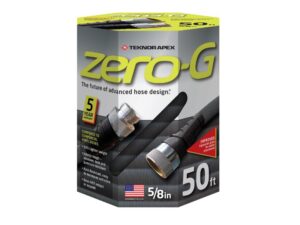 | zero-G 4001-50 Lightweight Garden Hose | Check Price |
Third Choice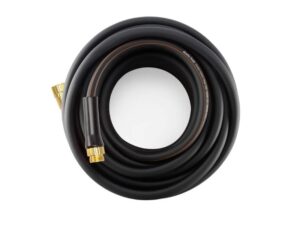 | Giraffe Tools Garden Hose 50 ft x 5/8-Inch | Check Price |
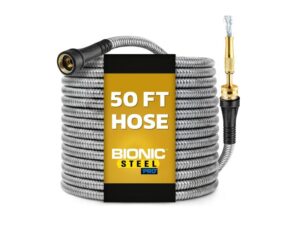 | Bionic Steel PRO 50 Ft Metal Garden Hose | Check Price |
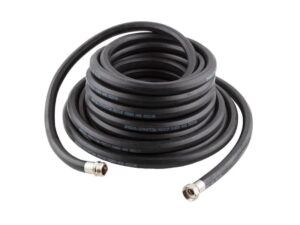 | Briggs & Stratton 8BS50 Heavy-Duty Rubber Garden Hose | Check Price |
A hose advertised as “kink free” should still be evaluated realistically. Almost any flexible hose can temporarily fold if it is sharply bent, twisted while empty, or pulled around a tight obstacle. The better products reduce those problems through low-memory materials, reinforced jackets, rotating grips, or segmented metal exteriors.
1. Flexzilla Garden Hose 5/8 in. x 50 ft.- Best Overall
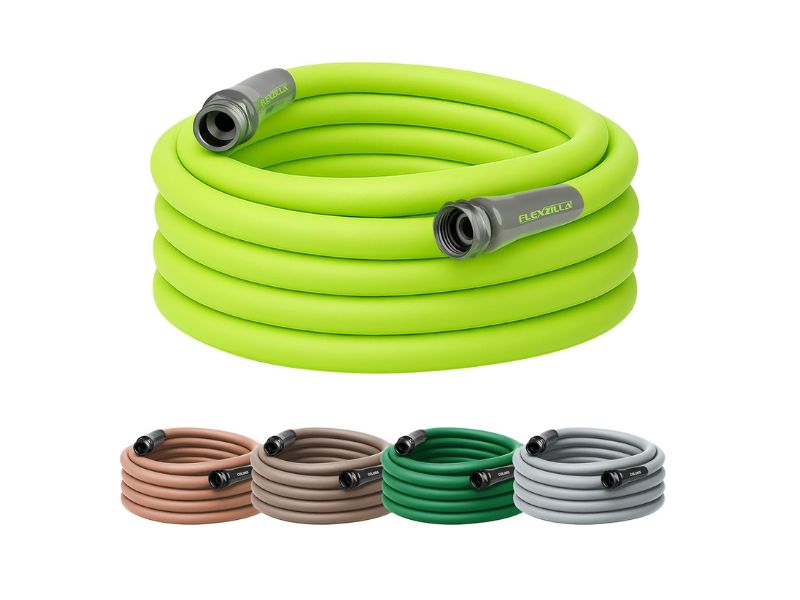
The Flexzilla is my first choice for homeowners who want a conventional round garden hose that remains unusually easy to handle. Its biggest advantage is not simply durability—it is the way its hybrid-polymer material behaves while you are moving through a yard.
Flexzilla describes the hose as virtually kink-free with zero memory, meaning it is designed to lie flatter rather than continually trying to return to the shape in which it was stored. The manufacturer also lists a 150 PSI working-pressure rating, abrasion-resistant covering, aluminum fittings, and flexibility in temperatures as low as -40°F.
That low hose memory is particularly useful when attaching a sprinkler. A hose that tries to recoil can rotate or drag a lightweight sprinkler out of position. Flexzilla’s design reduces that tendency while remaining flexible enough to guide around landscaping.
The 5/8-inch diameter is also a practical choice for general residential watering. It provides considerably more usable flow than many narrow expandable or metal hoses while remaining manageable at a 50-foot length.
Another advantage is the fittings. Crush-resistant aluminum connections and a durable O-ring help create a dependable seal without adding the weight associated with some heavy brass hardware.
What I Like
- Hybrid polymer remains extremely flexible.
- Low-memory design makes coiling and uncoiling easier.
- Full-size 5/8-inch hose diameter supports good water flow.
- Fittings are designed to resist crushing.
- Handles cold-weather use better than many inexpensive vinyl hoses.
- Suitable for a broad mix of gardening and household jobs.
What I Do Not Like
- The bright color may not appeal to buyers wanting a subtle-looking hose.
- A very loose coil can still develop a fold if the hose is pulled abruptly.
- It is not as resistant to sharp-object damage as a stainless-steel exterior.
Best for: Homeowners who want one highly flexible 50-foot hose for regular garden watering, sprinklers, patio cleaning, and vehicle washing.
2. zero-G 4001-50 Lightweight Garden Hose- Best Lightweight
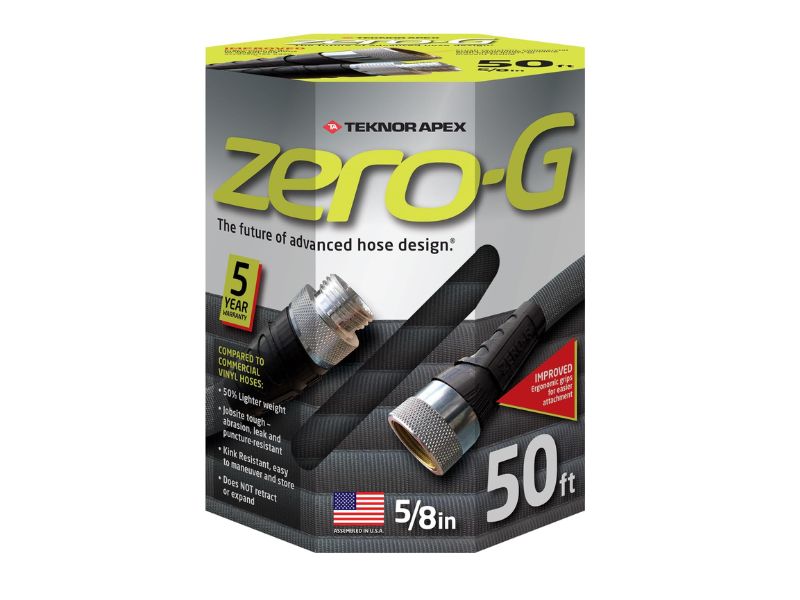
The zero-G 4001-50 takes a different approach. Rather than behaving like a thick conventional hose, it uses a high-density woven jacket around its inner structure. The result is a hose that becomes remarkably compact when it is drained.
That makes it one of my preferred choices for seniors, gardeners who move a hose frequently, and anyone who dislikes wrestling with thick rubber tubing.
The manufacturer lists the 4001-50 at 5/8 inch by 50 feet and describes the design as up to 50% lighter than standard garden hoses. It is also designed for kink-resistant flow, resistance to abrasion and punctures, and compatibility with common nozzles, sprinklers, and other watering accessories. Teknor Apex additionally cites a 600+ PSI burst rating for the zero-G design.
One important characteristic is that the hose does not keep a rigid round shape when empty. It flattens somewhat, which contributes to compact storage. Once pressurized, however, it expands into its working form.
For routine watering, this is a useful compromise. You get close to the flow characteristics expected from a conventional 5/8-inch garden hose without carrying the same amount of hose material around the yard.
Kink resistance is also good when the hose is under pressure. As with other flexible fabric-jacket hoses, I would unroll it before turning the water on rather than leaving a pile of overlapping loops beside the faucet.
What I Like
- Significantly lighter than many conventional hoses.
- 5/8-inch size maintains useful residential water flow.
- Compact when emptied and stored.
- Strong woven exterior helps resist abrasion.
- Easy to carry across larger yards.
- Works well with standard watering attachments.
What I Do Not Like
- It does not coil exactly like a traditional rubber hose.
- The flattened empty shape may take some getting used to.
- Keeping it neatly arranged on certain traditional hose reels can require more care.
Best for: Anyone prioritizing low weight, compact storage, and easy movement around flower beds, patios, raised gardens, and vehicles.
3. Giraffe Tools Garden Hose 50 ft x 5/8-Inch- Best for Easy Handling
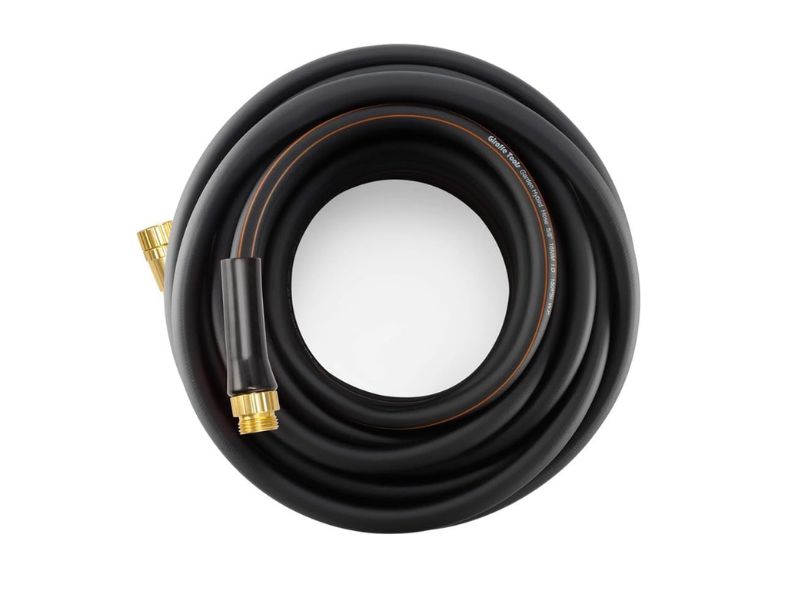
The Giraffe Tools 50-foot hose is a good middle ground between a traditional heavy hose and an ultralight fabric model. Its flexible construction is designed for users who want a normal round hose but also want easier maneuvering around corners.
The 50-foot version uses a 5/8-inch format and a flexible hybrid-style construction. Current specifications for the model list a 50-foot length and residential-pressure capability, while Giraffe’s hybrid-hose designs emphasize flexible handling, corrosion-resistant connections, and kink resistance.
The feature I find most useful is the enlarged connection area. A longer grip gives you better leverage when connecting or disconnecting the hose, especially if your hands are wet or the fitting has become tight.
This type of grip can also reduce twisting near the faucet. The first several inches of a garden hose experience considerable stress because users repeatedly turn the connector while attaching accessories. Better grip and strain control can therefore contribute to longer service life.
The 5/8-inch diameter makes this model appropriate for normal sprinklers, hand nozzles, garden watering wands, and general cleanup.
What I Like
- Flexible construction is relatively easy to maneuver.
- Grip area makes fittings easier to tighten and loosen.
- Good general-purpose 5/8-inch diameter.
- Suitable for users who prefer a traditional round hose.
- Helpful balance of durability and manageable weight.
What I Do Not Like
- Heavier than ultralight fabric-style hoses.
- Larger grip sections occupy slightly more space on compact storage reels.
- Like other flexible hoses, careless twisting while unpressurized can still create temporary folds.
Best for: Homeowners wanting comfortable fittings and easier hose control for frequent everyday watering.
4. Bionic Steel PRO 50 Ft Metal Garden Hose- Best Metal Hose
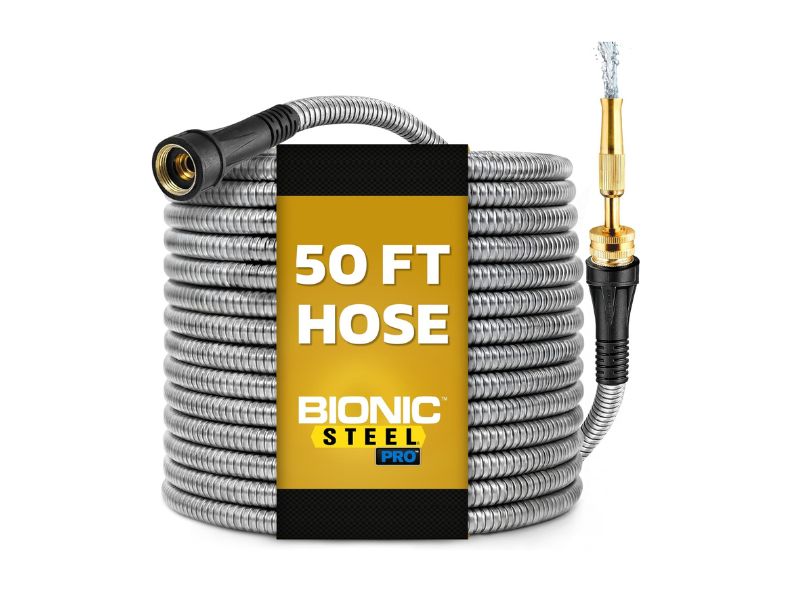
If your highest priority is preventing traditional hose kinks, a segmented stainless-steel exterior offers an entirely different solution. The Bionic Steel PRO uses an interlocking 304 stainless-steel jacket that bends while resisting the flattened folds common with vinyl and rubber hoses.
The PRO version is listed with brass fittings and a pressure capability up to 500 PSI. Independent testing also highlights its interlocking steel exterior as particularly resistant to kinking.
This design is attractive for users who frequently drag hoses over rough patios, gravel, concrete edges, or other abrasive surfaces. Instead of a soft exterior rubbing directly against the ground, the stainless jacket takes much of that wear.
Metal hoses also store differently. Because they do not have the same thick rubber wall, they can feel surprisingly manageable despite the steel exterior.
There is an important tradeoff, however: flow. The internal water passage is narrower than that of a conventional full-bore 5/8-inch hose. Independent testing has noted that this can produce noticeably lower water flow.
That makes the Bionic Steel PRO especially appealing for hand watering and washing, but less ideal when maximum flow to a demanding sprinkler is your primary concern.
What I Like
- Stainless exterior is exceptionally resistant to ordinary kinking.
- 304 stainless steel protects against surface abrasion.
- Flexible segmented construction moves easily around obstacles.
- Brass hardware adds durability.
- Good choice for rough patios and hardscaped yards.
- Less bulky than many traditional heavy-duty rubber hoses.
What I Do Not Like
- Narrower internal passage can reduce flow.
- Metal becomes warm when left in intense direct sunlight.
- Not my first choice for high-flow sprinkler systems.
Best for: Buyers who care more about kink prevention and abrasion resistance than maximum water volume.
5. Briggs & Stratton 8BS50 Heavy-Duty Rubber Garden Hose- Best Heavy-Duty Rubber
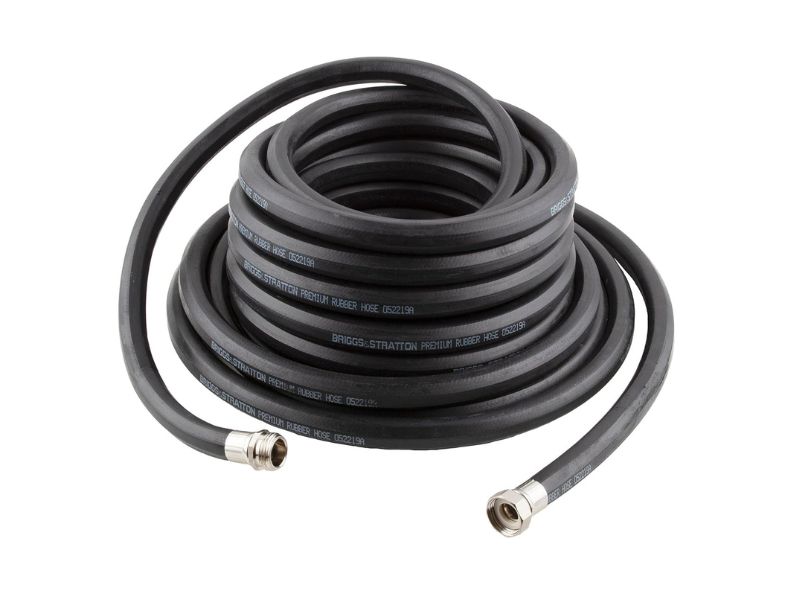
The Briggs & Stratton 8BS50 is the most traditional product in this lineup. It is a 5/8-inch, 50-foot rubber hose intended for buyers who value rugged construction and temperature tolerance more than minimal weight.
Its reinforced rubber wall makes it heavier than Flexzilla or zero-G, but the additional material brings useful advantages for demanding applications.
The manufacturer describes the 8BS50 as kink-resistant and equips it with industrial-style reinforcement plus crush-resistant nickel-plated brass couplings. Briggs & Stratton also states that its premium rubber hoses can handle hot water up to 200°F and remain flexible in cold conditions.
Rubber is particularly useful when the hose may be dragged over concrete, exposed to temperature swings, or used regularly for cleanup jobs. A thick rubber wall is less convenient to carry but inspires confidence in situations where lightweight construction is not the main objective.
The octagonal-style exterior geometry also helps the hose resist ordinary twisting and makes it somewhat easier to coil than a completely smooth, round rubber hose.
What I Like
- Tough rubber construction.
- 5/8-inch diameter supports strong water delivery.
- Industrial reinforcing improves durability.
- Crush-resistant metal couplings.
- Handles demanding temperatures well.
- Useful for frequent or heavier-duty outdoor work.
What I Do Not Like
- Noticeably heavier than the first four choices.
- More tiring to carry across a large yard.
- Requires more storage space than a compact fabric-jacket hose.
Best for: Buyers who want a rugged traditional rubber hose for demanding watering, cleanup, and frequent outdoor use.
Best Kink Free Garden Hose 50 Ft Comparison Table
| Product | Construction | Diameter | Main Strength | Best For |
| Flexzilla Garden Hose | Hybrid polymer | 5/8 in. | Flexibility and low memory | Best overall |
| zero-G 4001-50 | High-density jacket | 5/8 in. | Lightweight handling | Seniors and frequent movement |
| Giraffe Tools Garden Hose | Hybrid flexible hose | 5/8 in. | Grip and maneuverability | Everyday watering |
| Bionic Steel PRO | 304 stainless-steel jacket | Narrower internal passage | Exceptional kink resistance | Rough surfaces |
| Briggs & Stratton 8BS50 | Reinforced rubber | 5/8 in. | Heavy-duty durability | Demanding use |
Which 50-Foot Hose Should You Choose?
For most yards, I would pick Flexzilla because its combination of flow, flexibility, low hose memory, and manageable weight addresses the problems that cause most ordinary hoses to become frustrating.
Choose zero-G if carrying weight is your biggest concern. The Giraffe Tools model is an attractive conventional alternative when comfortable fittings and handling matter. Bionic Steel PRO is the strongest choice when you specifically dislike conventional hose kinks and frequently drag the hose over abrasive surfaces. Finally, the Briggs & Stratton 8BS50 makes sense when rugged rubber construction matters more than lightweight handling.
How I Chose These Kink-Resistant 50-Foot Garden Hoses
I considered several practical characteristics rather than treating every manufacturer’s “kink-free” claim equally.
Kink Resistance
The hose needed construction that actively reduces folding, twisting, or flow restriction. I favored hybrid polymers, woven jackets, reinforced rubber, and segmented stainless steel over inexpensive thin vinyl.
Flexibility
Extreme stiffness can be almost as frustrating as kinking. A useful garden hose should move around planters, trees, cars, and patio furniture without constantly pulling against you.
Hose Memory
Hose memory describes a material’s tendency to return to its stored coil. A high-memory hose can curl back onto itself and create loops that eventually fold.
Flow
A kink-resistant hose is not particularly useful if the internal diameter restricts water excessively. That is why full-size 5/8-inch hoses rank highly for general-purpose watering.
Coupling Quality
The fittings are among the most heavily stressed components. Strong aluminum or brass fittings with adequate strain relief are preferable to thin fittings that deform easily.
Weight
A 50-foot hose must often be carried from storage, pulled across the yard, and recoiled after use. Weight therefore affects usability more than many buyers expect.
Durability
I also considered abrasion resistance, reinforcement, temperature tolerance, and the hose’s ability to survive ordinary contact with concrete, landscaping, and outdoor storage.
Buying Guide: How to Choose the Best Kink Free Garden Hose 50 Ft
Understand What “Kink Free” Actually Means
No flexible garden hose should be assumed to be literally impossible to kink.
A hose normally kinks when it bends sharply enough for the inner water passage to collapse. The problem becomes more likely when the hose is:
- Twisted before being pressurized
- Pulled from a tight coil
- Bent sharply around a corner
- Stored incorrectly
- Made from high-memory material
- Too soft for the water pressure
- Degraded by age or prolonged weather exposure
A better hose reduces these situations rather than violating the basic physics of flexible tubing.
Hybrid Polymer vs. Rubber vs. Metal
Hybrid Polymer
Hybrid-polymer hoses are my preferred all-around choice. They combine good flexibility with lower weight and generally resist hose memory better than basic vinyl.
They are ideal for normal lawn and garden watering.
Rubber
Rubber hoses are traditionally tough, flexible, and temperature resistant. The downside is weight. A substantial 50-foot rubber hose may become tiring when filled with water.
Rubber makes sense when durability matters more than portability.
Fabric-Jacket Hose
A fabric-jacket model such as zero-G minimizes bulk and weight. These hoses flatten when depressurized and become more structured once water pressure is applied.
They are particularly useful when storage space is limited.
Stainless-Steel Hose
Metal garden hoses use an internal water tube protected by an articulated metal shell. They are extremely resistant to conventional kinking and surface abrasion.
Their potential disadvantage is the smaller internal waterway, which can reduce flow compared with a full-bore 5/8-inch hose.
Why 50 Feet Is a Practical Length
A 50-foot garden hose is a useful compromise for many residential properties.
A 25-foot hose may be easier to store but quickly becomes limiting if the faucet is located on one side of the house. A 75- or 100-foot hose provides additional reach but introduces extra weight, pressure loss, storage requirements, and opportunities for tangling.
Fifty feet is long enough for tasks such as:
- Watering raised beds
- Reaching a driveway
- Washing vehicles
- Cleaning patios
- Filling small pools
- Connecting a lawn sprinkler
- Reaching garden beds around an average home
Measure the distance from your outdoor faucet to the farthest watering point before purchasing. Ideally, allow a little extra length rather than stretching the hose tightly.
Choose the Right Diameter
For most homes, 5/8 inch is the sweet spot.
A larger internal diameter allows more water to pass through the hose with less restriction. This matters when supplying sprinklers, washing mud from surfaces, or running attachments requiring substantial flow.
A 1/2-inch hose can be lighter, but it usually delivers less volume.
A 3/4-inch hose provides more flow but becomes heavier and is generally unnecessary for ordinary residential gardening.
Do Not Confuse Working Pressure With Burst Pressure
These measurements describe different things.
Working pressure is the pressure the hose is designed to experience during normal operation.
Burst pressure indicates the much higher pressure at which the structure may fail during testing.
A hose advertised with a very high burst-pressure number is not necessarily intended to operate continuously at that pressure.
Typical household plumbing pressure is far below the dramatic burst-pressure figures advertised for many garden hoses.
Pay Attention to Fittings
A durable hose can still become annoying if the couplings are poorly made.
Look for:
- Brass or quality aluminum fittings
- Crush-resistant construction
- Adequate grip surface
- Strain relief behind the coupling
- Replaceable washers
- Standard garden-hose thread compatibility
Large grips are particularly useful for gardeners with limited hand strength.
Consider Weight Before Buying
A hose feels significantly heavier after it is filled with water.
If you frequently move the entire 50-foot length, a lightweight hose can make routine watering noticeably easier. This is especially important for older gardeners or users with large patios and multiple garden beds.
If the hose mostly remains on a reel near one location, weight becomes less important and you may prefer heavier reinforced construction.
Consider Your Climate
Temperature affects hose materials differently.
Basic vinyl tends to become stiff as temperatures drop. Rubber and quality hybrid-polymer hoses generally remain more flexible in cool weather.
In extremely hot climates, avoid leaving any hose pressurized in direct sunlight for prolonged periods. Heat can increase internal pressure and accelerate material aging.
Think About Abrasion
If your hose regularly crosses:
- Concrete
- Gravel
- Brick
- Rough decking
- Stone pathways
- Driveways
then exterior abrasion resistance deserves extra attention.
A stainless-steel outer shell performs particularly well against scraping. Heavy rubber and quality reinforced polymer hoses are also appropriate.
Check Drinking-Water Suitability Separately
Do not assume every garden hose is suitable for drinking water merely because clean tap water enters it.
If you plan to use the hose for potable water, RV filling, pets, or another situation involving drinking water, verify that the specific model is designated for that purpose.
Also flush standing water before use because water sitting inside a sun-heated hose can become extremely warm.
Technical and Setup Guidance
How to Connect a New Garden Hose Properly
Before connecting the hose, inspect the female coupling and confirm that its rubber washer is seated flat.
Thread the connector onto the faucet by hand. Tighten it until snug, but avoid forcing metal fittings excessively with pliers. Over-tightening can distort washers and make future removal difficult.
Next, fully extend or loosely uncoil the hose.
Only after obvious twists are removed should you turn on the water.
This simple sequence can significantly reduce initial kinking.
How to Stop a Hose From Kinking at the Faucet
The faucet connection is one of the most common kink points because the hose immediately changes direction after leaving the spigot.
You can reduce stress by:
- Giving the first few feet room to curve gradually
- Avoiding a sharp 90-degree bend
- Using a hose guide if necessary
- Keeping the hose untwisted before pressurizing
- Avoiding pulling directly against the coupling
How to Prevent Kinks When Using a Sprinkler
Unroll the hose toward the sprinkler rather than carrying a tight coil to the destination.
Then walk back toward the faucet and remove any loops.
Once the hose lies relatively straight, turn on the water.
This prevents pressure from locking twists into the hose.
Can You Connect Two 50-Foot Hoses?
Yes. Standard garden-hose fittings allow two compatible hoses to be connected.
However, turning two 50-foot sections into a 100-foot run increases friction loss. The effect may be noticeable with demanding sprinklers or low household water pressure.
For simple hand watering, this is usually less important.
How to Maintain a Kink-Resistant Garden Hose
Even a high-quality hose lasts longer when stored correctly.
Drain It After Use
Shut off the faucet, release pressure through the nozzle, and allow excess water to drain.
This reduces unnecessary internal pressure and makes the hose lighter to store.
Coil It in Large Loops
Avoid tightly wrapping the hose into very small circles. Large, relaxed loops reduce material memory and help prevent future kinks.
Do Not Leave It Pressurized
Keeping the faucet open while a closed nozzle holds the system under pressure places continuous stress on the hose and fittings.
Turn the faucet off when watering is finished.
Protect It From Vehicles
Crush-resistant fittings do not mean the entire hose should repeatedly be driven over.
Move hoses away from driveways whenever possible.
Store It Away From Prolonged Sun Exposure
UV exposure and heat gradually age many plastics and elastomers. A reel, hanger, hose pot, or shaded storage location can help extend service life.
Inspect the Washers
Many leaks blamed on the hose are actually caused by an inexpensive worn or missing connector washer.
Replacing the washer may solve the problem immediately.
Common Mistakes When Buying a 50-Foot Garden Hose
Choosing Based Only on “Kink-Free” Advertising
Construction matters more than marketing language. Look at the hose material, reinforcement, memory, diameter, and fittings.
Buying the Lightest Hose Without Checking Flow
Very narrow hoses can feel wonderfully light but may disappoint when connected to a sprinkler.
If water volume matters, choose a proper 5/8-inch internal passage whenever practical.
Buying the Heaviest Hose Assuming It Must Be Better
A commercial-style rubber hose can last a long time, but durability means little if you dislike carrying it enough that watering becomes inconvenient.
Ignoring Coupling Quality
Leaks and connection failures often originate at the ends rather than in the center of the hose.
Buying Too Much Length
Extra hose is not always an advantage. Excess length adds friction, weight, storage bulk, and tangles.
Storing the Hose in Tight Twisted Loops
Even a highly kink-resistant hose works better when allowed to coil naturally.
Leaving Water Pressure On Continuously
This unnecessarily loads fittings and hose walls and can contribute to premature failure.
Frequently Asked Questions
1. What is the best kink free garden hose 50 ft?
Flexzilla is my best overall choice for most residential users.
Its hybrid-polymer construction combines good water flow, low hose memory, manageable weight, and excellent flexibility. Those characteristics address the main reasons ordinary garden hoses become frustrating. Buyers prioritizing extremely low weight may prefer zero-G, while a metal design such as Bionic Steel PRO is worth considering when physical kink resistance is more important than maximum water flow.
2. Is there a garden hose that absolutely never kinks?
No flexible hose is completely immune to every possible kink.
A hose can still fold if it is sharply bent, twisted, crushed, or pulled from a badly tangled coil. High-quality hybrid-polymer hoses greatly reduce the problem, while articulated metal hoses resist traditional flattening particularly well. Correct uncoiling and storage remain important even with premium kink-resistant models.
3. Is a 50-foot garden hose long enough?
Fifty feet is sufficient for many average residential yards.
It normally provides enough reach for flower beds, patios, driveways, cars, and nearby lawn areas without creating the handling problems associated with very long hoses. Measure from your outdoor faucet to your farthest regular watering point and add a modest amount of extra reach before choosing.
4. Is a 5/8-inch garden hose better than a 1/2-inch hose?
A 5/8-inch hose is usually better when stronger water flow matters.
Its larger internal passage generally supplies sprinklers and watering attachments more effectively. A 1/2-inch hose can weigh less and may be perfectly adequate for gentle hand watering. For a versatile 50-foot household hose, however, I generally prefer the 5/8-inch size.
5. What garden-hose material is least likely to kink?
Articulated metal and quality hybrid-polymer designs offer excellent kink resistance.
Metal shells physically resist the flattened bends associated with conventional hoses. Hybrid polymers rely on flexibility and low memory, which makes them easier to maneuver without forming hard folds. I prefer hybrid polymer for all-around watering because it combines kink resistance with strong flow and conventional hose behavior.
6. Are lightweight garden hoses durable?
A well-designed lightweight hose can still be very durable.
Modern fabric jackets and reinforced polymers provide good abrasion and pressure resistance without requiring thick rubber walls. However, lightweight does not automatically mean durable. Examine the jacket construction, fittings, reinforcement, pressure ratings, and intended use rather than relying on weight alone.
7. Are metal garden hoses better than rubber hoses?
Neither construction is universally better; they excel at different tasks.
Metal hoses are highly resistant to ordinary kinks and surface abrasion while remaining relatively easy to move. Rubber hoses generally provide a larger internal waterway, excellent temperature tolerance, and traditional heavy-duty durability. Choose based on whether kink resistance, water flow, or ruggedness matters most.
8. Why does my garden hose keep kinking?
Twisting, hose memory, tight coils, and sharp bends are the most common causes.
A hose stored in small loops may try to return to those loops when uncoiled. Pulling it sideways introduces additional twists. Fully extending the hose before pressurizing it and storing it in larger loops can noticeably improve performance even without replacing the hose.
9. Does a longer garden hose reduce water pressure?
A longer hose creates additional friction that can reduce usable flow.
The effect becomes more important when using long runs, small internal diameters, low household pressure, or high-demand sprinklers. A 50-foot 5/8-inch hose represents a good compromise for most homes because it offers useful reach without the losses associated with unnecessary extra length.
10. Should I drain my hose after every use?
Draining the hose is a good habit and makes storage easier.
Releasing trapped water removes pressure from the hose and reduces its storage weight. It is particularly important before freezing temperatures because expanding ice can damage the inner tube, fittings, or connections. Drain thoroughly before seasonal winter storage.
11. Can a kink-resistant hose be used on a hose reel?
Most conventional kink-resistant hoses work well with properly sized reels.
Avoid forcing the hose into extremely tight turns while winding. Hybrid-polymer and rubber hoses usually behave much like conventional hoses on a reel. Flat fabric-jacket models can also be stored successfully, although their shape when depressurized may feel different during winding.
12. What causes garden-hose fittings to leak?
A worn washer is one of the most common causes of connection leaks.
First inspect the rubber washer inside the female coupling. Replace it if hardened, cracked, flattened, or missing. Also check that the threads are aligned correctly and the fitting has not been crushed. Hand tightening is normally sufficient; excessive tool pressure can sometimes create additional problems.
13. Can I leave a garden hose outside all year?
Outdoor storage is possible, but protected storage usually extends hose life.
Repeated ultraviolet exposure, freezing conditions, and extreme heat can gradually degrade hose materials. Drain the hose thoroughly before freezing weather and store it somewhere protected whenever practical. Even an all-weather model benefits from reduced UV exposure and proper seasonal care.
14. Is a rubber garden hose worth the extra weight?
Rubber is worthwhile when ruggedness and temperature tolerance outweigh portability.
Heavy-duty rubber hoses perform particularly well for frequent cleanup, demanding outdoor work, and situations where the hose is regularly exposed to rough surfaces. For routine plant watering, however, many homeowners will find a lighter hybrid-polymer hose considerably more convenient.
15. How can I make a garden hose last longer?
Drain it, avoid sharp bends, protect the fittings, and store it loosely.
Do not leave the hose continuously pressurized, repeatedly drive over it, or store it in tiny twisted loops. Use a suitable reel or hanger, inspect connector washers periodically, and keep the hose protected from prolonged direct sunlight whenever possible. These simple habits reduce stress on both the inner tube and fittings.
Conclusion
Choosing the best kink free garden hose 50 ft comes down to balancing kink resistance with water flow, weight, construction, and the way you actually use the hose.
My primary recommendation is the Flexzilla Garden Hose 5/8 in. x 50 ft. Its flexible hybrid-polymer construction, low hose memory, full-size diameter, and manageable handling make it the most balanced option for everyday residential watering. It is particularly attractive if you want one hose that can move between flower beds, sprinklers, car washing, and general outdoor cleanup.
The zero-G 4001-50 is my preferred alternative when lower weight and compact storage are priorities. The Giraffe Tools 50 ft hose is another practical conventional option for buyers who value comfortable handling around the fittings.
For maximum resistance to ordinary hose kinks and abrasion, the Bionic Steel PRO offers a useful stainless-steel design, although its narrower internal water passage is a consideration for high-flow applications. The Briggs & Stratton 8BS50 is the better fit when you want traditional heavy-duty rubber construction and do not mind additional weight.
For the broadest combination of flexibility, flow, and everyday usability, I would choose Flexzilla first.

I’m Maya L. Greenwood, a lifelong plant lover who believes anyone can grow something beautiful with the right guidance. After years of testing soil mixes, pruning methods, irrigation tricks, and pest-safe solutions, I started EasyGardenTips.com to turn hard-won lessons into step-by-step advice. From seed starting and container gardens to composting and seasonal checklists, my goal is to make gardening simple, sustainable, and fun.